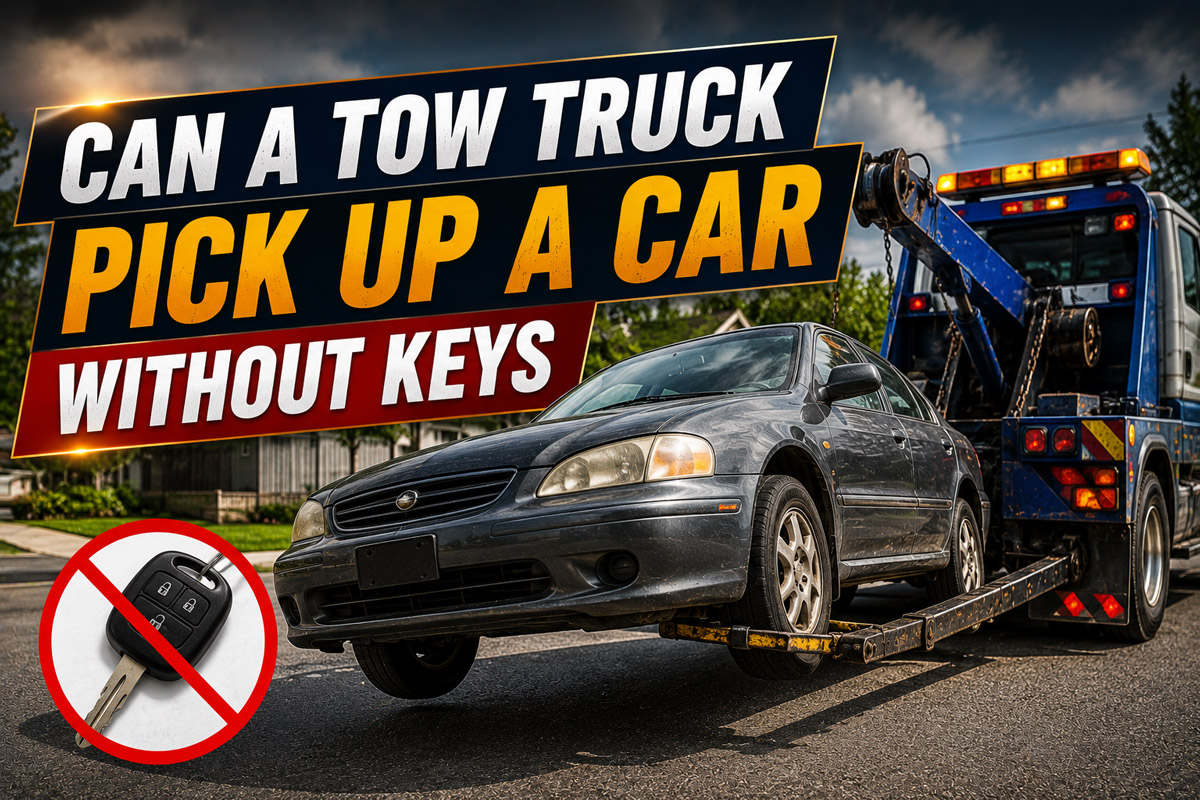
Losing your car keys or finding yourself with a disabled vehicle that lacks a key is a stressful experience. Whether you bought a project car at an auction, need to sell an old junk vehicle sitting in your driveway, or misplaced your keys while out running errands, you might wonder how a tow truck can move a vehicle that is locked up tight.
The short answer is yes: a professional tow truck can easily pick up a car without keys.
Towing companies handle keyless recoveries daily. From private impounds and law enforcement repossessions to junk car removals and roadside breakdowns, tow operators possess specialized tools, heavy duty winches, and equipment engineered specifically to transport vehicles without turning the ignition.
However, moving a car without a key requires specific techniques to avoid damaging the transmission, tires, steering assembly, and drivetrain. Understanding how tow operators move keyless vehicles and preparing for the tow process can help ensure a seamless experience.
The Mechanical Challenges of Towing Without Keys
When a car is turned off and the key is removed, several mechanical safety systems automatically engage:
- Transmission Locked in Park: Automatic vehicles lock the transmission output shaft when shifted into Park. If forced to roll while in Park, the parking pawl (a small metal pin inside the transmission) can shear off, causing thousands of dollars in internal transmission damage.
- Locked Steering Column: Modern ignition systems lock the steering wheel in place when the key is removed. Without a key to turn the cylinder or send an electronic signal to an engine control unit, the front wheels cannot turn to steer the vehicle.
- Electronic Parking Brake (EPB): Many modern vehicles automatically set an electronic parking brake when parked, locking the rear brakes electronically.
Professional tow operators use specialized methods designed to bypass or work around these mechanical lockouts safely.
How Tow Trucks Move Keyless Vehicles
Depending on the drive layout (front-wheel drive, rear-wheel drive, or all-wheel drive) and the location of the vehicle, towing companies choose from three primary mechanical methods.
1. Flatbed Towing with Tow Skates
Flatbed towing (also called rollback towing) is the safest and most effective method for moving a vehicle without keys. The truck features a hydraulic bed that tilts downward to create a ramp.
Because the car’s wheels cannot roll freely while locked in Park, operators place high-density polyethylene plastic “tow skates” under the tires. These slick plastic wedges reduce friction between the rubber tire and the metal bed or asphalt. In a pinch, operators sometimes use soapy water or specialized sliding pads.
A heavy duty hydraulic winch cable attaches to the car’s designated tow points under the chassis or frame, smoothly pulling the sliding vehicle onto the bed. Once loaded, the bed lowers to a horizontal position, and the vehicle is secured with four-point tie-down straps.
2. Wheel-Lift Towing with Tow Dollies
When a flatbed truck cannot fit into tight urban spaces or parking garages, operators use a wheel-lift tow truck combined with tow dollies.
A wheel-lift truck cradles two tires (usually the drive wheels) and lifts them off the ground. To handle keyless vehicles where all four tires are locked or the vehicle features an all-wheel-drive system, the operator places mechanical wheel dollies under the remaining two tires.
Tow dollies are small, heavy duty rolling frames equipped with their own miniature wheels. Once placed under the tires, the operator jacks up the dolly frame, lifting the car’s wheels completely off the pavement. This allows the car to roll smoothly behind the tow truck like a trailer without turning a single axle.
3. Lockout Tools and Shift Lock Overrides
If a vehicle needs to roll on its own wheels during loading, tow drivers with proper authorization can perform a entry procedure.
Using an inflatable air bladder to gently create a slight gap in the door frame, the driver inserts a long-reach tool to depress the internal unlock button or pull the door handle.
Once inside, the driver accesses the shift lock override switch. Most automatic vehicles feature a small panel near the gear shifter. By inserting a small screwdriver or key blade into this slot, the driver manual-releases the shift lever, allowing the car to be shifted from Park into Neutral even without a working key. In Neutral, the vehicle rolls freely without stressing the transmission gears.
Handling Complex and Specialized Towing Scenarios
Moving a standard vehicle from a paved driveway is straightforward, but keyless vehicles are often trapped in difficult conditions or tight spaces. Professional junk car buyers and towing services utilize specialized extraction techniques for these challenging setups.
How to Tow a Junk Car with Flat Tires
A keyless vehicle sitting for months or years often suffers from rotted or dry-flat tires. Towing a vehicle with flat tires without keys presents double the friction.
To tow a junk car with flat tires, operators use heavy duty steel or composite skids under the flat wheels or rims. If the tire is completely off the bead, using dollies or skates prevents the bare rim from gouging the asphalt or damaging suspension components during winching. In cases where tires are completely missing or shredded, operators hook winch straps directly to structural lower control arms or frame crossmembers to pull the vehicle onto a rollback bed safely.
How to Remove a Non-Running Car from a Garage
Low ceilings, tight quarter clearances, and steep driveway angles make garage extraction tricky. Standard flatbed trucks are often too tall to back into a residential garage.
To remove a non-running car from a garage, tow technicians rely on hydraulic wheel dollies (often referred to as Go-Jacks). Operators slide these dollies around each tire and pump a foot pedal to lift the vehicle off the garage floor. Once elevated, a single person can push and swivel the car in 360 degrees, rolling it out of the tight garage space and onto the driveway where a larger tow truck can safely hook up to it.
How to Tow a Car Stuck in Snow
Snow accumulation and ice introduce extra hazards when keys are unavailable. When wheels are frozen to the ground or buried in deep drifts, pulling a vehicle without keys can cause frame damage if hooked incorrectly.
To tow a car stuck in snow, recovery operators employ snatch blocks (heavy duty pulleys) to multiply winch pulling power and change the direction of the force. Before pulling, the driver clears packed snow from around the tires and undercarriage. They use traction ramps or sand under the locked wheels to guide the vehicle out of the drift without snapping control arms or tie rods.
How to Tow a Junk Car from a Backyard
Backyard recoveries present unique challenges, including soft soil, mud, tall grass, fence obstacles, and overgrown tree roots.
To tow a junk car from a backyard, tow operators utilize long-distance winch cables and synthetic recovery straps. Standard tow trucks cannot drive onto soft lawns without getting stuck or tearing up the turf. Operators anchor their truck on the driveway or street, run extended winch cables into the yard, and pull the car toward paved ground. If the car has sunken into the mud or lacks wheels entirely, ground mats or wood planks are placed under the chassis to create a sliding track, preventing the frame from digging deep trenches into the soil.
Legal and Verification Requirements: Proving Ownership
Tow operators will not pick up a vehicle without keys simply because someone requests it. Because keyless towing techniques resemble repossession or car theft equipment, strict state laws and company policies govern the process.
Before a tow operator hooks up a keyless vehicle, you must prove legal authority over the car.
Required Documentation
To authorize a keyless tow, you typically need to present:
- Valid Government-Issued Photo ID: Driver’s license or passport.
- Proof of Ownership: The original vehicle title showing your name as the owner, or a current vehicle registration document matching your photo ID.
- Bill of Sale (For Junk Cars): If you recently purchased a project or junk car without a title or key, a signed Bill of Sale accompanied by a title release form (depending on state regulations) may be required.
If you are requesting a tow on behalf of a company or property owner removing an abandoned car, specific impound documentation and legal notification forms must be completed beforehand.
Checklist: How to Prepare for a Keyless Tow
To ensure your towing service arrives with the correct equipment and avoids unnecessary delays, follow this quick preparation checklist before calling dispatcher services.
| Step | Action Required | Why It Matters |
|---|---|---|
| 1. Identify Vehicle Specs | Note the Make, Model, Year, and Drivetrain (FWD, RWD, AWD, 4WD). | Dictates whether dollies, skates, or flatbed setups are required. |
| 2. Assess Location | Determine if the car is in a garage, backyard, mud, snow, or street. | Determines winch line length, truck height clearance, and gear needed. |
| 3. Check Wheel Position | Note if the front wheels are turned sharp left/right or straight. | Turned wheels require Go-Jacks or dollies to maneuver onto a flatbed. |
| 4. Gather Proof of Ownership | Prepare your ID, Title, or Registration ahead of time. | Drivers cannot legally tow keyless vehicles without verifying ownership. |
| 5. Inform the Dispatcher | Explicitly state: “I do not have the keys to this vehicle.” | Ensures the company sends the correct rig equipped with skates or dollies. |
Frequently Asked Questions
Will towing a car without keys damage the transmission?
Not if done properly by a professional. If a vehicle locked in Park is dragged on its drive wheels without skates or dollies, it will cause severe transmission damage. However, flatbed winching with skates or using four-wheel dollies completely isolates the transmission from road friction, ensuring zero damage.
Can you tow an all-wheel-drive (AWD) car without keys?
Yes, but AWD vehicles require special care. Because all four wheels are mechanically linked to the drivetrain, dragging any wheel while in Park can ruin the transfer case and differential. AWD vehicles without keys must be transported on a flatbed or raised completely off the ground using a wheel-lift with rear dollies.
How much extra does it cost to tow a car without keys?
Most towing companies charge a standard hookup fee plus a mileage rate. However, if extra labor and equipment are required (such as installing dollies, using Go-Jacks in a garage, or performing a complex backyard winch recovery), an additional equipment or winching fee ranging from $50 to $150 may apply.
Final Thoughts
Losing your keys or managing a non-running project vehicle does not mean your car is stuck forever. Modern towing equipment and experienced operators make keyless vehicle recovery safe, efficient, and damage-free.
Whether you need to move a non-running car out of a tight garage, pull a junk vehicle from a muddy backyard, or haul away a stranded car with flat tires, informing your tow provider in advance ensures they bring the exact tools needed to get the job done smoothly.