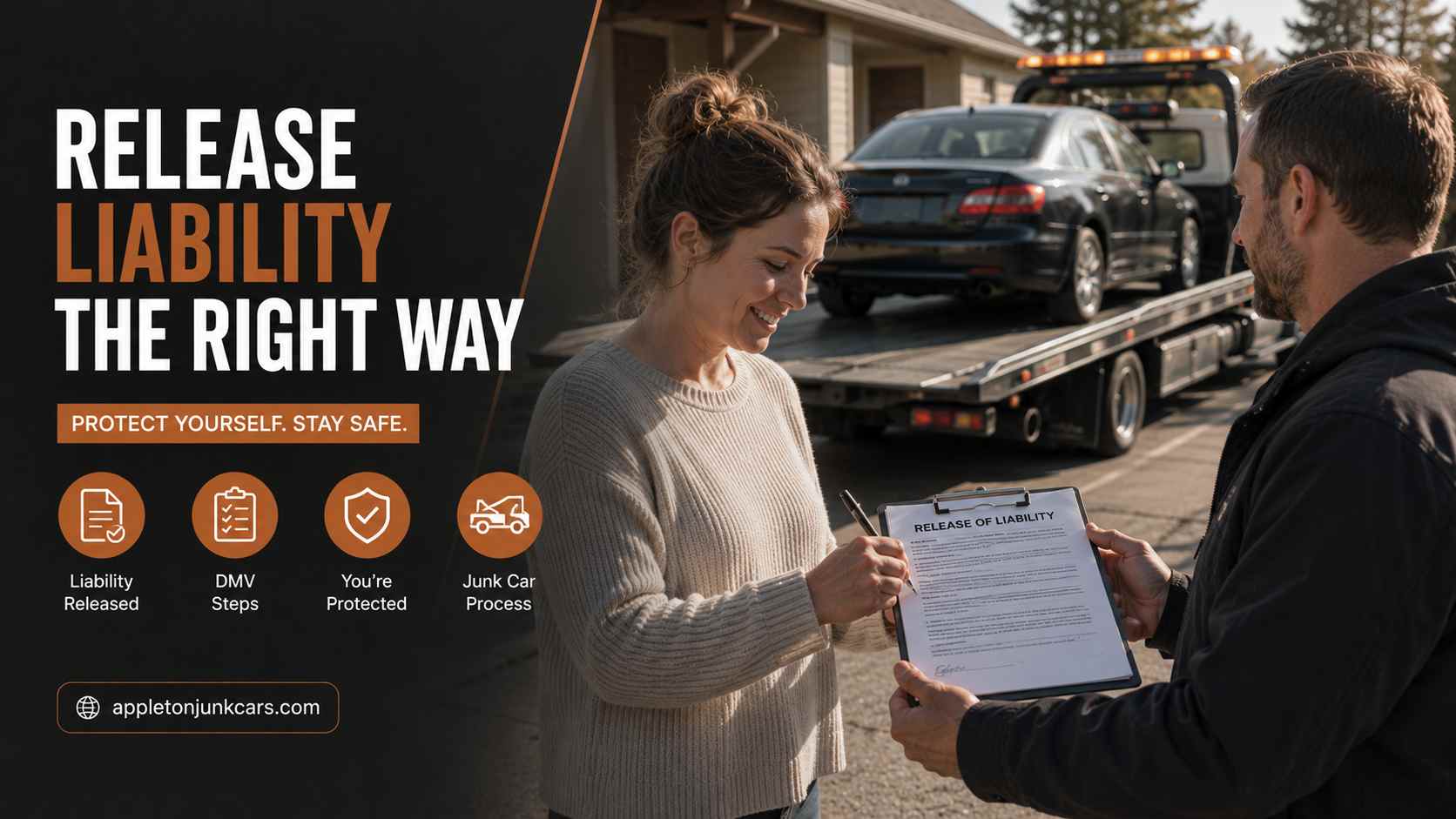
After junking a car, you file a Notice of Transfer or Release of Liability form with your state DMV or motor vehicle agency, on the same day the car is picked up if possible. This single step is what officially removes the vehicle from your name in the state’s records and cuts off any legal or financial responsibility tied to it after the handover.
It takes five to ten minutes. This guide covers what the form does, what information you need to fill it out, how to file it for the most commonly searched states, and what else you need to do alongside it to fully close out your liability.
What a Release of Liability Does and What It Does Not
A release of liability (also called a Notice of Transfer, Notice of Sale, or Vehicle Transfer Notification depending on your state) tells your state motor vehicle agency that you have handed the car over to someone else, in this case a junk buyer or salvage yard, and that as of the transfer date, anything that happens involving that vehicle is no longer your responsibility.
Once filed and recorded, the form protects you from:
- Parking tickets and traffic violations that accumulate after the car leaves your hands
- Toll charges if the vehicle is moved through tolled roads after pickup (with your plates removed)
- Civil lawsuits or liability claims tied to the vehicle’s operation after the sale date
- Registration renewal notices continuing to arrive in your name
One thing it does not do: it does not transfer the title. The junk buyer or salvage yard is responsible for applying for a salvage or junk title through their own process. Your release of liability only tells the state that you are no longer the owner. The state’s records will still show the car until the buyer completes their side of the paperwork, but your liability ends on the date you filed the notice.
This distinction matters because some people assume the title transfer that the junkyard handles is sufficient. It is not, at least not for your protection. The release of liability is your form to file, separately from anything the buyer does.
Information You Need to Have Ready
Every state’s form asks for roughly the same set of information. Have these details at hand before you start:
- The vehicle’s VIN (17-character code on the dashboard plate or door jamb sticker)
- The license plate number
- The vehicle’s year, make, model, and color
- The current odometer reading, or your best estimate if the car is non-running
- The date of the transfer (the day the junkyard picked it up or you handed it over)
- The sale price (for junking, this is the amount the junk buyer paid you; enter zero if you donated it)
- The name and address of the buyer (the junk car company or salvage yard)
- Your full name and address as the seller
For junking specifically, the “new owner” information is the junkyard or junk car service, not a private individual. Get the official registered business name and address from your paperwork or from the company’s website before you fill out the form, so the DMV record is accurate.
How to File Liability When Junking a Car: Online, by Mail, or in Person
Online (fastest and recommended in most states)
Most states now accept the release of liability or notice of transfer online. The online process typically takes under five minutes, and you receive an immediate confirmation that the state recorded your submission. Print or save that confirmation. It is your proof that you filed.
California’s online NRL at dmv.ca.gov is a good example of how smooth this process can be. You enter the VIN, the transfer date, the buyer’s information, and your own details, and the system confirms receipt immediately. Texas’s Vehicle Transfer Notification at txdmv.gov works similarly. Florida’s Form HSMV 82050 can be submitted in person or by mail to the local county tax collector’s office, though an online equivalent exists in some counties.
If your state does not have an online option, submit by mail. Certified mail with delivery confirmation gives you proof the form was received. Standard mail does not.
By mail
Download the form from your state’s official DMV or motor vehicle agency website. Fill it out completely and legibly. Mail it to the address on the form by certified mail. Keep a copy of the completed form and your certified mail receipt. Some states, including California, note explicitly that when you mail the form (rather than filing online), you will not receive any confirmation that it was received, which is why online filing is recommended wherever available.
In person
Some states, particularly Florida, require the form to be submitted at a specific office (Florida uses the county tax collector’s office, not the state FLHSMV office directly). If your state requires or recommends in-person submission, go on the same day as the pickup. Bring the completed form and a copy of your title or the bill of sale from the junkyard so the clerk can verify the vehicle details.
State-by-State Reference: Form Name, Deadline, and Where to File
Laws and deadlines change. Use this table as a starting reference, then confirm current requirements at your state’s official DMV or motor vehicle agency website before filing.
| State | Form / Process | Filing Deadline | How to File and Key Notes |
| Arizona | No specific form — notify AZ MVD online | No set deadline; file promptly | AZ MVD online portal at servicearizona.com. Enter vehicle details and transfer date. Free to file. |
| California | Notice of Transfer and Release of Liability (REG 138 / NRL) | 5 calendar days — required by law (Vehicle Code § 5900) | Online at dmv.ca.gov (fastest, gives instant confirmation). Mail the paper REG 138 if online is not available. Keep the confirmation printout. |
| Colorado | No specific form required | Recommended within 5 days | Notify CO DMV online or by mail. No mandatory form, but a written notification with VIN, transfer date, and buyer/yard name is recommended for your records. |
| Florida | Notice of Sale (Form HSMV 82050) | 30 days — late fee applies after | Submit to your local county tax collector office in person or by mail. Downloadable from flhsmv.gov. Failure to submit within 30 days triggers a $20 late fee. |
| Georgia | Notify GA DOR — no specific release form | No set deadline; file promptly | Notify the GA Department of Revenue. Cancel registration and surrender or transfer plates. Confirmation recommended in writing. |
| Illinois | Notify IL Secretary of State — no single release form | No set deadline; notify promptly | Contact IL SOS online at ilsos.gov. Cancel the registration and confirm the vehicle is recorded as transferred. |
| Michigan | No seller notification form required | Buyer must transfer within 15 days | Michigan places the transfer burden on the buyer. However, cancel your registration and insurance to protect yourself. Retain a signed copy of the title transfer. |
| New York | Seller’s Notification of Sale or Transfer (MV-28) | 10 days | Submit Form MV-28 to NY DMV by mail or in person. Download from dmv.ny.gov. Surrender or transfer your plates separately. |
| North Carolina | Notify NC DMV of transfer | No set deadline; promptly recommended | Notify NC DMV via the online portal at ncdot.gov. Cancel the registration. Plates are surrendered or transferred per NC rules. |
| Ohio | No formal release form; notify OH BMV | No set deadline; notify promptly | Contact OH BMV to cancel registration. Retain the signed title copy and as-is documentation as proof of transfer. |
| Pennsylvania | Notify PennDOT — no specific release form | No set deadline; notify promptly | Report the sale at PennDOT online. Cancel registration. PA plates belong to the owner and transfer to another vehicle or can be surrendered. |
| Texas | Vehicle Transfer Notification (VTR-346) | 30 days — strongly recommended | Submit Form VTR-346 at txdmv.gov/forms. Free to submit online or by mail. Late submission still notated but you lose the clean-liability protection for the gap period. |
| Virginia | Notify VA DMV of sale or transfer | No set deadline; promptly recommended | File a Vehicle Transaction Record at dmvNOW.com. Cancel registration and confirm plates are surrendered or transferred. |
| Washington | Dealer or seller files Report of Sale online | Promptly; no hard deadline | Submit at dol.wa.gov. Licensed dealers can file on your behalf, but you remain responsible for ensuring it is submitted. Confirm with the yard before assuming they filed it. |
| Wisconsin | Notify WI DMV of transfer | No set deadline; notify promptly | Report at Wisconsin DMV online portal. Cancel registration. Retain signed bill of sale or junk vehicle documentation as proof. |
Your state is not listed? Search “[your state] DMV notice of transfer” or “[your state] release of liability vehicle sale” on your state’s official motor vehicle agency website. Every state has a process. The form name and the agency that receives it are the two things that vary most.
The Other Steps That Complete Your Protection
Filing the release of liability is the core step, but it works best as part of a short checklist you complete on pickup day.
Cancel your insurance the same day
Call your insurer and request cancellation of the policy for that specific vehicle effective the day of the junk car pickup. Until you cancel, you are paying premiums on a car you no longer own. Most insurers prorate the unused premium and issue a refund for the remaining days. Canceling promptly puts that money back in your pocket.
If the junk buyer later causes damage with the car during transport (with your plates removed, as they should be), you do not want an active insurance policy tied to the vehicle creating any ambiguity about responsibility. Cancel it clean on pickup day.
Handle your license plates
In most states, license plates belong to the registered owner, not to the vehicle. Remove both plates before the tow truck leaves. Leaving your plates on a junked car means any toll charges, parking violations, or citations tied to those plates during transport or at the yard can come back to you. Remove them before the vehicle moves.
What to do with the plates varies by state. Most states allow you to transfer your plates to a replacement vehicle. Some require you to return them to the DMV or cancel them online when you cancel the registration. Check your state’s rule on the same page where you find the release of liability form, as they are typically covered together.
File the Notice of Transfer the same day
Do not leave this for later. The NMVTIS reporting system gives salvage yards their own obligation to report incoming vehicles, but that reporting protects the system from stolen vehicles, not you from ongoing liability. Your notice of transfer is your protection. The sooner it is on file, the cleaner the cutoff date.
If something happens to the car after pickup (say, the tow truck driver gets into an incident on the way to the yard), the date on your filed notice of transfer is what establishes when your ownership ended. File it the same day.
Keep your confirmation and a copy of the sale paperwork
Whether you file online, by mail, or in person, keep the following in a folder or digital file:
- The online confirmation receipt or a photo of the completed mailed form
- The certified mail receipt if you mailed it
- The bill of sale or receipt from the junkyard showing the transfer date, VIN, and buyer’s name
- A copy of the signed title transfer
- Your insurance cancellation confirmation
These documents are your defense if a collection notice, citation, or liability claim arrives months after the sale. Courts and DMV dispute processes ask for documentation showing you filed the notice and when. Keep it.
What Can Happen If You Skip This Step
Skipping the release of liability leaves you legally connected to the vehicle after it is no longer in your possession. Real consequences that happen to sellers who skip this step:
Parking tickets and citations sent to you
If the car is moved on public roads with expired plates or improperly transferred, citations tie to the last registered owner in the state system. That is you, until you file the notice. Several states aggressively pursue registered owners for unpaid violations, sometimes suspending driver’s licenses over unpaid fines that were generated after the owner had already sold the vehicle.
Registration renewal notices
Your DMV will keep sending renewal notices for the vehicle until its records are updated. Some states flag unpaid registrations after a period of non-renewal and can suspend your driving record over a vehicle you no longer own.
Toll charges
This is especially relevant if you left an EZPass, SunPass, FasTrak, or other toll transponder in the vehicle (which you should not have), or if the car was transported through tolled roads with readable plates or a license plate reader that caught a cached plate record. Without a filed notice of transfer showing the transfer date, toll authorities will bill the registered owner.
Civil liability in edge cases
This one is rare but real. If a junk car buyer or towing company operates the vehicle on public roads without proper authorization and causes an accident before the title is transferred to them, a plaintiff’s attorney will name every party connected to the vehicle. Your filed notice of transfer with an established date gives you a documented position that your ownership ended before the incident.
Questions Worth Answering
Does the junkyard file the release of liability for me?
No. The junkyard files their own paperwork: a junk title application or salvage report with the state, often through the NMVTIS system, to establish themselves as the new owner for scrapping purposes. That filing protects the junkyard, not you. Your release of liability or notice of transfer is a separate form that you file, in your name, with your state DMV. Both filings need to happen.
What if I lost the title before junking the car?
You can still file the release of liability with the information you have (VIN, plate number, vehicle details, buyer name). The title transfer itself is the junkyard’s problem to resolve. Some junkyards can process vehicles without a clean title through an abandoned title or salvage title process. Get a replacement title from your state DMV if possible, since yards pay slightly less for no-title vehicles, but do not let a missing title stop you from filing the notice of transfer after the sale.
How do I find the right form for my state?
Search “[your state] DMV notice of transfer” or “[your state name] release of liability vehicle sale” on your state’s official motor vehicle agency website. The form is almost always free to download or file online. Do not pay a third-party website to generate this form for you. It is available for free from the state.
What is the deadline to file?
It depends on your state. California requires filing within 5 calendar days. Texas and Florida both have 30-day windows. Many states have no hard deadline but note that liability for violations continues until you file. The safest approach everywhere is to file on the same day as the pickup.
Does filing the release of liability mean the title is transferred?
No. These are two separate things. The release of liability tells the state you no longer possess the vehicle. The title transfer is a separate legal transaction that the buyer must initiate and pay for through their own DMV process. Until the buyer transfers the title, the vehicle may still appear in your name in DMV records, but your liability is ended as of the date on the notice of transfer, once filed.
What if I already junked the car and forgot to file?
File it now. Most states still accept late filings and will note the transfer date in their records. Texas specifically confirms that late submissions are still recorded even after the 30-day window. You may have a gap in liability coverage for the period between the transfer date and your filing date, but filing late is significantly better than not filing at all. Use the actual transfer date (the day the car was picked up), not today’s date.
Can I file the notice before the car is actually picked up?
No. The form requires the actual transfer date, which is the date the car physically changes hands. Fill it out on pickup day with the correct date. Filing early with a future date is inaccurate and could create problems if the pickup is delayed or rescheduled.
What to Do and When
- On pickup day, before the tow truck arrives: Remove your license plates and any personal items. Have your VIN, plate number, and the junk buyer’s business name and address ready.
- At pickup: Sign the title and receive payment. Get a bill of sale or receipt from the buyer showing the date, VIN, buyer’s name, and sale price.
- Same day, as soon as the car is gone: File the release of liability or notice of transfer with your state DMV online (preferred), in person, or by mail. Use the actual pickup date as the transfer date.
- Same day: Call your insurer and cancel the insurance policy for that vehicle. Request the cancellation confirmation in writing.
- Keep everything: File the online confirmation receipt, the junkyard’s bill of sale, and your insurance cancellation in a folder. Hold on to it for at least a year.
Five to ten minutes and a single form is all that stands between you and ongoing liability for a car you no longer own. File it on pickup day. Print the confirmation. Done.