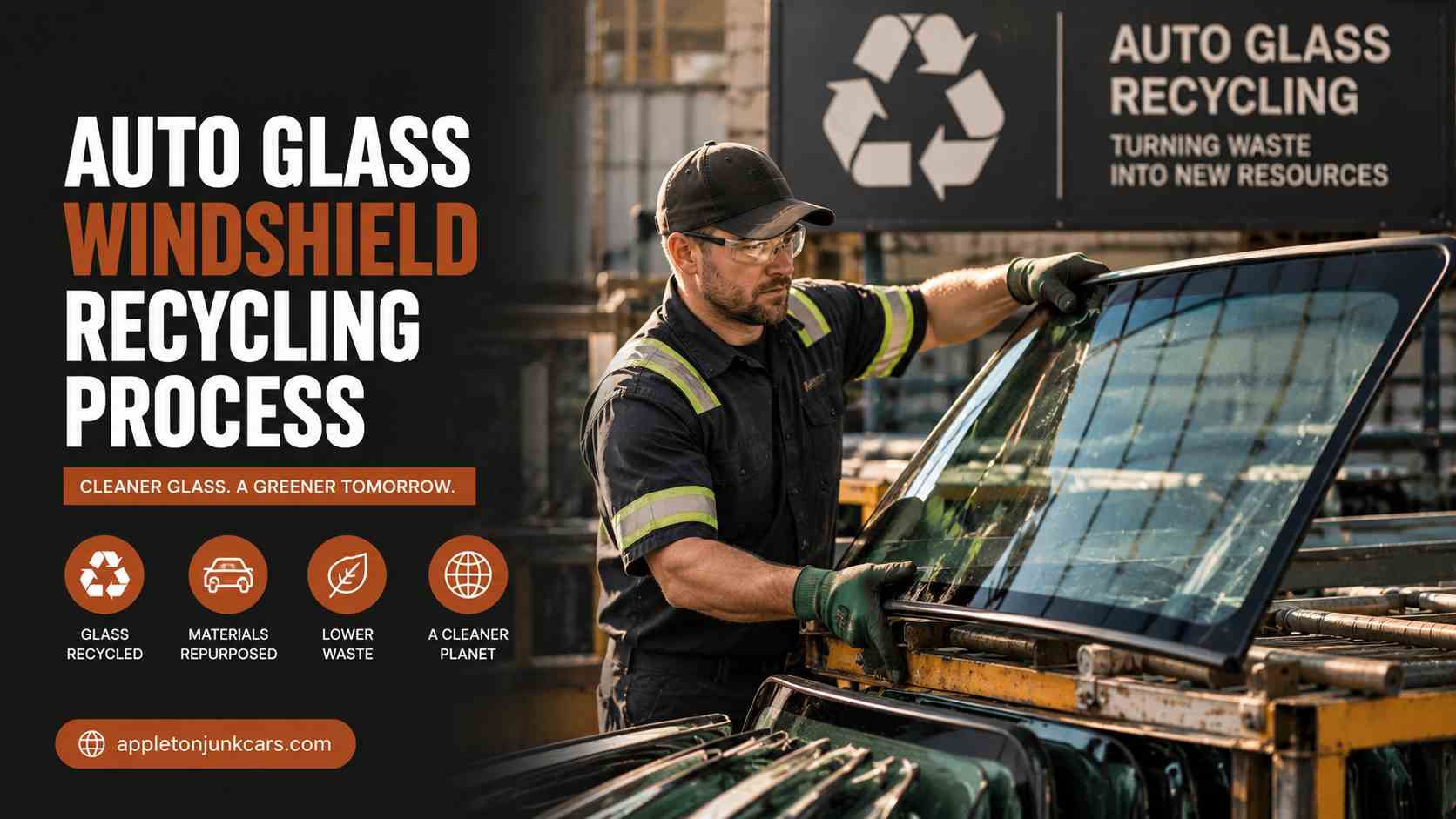
Every year, tens of millions of windshields are replaced across the United States and around the world. Car accidents, rock chips that grow into cracks, storm damage, and ordinary wear eventually end the life of every windshield on every vehicle ever made. What happens to that glass after the technician pulls it off your car and sets the new one in its place is a question most people never think to ask, and the answer is more interesting and more technically demanding than almost anyone would guess.
Unlike the glass bottles you drop into a recycling bin, windshields cannot simply be crushed and melted down with other glass. They are a fundamentally different material: a laminated sandwich of two glass sheets bonded around a flexible plastic film that is engineered to hold the windshield together when it shatters, protecting occupants from flying glass. That engineering, which makes windshields one of the most effective passive safety systems in a modern vehicle, is also what makes recycling them a specialized industrial challenge.
This guide covers the complete windshield recycling process from collection to finished recycled product, explains why each step is necessary, and covers the environmental case for getting this right at industrial scale.
Why Windshields Cannot Be Recycled Like Regular Glass
To understand why windshield recycling requires specialized equipment and processes, you first need to understand what a windshield actually is. Most people think of glass as a single material. A windshield is three bonded layers that behave very differently from each other and that standard glass recycling equipment cannot separate.
The Laminated Glass Challenge
A modern automotive windshield consists of two sheets of glass, each typically 2 to 3 millimeters thick, bonded on either side of a thin film of Polyvinyl Butyral, commonly abbreviated as PVB. The PVB interlayer is approximately 0.76 millimeters thick and is transparent, flexible, and extraordinarily tough. It is the reason a windshield, when struck hard enough to shatter, holds together rather than disintegrating into sharp fragments.
Each windshield contains approximately one kilogram of PVB. That film is chemically bonded to both glass surfaces under heat and pressure during manufacturing. The bond is strong enough that glass and plastic cannot be separated by simply soaking, mechanical force alone, or standard container glass processing. Standard glass recycling facilities that process bottles and jars cannot handle windshields: the PVB contaminates the glass melt and produces defects that make the resulting product unusable. Auto glass must be routed to specialized facilities that have the equipment to handle the separation.
Why Side Windows (Tempered Glass) Are Handled Differently
Not all automotive glass is laminated. Standard side windows and rear windows on most vehicles are made of tempered glass: a single sheet of glass that has been heat-treated to increase its strength and change its fracture pattern. When tempered glass breaks, it shatters into small rounded pebbles rather than sharp shards, which is a safety feature in itself but a completely different structure from laminated glass.
Tempered glass does not have a PVB interlayer, so it does not require the same separation process as windshields. However, it still cannot be processed with standard container glass because its heat treatment gives it a different thermal expansion coefficient. Tempered glass must be melted at higher temperatures (above 1,200 degrees Celsius) and is typically converted into products like fiberglass or construction aggregate rather than being reused for new glass containers. Worth noting: by 2018, approximately one-third of car models had adopted laminated glass for side windows as well as windshields, expanding the volume of automotive laminated glass that requires specialized recycling.
Where Your Old Windshield Goes: The Step-by-Step Recycling Process
Step 1: Collection and Pre-Processing
The windshield recycling process begins long before any machine touches the glass. The logistics of collecting old windshields from the decentralized network of auto glass shops, dealerships, and vehicle scrapyards that generate them is itself a significant operational challenge. Pre-processing at the collection point removes components that would contaminate or damage the recycling machinery downstream.
Where Old Windshields Are Collected
The primary sources of windshields for recycling are auto glass repair and replacement shops, which generate a replaced windshield for virtually every installation job they perform. Vehicle scrapyards and salvage operations provide windshields from end-of-life vehicles, which are demolished whole. Insurance company-directed repair networks have become significant sources of organized windshield collection because their scale of operations makes systematic recycling economically viable. Specialized glass recycling contractors often operate collection routes that pick up old windshields from multiple shops in a region, consolidating them at a central processing facility or at dedicated windshield recycling plants.
Stripping Components Before Processing
Before a windshield can enter mechanical recycling, workers manually strip every non-glass component from its edges and surfaces. This includes the rubber or polymer molding that runs around the windshield perimeter, metal clips and brackets that held the molding in place, rain sensors, cameras, and electronic modules that modern windshields increasingly carry for ADAS (Advanced Driver Assistance System) functions, and most importantly the urethane adhesive sealant that bonded the windshield to the vehicle body.
The urethane adhesive is particularly important to remove thoroughly because it is a different polymer from PVB and would contaminate the PVB recycling stream. Workers use specialized cutting tools to slice the urethane bead from the glass edge. Electronic components including rain sensors, heads-up display coatings, and embedded heating elements are removed individually. This manual pre-processing stage is labor-intensive but necessary: contamination at this stage reduces the purity and value of both recovered materials downstream.
Step 2: Crushing and Mechanical Separation
With the windshield stripped to bare glass and PVB, it enters the core of the recycling process: the mechanical separation of two materials that were industrially bonded and that behave completely differently under applied force. This step is the technical heart of windshield recycling and is what distinguishes a specialized automotive glass recycler from a standard glass processing facility.
The Crushing Stage
The pre-processed windshield is fed into a specialized industrial crushing or rolling machine. The design of these machines exploits a fundamental difference in the physical properties of glass and PVB: glass is rigid and brittle, meaning it fractures with applied force, while PVB is flexible and tough, meaning it deforms without breaking under the same force.
When the machine crushes the windshield, the glass layers shatter into thousands of small fragments. The PVB interlayer, sandwiched between them, does not shatter. Instead, it deforms and flexes, remaining as a continuous or near-continuous sheet while the glass on both sides fractures around it. This differential behavior under force is the mechanical key that makes separation possible: the machine has produced a structure where the glass is broken into pieces and the PVB remains intact, rather than a homogeneous mixture of the two.
Separating Glass From the PVB Interlayer
Once the glass is shattered around the intact PVB layer, the separation process uses mechanical action to remove the glass fragments from the PVB surface. Different facility designs use slightly different approaches: some use rotating brushes or scrapers that sweep glass fragments off the PVB sheet, others use shaking and vibration to allow glass pieces to fall away from the more flexible plastic surface, and some facilities use a combination of air jets and mechanical agitation. The goal in every case is to remove glass fragments from the PVB without shredding or fragmenting the PVB itself.
Modern recycling facilities achieve remarkably high recovery rates through this process. Research has demonstrated average PVB recovery efficiency of approximately 98.86 percent and glass recovery efficiency of approximately 99.26 percent using optimized mechanical separation processes. This means nearly all of both materials are successfully recovered from each windshield processed, leaving very little waste from the separation stage itself.
Step 3: Purification and Refining
The separated glass and PVB coming out of the mechanical separation stage are not yet ready for use in new products. Both materials carry contamination from the other: the glass contains PVB fragments and dust, and the PVB carries glass dust, micro-particles, and potentially paper or adhesive residues from the stripping stage. Purification transforms these separated but impure materials into consistent, specification-grade recycled products.
Creating Glass Cullet
The separated glass fragments are fed into a secondary processing stage where they are ground further into a uniform granular material called cullet. Cullet is the standard form in which recycled glass is traded and processed industrially: a consistent particle size and shape makes it easier to handle, transport, mix with other materials, and feed into melting furnaces.
The grinding stage also helps remove residual PVB that is still clinging to glass surfaces. As glass particles become smaller, the surface-area-to-volume ratio increases, making it easier to separate and remove plastic residue. The resulting cullet is sieved to achieve consistent particle sizing and inspected for purity. Any remaining PVB fragments that have not been removed are lighter than glass and can be separated by air classification: a controlled airstream that carries away lighter plastic particles while heavier glass particles fall through.
Cleaning and Preparing the PVB Interlayer
The recovered PVB sheet goes through its own purification process. A wash and filtration cycle removes the micro-dust of glass particles that are embedded in or on the surface of the PVB film. This cleaning step is critical because even a small quantity of glass contamination in the final PVB product would create defects in any product made from it, and in some applications could pose a safety hazard.
Filtration removes particles down to a fine size, and the washed PVB is then dried. The cleaned PVB is typically shredded or pelletized at this stage to produce a consistent feedstock material that manufacturing customers can blend, melt, and process through standard plastic extrusion or compounding equipment. The purification step transforms the recovered PVB from a variable-quality industrial byproduct into a consistent, specification-grade recycled material with a reliable market value.
Step 4: Transformation Into New Products
The final stage of the recycling process is where the separated and purified materials become raw inputs for other industries. This is where windshield recycling connects to the broader manufacturing economy, and where the circular potential of the process becomes most visible. Both the glass cullet and the recycled PVB find productive second lives in industries that would otherwise require virgin raw materials.
What Glass Cullet Becomes
Automotive windshield glass contains chemical additives, including compounds that provide ultraviolet filtering and improve impact resistance, that are introduced during original manufacture to meet safety performance requirements. These additives mean the glass is not optically pure enough to be remelted directly into new automotive windshields, which require extremely tight specifications for clarity, distortion, and chemical composition.
Instead, windshield cullet is melted and repurposed into a range of other products where optical purity is less critical. Fiberglass insulation is one of the largest consumers of recycled glass cullet: the manufacturing process for fiberglass tolerates the chemical variability in automotive cullet and produces the same quality thermal insulation. Ceramic tiles incorporate glass cullet as a component in their base material. Reflective highway paint, which uses glass microspheres to reflect headlights back to drivers, is produced from recycled glass cullet that is ground to a specific fine particle size. Concrete aggregate and road base material incorporate glass cullet as a partial replacement for gravel and sand. Pool filtration systems use glass media ground from cullet as an alternative to traditional sand.
What Recycled PVB Becomes
The cleaned and pelletized PVB recovered from windshields has genuine commercial value in multiple industries. The PVB interlayer market is substantial: the global PVB industry was valued at approximately 4.4 billion dollars in 2024 with a compound annual growth rate near 7 percent, driven by demand from automotive, architectural, and solar panel applications. Recycled PVB can substitute for virgin PVB in several applications.
Soundproofing and acoustic barrier materials incorporate recycled PVB because its flexibility and density make it effective at damping sound transmission. Heavy-duty carpet backing uses recycled PVB as a binding and stiffening compound that improves carpet durability and dimensional stability. Industrial adhesive and sealant formulations incorporate PVB as a bonding component. Protective coatings for concrete, metal, and other substrates use PVB for its adhesion and weather resistance properties. Some manufacturers use recycled PVB in new laminated glass production for architectural applications where optical requirements are less stringent than automotive safety glass.
Recycling Stage | Input | Process | Output |
|---|---|---|---|
Collection and Pre-processing | Replaced windshield with all components | Manual removal of molding, clips, urethane, sensors | Bare laminated glass ready for mechanical processing |
Crushing and Separation | Bare laminated windshield | Industrial rolling/crushing exploits brittleness difference | Shattered glass fragments + intact PVB sheet |
Purification and Refining | Separated glass and PVB (with residual cross-contamination) | Grinding to cullet; PVB washing and filtration | Clean glass cullet + clean PVB pellets |
Transformation | Glass cullet and recycled PVB pellets | Melting and reforming into new product categories | Fiberglass, tiles, highway paint, carpet backing, adhesives |
The Environmental Case for Windshield Recycling
Windshield recycling is not a marginal environmental consideration. The scale of automotive glass production and disposal, combined with the specific environmental properties of laminated glass in a landfill, makes this recycling stream consequential in ways that numbers make concrete.
The Landfill Problem When Windshields Are Not Recycled
Laminated glass does not degrade at any meaningful rate in a landfill environment. The combination of glass and PVB creates a composite that resists chemical breakdown, biological decomposition, and physical fragmentation over human timescales. Estimates of laminated glass persistence in landfill environments reach up to one million years: effectively permanent from any practical planning perspective.
Millions of windshields are replaced annually in the United States alone. The volume of glass in each windshield is substantial, typically six to eight kilograms of glass plus approximately one kilogram of PVB. Without dedicated recycling infrastructure, the entire weight of that replaced windshield goes to landfill and stays there essentially forever. As the global vehicle fleet continues to grow and more end-of-life vehicles are processed each year, the volume of windshield glass requiring disposal increases correspondingly.
Measurable Environmental Benefits of Windshield Recycling
The environmental benefits of recycling glass cullet rather than producing glass from virgin raw materials are substantial and well-documented. Manufacturing glass from recycled cullet requires up to 40 percent less energy than producing glass from raw materials like silica sand, soda ash, and limestone, because cullet melts at a lower temperature than virgin raw materials and does not require the same calcination energy. For every six tons of recycled glass cullet used in manufacturing, approximately one ton of carbon dioxide emissions is prevented compared to virgin glass production.
Recycling one ton of glass conserves over 1,300 pounds of silica sand and proportional quantities of soda ash and limestone that would otherwise be mined. Air pollution from glass manufacturing is reduced by approximately 20 percent when recycled cullet replaces virgin materials, because the lower melting temperatures required for cullet reduce nitrogen oxide and particulate emissions from furnace combustion. The PVB recovery stream has its own environmental value: producing recycled PVB requires less energy and fewer petrochemical feedstocks than producing virgin PVB, and it diverts a persistent plastic from landfill.
What Happens to Your Windshield After Replacement
From the perspective of a car owner getting a windshield replaced, the process is straightforward: the technician removes the old windshield and installs the new one. What happens to the old glass depends almost entirely on which shop you use and whether they have a relationship with a glass recycling contractor or facility.
The Recycling Chain From Shop to Facility
In markets with well-developed recycling infrastructure, the process after your replacement looks like this: the installer stores removed windshields on a rack or in a designated storage area at the shop. A glass recycling contractor makes periodic collection runs, picking up accumulated windshields and transporting them to a regional collection and processing center. Pre-processing (stripping of molding and urethane) may happen at a secondary location before shipment to the actual recycling facility, or the facility may handle all steps internally.
Large national auto glass companies increasingly have formal recycling programs integrated into their operations as both an environmental commitment and a cost-efficiency measure. Insurance-directed repair networks often require shops in their network to demonstrate responsible glass disposal. The recycling rate for windshields varies significantly by country and region: some European markets have organized take-back and recycling programs with high diversion rates, while in the United States the infrastructure is more fragmented and a meaningful percentage of replaced windshields still reach landfill.
How to Ensure Your Windshield Gets Recycled
When selecting an auto glass shop for a replacement, it is entirely reasonable to ask whether they recycle removed windshields and how. A shop with an established recycling program will be able to name the contractor or facility they work with. Shops that do not have an answer to this question are more likely to be sending glass to landfill. National chains that advertise environmental commitments typically have documentation of their recycling programs available on request.
An equally important environmental consideration before replacement is whether repair is possible. A chip smaller than a quarter, and a crack shorter than six inches and not in the driver’s line of sight, can often be repaired by a resin injection process that restores optical clarity and structural integrity without generating any glass waste at all. Repair preserves the original windshield, eliminates the recycling question entirely, and is less expensive than replacement. The first priority in the glass sustainability hierarchy is always to reduce waste, and a repairable windshield that gets replaced unnecessarily represents the largest preventable waste in the entire automotive glass cycle.
Frequently Asked Questions
Can windshields be recycled?
Yes, but through specialized facilities rather than standard glass recycling programs. Windshields are laminated glass: two sheets of glass bonded around a PVB plastic interlayer. Standard glass recycling equipment cannot separate these materials, but dedicated automotive glass recycling facilities use mechanical crushing and separation to recover both the glass and the PVB at recovery efficiencies above 98 percent for each material.
Why can windshield glass not be made into new windshields?
New automotive windshields require exceptionally high optical clarity and precise chemical composition to meet safety standards. Windshield glass contains additives including UV-filtering compounds and impact-resistance modifiers that make the recycled cullet chemically variable in ways that are incompatible with the tight specifications for new automotive safety glass. Instead, windshield cullet is used in applications where exact chemical composition is less critical, such as fiberglass insulation, ceramic tiles, and construction materials.
What is PVB and why does it matter in windshield recycling?
PVB stands for Polyvinyl Butyral, the transparent plastic interlayer film sandwiched between the two glass layers of a laminated windshield. Each windshield contains approximately one kilogram of PVB. It is the material that holds broken windshield glass together rather than allowing it to shatter into sharp fragments, making it a critical safety component. In recycling, the PVB is separated from the glass, cleaned, and converted into pellets that are used in soundproofing, carpet backing, adhesives, and construction coatings.
Can I recycle my old windshield myself?
Not through standard curbside recycling programs, which do not accept automotive or laminated glass. Windshields should be dropped off at an auto glass shop, a vehicle scrapyard, or a specialty glass recycler. Many auto glass shops accept windshields for recycling even if they did not perform the removal. Contact your local recycling authority to find glass recyclers in your area that accept automotive safety glass.
Is windshield recycling environmentally significant?
Yes. Recycling glass cullet instead of producing glass from virgin materials reduces energy use by up to 40 percent, reduces air pollution by approximately 20 percent, conserves over 1,300 pounds of silica sand per ton recycled, and prevents roughly one ton of CO2 per six tons of cullet used. Laminated glass in a landfill persists for an estimated one million years, making diversion from landfill a meaningful long-term environmental benefit.
The Bottom Line
Auto windshield recycling is a genuinely specialized industrial process that most people never encounter but that handles tens of millions of windshields every year. The laminated construction that makes windshields effective safety devices, the bonded sandwich of glass and PVB, is what makes standard glass recycling impossible and what necessitates the four-step mechanical separation process described in this guide.
Collection and stripping remove components that would contaminate the process. Crushing and mechanical separation exploit the brittleness difference between glass and PVB to break them apart. Purification turns the separated materials into consistent specification-grade recycled products. And transformation connects those recovered materials to industries that turn them into fiberglass, soundproofing, highway paint, carpet, and adhesives, closing the material loop and reducing the demand for virgin raw materials.
For the individual car owner, the most actionable insight is to choose shops that recycle removed windshields, to ask about their recycling arrangements before booking replacement work, and to prioritize repair over replacement whenever a chip or crack is within the repairable range. Every windshield that is repaired rather than replaced is one that generates no recycling challenge at all.