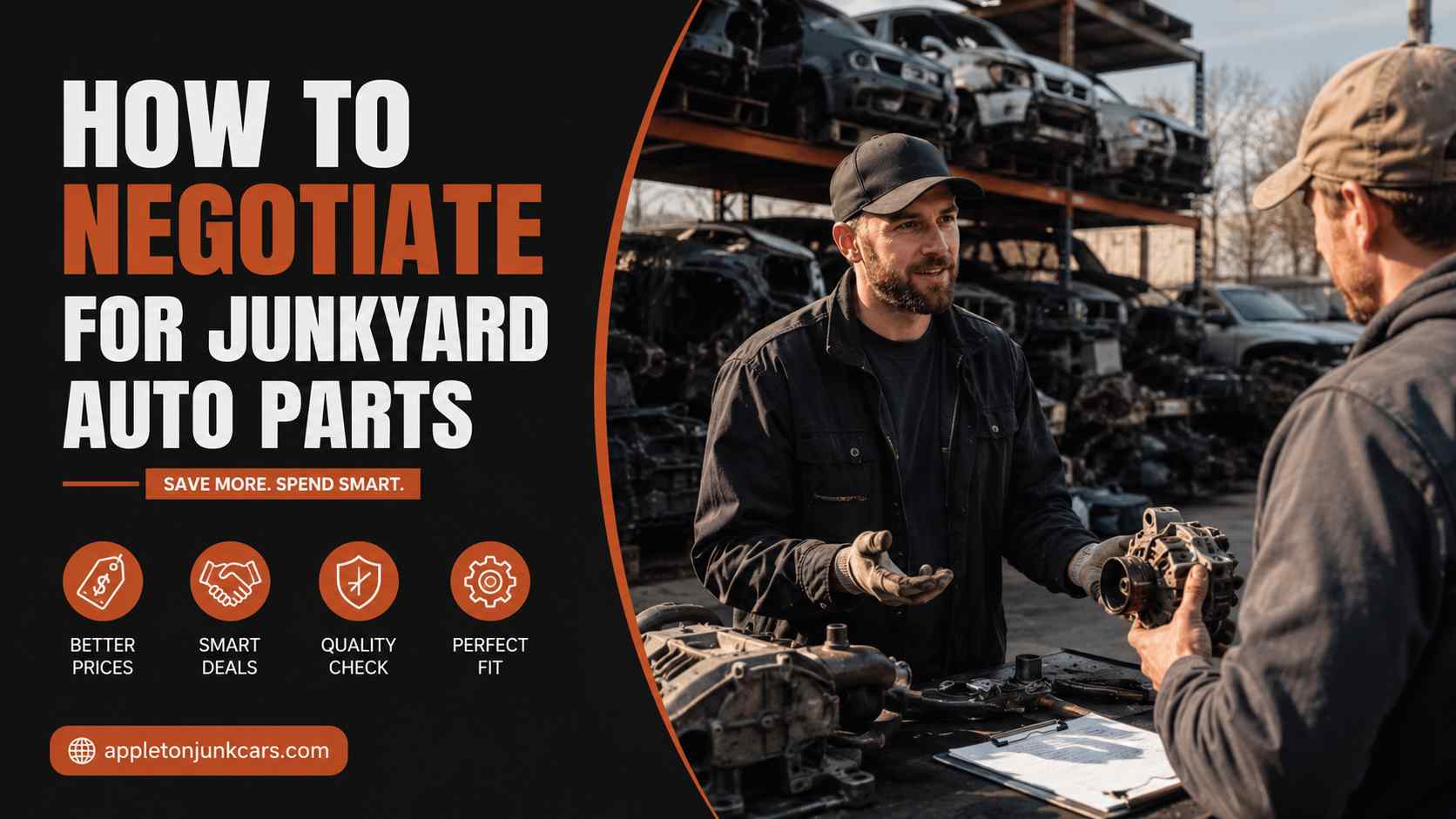
Most people walk into a scrap yard, accept the price on the tag, and leave thinking they paid a fair rate. Some of them did. Most of them did not. Unlike a dealership or an auto parts store where pricing is fixed and non-negotiable, salvage yard prices are set by an individual, often revised by pen and paper, and built around the assumption that most customers will not push back.
The customers who consistently pay less for vehicle parts are not the ones who are rude or confrontational. They are the ones who arrived with information. They know what the same part costs new, they know which other local yards have the same vehicle, and they know how to point out real flaws that justify a lower price without manufacturing problems that do not exist.
To successfully negotiate for junkyard auto parts, you must leverage market data, build counter rapport, and physically point out part flaws. Unlike retail stores, salvage yard prices are highly flexible if you know how the industry operates. This guide gives you the framework to walk in informed and walk out with a better price every time.
Can You Negotiate With a Junkyard? The Honest Answer
Yes, and it happens more often than most people realize. The question people commonly ask on automotive forums is whether salvage yards have any wiggle room at all, particularly when searching phrases like “how to negotiate for junkyard auto parts Reddit.” The community consensus, across years of discussion, is consistent: most yards will negotiate, but only when approached the right way.
The staff at a scrap yard have pricing authority that a cashier at a retail chain does not. Prices are typically set by the counter manager or owner based on their estimate of market value, demand for that specific vehicle parts, and what the same component is selling for at competing car wreckers in the area. None of these numbers are precise sciences. That creates room.
The exception is large national pull parts operations with computer-set pricing tied to market databases. These yards often have less flexibility than independent local scrap yards because individual cashiers are not authorized to deviate from the system. Even then, bundling, warranty removal, and condition-based arguments can sometimes move the needle.
The Research That Gives You Negotiating Power Before You Set Foot in the Yard
Negotiating without information is guessing. Negotiating with information is leverage. The three research steps below take about twenty minutes at home and change the entire dynamic of the conversation at the counter.
Know the New Part Price and the Aftermarket Alternative
Before visiting any scrap yard, look up the exact OEM retail price for the part you need. Check the dealership website or call the parts department directly for the OEM figure. Then check an aftermarket equivalent from an auto parts store. These two numbers define the ceiling of what any used part is worth.
A junkyard part should cost 40 to 60 percent less than a comparable new aftermarket option, and significantly less than OEM dealership pricing. If a yard is quoting you 80 percent of the new part price for a used component, you have a reference point to say so clearly and calmly. Most counter staff will respond to this when the number is specific and verifiable, not just a vague assertion that it is too expensive.
Bring the numbers with you. A screenshot of the dealership parts page or an auto repair estimate showing the OEM cost carries more weight than quoting a number from memory. It signals preparation and makes the comparison concrete rather than theoretical.
Check How Many Local Yards Have the Same Donor Vehicle
Scrap yard pricing responds to supply and demand the same way any market does. If you are in an area like Port Charlotte where multiple yards might carry the same make and model, call around before committing to the first quote you receive. Most yards have online inventory search tools or will answer a quick phone inquiry about whether they have a specific year, make, and model in stock.
When you walk into a yard knowing that two other local car wreckers have the same donor vehicle, you have a specific, credible alternative to reference if the price is not right. You do not need to mention the competing yard aggressively. Simply noting that you have other options in the area, and that you would prefer to buy here if the price works, is enough to signal that you are not a captive buyer.
Research Cross-Interchange Fitments
This is the research step that most people skip and the one with the highest payoff. Many vehicle parts fit across multiple years, models, and even sister brands without modification. An alternator from a Chevrolet Silverado may fit a GMC Sierra. A starter from a Toyota Camry may fit a Lexus ES. A transmission from a 2008 model may interchange with a 2006 and 2010.
When you know the interchange fitments for your specific part, you can shop the less popular or less desirable donor vehicles that happen to contain compatible components. A scrap yard that has three clean low-mileage Silverados and one rusty high-mileage Sierra will price the Sierra lower. If they share your part, buying from the cheaper donor produces the same result at a lower price.
Car-Part.com and the Hollander interchange system both provide this data. Spend fifteen minutes confirming what years and models are compatible with your part before visiting any yard. This expands your options at every location and gives you a direct argument for why a lower-demand vehicle’s part should be priced accordingly.
How to Use Physical Inspection as a Negotiating Tool
Every part in a salvage yard has some wear, some imperfection, or some risk associated with it. Your job is not to manufacture problems that do not exist. That approach destroys rapport and usually backfires. Your job is to accurately identify legitimate issues and use them in the pricing conversation in a structured way.
Document Cosmetic Defects Before Negotiating
Walk around the part, look at it from multiple angles, and use your phone to photograph any scratches, dents, surface rust, faded paint, or other visible wear before you approach the counter. These photographs serve two purposes: they are your evidence in the negotiation, and they protect you if you need to make a warranty claim later.
When you present these at the counter, do it factually. Do not say the part is garbage or not worth buying. Say specifically what you observed: there is surface rust along the lower edge, there is a paint chip on the front face, there is a small crack in the mounting bracket. Each specific, documented defect is a reason to ask for a price adjustment.
Check the Donor Vehicle Odometer
If the interior of the donor vehicle is accessible, take thirty seconds to check the odometer. High mileage is one of the strongest arguments for lower prices on mechanical components. A scrap yard pricing an alternator from a 180,000-mile vehicle at near-new rates is ignoring a material factor in that component’s remaining useful life.
When you reference the mileage, do it in a way that is informative rather than accusatory. Noting that the donor vehicle has 180,000 miles and asking whether that affects the pricing is a legitimate, polite question. It opens the conversation rather than closing it down. Counter staff at a scrap yard know the mileage argument is valid. They will often adjust for it when asked directly.
Factor In Extraction Difficulty at Pull Parts Yards
At a pull parts or self-serve scrap yard where you remove the vehicle parts yourself, the difficulty of extraction is a legitimate factor in what you should pay. If reaching a component requires removing three panels, multiple fasteners, and working in an awkward position for forty minutes, that labor cost belongs in the negotiation.
When you bring the part to the counter, mention specifically what was involved in getting it out. Most pull parts yard staff have experience with these jobs and know which extractions are straightforward and which are genuinely difficult. Acknowledging that you did significant work to retrieve the part and asking whether that is reflected in the price is a natural and often effective conversation to have.
The Three Negotiation Moves That Consistently Lower the Final Price
1. Bundle Everything Into a Single Offer
Never buy multiple parts individually if you need more than one thing. Bundling is the single most effective pricing tactic available at a salvage yard, and it works because it changes the nature of the transaction from several small sales to one meaningful one.
Collect every vehicle part you need, including the sensors, trim pieces, brackets, and hardware, and bring the entire pile to the counter at once. Ask for a single price for everything together rather than letting the cashier ring each item individually. The aggregate discount on a bundled sale is almost always more favorable than the sum of individual line-item prices.
Yards benefit from bundled sales too. One transaction instead of five means less processing time, less paperwork, and a customer who leaves satisfied rather than making multiple trips to the register. Use this to frame the ask: you are trying to simplify the transaction and take everything in one go if the number works.
2. Ask to Remove the Warranty Charge
Most professional salvage yards automatically add a 30 to 90-day warranty fee to the ticket for parts they sell. This is a genuine service and has value if you want the security of a guaranteed exchange or refund window. But if you are a mechanic, have experience with the specific part, or simply want to take the risk yourself to reduce the upfront cost, you can ask to waive the warranty.
Ask specifically to remove the warranty and its associated fee from the ticket. This is a standard option at most yards and the counter staff is accustomed to processing it. The savings vary by yard and part, but warranty charges typically add 10 to 25 percent to the listed part price. Removing it on a $120 component saves $12 to $30 immediately without any negotiation on the base price.
One caveat: if you are unsure about the part’s condition or your ability to evaluate it accurately, the warranty is genuinely worth keeping. The goal is to pay a fair price, not to minimize cost at the expense of protection you actually need.
3. Be Respectful, Strategic, and Quiet About Your Knowledge
This is the tactic that works best and the one that feels most counterintuitive. The instinct when you know more than the person on the other side of the counter is to demonstrate that knowledge. Resist it.
Telling a scrap yard that their price is lower online, that another yard will sell it cheaper, or that you know what it really should cost sounds like leverage but almost always triggers defensiveness. Counter staff who feel challenged or talked down to become less flexible, not more.
Instead: ask questions rather than making assertions. Ask whether the mileage affects the price. Ask whether there is any flexibility on the total if you are buying multiple items. Ask whether removing the warranty changes the number. These questions invite the staff into a collaborative problem rather than a confrontation.
Be conversational, acknowledge that you want to give them the business, and give them room to offer you something without feeling pressured. People who negotiate at salvage yards and report the best outcomes on automotive forums consistently describe this dynamic: be friendly, be patient, and let the yard feel like they are helping you rather than losing to you.
What Not to Do When Negotiating at a Salvage Yard
These are the approaches that reliably produce worse outcomes than simply paying the listed price.
Do not show urgency. If you need the part to finish an auto repair job today and you communicate that clearly, the yard knows you are not a credible candidate to walk away. Urgency eliminates your best leverage. If you have time pressure, do not reveal it.
Do not compare the yard to online prices without context. Shipping a scrap alternator from an online seller costs $30 to $60 and takes three to seven days. A local scrap yard offers same-day availability you can inspect before buying. These are different value propositions. Telling a yard their price should match an online listing ignores the convenience premium that yard availability genuinely commands. The argument undermines rather than strengthens your position.
Do not get into condition arguments about parts you have not inspected. Some buyers talk down a part based on assumptions about its quality without having actually looked at it. Staff at a scrap yard know their inventory. Making claims about condition that you cannot back up with specific observations destroys your credibility for the rest of the negotiation.
Do not low-ball by such a significant margin that the offer is insulting. There is a threshold below which an offer signals that you are not a serious buyer, and experienced salvage yard staff recognize it instantly. An offer at 30 percent of the listed price on a reasonable part is not a negotiating position. It is a conversation ender. Start at 60 to 70 percent of the listed price and work from there.
Do not visit during peak hours. A counter cashier processing a line of customers has no time to negotiate anything. Arrive when the yard opens or late in the afternoon on a weekday when traffic is lower. A staff member who has time to talk is significantly more likely to be flexible than one managing a busy counter.
What Experienced Buyers Say About Negotiating at Salvage Yards
People who discuss salvage yard pricing in automotive communities share patterns that come up consistently enough to be reliable guides.
The bundling approach is mentioned most frequently as the highest-return tactic. Buyers who bring a handful of small parts including sensors, clips, and trim to the counter alongside a larger mechanical component and ask for a total flat price consistently report saving 20 to 35 percent compared to the combined individual prices. The yard moves more inventory in one transaction and both sides feel good about the outcome.
The warranty removal option surprises a lot of first-time yard buyers who did not know it existed. Several people describe discovering this option mid-transaction, asking about it, and immediately reducing a bill by $15 to $25 without any other negotiation. It is one of the cleaner savings available because it costs the yard nothing except the risk associated with the warranty itself.
The approaches that people report as counterproductive are almost always some version of being aggressive or dismissive toward staff. A cashier at a scrap yard has discretion to help you or to enforce the list price. Treating them as an obstacle rather than a partner in the transaction reliably produces the worst outcomes.
One regional note worth making: pricing flexibility varies significantly by location and market. In a competitive area where multiple car wreckers operate within a short distance of each other, individual yards tend to be more flexible because they cannot afford to lose a sale to a competitor down the road. In areas with limited competition, yards have less incentive to move on price. Knowing the competitive landscape of your local market helps set realistic expectations for how much room exists before you arrive.
A Practical Pricing Framework: What Used Parts Should Cost
Use this as a baseline reference when assessing whether a yard’s quoted price leaves room for negotiation.
Part Type | OEM Retail Range | Fair Used Price (Target) | Walk Away Above |
|---|---|---|---|
Alternator | $180 to $400 | $60 to $120 | $150 |
Starter motor | $120 to $280 | $40 to $90 | $110 |
Power window regulator | $80 to $200 | $25 to $60 | $80 |
Door mirror assembly | $100 to $350 | $30 to $80 | $120 |
Engine control module | $200 to $800 | $80 to $200 | $280 |
Tail light assembly | $60 to $250 | $20 to $70 | $100 |
Steering rack | $250 to $700 | $80 to $200 | $250 |
Transmission (complete) | $1,200 to $3,500 | $300 to $800 | $900 |
These ranges are general benchmarks. Actual pricing varies by make, model, mileage, and regional market. Use them as a starting point for assessing whether a quoted price is in a reasonable range and how much room for movement exists.
Frequently Asked Questions
Can you negotiate with junkyards?
Yes. Most independently operated salvage yards have pricing flexibility, particularly on high-ticket items and bundled purchases. Large national chains with computer-set pricing systems offer less room, but even there, warranty removal and bundling can produce savings. The key is approaching the conversation respectfully, with specific information about competitive prices and the part’s actual condition.
How to negotiate for junkyard auto parts Reddit says works best?
The automotive communities on Reddit consistently highlight three approaches as most effective: bundling multiple parts into a single flat-price offer, asking about warranty removal to reduce the ticket total, and referencing competing yards that have the same donor vehicle. What community members consistently warn against is being confrontational, mentioning online prices without context, or revealing urgency in the need for the part.
What is the best time to negotiate at a salvage yard?
Weekday mornings when the yard opens, or late weekday afternoons. Counter staff have time to engage in a conversation rather than managing a line. Avoid Saturday mornings and any time a yard is at peak traffic.
Does bundling parts always work?
Not always, but it works more often than any other single tactic. Yards benefit from higher-volume single transactions because they reduce processing time and paperwork. Even a modest bundling discount on several small vehicle parts adds up. On purchases over $100 total, bundling almost always produces some savings.
Is it worth removing the warranty?
It depends on the part and your confidence in its condition. For a part you have inspected carefully, that passed physical and visual checks, and that you are confident about, removing the warranty saves 10 to 25 percent with minimal additional risk. For electrical components, sensors, or parts where internal failure is possible without visible signs, the warranty protection is worth its cost.
How does knowing the OEM price help?
It sets the ceiling. No used part from a scrap yard should cost more than 60 percent of the equivalent new OEM or quality aftermarket price. When you can show a counter staff member the specific OEM part price on your phone and calculate what 50 to 60 percent of that looks like, the negotiation has a concrete reference point that is hard to argue against.
The Bottom Line
Negotiating for junkyard auto parts is not about being difficult or demanding. It is about arriving with more information than the person on the other side of the counter expects you to have and using that information constructively.
Know the OEM and aftermarket prices before you walk in. Know which local car wreckers carry competing inventory. Inspect every part for real, documentable flaws. Bundle everything you need into one offer. Ask about warranty removal. And do all of this in a tone that makes the yard want to give you a deal rather than dig in on the list price.
The savings available to prepared buyers at a scrap yard are real and consistent. The difference between a buyer who pays asking price and one who pays significantly less is almost never who argued harder. It is who came in knowing more.