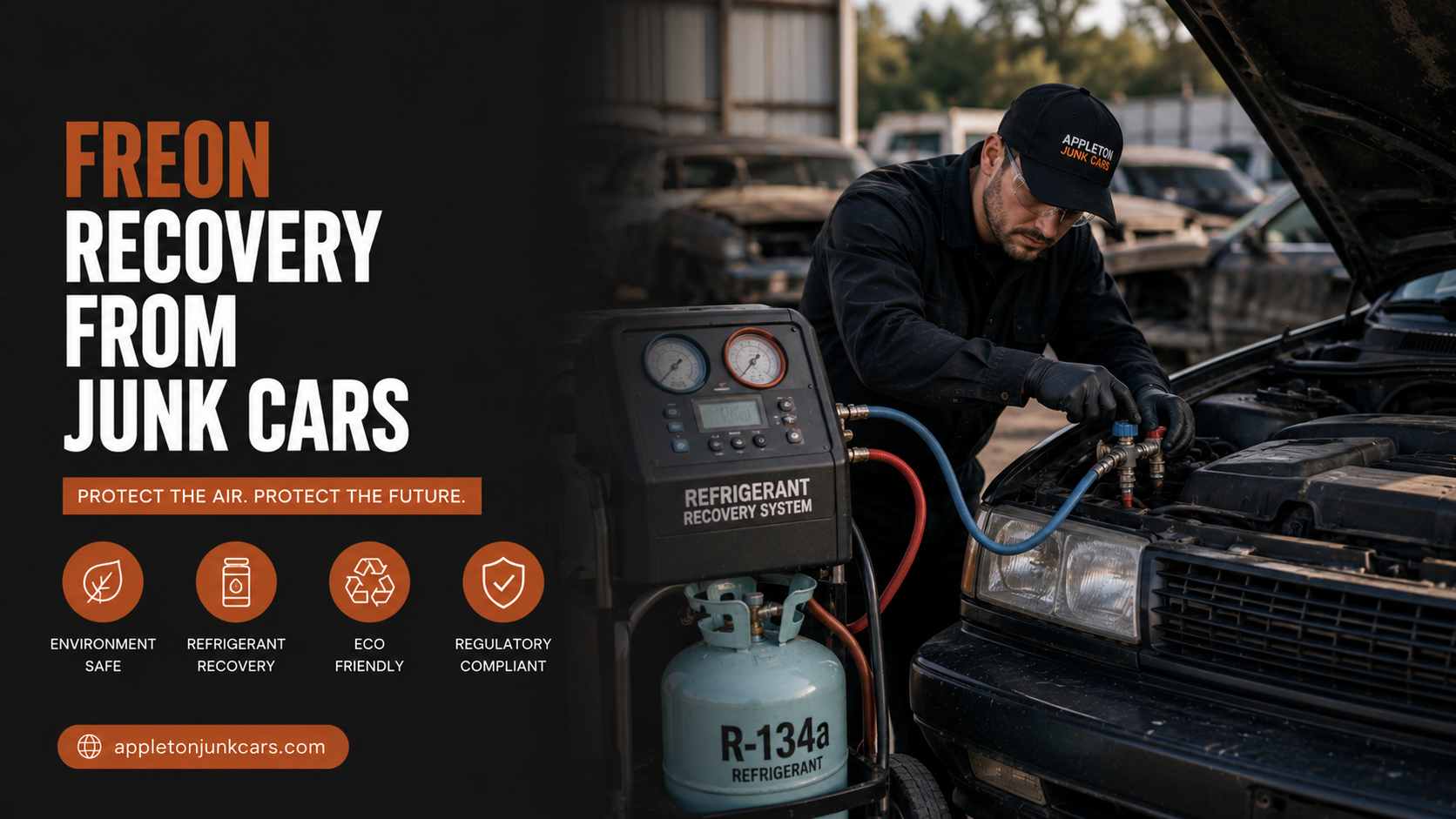
When a junk car arrives at a salvage yard, the air conditioning system contains pressurized refrigerant that cannot legally be released into the atmosphere. Under Section 609 of the Clean Air Act, as enforced by the Environmental Protection Agency, intentional venting of refrigerant from any motor vehicle air conditioning system is a federal violation carrying civil penalties of up to $44,539 per day per violation. The recovery requirement has been in force since 1992, and it applies to everyone who services, repairs, or disposes of a motor vehicle AC system, including salvage yards, junk car buyers, and mechanics.
The term “Freon” is technically a brand name belonging to Chemours (formerly DuPont) and refers specifically to a family of chlorofluorocarbon and hydrochlorofluorocarbon refrigerants. In common use, the term is applied to any automotive refrigerant. Modern junk cars contain one of three refrigerants depending on the year of manufacture: R-12 in pre-1994 vehicles, R-134a in vehicles from 1994 through approximately 2021, and HFO-1234yf in most vehicles produced from 2014 onward. Each refrigerant has different environmental properties, different handling requirements, and different recovery markets.
This guide explains the specific legal requirements for refrigerant recovery, how the recovery process works at a licensed salvage operation, what happens to the recovered refrigerant, and what sellers of junk cars should know before their vehicle is picked up.
What Refrigerants Are Found in Junk Cars and Why Each Is Handled Differently
Three refrigerants appear in the vehicle AC systems that junk car buyers encounter, and each has a distinct environmental profile, regulatory history, and market value.
Refrigerant | Vehicle Years | Ozone Depletion Potential | Global Warming Potential (100-yr) | Current Market Value | Recovery Required |
|---|---|---|---|---|---|
R-12 (CFC-12, original Freon) | Pre-1994 | High (ODP: 1.0) | 10,900 | $25 to $55 per pound (scarce) | Yes, EPA Section 608 and 609 |
R-134a (HFC-134a) | 1994 to approximately 2021 | Zero | 1,430 | $2 to $8 per pound | Yes, EPA Section 609 |
HFO-1234yf | 2014 to present (increasing) | Zero | 4 (near zero) | $40 to $80 per pound | Yes, EPA Section 609 |
R-12 is significant for its scarcity and value. Its production was phased out in the United States in 1996 under the Montreal Protocol because of its ozone-depleting properties. Existing R-12 can be reclaimed and reused, but no new R-12 can be manufactured. This scarcity means recovered R-12 from older vehicles has considerable commodity value to owners of pre-1994 vehicles who need refrigerant for their systems.
HFO-1234yf has a global warming potential of only 4, compared to 1,430 for R-134a. The EU mandated its use beginning in 2017, and US automakers have been transitioning to it progressively since 2014. Because it is also a newer and more expensive refrigerant, recovered HFO-1234yf commands a significantly higher price than R-134a on the reclaimed refrigerant market.
The Legal Framework: What EPA Sections 608 and 609 Require
Two sections of the Clean Air Act govern automotive refrigerant handling. Understanding the difference between them is important for anyone working in auto recycling.
Section 608: Stationary Refrigeration and General HVAC
Section 608 of the Clean Air Act regulates refrigerant handling in stationary refrigeration and air conditioning equipment. It establishes the general framework for refrigerant recovery requirements, prohibits intentional venting of Class I (ozone-depleting) and Class II (HCFC) substances, and requires that technicians working on large commercial refrigeration systems be certified. Section 608 also covers the handling requirements for refrigerants during vehicle manufacturing and some recovery scenarios involving equipment other than MVAC systems.
Section 609: Motor Vehicle Air Conditioning
Section 609 specifically governs motor vehicle air conditioning (MVAC) systems. It requires that technicians who service MVAC systems be certified by an EPA-approved organization, that all refrigerant be recovered before any AC service or before vehicle disposal, and that recovery and recycling equipment used in MVAC service be certified by the EPA. Intentional venting of any refrigerant from an MVAC system is prohibited, regardless of the refrigerant type or the age of the vehicle. This prohibition applies to CFC-12, HCFC-22, HFC-134a, and HFO-1234yf equally.
The penalty for violations is up to $44,539 per day per violation as of current EPA enforcement guidance. Enforcement is through EPA regional offices and state environmental agencies. Salvage yards that are found to be crushing vehicles without recovering refrigerant are subject to these penalties, and the EPA conducts periodic compliance inspections of auto recycling facilities.
The Technician Certification Requirement
Section 609 requires that technicians who service or recover refrigerant from motor vehicle AC systems be certified by an EPA-approved certification program. Certification involves passing a written test covering refrigerant handling procedures, environmental regulations, and safe practices. Programs are administered by organizations including MACS (Mobile Air Conditioning Society Worldwide), ASE (Automotive Service Excellence), and others approved by the EPA.
The certification is specific to motor vehicle AC systems and is separate from Section 608 certifications that cover stationary HVAC equipment. A salvage yard employee who recovers refrigerant from junk cars is required to hold a valid Section 609 certification. The certification does not expire once earned, though professional organizations recommend periodic refresher training as refrigerant technology evolves.
Recovery-only certification is a lower-tier option that allows a technician to recover refrigerant without servicing or recharging AC systems. This certification is appropriate for salvage yard technicians whose only task is removing refrigerant from vehicles prior to dismantling. Full Section 609 certification is required for technicians who also perform refrigerant recharging and AC system diagnosis.
How Refrigerant Recovery Equipment Works
Refrigerant recovery equipment for MVAC systems is EPA-certified machinery that extracts refrigerant from a vehicle’s AC system under controlled conditions and stores it in a recovery cylinder without releasing it to the atmosphere. The equipment must meet UL Standard 1963 or an equivalent recognized standard. Different equipment is required for R-12, R-134a, and HFO-1234yf because the refrigerants cannot be mixed in a recovery cylinder.
The basic principle of operation: the recovery machine connects to the vehicle’s AC service ports (the high-side and low-side Schrader valves accessible without discharging the system). The machine draws refrigerant from the system using a compressor that creates a pressure differential. The refrigerant vapor is condensed by the machine’s internal condenser and stored as liquid in the recovery cylinder. Oil that was circulating in the AC system is separated from the refrigerant during recovery and collected separately.
Modern recovery machines include automatic shut-off functions that stop the recovery process when the vehicle AC system reaches near-vacuum pressure, indicating that substantially all recoverable refrigerant has been captured. A pressure gauge on the recovery machine allows the technician to verify system evacuation. Records of recovered refrigerant volumes are maintained by licensed facilities for regulatory compliance documentation.
The Recovery Process Step by Step
Step 1: Vehicle inspection. The technician checks the AC system service ports for accessibility, identifies the refrigerant type from the vehicle information label (found near the AC service ports under the hood on most vehicles), and selects the appropriate recovery machine and cylinder for that refrigerant type. Mixing different refrigerants in a recovery cylinder renders the refrigerant unusable for reclaiming and creates a contaminated waste stream.
Step 2: Equipment connection. The recovery machine hoses are connected to the vehicle’s high-side and low-side service ports. The connections are made with fittings designed to prevent refrigerant release during connection and disconnection.
Step 3: Recovery. The technician starts the recovery machine, which draws refrigerant from the vehicle AC system into the recovery cylinder. The process takes 5 to 20 minutes depending on the system size, refrigerant type, and ambient temperature. The machine automatically shuts off when system pressure reaches near-vacuum.
Step 4: Verification. The technician verifies that the system pressure has stabilized at near-vacuum and that no significant pressure rise occurs over a two-minute waiting period, which would indicate additional liquid refrigerant flashing into vapor. If pressure rises significantly, recovery continues until it stabilizes.
Step 5: Documentation. The recovered refrigerant volume is recorded. Recovery cylinders are labeled with the refrigerant type and the date of recovery. Full cylinders are stored for pickup by a refrigerant reclaimer.
Where Recovered Refrigerant Goes: Reclaiming, Recycling, and Destruction
Process | What It Does | Who Performs It | End Use of Refrigerant |
|---|---|---|---|
On-site recycling | Filters, dries, and removes non-condensable gases from refrigerant; restores to acceptable purity for reuse in same owner’s equipment | Certified technician at the service facility | Reused in the same vehicle or fleet; not sold to others without reclaiming |
Reclaiming | Full purification to AHRI 700 standard (same purity as virgin refrigerant); requires chemical analysis | EPA-certified reclaimers only | Resold as reclaimed refrigerant; interchangeable with virgin refrigerant |
Destruction | High-temperature incineration in EPA-approved facility; converts refrigerant to CO2, HF, and HCl for further neutralization | Licensed hazardous waste incinerators | No reuse; refrigerant is permanently eliminated |
Reclaiming is the most commercially important pathway for recovered refrigerant from junk cars. Only EPA-certified refrigerant reclaimers (a list maintained by the EPA) can process refrigerant to the AHRI 700 purity standard required for resale. Reclaimed R-134a and HFO-1234yf enter the refrigerant supply chain alongside virgin refrigerant and are used by AC service facilities to recharge vehicle systems. Reclaimed R-12 is especially valuable given the phase-out of production, and certified reclaimers pay $20 to $40 per pound for high-quality recovered R-12 cylinders.
How Refrigerant Recovery Affects the Junk Car Selling Process
For sellers of junk cars, the refrigerant situation is important to understand for one practical reason: a buyer who does not perform refrigerant recovery before crushing is not operating legally. An unlicensed buyer or one who bypasses the recovery step to save time or money is passing a regulatory violation downstream and contributing to atmospheric emissions of substances regulated under the Clean Air Act.
At a licensed salvage operation, refrigerant recovery is a routine part of the intake process and happens before any mechanical dismantling. Sellers do not need to arrange or pay for refrigerant recovery separately. It is part of the standard depollution sequence that licensed facilities perform on every vehicle.
The one practical consideration: if your junk car has an AC system that was already discharged through a leak or a previous repair, there may be little or no refrigerant to recover. This is not a problem for the sale, but it is worth mentioning to the buyer so the recovery technician knows what to expect. An AC system at ambient pressure with no refrigerant present requires no recovery but does require the technician to document that the system was verified empty before the vehicle was processed.
Frequently Asked Questions
Is it illegal to release Freon from a car?
Yes. Intentional venting of any refrigerant from a motor vehicle air conditioning system is prohibited under Section 609 of the Clean Air Act, regardless of the refrigerant type. This prohibition covers R-12, R-134a, and HFO-1234yf. Civil penalties for violations are up to $44,539 per day per violation. The requirement applies to mechanics, salvage yards, junk car buyers, and anyone else who services or disposes of a vehicle AC system.
What happens to Freon when a car is junked?
At a licensed salvage yard, refrigerant is recovered from the vehicle’s AC system using EPA-certified recovery equipment before any other work is performed on the vehicle. The recovered refrigerant is stored in certified cylinders and collected by an EPA-certified refrigerant reclaimer, who processes it to AHRI 700 purity standards and returns it to the refrigerant supply chain for reuse in vehicle AC systems. Unlicensed buyers who do not perform recovery are violating federal law.
How much refrigerant is in a typical car?
Most passenger vehicles contain 0.75 to 1.75 pounds of refrigerant in their factory-charged AC systems. Larger vehicles including SUVs, trucks, and vans may contain 1.5 to 2.5 pounds. The exact charge specification is listed on the refrigerant label affixed under the hood near the AC service ports. Vehicles that have experienced refrigerant leaks may contain significantly less than their factory charge and in some cases none at all.
Do I need to drain the Freon before junking my car?
No. The salvage yard or junk buyer is legally required to recover the refrigerant using certified equipment and a certified technician before the vehicle is processed. You are not responsible for refrigerant removal and should not attempt to discharge the AC system yourself. Intentional venting of refrigerant by any party, including the vehicle owner, is a federal violation.
What is the difference between R-12, R-134a, and HFO-1234yf?
R-12 (CFC-12) was used in vehicle AC systems before 1994 and is an ozone-depleting substance that has been phased out of production. R-134a (HFC-134a) replaced R-12 in 1994 and has no ozone-depleting potential but a global warming potential of 1,430. HFO-1234yf has near-zero ozone depletion potential and a global warming potential of only 4, making it the most environmentally benign of the three. Each requires separate recovery equipment and separate recovery cylinders; they cannot be mixed.
What certification is required to recover Freon from cars?
Section 609 of the Clean Air Act requires technicians who service motor vehicle AC systems to be certified by an EPA-approved certification program. Programs are offered by MACS (Mobile Air Conditioning Society Worldwide), ASE (Automotive Service Excellence), and other approved organizations. Recovery-only certification, a subset of the full certification, is sufficient for technicians whose sole task is removing refrigerant from vehicles before dismantling. Salvage yard employees performing refrigerant recovery must hold a valid Section 609 certification.
Can recovered Freon be reused?
Yes. Refrigerant recovered from vehicle AC systems can be recycled on-site for reuse in the same fleet or owner’s equipment, or sent to an EPA-certified reclaimer for purification to AHRI 700 standards. Reclaimed refrigerant meets the same purity specifications as virgin refrigerant and is sold back into the automotive refrigerant market. Reclaimed R-12 is especially valuable because no new production is permitted under the Montreal Protocol.
How much is recovered car AC refrigerant worth?
The value of recovered refrigerant varies by type. R-12 is the most valuable at $25 to $55 per pound due to its production phase-out and ongoing demand from pre-1994 vehicle owners. HFO-1234yf typically sells for $40 to $80 per pound because it is a newer, more expensive refrigerant. R-134a is worth $2 to $8 per pound. The individual salvage yard or junk buyer typically does not receive payment for refrigerant recovery; the value accrues to the certified reclaimer who processes the collected cylinders.
The Bottom Line
Refrigerant recovery from junk cars is not optional and it is not the seller’s responsibility. The law places the obligation on the technician and the facility that services or processes the vehicle, and licensed salvage operations fulfill that obligation as a standard part of their intake process. The environmental rationale is clear: automotive refrigerants are either ozone-depleting substances or potent greenhouse gases, and their atmospheric release during vehicle disposal would represent a significant and unnecessary source of emissions.
The recovery infrastructure that has developed around Section 609 compliance has created a functioning circular market for automotive refrigerants. R-134a and HFO-1234yf recovered from junk cars flow back into the refrigerant supply chain and displace the need for virgin refrigerant production. R-12 recovered from older vehicles extends the available supply for the existing fleet of pre-1994 vehicles whose owners cannot substitute a different refrigerant without system modification.
For sellers of junk cars, the practical message is to choose a licensed buyer who performs proper refrigerant recovery as part of their standard process. A buyer who skips recovery is not operating legally, and a crushed vehicle with refrigerant still inside it represents an atmospheric release that proper handling would have prevented. The licensed salvage yard system exists precisely to prevent that outcome.