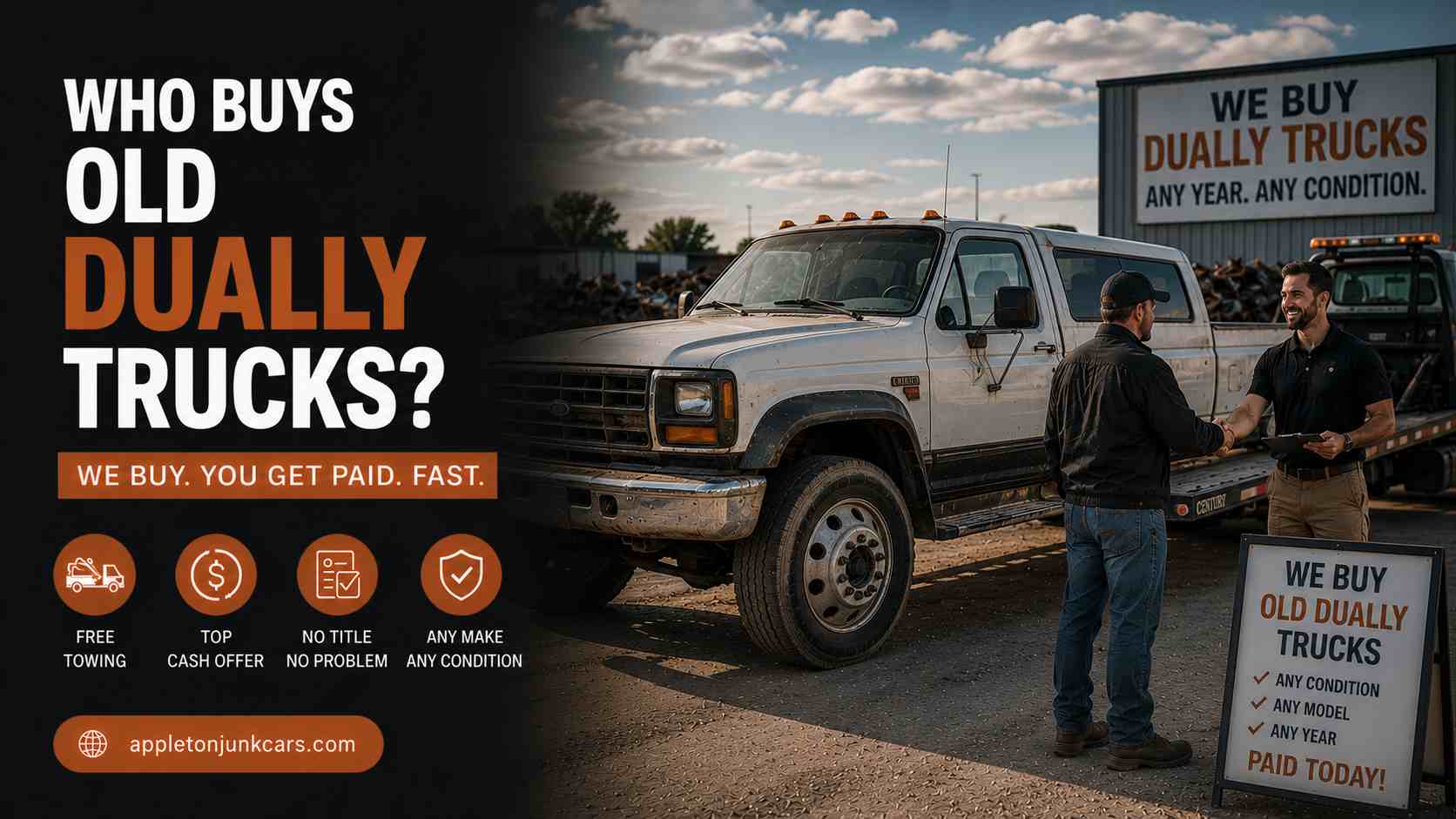
A dually truck is a one-ton pickup with dual rear wheels on each side of the rear axle. The F-350 DRW, the Ram 3500, the Silverado 3500HD, and the Sierra 3500HD are the most common examples. When one of these trucks reaches the end of its service life, it occupies a different and more valuable position in the used and salvage market than a standard half-ton pickup, for one core reason: everything about a dually truck is heavier, more capable, and more expensive to replace than the equivalent component on a standard truck.
The dual rear wheel setup requires a unique rear axle housing, dual wheel hubs on each side, dually-specific fender flares, and in most cases a larger brake system than any standard pickup runs. Every one of those components has a buyer who needs it. Add the premium towing equipment that most duallies were spec’d with from the factory or added in service, and a non-running or heavily worn dually truck is worth meaningfully more per pound than a standard pickup in equivalent condition.
This guide covers what your specific dually truck is worth based on brand, generation, and drivetrain, which buyers pay the most for old or non-running duallies, the dually-specific components that carry independent value, and how to reach each buyer type for the fastest and most effective transaction.
What an Old or Non-Running Dually Truck Is Actually Worth
Dually truck values in non-running or end-of-life condition are driven by three factors: the diesel engine configuration, the rear axle and dually-specific running gear, and any towing or work equipment installed on the truck. Diesel-equipped duallies earn the highest offers by a significant margin across every buyer type.
Dually Truck Configuration | Non-Running / End of Life | Driveable, High Mileage | Notes |
|---|---|---|---|
Ford F-350 DRW with 6.7 Power Stroke (2011+) | $2,500 to $7,000 | $8,000 to $28,000 | Highest demand diesel; strong across all condition levels |
Ford F-350 DRW with 7.3 Power Stroke (1994 to 2003) | $3,000 to $8,000 | $7,000 to $25,000 | Cult following; non-running units sought for drivetrain |
Ram 3500 DRW with 6.7 Cummins (2007+) | $2,500 to $7,500 | $9,000 to $30,000 | Cummins premium; very strong salvage market |
Chevy/GMC 3500 DRW with 6.6 Duramax (2001+) | $2,000 to $6,500 | $8,000 to $26,000 | Duramax consistent demand; LML and LBZ eras highest |
Ford F-450 or F-550 DRW (commercial grade) | $2,500 to $8,000 | $10,000 to $35,000 | Heavier chassis; commercial buyer pool |
Any dually with gas V8 or V10 (no diesel) | $800 to $2,500 | $3,000 to $9,000 | Gas duallies earn significantly less; smaller buyer pool |
Any dually with flatbed or service body installed | Add $800 to $4,000 above chassis value | Add $2,000 to $8,000 | Body condition and type determine addition |
The diesel engine premium on dually trucks is larger than on any other vehicle category in the salvage market. A non-running Ram 3500 with a 6.7 Cummins and a non-running Ram 3500 with a 5.7 Hemi gas engine in identical physical condition receive offers that are $1,500 to $3,500 apart from most buyers. The Cummins engine alone is worth $3,000 to $8,000 to a rebuild buyer. The gas engine has far more limited standalone value.
Why Dually Trucks Have a More Active Buyer Market Than Standard Pickups
Dually trucks are purchased for specific high-load towing and hauling applications that standard half-ton and three-quarter-ton trucks cannot perform reliably. Fifth wheel and gooseneck trailers with loaded weights above 18,000 pounds require the stability, braking capacity, and rear axle load rating that only a properly spec’d one-ton dually provides. Contractors who pull equipment trailers, farmers who move large livestock or grain trailers, and RV owners with large fifth wheels all have consistent demand for capable dually trucks.
This functional demand creates a used market where running duallies are aggressively purchased by buyers who need the capability. That same demand flows into the non-running and salvage market because the components that make a dually valuable are the same ones that wear out and need replacement: rear axle assemblies, dual wheel hub bearings, brake systems, and towing hitches. A non-running dually is a parts source for every running dually that needs those components replaced.
The heavy-duty commercial application also means that dually trucks frequently carry additional equipment that has standalone value: fifth wheel hitches, gooseneck hitches, work body lighting systems, and in commercial applications, service bodies and flatbed beds that are worth thousands of dollars independently of the truck chassis.
The Buyers Who Specifically Seek Old Dually Trucks
Private Work Truck Buyers
The largest buyer segment for old dually trucks is private individuals who need a capable towing or hauling platform and cannot or do not want to pay new or near-new prices. A farmer who needs to pull a 20,000-pound grain trailer, a construction contractor who moves an equipment trailer regularly, or a horse owner who hauls a large trailer several times per month will pay $3,000 to $9,000 for a high-mileage but running dually diesel because the alternative is a $40,000 to $80,000 new truck.
Commercial Vehicle Salvage Yards
Commercial salvage yards that specialize in heavy-duty trucks and one-ton pickups are the most consistent commercial buyers for non-running dually trucks. These yards have active demand from repair shops for rear axle assemblies, wheel hub units, brake components, diesel engines, and transmissions from dually platforms. Because the components are expensive new, the salvage market for heavy-duty truck parts is more active and better-priced than the equivalent market for standard pickup parts.
Diesel Engine Specialists
The 7.3 Power Stroke, 6.7 Power Stroke, 6.7 Cummins, and 6.6 Duramax engines have dedicated rebuild and parts buyer communities that specifically seek non-running trucks for their engine and drivetrain. A non-running F-350 with a 7.3 Power Stroke is worth $3,000 to $8,000 to a diesel buyer for the engine alone. Reaching these buyers through diesel-specific forums and Facebook groups rather than general salvage yards produces offers that reflect the engine’s actual market value.
Flatbed and Service Body Buyers
Many old dually trucks have flatbed beds, service bodies, or utility bodies installed by a previous owner or upfitter. These bodies often have more remaining value than the truck chassis underneath them. A CM, Knapheide, or Reading service body in good condition is worth $1,500 to $5,000 to a truck body dealer or a contractor who wants to install it on a different chassis. Assessing and pricing the bed or body separately before any whole-truck sale is worth the extra 20 minutes it takes.
Which Dually Configurations Command the Highest Offers
Configuration Detail | Demand Level | Why It Matters |
|---|---|---|
6.7 Cummins (Ram 3500, 2007 to present) | Extremely high | Most sought-after diesel in the one-ton market; engine alone worth $3,000 to $8,000+ |
6.7 Power Stroke (F-350, 2011 to present) | Very high | Current-gen Ford diesel; strong demand from private and commercial buyers |
7.3 Power Stroke (F-350, 1994 to 2003) | Very high | Cult following among diesel enthusiasts; non-running trucks sought specifically |
6.6 Duramax LML or LBZ (2001 to 2016) | High | Preferred Duramax eras; LML (2011 to 2016) and LBZ (2006 to 2007) command premium |
Fifth wheel hitch installed (factory or aftermarket) | High impact | Adds $400 to $1,200 to any offer; confirms truck was used for serious towing |
Gooseneck hitch and ball installed | High impact | Adds $400 to $1,200; gooseneck balls run $300 to $800 new |
Flatbed or service body (branded, good condition) | Very high impact | Adds $1,500 to $5,000 depending on brand, size, and condition |
Gas engine V8 or V10 (no diesel) | Low | Significantly smaller buyer pool; offers reflect parts-only value primarily |
The 6.7 Cummins in the Ram 3500 is the single engine configuration that most consistently produces offers above all competing quotes. Cummins diesel buyers are among the most motivated and best-networked buyers in the one-ton truck market. Posting a non-running Ram 3500 DRW with a 6.7 Cummins in diesel-specific Facebook groups or on Cummins forums produces offers within hours in most regions.
The High-Value Components Unique to Dually Trucks
Dually trucks carry components that standard pickups do not, and those components command prices that the salvage market for standard trucks does not approach. Knowing what is on your specific truck before any buyer conversation makes you an informed negotiator.
Dually-Specific Component | Typical Used Market Value | Notes |
|---|---|---|
Rear axle assembly (Dana 80, AAM 11.5, complete) | $800 to $2,500 | One-ton dually axles wear faster; consistent demand from repair shops |
Dual rear wheel hub and bearing assembly (each side) | $300 to $900 per side | Failure item; frequent demand from running dually owners |
Fifth wheel hitch (Reese, B&W, PullRite, in-bed) | $400 to $1,200 | Condition and brand determine value; remove and sell if truck is scrapped |
Gooseneck hitch and ball (under-bed or above-bed) | $400 to $1,200 | Quality gooseneck hardware is expensive new; quick private sale |
CM, Knapheide, or Reading service body (good condition) | $1,500 to $5,000 | Significant standalone asset; sell to truck body dealer or contractor |
Flatbed bed (aluminum, commercial grade, 8 to 12 ft) | $800 to $3,000 | Aluminum flatbeds command premium; steel lower value |
Dually fender flares (OEM or aftermarket, matching set) | $200 to $700 | Dually-specific body part; private sale through truck forums |
Transfer case (NV271, NV273, 4WD equipped truck) | $400 to $1,200 | 4WD duallies command additional premium; TC adds to drivetrain value |
The fifth wheel hitch and gooseneck ball are the two dually-specific accessories most consistently left on old trucks without the seller realizing their independent value. A quality B&W Companion fifth wheel hitch lists for $1,200 to $1,800 new. A used unit in good working condition sells privately for $400 to $900. Removing and listing it separately on Facebook Marketplace before any whole-truck negotiation takes 30 minutes and produces a return that most buyers would not have allocated in a whole-truck offer.
How to Reach the Right Buyer for Your Specific Dually
The sequence for selling or junking a dually truck follows the same principle as any high-value commercial vehicle: establish the scrap floor, then reach specialist buyers before accepting any general offer.
Step one: establish the scrap floor. A full-size one-ton dually weighs 6,000 to 8,000 pounds for a standard pickup configuration and up to 10,000 pounds or more with a service body. At current steel prices, that weight produces $480 to $1,600 in pure scrap value. Call a scrap yard for this number before any other conversation.
Step two: call commercial vehicle salvage yards that specifically carry heavy-duty trucks. Provide the year, make, model, engine, drivetrain (two-wheel or four-wheel drive), and the specific mechanical failure. Yards with active demand for that chassis and engine will produce offers in the $2,000 to $5,000 range for a non-running diesel dually in intact condition.
Step three: post in diesel-specific communities. Ram Cummins, Ford Power Stroke, and Duramax Facebook groups have hundreds of thousands of members. A non-running dually with a rebuildable diesel engine posted with the specific engine, VIN-confirmed configuration, and honest condition photos generates more serious offers more quickly than any general classified listing.
What Dually Truck Sellers Consistently Report
Sellers of old and non-running dually trucks share consistent lessons. The most common: selling to a generic junk buyer without mentioning the diesel engine or the towing equipment. A generic junk buyer who quotes based on weight misses the Cummins or Power Stroke entirely in their formula. A diesel-specific buyer who knows that engine’s market value produces offers that are $1,500 to $3,000 higher for the same truck.
The second consistent finding is the towing equipment. Multiple sellers reported discovering after the fact that the fifth wheel hitch or the gooseneck ball they left on the truck was worth more than they realized. Several described the whole-truck buyer specifically noting those items as part of the deal, which indicated the buyer intended to resell them separately. Identifying and pricing towing accessories before any buyer conversation puts that value back in the seller’s hands.
Those who posted in Cummins and Power Stroke diesel communities reported the fastest responses and the most competitive offers, particularly for trucks in the 2005 to 2015 model range where diesel demand is highest and parts availability is strong enough that buyers are comfortable purchasing a non-running truck for rebuild or parts use. The brand community approach consistently outperformed general classified platforms for diesel dually sellers in every reported case.
Frequently Asked Questions
Who buys old dually trucks?
Old dually trucks are purchased by private work truck buyers who need a capable towing platform at below-retail cost, commercial vehicle salvage yards that carry heavy-duty truck parts inventory, diesel engine rebuild specialists who buy non-running trucks for drivetrain recovery, flatbed and service body dealers who buy trucks for the work body installed on them, and scrap metal yards for vehicles at end of life. Diesel-equipped duallies attract the most competitive buyer pools.
How much is an old dually truck worth?
An old dually truck with a diesel engine is worth $2,000 to $8,000 in non-running condition from a parts or diesel buyer, and $7,000 to $30,000 in driveable high-mileage condition. Gas-engine duallies earn significantly less, typically $800 to $2,500 non-running. Trucks with flatbeds, service bodies, or fifth wheel and gooseneck hitches earn more in every condition category because those components have strong independent market values.
Is a Ram 3500 Cummins worth more than an F-350 Power Stroke when junked?
The Ram 3500 with a 6.7 Cummins and the F-350 with a 6.7 Power Stroke are both premium diesel configurations that command the highest dually offers in the market. Historically, the Cummins has a slightly larger and more active enthusiast buyer community, which produces marginally higher offers in some markets. Both are significantly more valuable than gas-engine equivalents, and both attract diesel-specific buyers who will pay well above scrap for a non-running truck with a rebuildable engine.
What is the most valuable part of a dually truck?
On a diesel dually, the engine is the most valuable single component, worth $3,000 to $8,000 or more to a rebuild buyer for common configurations like the Cummins, Power Stroke, and Duramax. The rear axle assembly is the second most valuable dually-specific component, worth $800 to $2,500 because it is a wear item on one-ton trucks. Fifth wheel and gooseneck hitches, service bodies, and flatbed beds are the most valuable accessories that are commonly overlooked in whole-truck sales.
Should I remove the fifth wheel hitch before selling my old dually?
If the hitch is in good working condition and the truck is being sold to a junk buyer at below-retail prices, removing and selling the hitch separately almost always produces more value. A quality in-bed fifth wheel hitch from B&W, Reese, or PullRite sells for $400 to $900 used. Most junk or salvage buyers will not allocate the full market value of the hitch in their whole-truck offer. A 30-minute removal and a Facebook Marketplace listing typically produces $400 to $700 in additional recovery.
Can I sell a dually truck without a title?
Most commercial vehicle salvage yards require a title for legal ownership transfer. Scrap metal yards may accept current registration with ID in some states for low-value vehicles, but a dually truck with a diesel engine is rarely low enough value to qualify for title-waiver scrap in most states. If the title is missing, obtain a replacement from your state DMV before listing. A replacement title typically takes one to three weeks and costs $15 to $30 in most states.
What is the best way to sell a non-running dually truck?
The sequence that produces the best outcomes: establish the scrap floor first, then post in diesel-specific Facebook groups for the engine brand (Cummins, Power Stroke, or Duramax) with the specific engine and drivetrain details, and simultaneously contact two or three heavy-duty vehicle salvage yards with the full configuration details. Use every quote as leverage in subsequent conversations. For diesel dually trucks, this process consistently produces offers two to four times the scrap floor from diesel buyers who specifically need that engine.
Do dually trucks sell for more than standard pickups when junked?
Yes, consistently and often significantly. The dually-specific rear axle assembly, dual wheel hubs, heavier brake components, and typically larger diesel engines all command higher parts prices than equivalent components on a standard half-ton or three-quarter-ton pickup. A diesel-equipped dually typically earns two to three times the offer of an equivalent-condition gas-engine half-ton pickup at any buyer type.
The Bottom Line
An old dually truck is one of the better junk vehicle assets available if the diesel engine is intact and the dually-specific running gear is in place. The buyer pool for diesel dually trucks is more motivated, more specialized, and better-paying than the buyer pool for standard pickups, because the components they need are expensive to source new and consistently available from non-running trucks that are otherwise at end of life.
Remove the fifth wheel hitch and any gooseneck equipment before any whole-truck negotiation if the truck is going to a junk or salvage buyer. Price the service body or flatbed as a separate asset if one is installed. Reach diesel-specific buyer communities before calling any general salvage yard. Those three steps consistently produce $1,000 to $3,500 more total recovery than accepting the first whole-truck offer from the first buyer who responds.
The scrap floor establishes your baseline. The diesel engine establishes your ceiling. The distance between those two numbers on a one-ton diesel dually is wide enough that the 30 minutes spent making targeted calls to specialist buyers rather than general junk buyers is among the highest-return time investments available in any junk vehicle sale.