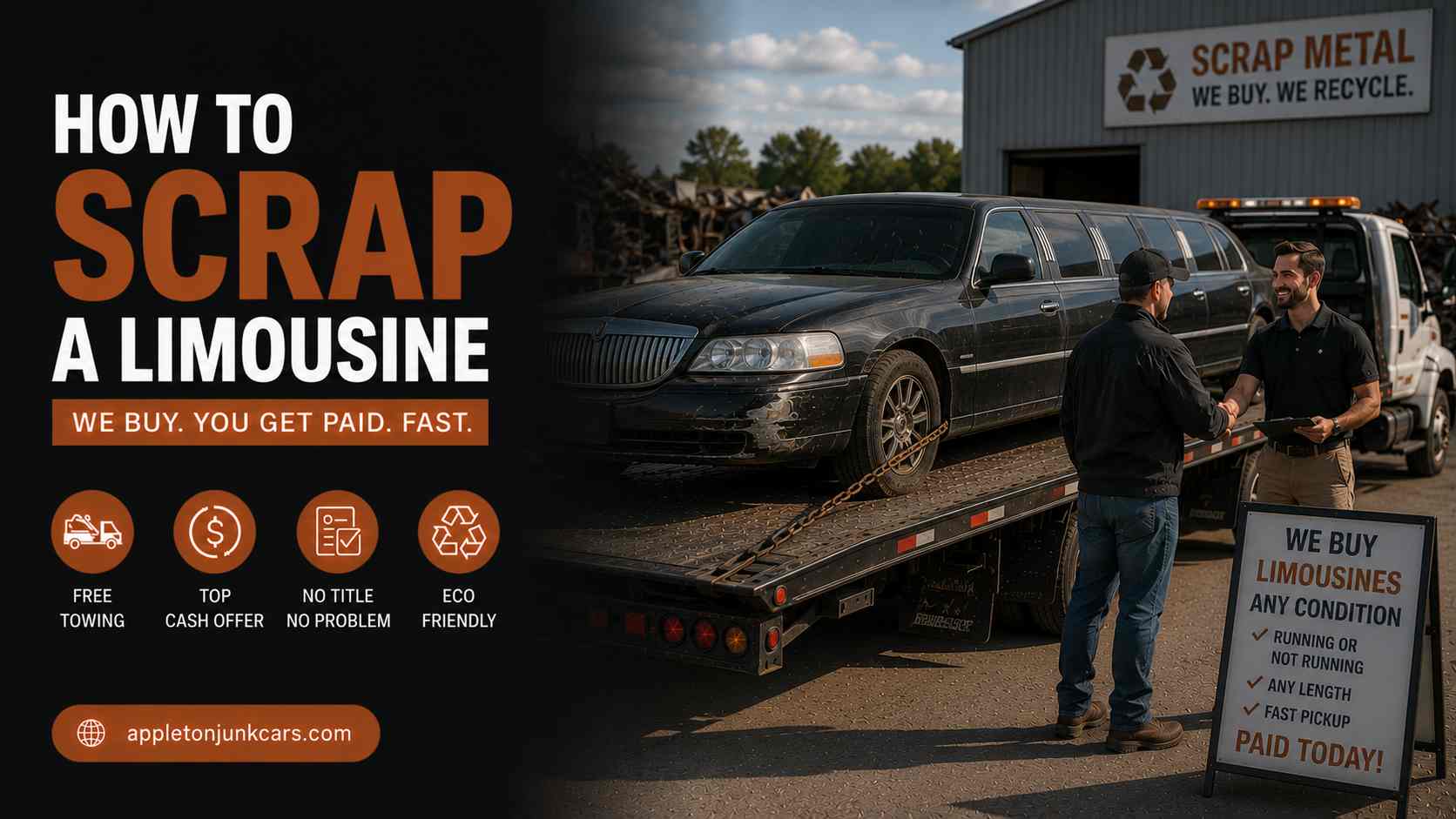
A limousine at the end of its commercial life is one of the harder vehicles to move, not because it has no value, but because it does not fit neatly into any standard sale category. Standard salvage yards are reluctant to take a 30-foot stretched Lincoln. Standard scrap yards will take it but only for the weight of the metal frame, which dramatically undervalues what is inside. And private buyers for working limousines are not in the market for a non-running one.
Scrapping a limousine means understanding that you own two separate assets: the production chassis underneath (a Lincoln Town Car, Chevy Suburban, or Ford Excursion) and the custom coach body built on top of it by a coachbuilder. Each part has a different value, a different buyer, and in some cases a different title. Getting the most from the transaction means separating those two values before any buyer negotiation.
This guide covers what each type of limousine is worth in scrap or end-of-life condition, how the title situation works for custom-bodied vehicles, which interior components can be sold before scrapping, and where to find the specific buyers who will pay more than a generic scrap yard for a limousine in any condition.
What a Junk or Non-Running Limousine Is Actually Worth
Limousine values in end-of-life condition depend primarily on the underlying chassis, the interior condition, and whether the vehicle can be driven or towed to a buyer. The coach body itself, the stretched section built by the coachbuilder, has almost no secondary parts market because every limousine is a one-off custom build.
Limousine Type | Scrap Metal Value | Interior Parts Recovery | Whole-Unit Buyer Range |
|---|---|---|---|
Stretched Lincoln Town Car (120 to 140 inch) | $400 to $900 (Town Car chassis metal) | $200 to $1,200 (electronics, seating, bar) | $500 to $2,500 (private or novelty buyer) |
Stretched Cadillac DeVille or DTS | $400 to $900 | $200 to $1,000 | $500 to $2,500 |
SUV stretch (Suburban, Escalade, Excursion) | $800 to $1,800 (heavier chassis) | $400 to $2,000 | $1,500 to $5,000 |
Chrysler 300 or Dodge Charger stretch | $400 to $800 | $200 to $900 | $600 to $2,500 |
Party bus or van conversion (full coach) | $600 to $1,500 | $500 to $3,000 | $1,000 to $6,000 |
Antique or vintage limousine (pre-1980) | $300 to $700 | $300 to $1,500 (parts) | $1,000 to $8,000 (collector market) |
The SUV-based stretch (Suburban, Escalade, or Excursion platform) commands the highest whole-unit buyer value because the underlying chassis is heavier, the interior volume is larger, and the vehicles have stronger appeal to event operators and novelty buyers who occasionally purchase end-of-life limos for one-time use or conversion. The Town Car stretch, which was the dominant limousine platform for two decades, has a very limited buyer market now that Lincoln discontinued the Town Car entirely and the vehicles are aging out of commercial service simultaneously.
Why Scrapping a Limousine Is More Complex Than a Standard Vehicle
A production limousine has a dual structure that creates two specific complications. First, the VIN situation. The original factory VIN belongs to the production vehicle, the Lincoln Town Car, Chevy Suburban, or other base vehicle, before it was sent to the coachbuilder for modification. The coachbuilder typically does not add a second VIN. This means the title VIN and the description on the title (often “Lincoln Town Car”) may not match what the vehicle physically looks like, which is a 30-foot limousine. Most state DMVs are aware of this situation for limousines and can advise on title transfer for modified vehicles.
Second, the size and weight of the finished vehicle creates towing complications. A standard stretched Lincoln limousine is 28 to 36 feet long and weighs 7,000 to 9,000 pounds. A standard flatbed tow truck cannot accommodate a vehicle of this length without special low-profile equipment or a trailer specifically designed for long-wheelbase vehicles. An SUV stretch or party bus is even heavier. Moving the vehicle requires coordination with a tow company that has the right equipment and experience with oversized vehicles.
Third, limousines typically have aftermarket electrical systems installed by the coachbuilder: lighting controllers, sound systems, partition controls, and bar refrigeration units. These systems are non-standard and wired by the coachbuilder, which means they are not documented in any factory service manual. Working with these systems during disassembly requires comfort with custom wiring rather than OEM documentation.
A Step-by-Step Guide to Scrapping a Limousine
Step 1: Identify the Chassis and Coachbuilder
The most important first step in scrapping a limousine is identifying the specific production chassis underneath and the coachbuilder who performed the conversion. Both affect the value and the title process.
The production chassis is identified by the original VIN, which appears on the dashboard, the driver’s door jamb, and the title. The most common production chassis are the Lincoln Town Car (1998 to 2011), the Cadillac DeVille and DTS (1994 to 2011), the Chevrolet Suburban and Cadillac Escalade (various years), and the Ford Excursion (2000 to 2005). The Town Car chassis has the largest parts salvage market because millions were produced over the same era.
The coachbuilder is typically identified by a badge on the B-pillar or rear quarter panel (common builders include Executive Coach, Krystal, Craftmaster, Empire Coach, Moonacre, and Superior Coaches) and by the coachbuilder’s data plate, which is required in most states and appears near the driver’s compartment. The coachbuilder’s name does not affect the scrap value but does affect the novelty buyer market: some coachbuilders have stronger reputations than others among collectors and event operators.
Step 2: Assess the Passenger Compartment for Sellable Components
Before contacting any scrap buyer, walk through the passenger compartment and identify the condition of these specific components. Selling them separately before scrapping the shell adds $200 to $2,000 to total recovery in most cases.
Interior Component | Typical Used Value | Best Sales Channel |
|---|---|---|
LCD television screens (each, working) | $50 to $200 | Facebook Marketplace, Craigslist |
LED lighting control system (full kit) | $100 to $400 | Event lighting suppliers, DJ equipment buyers |
Partition glass and frame (intact) | $150 to $500 | Other limo operators, coachbuilder shops |
Bar refrigerator unit (working) | $100 to $350 | Restaurant supply, Craigslist |
Sound amplifier and speaker system | $100 to $500 | Car audio buyers, Facebook Marketplace |
Leather seating sections (good condition) | $50 to $200 per section | Upholstery shops, private buyers |
Fiber optic ceiling panels (intact) | $100 to $400 | Specialty lighting buyers, novelty collectors |
Intercom and partition control systems | $50 to $200 | Limo repair shops, coachbuilder suppliers |
Intact partition glass is one of the more consistently saleable limousine interior components because it is custom-sized and expensive to replace on other limousines. Limo operators who damage or break their own partition frequently prefer buying a used unit from a scrapped vehicle over ordering a custom replacement through a coachbuilder. Posting in limousine operator forums and Facebook groups for transportation companies produces faster results for partition glass than general classified platforms.
Step 3: Find the Right Buyer for Your Specific Limousine Type
Limousine Operators and Transportation Companies
The most motivated buyers for end-of-life limousines are other limousine operators who need interior parts. A limo company running 10 Town Car stretches of the same era can use your vehicle for everything: interior panels, partition systems, bar sections, lighting controllers, and drivetrain components from the Town Car chassis. These buyers are found through the National Limousine Association, regional transportation industry networks, and Facebook groups for limousine operators.
Novelty and Event Buyers
A small buyer segment purchases non-running or cosmetically tired limousines for one-time novelty use: promotional events, photo shoots, stage props, and temporary installations. These buyers are found through event planning networks and general classified platforms. They typically pay $500 to $1,500 for a vehicle that runs or can be repaired cheaply, and $200 to $600 for a vehicle that will be displayed rather than driven.
Scrap Metal Yards That Accept Oversized Vehicles
The scrap yard is the floor buyer for any limousine. The challenge is finding a scrap facility with the equipment to handle a 30-foot, 8,000-pound vehicle. General auto scrap yards often decline limos because their standard shredders and car crushers are not designed for vehicles of that length. Commercial scrap facilities that process buses, trucks, and heavy equipment have the appropriate equipment. Call and confirm before transporting.
Coachbuilder Shops and Limousine Repair Specialists
Coachbuilder shops that build or repair custom limousines occasionally purchase end-of-life vehicles for their interior parts inventory. A shop that regularly produces Town Car stretches may want your vehicle specifically for body panels, wiring harnesses, or interior sections that would otherwise require custom fabrication. Contact coachbuilder shops in your region directly; their needs are specific and not easily matched through standard classified platforms.
Step 4: Navigate the Title for a Custom-Bodied Vehicle
The title on a limousine typically reflects the original production vehicle, described as a Lincoln Town Car, Chevrolet Suburban, or whatever chassis was used before the coachbuilder conversion. In most states, the limousine is titled under the original VIN and the vehicle description may not mention the coachbuilder modification at all.
For title transfer in a sale or scrap transaction, the seller signs the back of the original title and provides it to the buyer along with any coachbuilder data plate or documentation available. The buyer processes the title transfer at the DMV under the original VIN and vehicle description. Some states require a vehicle identification number verification inspection for modified vehicles before the title can transfer, which a local DMV or licensed inspector can perform.
If the limousine has been registered as a for-hire vehicle (with a commercial registration or livery plates), the commercial registration must be surrendered to the DMV separately from the title transfer. The for-hire designation does not transfer to a scrap or novelty buyer and must be resolved through the DMV before the title can be cleanly transferred.
What Limousine Sellers Consistently Report
Owners and operators who have sold or scrapped limousines share a consistent set of experiences. The most common challenge: finding a scrap yard willing to accept the vehicle. Multiple sellers reported calling five to ten general auto salvage yards before finding one with equipment capable of handling a stretched limo. The solution that consistently worked was calling commercial vehicle scrap facilities and heavy equipment scrap yards rather than standard auto salvage operations.
The second consistent finding is the interior component sale. Sellers who stripped the passenger compartment of electronics, lighting, and partition systems before contacting any scrap buyer recovered $400 to $1,500 more than those who sold or scrapped the whole vehicle without removing any components. The individual components sell faster than expected through Craigslist and Facebook Marketplace because the buyer pool includes event operators, nightclub owners, and audio enthusiasts who have no interest in the vehicle itself but significant interest in what is inside it.
Those who reached limousine operators directly through industry networks rather than only through general classified platforms consistently received better offers. A limo company with a fleet of matching vehicles that loses one to mechanical failure is a motivated buyer for the interior components and chassis parts from the same model. These buyers are not browsing Craigslist; they are found through the National Limousine Association and regional transportation industry groups.
Frequently Asked Questions
How much is a junk limousine worth?
A junk limousine is worth $400 to $1,800 in pure scrap metal value depending on the size and weight of the underlying chassis. The same vehicle sold as a whole unit to a novelty buyer or limo operator is worth $500 to $5,000 depending on limo type, with SUV stretch limos commanding the highest values. Interior components sold separately can add $200 to $2,000 to total recovery before the shell is scrapped.
Who buys junk or non-running limousines?
Non-running limousines are purchased by other limousine operators who need interior parts and chassis components, novelty and event buyers who want a limousine for promotional or display purposes, coachbuilder shops that need interior components for ongoing repair work, and commercial scrap metal facilities that can handle oversized vehicles. General auto salvage yards and standard scrap yards frequently decline limousines because of the vehicle’s size.
Can a standard scrap yard take a limousine?
Standard auto scrap yards and car crushers often cannot process a 28 to 36-foot limousine because their equipment is designed for standard vehicle dimensions. Commercial scrap facilities that process buses, heavy trucks, and large equipment can handle oversized vehicles. Call the facility before transporting and confirm they have the equipment and that they can provide pickup for a vehicle of the limousine’s size and weight.
What is the title process for scrapping a limousine?
A limousine is titled under the original production vehicle VIN (the Lincoln Town Car, Chevy Suburban, or other base chassis) and the title description reflects that original vehicle even after the coachbuilder conversion. The title transfer follows the standard vehicle title process: the seller signs the back of the title, the buyer processes the transfer at the DMV. Some states require a VIN inspection for modified vehicles before transfer. Commercial for-hire registrations must be surrendered separately.
Is the interior of a limousine worth anything when scrapping?
Yes. LCD televisions, LED lighting control systems, partition glass, bar refrigerators, sound systems, and fiber optic ceiling panels from limousine interiors all have private buyer markets through Craigslist and Facebook Marketplace. Intact partition glass is particularly sought after by limousine operators who need a replacement. Removing and selling interior components before scrapping the shell typically adds $400 to $1,500 to total recovery.
How do I move a limousine that does not run?
Moving a non-running limousine requires a tow company with equipment capable of handling a vehicle that is 28 to 36 feet long and weighs 7,000 to 9,000 pounds or more for SUV stretches. Standard flatbeds are not long enough for most stretch limos. Contact towing companies that specifically handle oversized vehicles, buses, or commercial equipment and confirm they have the right trailer before scheduling. The buyer or scrap facility may offer to arrange specialized transport as part of the transaction.
Can I donate an old limousine instead of scrapping it?
Yes, though the pool of organizations that can accept and use a limousine is smaller than for passenger vehicles. Vocational programs at community colleges that teach automotive or coachbuilding skills occasionally accept unusual vehicle donations. Some nonprofit event companies and community organizations that run special event programs for children have accepted limousine donations for one-time use. A qualified appraisal is required for donations over $500 to support the tax deduction.
What makes an SUV stretch limousine worth more than a Town Car stretch?
SUV stretch limousines on Suburban, Escalade, or Excursion platforms are worth more for three reasons: the heavier chassis has more scrap metal value, the larger interior volume is more appealing to event operators who might purchase the vehicle for a second life, and the SUV platform parts have more active buyer markets than the discontinued Lincoln Town Car chassis. An end-of-life Excursion stretch typically earns $1,000 to $2,000 more than an equivalent Town Car stretch in the same condition.
The Bottom Line
Scrapping a limousine requires matching the right buyer to the right part of the vehicle. The passenger compartment components have buyers in the event and entertainment world. The limousine as a whole unit has a limited but real buyer pool among operators and novelty purchasers. The chassis has scrap value at commercial facilities that can handle the size. None of these buyers is the same, and treating the limousine as a single asset to be offered to a single buyer consistently produces less than treating it as the multi-part asset it actually is.
Strip the interior of sellable components first. Find the right commercial scrap facility that can handle the size before assuming any yard will take it. If the limo has any life in it, reach limousine operators directly through industry networks rather than waiting for them to find a general classified listing.
The title complication, if there is one, is almost always resolvable. The vehicle was titled as its base chassis and that title is what transfers. A phone call to your state DMV with the VIN and a description of the modification resolves most title questions before they become obstacles.