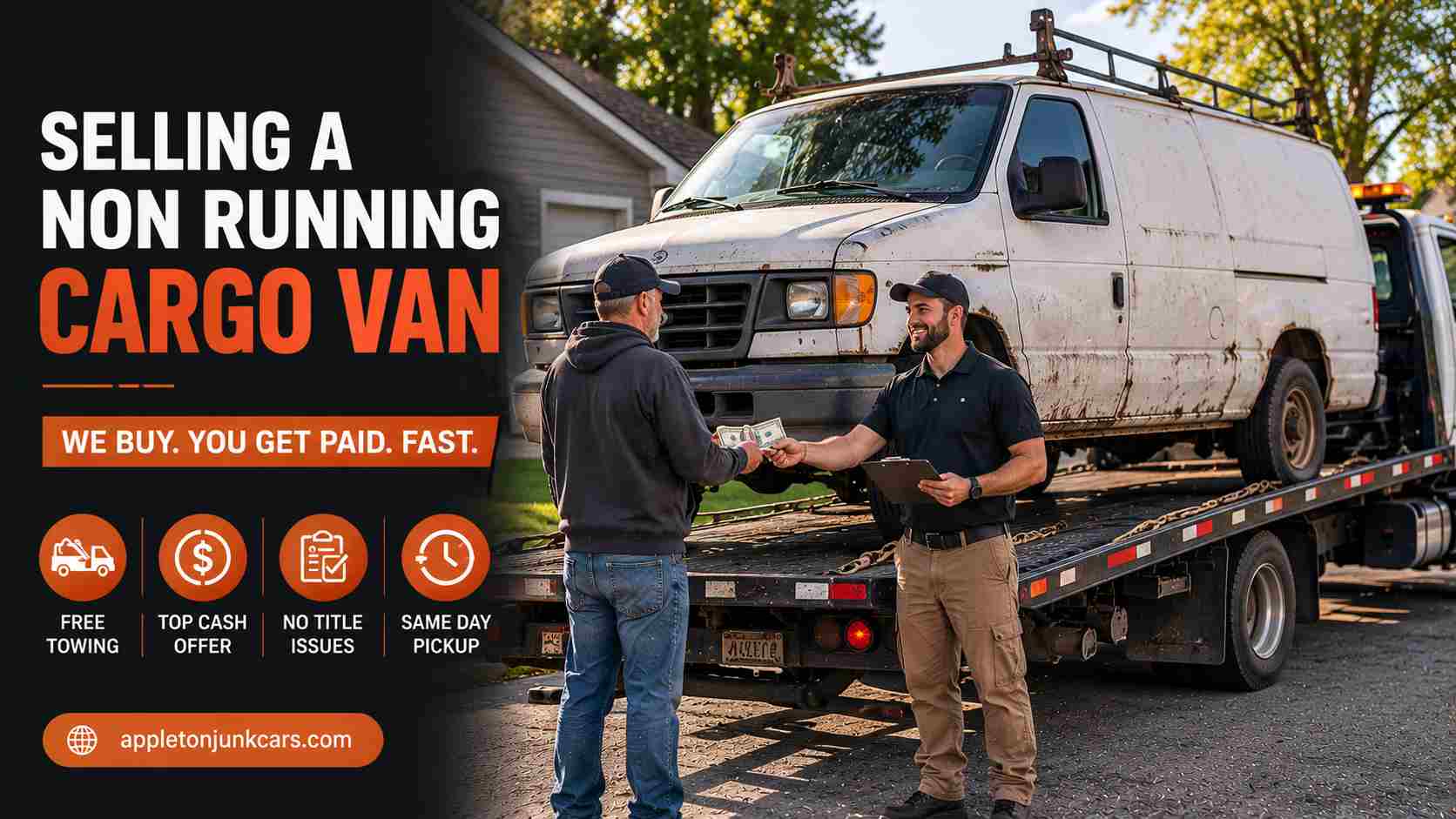
The cargo van is dead. The engine seized, the transmission failed, or the cost to repair it crossed the line where fixing it made no financial sense. What most owners do not realize is that a non-running cargo van sits in one of the stronger buyer markets among commercial vehicles. The combination of usable cargo volume, fleet-standard chassis components, and active conversion communities means the right buyer is typically not a scrap yard but someone who values what the van can become.
Cargo vans that will never run again are purchased by commercial vehicle salvage yards for parts, by van life and campervan conversion builders who need a chassis platform, by fleet maintenance shops that buy whole vans for specific components, and by refrigerated van buyers who want the reefer unit regardless of whether the van runs. Each of these buyers values completely different things, and reaching the right one for your specific make and model determines whether you recover scrap weight or two to four times that amount.
This guide covers what your specific van is worth based on chassis brand and configuration, how each buyer type calculates their offer, which components carry the most separate value, and how to move a non-running van efficiently once you have the right buyer.
What a Non-Running Cargo Van Is Worth Before Your First Call
Cargo van values in non-running condition vary significantly based on the chassis brand, engine type, body length, and whether any specialty equipment such as refrigeration is installed. The spread between scrap value and the right buyer’s offer is wider for cargo vans than for most vehicle categories.
Cargo Van Type | Scrap or Metal Value | Non-Running Buyer Range | Notes |
|---|---|---|---|
Mercedes Sprinter (any year, standard cargo) | $600 to $1,200 | $2,000 to $6,000 | Strongest conversion market; chassis alone has premium value |
Ford Transit (2015 to present) | $500 to $1,000 | $1,500 to $4,500 | Active conversion community; fleet parts demand strong |
Ford E-Series Econoline (any year) | $400 to $900 | $800 to $2,500 | Massive install base; consistent parts demand from fleet shops |
Chevy Express or GMC Savana | $400 to $900 | $700 to $2,200 | Strong fleet parts market; V8 gasoline versions most common |
Ram ProMaster (2014 to present) | $400 to $800 | $700 to $2,000 | Growing parts market as fleet penetration increases |
Any cargo van with refrigeration (reefer) | Same frame value | Add $1,500 to $5,000 for functional reefer unit | Reefer unit has its own buyer market; sell separately if possible |
High-roof extended cargo van (any brand) | Same as standard | Add $200 to $600 premium | More usable interior volume = more appeal to conversion buyers |
The Mercedes Sprinter commands the largest premium among non-running cargo vans at every condition level because the van life and campervan conversion community specifically seeks Sprinter chassis as their preferred platform. A non-running Sprinter with a solid body, no rust-through, and a rebuildable or replaceable engine is a viable conversion project. That buyer will pay $3,000 to $6,000 for a van the scrap yard would quote at $700.
Why Cargo Vans Have a Stronger Buyer Market Than Most Non-Running Commercial Vehicles
Cargo vans occupy a unique position in the commercial vehicle aftermarket for three reasons. First, the fleet usage patterns that put vans in service also create consistent demand for used parts: fleet operators running 50 or 100 of the same van platform regularly need used transmissions, alternators, cooling system components, and body panels to maintain their operational fleet at below-dealer-parts cost.
Second, the cargo van body is structurally versatile. Unlike a box truck where the cargo body is purpose-built for freight, a cargo van body is a blank interior shell that conversion builders can transform into a campervan, a mobile workshop, a food service vehicle, or a medical transport unit. Buyers in the conversion market are not looking for a functioning vehicle. They are looking for a structural platform, and a non-running van with a solid body and frame serves that purpose as well as a running one in many cases.
Third, cargo van chassis are shared across multiple manufacturer applications. The Sprinter chassis appears in ambulances, airport shuttles, and specialty vehicles. Parts interchangeability across those applications creates buyer demand that extends well beyond standard cargo van repair shops.
The Buyers Who Pay the Most for a Dead or Damaged Cargo Van
Van Life and Campervan Conversion Builders
The van conversion community is the highest-paying buyer segment for Mercedes Sprinter and Ford Transit non-running cargo vans. These buyers convert cargo van platforms into full-time mobile living spaces and are willing to pay a meaningful premium for a solid structural platform because the interior will be completely rebuilt regardless. A seized Sprinter engine is a known cost they budget for; a rusted-through floor or a compromised frame is not. If your Sprinter or Transit has a sound body with no significant rust, the conversion community will pay $2,500 to $5,000 for the platform regardless of the mechanical failure.
Commercial Vehicle Salvage Yards
Commercial salvage yards that specialize in cargo vans and light commercial vehicles buy non-running vans for their parts inventory. Transmissions, engines, doors, instrument panels, alternators, and cooling system components from popular van platforms have consistent demand from fleet mechanics. These yards offer more than scrap and less than a conversion buyer. For Ford E-Series, Chevy Express, and ProMaster vans where the conversion market is limited, a commercial salvage yard is typically the highest-paying realistic buyer.
Refrigeration Equipment Buyers
A non-running cargo van equipped with a refrigeration (reefer) unit from Thermo King, Carrier, or Frigiking retains significant value in the refrigeration unit itself, independent of the van’s mechanical condition. A functional reefer unit from a common manufacturer sells for $2,000 to $5,000 to food service operators and refrigeration equipment dealers. This component should be offered separately to refrigeration buyers before the van is offered whole, because a whole-van buyer will pay less for the combined package than the two components earn separately.
Fleet Maintenance Shops
Fleet maintenance operations that service large numbers of commercial vans are consistent buyers of specific components from non-running units. They are not buying the whole van: they want the transmission, the alternator, the power steering pump, or a specific body panel they cannot source new quickly. These buyers typically negotiate for individual components rather than whole vehicles, but for sellers who want to maximize recovery and have the time and tools to part out, fleet maintenance buyers are a reliable market for high-demand components.
Chassis Brand and Engine Configuration: The Two Factors That Change Every Offer
The chassis brand is the most important single factor in a non-running cargo van’s value. Fleet buyers, conversion builders, and salvage yards all have specific preferences, and the spread in offer prices between the most and least sought-after platforms is significant.
Chassis | Engine Options | Buyer Pool | Relative Value vs Scrap Floor |
|---|---|---|---|
Mercedes Sprinter (2500/3500) | 2.1L or 3.0L diesel; 2.0L 4-cyl turbo gas | Conversion, fleet salvage, diesel specialists | 3x to 6x scrap value for intact vans |
Ford Transit (2015+) | 2.0L EcoBoost; 3.5L EcoBoost; 3.5L V6 | Conversion, fleet salvage | 2x to 4x scrap value |
Ford E-Series (any year) | 4.6L or 5.4L V8 gas; 6.8L V10 | Fleet salvage, private buyers | 1.5x to 3x scrap value |
Chevy Express / GMC Savana | 4.3L V6; 5.3L or 6.0L V8 gas; 6.6L Duramax diesel | Fleet salvage, private | 1.5x to 2.5x scrap value |
Ram ProMaster | 3.6L V6 gas; 3.0L diesel (early years) | Fleet salvage, growing private market | 1.5x to 2.5x scrap value |
The presence of a diesel engine increases the offer from almost every buyer type. Diesel cargo vans have longer expected service lives, lower operating costs for fleet users, and stronger appeal to the conversion community that uses vans for long-distance travel. A non-running Sprinter diesel and a non-running Sprinter gas unit of the same year and mileage will receive offers that differ by $500 to $1,500 from most buyers.
The High-Value Components That Boost Any Cargo Van Offer
Before contacting any buyer, assess the condition of these specific components. Their presence adds to every offer. Their absence or damage is the first thing buyers discount.
Component | Estimated Used Value | When to Sell Separately |
|---|---|---|
Refrigeration unit (Thermo King, Carrier) | $2,000 to $5,000 | Always; reefer buyers pay more than whole-van buyers allocate for it |
Sprinter diesel engine (OM642 or OM651, rebuildable) | $2,000 to $6,000 | If you have a direct diesel buyer; complex removal |
Transmission (7G-Tronic or Ford 6-speed, functional) | $800 to $2,500 | Fleet salvage buyers purchase directly |
Partition wall (steel, intact) | $200 to $600 | Van upfitters and fleet buyers use these |
Shelving and racking systems (Adrian Steel, Sortimo) | $300 to $1,200 | Tradespeople and fleet managers buy as-is |
Upfitter lighting (strobe, LED emergency) | $100 to $500 | Specialty buyers; sell separately if connected |
Ladder racks (roof-mounted, commercial grade) | $150 to $500 | Craigslist and Facebook Marketplace; quick private sale |
Shelving and racking systems installed by previous owners, particularly branded systems from Adrian Steel, Sortimo, or Ranger Design, have active buyer markets among tradespeople who need organized van storage. Posting these separately on Craigslist or Facebook Marketplace before offering the van whole frequently produces $300 to $1,000 in additional recovery that a whole-van buyer would not have paid.
How to Get Competing Quotes and Move the Van Efficiently
The scrap metal value of a cargo van is your floor. A full-size cargo van weighs 5,000 to 6,500 pounds depending on the platform and configuration. At current scrap steel rates, the metal value runs $400 to $975. Establish this number first by calling a local scrap yard with the van’s approximate weight.
Then contact buyers in order of likely payout. For Sprinter and Transit vans: post in van life and campervan conversion Facebook groups first. List the chassis, diesel or gas engine, the specific failure, body condition, and roof height. Motivated conversion buyers respond within 24 to 48 hours for desirable platforms. For E-Series, Express, and ProMaster vans: call two or three commercial vehicle salvage yards with the specific engine, mileage, and a clear description of what works and what does not.
Moving a non-running cargo van requires a flatbed tow truck rated for the vehicle’s weight. Most van platforms fall within standard flatbed capacity. Confirm the van’s GVWR before scheduling pickup, as some larger Sprinter and ProMaster configurations approach or exceed 11,000 pounds gross vehicle weight, which requires a heavier-duty flatbed. Inform the tow company of the weight at scheduling time.
What Sellers of Non-Running Cargo Vans Consistently Report
Sellers who have moved non-running cargo vans report consistent patterns. Those with Sprinter vans who posted in van life communities before calling any commercial buyer received offers they described as genuinely surprising, typically $2,500 to $4,500 for vans they expected to receive $700 to $900 for at a scrap yard. The conversion buyer’s offer reflected the van’s structural value rather than its mechanical status.
Sellers of Ford E-Series and Chevy Express vans reported more mixed outcomes. Those who called commercial vehicle salvage yards specifically (rather than passenger car salvage yards) received meaningfully better offers because the yards had active demand for fleet-standard components from those platforms. Calling a general auto salvage yard for a commercial van consistently produced lower offers than calling a yard that specifically handles commercial vehicles.
The most consistent lesson: the reefer unit. Multiple sellers reported accepting a whole-van offer that included the refrigeration unit, then discovering afterward that the reefer unit alone was worth more than they received for the whole van. Identifying refrigeration equipment as a separate asset before any whole-van negotiation is the single highest-impact preparation step for any refrigerated cargo van disposal.
Frequently Asked Questions
Who buys non-running cargo vans?
Non-running cargo vans are purchased by van life and campervan conversion builders (especially for Sprinter and Transit platforms), commercial vehicle salvage yards for fleet parts, refrigeration equipment buyers for the reefer unit, fleet maintenance shops for specific components, and scrap metal yards for vehicle weight. Conversion builders pay the most for Sprinter and Transit chassis. Commercial salvage yards pay the most for E-Series and Express platforms with intact drivetrain components.
How much is a non-running cargo van worth?
A non-running cargo van is worth $400 to $975 at scrap metal rates based on vehicle weight, and $700 to $6,000 or more to the right buyer depending on the chassis brand. Mercedes Sprinter non-running cargo vans earn the highest offers because of conversion community demand. Ford E-Series and Chevy Express vans earn moderate offers from fleet salvage buyers. Refrigerated vans earn additional value from the reefer unit, which can be worth $2,000 to $5,000 on its own.
Can I sell a cargo van without a title?
Most commercial vehicle salvage yards and legitimate buyers require a title for a cargo van purchase. Commercial vans are titled as vehicles in all states, and the title transfer is required for legal ownership change. If the title is missing, apply for a replacement at your state DMV before listing. Scrap metal yards may accept current registration as an alternative in some states for low-value vehicles, but this limits your buyer pool and typically means accepting scrap rates.
Do cargo van buyers offer free towing?
Established commercial vehicle salvage yards and national junk vehicle buyers typically include free towing for cargo vans within their standard service radius. Conversion buyers who are motivated to purchase a specific van often arrange and pay for transport at their own expense. Refrigeration equipment buyers may or may not include pickup depending on whether they have the right tow equipment for your van’s size.
Is a non-running Mercedes Sprinter worth more than other cargo vans?
Yes, consistently. The Sprinter commands the highest non-running offers among cargo van platforms because of the strong conversion buyer market and the active diesel engine parts market. A non-running Sprinter in sound structural condition with a rebuildable engine typically earns $2,000 to $6,000 from conversion or diesel buyers, compared to $700 to $2,500 for an equivalent Ford E-Series at a fleet salvage yard.
Should I sell the refrigeration unit separately before scrapping my cargo van?
In almost every case, yes. A functional refrigeration unit from Thermo King, Carrier, or a similar brand sells for $2,000 to $5,000 to food service operators and refrigeration dealers. A whole-van buyer who wants primarily the chassis will not allocate the full market value of the reefer unit in their offer for the combined package. Selling the reefer unit separately and then selling the van without it typically produces more total recovery.
What is the easiest way to sell a non-running cargo van quickly?
The fastest route for a non-running cargo van is a national junk vehicle buying platform that handles commercial vans, or a local commercial vehicle salvage yard that offers pickup within 24 to 48 hours. For Sprinter vans specifically, posting in van conversion Facebook groups with an honest description and clear photos generates motivated buyers within one to two days in most regions. For other platforms, a commercial salvage yard that specifically handles fleet vehicles is faster and higher-paying than a general auto salvage operation.
How do I move a non-running cargo van for sale or scrap?
A non-running cargo van requires a flatbed tow truck. Standard flatbeds handle most full-size cargo van platforms up to 10,000 pounds GVWR. High-roof extended vans may require specific height clearance at overhead structures. Confirm the van’s GVWR (found on the door jamb sticker) before scheduling towing and provide it to the tow company. Most buyers who offer free towing arrange the appropriate flatbed equipment as part of the standard transaction.
The Bottom Line
A non-running cargo van has more buyer options and significantly more potential recovery than its mechanical condition suggests, particularly on Mercedes Sprinter and Ford Transit platforms where conversion buyers have made the non-running van a legitimate market segment. The scrap yard is the floor. The conversion community is the ceiling, and for the right van in the right structural condition, those two numbers are very far apart.
Refrigeration equipment is a separate decision that should happen before any whole-van negotiation. Shelving and racking systems have their own buyer market. The chassis brand and engine type determine which buyer to call first, and calling in the wrong order consistently costs sellers $500 to $2,000 in recoverable value.
Establish the scrap floor, identify any specialty equipment on the van, match the chassis to the right buyer segment, and get two or three competing quotes before accepting any single offer. That sequence takes a few hours and produces meaningfully better outcomes than the first quote from the first buyer who returns a call.