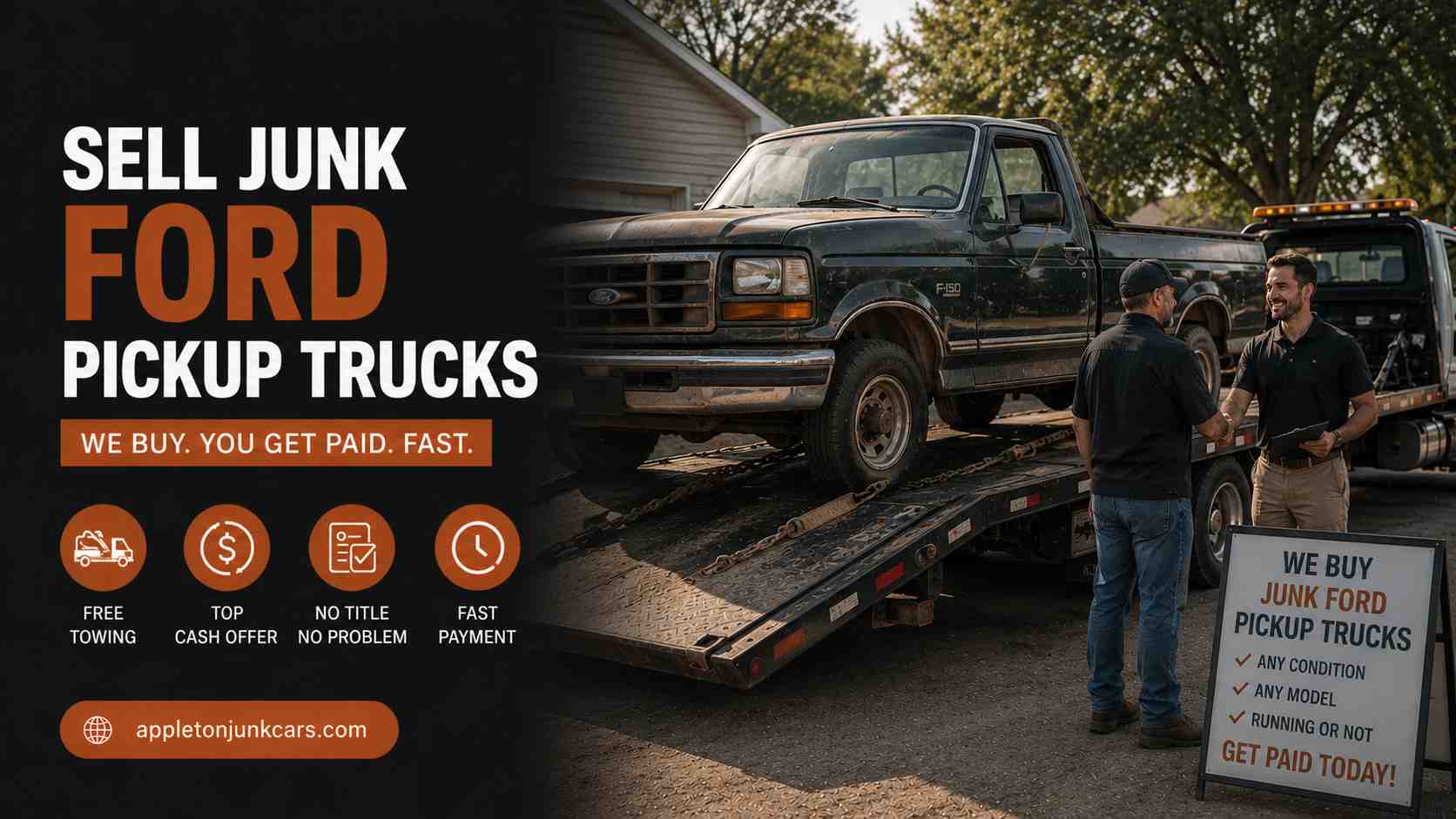
The Ford F-Series has been the best-selling vehicle in the United States for more than four decades. That fact means one thing when you are trying to sell a junk one: there are more buyers, more salvage yards stocked with F-Series parts, more private buyers looking for project trucks, and more secondary market demand for Ford pickup truck components than for almost any other vehicle on the road. A junk Ford truck is not just a piece of metal. It is a parts source with an active national buyer pool.
Most sellers of junk Ford pickups underestimate what they have and accept the first offer they receive, which is typically a generic junk car quote that treats the truck the same as any other vehicle at the same weight. That approach ignores the substantial premium that the F-Series parts market creates for specific engine configurations, body styles, trim levels, and generation years.
This guide covers what your specific junk Ford truck is worth based on generation and engine, which buyers pay the most for non-running or heavily damaged F-Series trucks, which parts on your specific truck are worth selling separately, and how to structure the sale to capture the most value regardless of the truck’s condition.
Why the F-Series Parts Market Changes Everything About This Sale
The F-150, F-250, and F-350 are the three most commonly owned and most commonly serviced vehicles in the American automotive aftermarket. Every mechanic knows these trucks. Every parts store stocks parts for them. Every salvage yard that handles American vehicles has a section dedicated to F-Series components. This market depth creates a specific dynamic for sellers of junk Ford pickups: your non-running truck is worth significantly more to the right buyer than its scrap weight suggests.
The specific engine under the hood of your Ford pickup is the most important value driver. The 7.3-liter Power Stroke diesel (1994 to 2003 F-250 and F-350) has a cult following among diesel enthusiasts who specifically seek these trucks regardless of overall condition. A seized 7.3 on a rotted frame is still worth $1,500 to $3,000 to the right diesel buyer for the engine alone. The 6.2-liter V8 gasoline engine in Super Duty trucks has strong demand from performance and work truck buyers. The 5.0-liter Coyote V8 in newer F-150 models commands strong salvage interest. Knowing which engine you have determines which buyer segment to target first.
What Your Junk Ford Pickup Truck Is Actually Worth Right Now
F-Series Generation and Engine | Non-Running / Heavy Damage | Fair Running Condition | Notes |
|---|---|---|---|
F-150 (2015 to present), 2.7 or 3.5 EcoBoost | $1,500 to $5,000 | $6,000 to $18,000 | EcoBoost engines have strong salvage demand |
F-150 (2011 to 2014), 5.0 Coyote V8 | $1,200 to $4,000 | $5,000 to $14,000 | Coyote engine is a premium parts item |
F-150 (2004 to 2010), 5.4 Triton V8 | $800 to $2,500 | $3,000 to $9,000 | Cam phaser issues common; affects offer |
F-250 / F-350 (1999 to 2003), 7.3 Power Stroke | $2,500 to $8,000 | $6,000 to $25,000 | Highest demand diesel; engine alone worth $2k+ |
F-250 / F-350 (2003 to 2007), 6.0 Power Stroke | $800 to $2,500 | $3,500 to $10,000 | Known issues limit offer; engine less desirable |
F-250 / F-350 (2008 to 2010), 6.4 Power Stroke | $1,000 to $3,000 | $4,000 to $12,000 | Short service life concerns lower demand |
F-250 / F-350 (2011 to present), 6.7 Power Stroke | $2,000 to $6,000 | $7,000 to $28,000 | Strong diesel; high demand at all condition levels |
F-150 Raptor (any year) | $4,000 to $10,000 | $15,000 to $35,000 | Raptor parts carry extreme premiums |
The 7.3-liter Power Stroke and the F-150 Raptor are the two highest-value scenarios regardless of truck condition. A Raptor with a salvage title and major collision damage still carries significant buyer interest from Raptor-specific parts buyers and rebuild specialists who need OEM suspension components, bumpers, and running gear. The value of a specific truck can be significantly above or below these ranges based on trim level, cab style, bed length, four-wheel drive status, and regional market demand.
The Buyers Who Pay the Most for Non-Running Ford Trucks
Ford-Specific Salvage Yards
Large salvage yards that specialize in or carry significant Ford inventory have the most active buyer relationships for F-Series parts. They know which years and engines are in demand, they have established pricing for every component, and they will pay more for an intact truck than a generic salvage yard because they can move the parts efficiently. Calling salvage yards that specifically advertise Ford or F-Series inventory rather than general auto salvage operations typically produces offers 20 to 40 percent higher for the same truck.
7.3 Power Stroke Diesel Buyers
The 7.3-liter International Power Stroke diesel engine produced from 1994 to 2003 has a dedicated and active buyer community that specifically seeks these trucks regardless of overall condition. Buyers in this community want the engine, the injection pump, the injectors, the turbocharger, and the associated electronics. A truck with a seized 7.3 that is otherwise complete is worth $2,000 to $5,000 to diesel engine salvage buyers. A complete running 7.3 transplanted into a clean truck is worth $3,000 to $7,000 to the same market. Searching for 7.3 Power Stroke buyers on diesel forums and Facebook groups dedicated to this engine produces better results than calling generic salvage yards.
Raptor and Performance Parts Buyers
F-150 Raptor components carry some of the highest premiums of any Ford part in the secondary market. The Fox shock absorbers ($300 to $600 each new), the front bumper and fascia ($1,200 to $2,500 new), the unique fender flares ($600 to $1,200 new), and the bed-mounted spare tire carrier are all parts that Raptor owners replace, upgrade, or source for Raptor conversion builds. A salvage-titled Raptor with major frame or engine damage still yields $4,000 to $10,000 to the right buyer for its parts content alone.
Private Buyers for Project Trucks
The F-Series project truck market on Facebook Marketplace, Craigslist, and eBay Motors is consistently active. Buyers looking to restore a specific generation, swap engines, or build a custom work truck regularly pay above salvage yard rates for a complete truck with a repairable issue. A non-running F-150 with a blown engine but solid body, interior, and frame in a desirable configuration frequently earns $1,500 to $4,000 from a private buyer who is comfortable completing the repair themselves.
Which Ford Truck Years and Configurations Command the Highest Offers
Not all F-Series trucks carry equal market value in non-running condition. The generation, engine, drivetrain, cab style, and certain factory options each affect how much the truck is worth to the buyers who specifically seek it.
Configuration | Demand Level | Why It Matters |
|---|---|---|
Four-wheel drive (any generation) | Very high | 4×4 parts and drivetrains are in significantly higher demand than 2WD |
7.3 Power Stroke diesel (1994 to 2003) | Extremely high | Most sought-after diesel; intact trucks command 2x to 4x non-diesel premium |
6.7 Power Stroke (2011 to present) | Very high | Current generation diesel; strong parts demand |
F-150 Raptor (any year) | Extremely high | OEM parts carry large premiums; niche but very motivated buyers |
Crew cab, short or standard bed (2015+) | High | Most popular configuration; broadest buyer pool |
5.0 Coyote V8 F-150 (2011 to present) | High | Engine is popular swap candidate; strong standalone demand |
6.0 Power Stroke (2003 to 2007) | Moderate | Known issues reduce demand; motivated buyers seek specific parts |
5.4 Triton V8 with cam phaser issues | Lower | Cam phaser failure is widely known and discounts offers |
Two-wheel drive, base trim, long bed | Lower | Narrower buyer pool; primarily scrap or stripped value |
Four-wheel drive status is the single configuration detail that most consistently increases the offer on a junk Ford truck. A 4×4 transfer case and front axle assembly from a Super Duty truck sells for $800 to $2,500 used. Buyers know this and reflect it in their offers for complete trucks. A 4×4 F-250 and a 2WD F-250 in identical mechanical condition will produce offers that differ by $400 to $1,500 at most salvage yards.
The Parts That Make a Junk Ford Truck Worth More Than It Looks
Certain components on F-Series trucks carry disproportionate secondary market value relative to their size or the truck’s overall condition. Identifying these before calling any buyer ensures you are negotiating from accurate information about what you actually have.
Ford Truck Component | Typical Used Parts Market Value | When to Sell Separately |
|---|---|---|
7.3 Power Stroke engine, complete and rebuildable | $2,500 to $7,000 | Almost always worth separating if buying the whole truck is not the goal |
6.7 Power Stroke engine, rebuildable | $4,000 to $10,000 | Very high demand; separate sale recommended if engine is intact |
F-150 Raptor Fox shocks, complete set of 4 | $800 to $2,000 | Only on genuine Raptors; sell as set |
Crew cab doors (2015+ F-150, matching color) | $300 to $800 each | If panels are undamaged; color match helps private buyers |
Bed (short or standard, undamaged) | $400 to $1,500 | High demand for bed replacements; separate if bed is solid |
Front axle assembly (Dana 60 or Sterling, 4×4) | $600 to $2,000 | Super Duty 4×4 axles are consistently in demand |
OEM navigation or SYNC system (working) | $100 to $500 | Depends on year; later systems bring more |
Running boards or step bars (OEM chrome or black) | $150 to $500 per set | If undamaged; quick private sale item |
The practical decision on whether to pull and sell parts separately depends on how much time you have and where the truck is located. If the truck is at your shop or property and you have 30 to 60 days before you need it gone, removing the two or three highest-value components and selling them through Facebook Marketplace or eBay Motors before calling a salvage yard typically adds $500 to $2,500 to total recovery without significant effort.
How to Get Multiple Competing Offers and Use Them Effectively
The scrap metal value of your Ford truck is your floor. Get this first. A half-ton F-150 weighs approximately 4,500 to 5,500 pounds; a Super Duty F-250 or F-350 weighs 5,500 to 7,000 pounds. At current scrap steel rates, these weights translate to $400 to $700 for an F-150 and $500 to $900 for a Super Duty. Call the nearest scrap yard with the truck’s approximate weight and get that number before any other conversation.
Then call three salvage yards that specifically carry Ford or F-Series inventory. Provide the year, model, engine, drivetrain, cab style, bed size, approximate mileage, the specific failure, and whether the title is in hand. These specifics allow an accurate parts-market quote rather than a conservative generic bid. The difference between a specific quote and a generic quote for the same truck is often $300 to $800.
Post simultaneously on Facebook Marketplace and Craigslist with the engine and drivetrain clearly in the title. “2002 F-250 7.3 Power Stroke 4×4, engine issues, runs but smokes, title in hand” attracts diesel buyers immediately. “2002 Ford truck, engine problems” attracts lookers and lowball offers. The specificity of your listing determines the quality of the buyers who respond.
Use every offer you receive in subsequent conversations. Telling a salvage yard that you have a competing offer of $1,100 from another yard gives them a specific number to beat. Most yards have some pricing flexibility when they know the truck is otherwise going to a competitor, particularly for desirable engine and drivetrain configurations they currently need in their inventory.
What Ford Truck Sellers Consistently Report
Sellers of junk F-Series trucks share consistent findings across every generation and condition. The most common: accepting a generic junk car buyer’s offer without making a single call to a Ford-specific or diesel-specific salvage buyer. The difference between what a generic junk buyer offers for a 7.3 Power Stroke truck and what a diesel parts buyer offers for the same truck is frequently $800 to $2,500. The call takes five minutes and the return is disproportionate.
The second consistent finding is that listing specifics attract better buyers. Sellers who listed the engine size, drivetrain, and cab configuration in their private sale post received significantly more inquiries from buyers who already understood the truck’s value than those who posted generic descriptions. In the F-Series market, the buyer who searches “7.3 Power Stroke” is a different and better buyer than the one who searches “old Ford truck.” Meeting that specific buyer where they are searching requires the right keywords in your listing title.
Those who removed and sold a 7.3 Power Stroke or a 6.7 Power Stroke engine before contacting any salvage yard reported the most dramatic improvements in total recovery. The engine alone often brought more than any salvage yard was willing to pay for the whole truck. The remainder, a stripped Super Duty frame with cab and body, still earned $600 to $1,200 from a scrap buyer or parts yard. The sum of those two transactions consistently exceeded the best whole-truck offer.
Frequently Asked Questions
How much is a junk Ford pickup truck worth?
A junk Ford pickup truck is worth $500 to $8,000 or more depending on the generation, engine, drivetrain, and which buyer you reach. F-250 and F-350 trucks with 7.3 or 6.7 Power Stroke diesel engines in non-running condition consistently bring $2,500 to $8,000 from diesel-specific buyers. Standard F-150 trucks in non-running condition typically sell for $800 to $3,500 at salvage yards, with higher offers for EcoBoost and Coyote engine configurations. The specific engine under the hood is the most important single value driver.
Who buys junk Ford pickup trucks?
Junk Ford pickup trucks are purchased by Ford-specific or F-Series salvage yards, diesel engine buyers who specifically seek 7.3 and 6.7 Power Stroke trucks, private project truck buyers through Facebook Marketplace and Craigslist, scrap metal yards for metal weight value, and national junk vehicle buying services. For 7.3 Power Stroke trucks, diesel forums and Facebook groups dedicated to that engine produce the most motivated and highest-paying buyers. Raptor trucks attract specialty parts buyers who pay significant premiums for OEM Raptor-specific components.
How much is a 7.3 Power Stroke truck worth in junk condition?
A non-running F-250 or F-350 with a 7.3 Power Stroke diesel in rebuildable condition typically sells for $2,500 to $8,000 to a diesel-specific buyer. The engine alone is worth $2,000 to $7,000 depending on mileage and whether the injection pump and injectors are intact. The 7.3-liter International Power Stroke produced from 1994 to 2003 has one of the most active secondary markets of any diesel engine and commands premiums far above scrap value regardless of the truck’s overall condition.
What year Ford trucks are worth the most when junked?
The 1994 to 2003 F-250 and F-350 with the 7.3 Power Stroke diesel are consistently the highest-value junk trucks in the F-Series lineup because of the strong and motivated buyer community for that engine. Among gas-engine trucks, F-150 Raptors of any year and F-150s with the 5.0 Coyote V8 (2011 and newer) command significant premiums. Among newer Super Duty trucks, the 2011 and newer 6.7 Power Stroke configurations bring the strongest offers from diesel buyers.
Should I part out my Ford truck or sell it whole?
For most sellers, selling the one or two highest-value components separately and then selling the remainder whole produces the best outcome without the full commitment of a complete part-out. Removing the engine on a 7.3 Power Stroke truck and selling it separately, then selling the remainder as a whole truck, typically produces $800 to $2,500 more than any whole-truck offer. A complete part-out adds more total value but requires weeks of time and a place to store the truck while parts sell individually.
How do I sell a Ford truck that doesn’t run?
Selling a non-running Ford truck starts with identifying the specific mechanical failure and noting the engine, drivetrain, and cab configuration clearly. Get the scrap metal quote first as your floor. Then call Ford-specific salvage yards with the specific details. Post on Facebook Marketplace and Craigslist with the engine size and drivetrain in the headline. For 7.3 or 6.7 Power Stroke trucks, post in diesel-specific Facebook groups where motivated buyers are actively looking. Use every quote you receive as leverage in subsequent conversations.
Do junkyards pay more for 4×4 Ford trucks?
Yes, consistently. Four-wheel drive configurations command higher offers at salvage yards for F-Series trucks because the front axle assembly, transfer case, and 4×4-specific suspension components are in ongoing demand from repair shops and private owners maintaining their four-wheel drive trucks. The premium for 4×4 over 2WD at most salvage yards ranges from $300 to $800 for equivalent trucks in the same condition. The front axle assembly alone from a Super Duty 4×4 sells for $600 to $2,000 depending on the axle rating.
What is a junk Ford F-150 Raptor worth?
A junk F-150 Raptor, even with major mechanical damage or a salvage title, typically sells for $4,000 to $12,000 or more because the OEM Raptor-specific components carry large premiums. Fox shock absorbers, Raptor-specific front bumpers, unique fender flares, and the factory beadlock-capable wheels all have active secondary markets among Raptor owners and Raptor conversion builders. Raptor-specific buyers will purchase a heavily damaged truck just for these components. Search for F-150 Raptor parts buyers and Raptor owner forums before calling any generic salvage yard.
The Bottom Line
A junk Ford pickup truck is not just a piece of metal. It is an entry into one of the most active vehicle parts markets in the country, and the offer you receive depends almost entirely on which buyer you reach first and how specifically you describe what you have.
The engine is the most important detail. A 7.3 Power Stroke changes every number in this article upward. A 6.7 Power Stroke does the same. An EcoBoost or a Coyote V8 in a newer F-150 attracts a specific, motivated buyer who knows exactly what those engines are worth and will pay accordingly. Starting your search by targeting buyers who specifically seek your engine configuration almost always produces a better result than calling a generic junk buyer.
Get the scrap floor first, call Ford-specific salvage yards second, post online with specifics third, and use every competing offer as leverage. That sequence takes a few hours and consistently produces $400 to $2,000 more than accepting the first offer from whoever calls back after a generic online quote form.