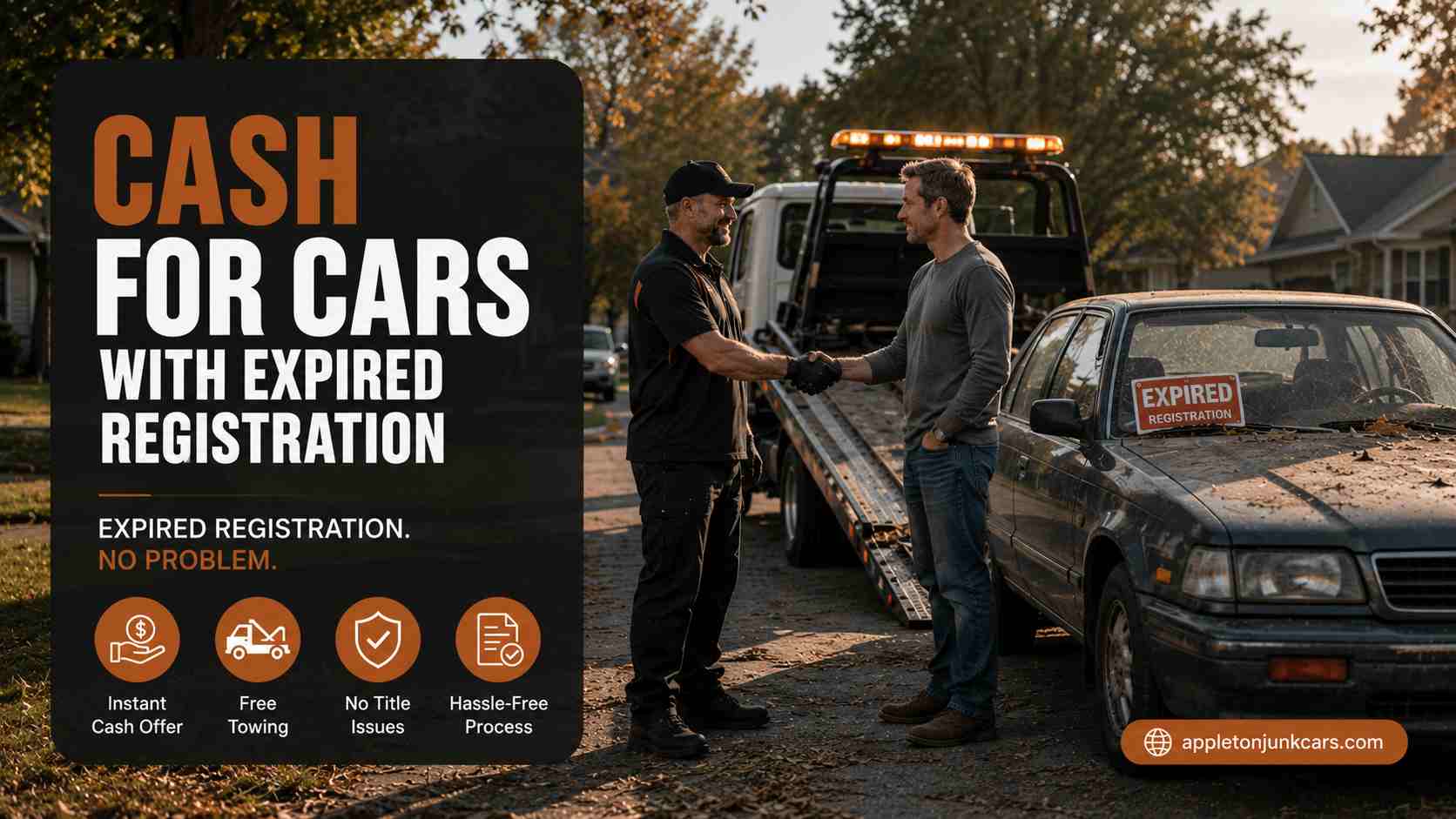
You have a car sitting in the driveway with a registration that expired months or even years ago. Maybe you stopped driving it, maybe repairs piled up, maybe you just let it slide. Whatever the reason, the sticker on the plate is out of date and you are wondering whether that is going to be a problem when you try to sell it.
Here is the direct answer: expired registration rarely prevents a car sale. Registration is not what proves you own the car. The title does. And as long as the title is in your name and clean, you can sell that vehicle regardless of whether the registration is current. This guide walks through who will buy it, what documents you actually need, and how to get the most money for a car with an expired registration.
Can You Sell a Car With Expired Registration?
Yes, in virtually every state. There is no requirement that registration be current at the time of a private vehicle sale. The legal requirement is that you transfer valid title ownership to the buyer. The buyer then takes responsibility for registering the vehicle in their name, and that registration is a fresh process that starts from the sale date regardless of what the previous registration status was.
Think of it this way: the registration is your permission to operate the vehicle on public roads. The title is proof that you own it. When you sell a car, you are transferring ownership (title), not road operating permission (registration). The buyer will get their own registration through their own DMV process.
Is Expired Registration a Problem?
For the sale itself, no. For driving the car to a buyer or showing it, yes. A vehicle with expired registration cannot be legally driven on public roads without risking a ticket. This means if the car is otherwise drivable, you should not drive it to meet a buyer or to a shop for a pre-sale inspection unless you are prepared to handle any traffic stop.
The practical workaround: many buyers will come to you. Online instant-offer buyers include free towing pickup, so you never need to move the car. Private buyers can meet at your location. The expired registration affects your ability to drive the car, not your ability to sell it.
Who Buys Cars With Expired Registration?
The good news is that most buyers who deal in used vehicles, junk cars, and damaged vehicles encounter expired registration regularly and are not deterred by it. Here is how each buyer type handles the situation.
Cash for Cars Companies
National cash-for-cars companies explicitly accept vehicles with expired registration. It is among the most common conditions they encounter. These companies send a tow truck, verify the title at pickup, and complete the transaction without any requirement for current registration. Getting a quote takes minutes online or by phone, and pickup is typically scheduled within 24 to 48 hours.
Junk Car Buyers
Platforms like Peddle, Wheelzy, and CarBrain buy vehicles regardless of registration status. When getting your quote online, you do not need to mention the expired registration specifically, as it is not a field in their quote process. What matters to them is the title status, the vehicle condition, and the make, model, and year. They bring a flatbed for non-running vehicles, and a drive-on truck or tow if the vehicle is mobile.
Salvage Yards
Local salvage yards and junkyards accept cars with expired registration routinely. They are buying for scrap metal and parts, and the registration status is irrelevant to that transaction. Call several local yards with your year, make, model, and mileage to get competing quotes. Salvage yards typically offer less than online buyers for the same vehicle because they price on weight rather than parts value.
Dealerships
Dealers accept trade-ins with expired registration. The dealer has a dealer’s license that allows them to take possession of unregistered vehicles, retitle, recondition, and resell them. The expired registration will not prevent a trade-in, though like any trade-in, the dealer will factor the vehicle’s condition into their offer. If the expired registration is accompanied by other issues (failed inspection, mechanical problems), the dealer’s trade-in offer will reflect all of it.
Private Buyers
Private buyers are the most likely to ask about the expired registration but are also usually satisfied with a clear explanation: you have the title, the registration expired, and they will register it in their name after purchase. Private buyers who understand the vehicle purchase process know that registration transfers do not carry over. If a private buyer is asking for current registration as a condition, they may not fully understand how the title-transfer process works, and explaining it clearly usually resolves the concern.
Documents You Will Need
For a sale involving an expired registration, the document list is the same as any normal car sale. The expired registration does not add requirements.
The Vehicle Title
The title is the essential document. It must be in your name, free of active liens, and physically available. If you cannot find the title, apply for a duplicate at your state’s DMV before proceeding. You cannot complete a legal sale without transferring the title, and the buyer cannot register the vehicle without it. Do not attempt to sell using only the registration document: the registration is not proof of ownership.
Bill of Sale
A bill of sale documenting the transaction date, sale price, vehicle VIN, and the signatures of both buyer and seller is recommended even in states that do not technically require it. It protects both parties and provides documentation that the transfer occurred on a specific date. The bill of sale is particularly useful for protecting yourself if the buyer delays registering the vehicle after purchase.
Lien Release if Applicable
If the vehicle had a loan that has been paid off, provide the lien release from the lender. This is especially important if the lienholder’s name is still on the title. The buyer needs to see that the lien is cleared before completing the purchase.
Is the Title More Important Than Registration?
Yes, significantly. The title is the legal proof of vehicle ownership in the United States. It is the document that establishes the ownership chain and enables transfer. Registration is evidence that you have paid the state’s annual fee to operate the vehicle on public roads. These are two completely separate legal instruments with different purposes.
A car can be sold with an expired registration but not without a valid title. A car can also be registered without you having clear title under very limited circumstances (bonded title situations), but these are exceptional cases. For a normal private vehicle sale, the title is what enables and completes the legal transfer. The registration status is largely irrelevant to that process.
What If You Lost the Registration?
The registration document itself is not required to sell the vehicle. The buyer needs the title, not the registration. If you have the title but not the registration card, you can proceed with the sale. The registration is helpful to have for reference (it lists the VIN and vehicle description and makes the title fields easier to fill out accurately), but it is not a legal prerequisite for the sale.
If you need a replacement registration for another reason (such as to register the vehicle yourself before selling it), contact your state’s DMV for a replacement. Most states provide duplicate registration documents for a small fee. In many states this can be done online.
How Much Is the Car Worth?
Expired registration does not reduce a car’s value. The buyer will renew registration in their name regardless of the previous registration status, and what they pay at the DMV is determined by the current year’s fees, not by the history. The vehicle is worth what it is worth based on make, model, year, mileage, and condition.
Use Kelley Blue Book or Edmunds to establish a realistic market value for your vehicle. For junk or salvage buyers, the vehicle’s worth is based on scrap weight and parts value for your specific make and model. Getting multiple quotes from different buyer types reveals the realistic range. Do not accept a lower offer simply because a buyer mentions the expired registration: it is not your problem after the sale and does not justify a price reduction.
How to Sell a Car With Expired Registration Step by Step
The process follows the same steps as any vehicle sale, with the only meaningful difference being that the car probably cannot be driven to a buyer without legal risk.
Step 1: Gather Your Documents
Locate the vehicle title and verify it is in your name with no active liens. Prepare a bill of sale. If the vehicle had a paid-off loan, locate the lien release from the lender. Take photos of the vehicle condition for listing purposes.
Step 2: Get Multiple Quotes
Contact two or three online instant-offer services and get quotes. Each quote takes five minutes and includes free towing pickup. Also call one or two local salvage yards for comparison. Compare all offers and use the highest as your baseline.
Step 3: Accept an Offer and Schedule Pickup
Accept the highest offer. Confirm that towing is included if the vehicle cannot be driven. Schedule a pickup time when you will be available to hand over the title, sign the paperwork, and receive payment.
Step 4: Complete the Transfer
At pickup, sign the title over to the buyer in the designated seller section. Complete all required fields: date, sale price, odometer reading, your signature. Sign the bill of sale. Receive payment. Remove your license plates and keep them.
Step 5: Notify Your State and Cancel Insurance
File any required notice of sale with your state’s DMV to protect yourself if the buyer delays registering the vehicle. Cancel your auto insurance on the vehicle. In most states, you can also apply for a registration refund for any unexpired portion of your registration fee if applicable.
Do You Need to Renew the Registration Before Selling?
No. You are not required to renew the registration before selling the vehicle. Renewing the registration costs money and does not increase the vehicle’s sale value. The buyer will register it in their own name after purchase, and the previous registration history is irrelevant to that process.
The only scenario where renewing before selling might make sense is if you plan to drive the vehicle yourself before the sale, need to move it to a different location, or if a specific private buyer is concerned about the expired registration and you prefer to address that concern rather than explain the process. In those cases, the cost of a registration renewal may be worth the convenience.
State-Specific Requirements
While expired registration does not prevent a sale in any state, a few state-specific nuances are worth knowing.
California
California charges back registration fees when a vehicle is re-registered if the previous owner did not pay timely registration. These back fees are assessed to the new owner on registration, not to the seller. In a private sale, buyers of California vehicles with expired registration should be aware that they may face back fee obligations. This does not prevent the sale but should be disclosed to buyers who ask.
States With Required Smog or Safety Inspections
Many states require a smog or safety inspection as part of the vehicle sale or re-registration process. In California, a smog certificate is required at the time of private sale. In states like Texas and New York, safety inspections are required for re-registration. These are the buyer’s responsibility to arrange after the sale, but informing the buyer upfront prevents surprise after the transaction.
Tips to Get the Best Cash Offer
Several practices consistently produce higher offers for cars with expired registration.
Get at Least Three Competing Quotes
The spread between quotes from different buyers for the same vehicle routinely reaches $200 to $600. Getting three quotes from online buyers and one from a local junkyard takes about 20 minutes and establishes a range. Use the highest quote as leverage when speaking with others. Several services will match or beat a competing offer.
Describe the Vehicle Accurately and Highlight What Works
When getting online quotes, describe the vehicle completely. Mention that the registration is expired but be specific about what mechanical systems work. A car with expired registration but a running engine, working AC, clean interior, and good tires is worth more than a car where those things are also failing. The registration status should not be used as justification for a lower overall offer.
Be Ready to Complete the Transaction Quickly
Buyers who pay the most through online platforms often commit the fastest. Having your title ready, your documents organized, and your schedule open for pickup within the next few days produces smoother and sometimes more competitive offers from time-sensitive buyers.
Common Mistakes to Avoid
Several mistakes consistently reduce the money sellers receive or complicate the transaction unnecessarily.
Accepting the First Offer Without Shopping Around
The single most common mistake in junk and damaged car sales is accepting the first offer without comparison. The difference between the first offer and the highest offer for the same car with expired registration is frequently $200 to $800. Never accept a first offer as the only offer.
Trying to Renew the Registration to Add Value
Renewing the registration costs money and does not meaningfully increase the sale price in any buyer category. Buyers price based on the vehicle, not the registration status. Spending $150 to $400 on a registration renewal to slightly reassure a hesitant buyer almost never results in a higher offer that offsets the renewal cost.
Not Having the Title Ready
The title is the transaction. A buyer who arrives to pick up the vehicle and discovers the title is lost, not in the seller’s name, or has an active lien will walk away or significantly revise their offer. Resolve any title issues before scheduling any pickup or meeting any buyer.
Failing to File the Notice of Sale
If your state requires a notice of sale or release of liability, file it on the date of the sale, not days or weeks later. Delays leave you potentially liable for any tickets, toll violations, or incidents involving the vehicle between the sale date and the filing date.
Frequently Asked Questions
Can I sell a car with expired registration?
Yes. Expired registration does not prevent a legal vehicle sale in any state. You transfer ownership through the title, not the registration. The buyer registers the vehicle in their own name after purchase, and their registration is a fresh process independent of the previous registration status.
Do junk car buyers take cars with expired registration?
Yes, routinely. Online junk car buyers like Peddle, Wheelzy, and CarBrain do not require current registration. They need the title. Expired registration is one of the most common conditions they encounter and is not a factor in their purchase decision or pricing.
Will expired registration reduce my car’s value?
No. Registration status does not affect the vehicle’s market value. The car is worth what it is worth based on its condition, make, model, and mileage. Do not accept a lower offer from any buyer who cites expired registration as justification for reducing the price.
Do I need to renew the registration before selling?
No. There is no legal requirement to renew registration before a sale in any state. The buyer registers the vehicle themselves after purchase. Renewing before selling costs money and does not increase your sale price.
What documents do I need to sell a car with expired registration?
The vehicle title (in your name, lien-free) is the primary required document. A bill of sale documenting the transaction is strongly recommended. A lien release if the vehicle previously had a loan. The expired registration card itself is not required for the sale, though it may be helpful for reference when filling out the title transfer.
Conclusion
An expired registration is not an obstacle to selling your car. It is simply an administrative status that has no bearing on the vehicle ownership transfer process. The title is what matters. As long as your title is in your name and clear of liens, you can sell the vehicle today, to any buyer type, at a fair price. Get multiple quotes, have your title ready, sign it over accurately, file your notice of sale, and cancel your insurance. The expired registration sticker on the plate is the buyer’s problem to replace after they register the vehicle in their name.