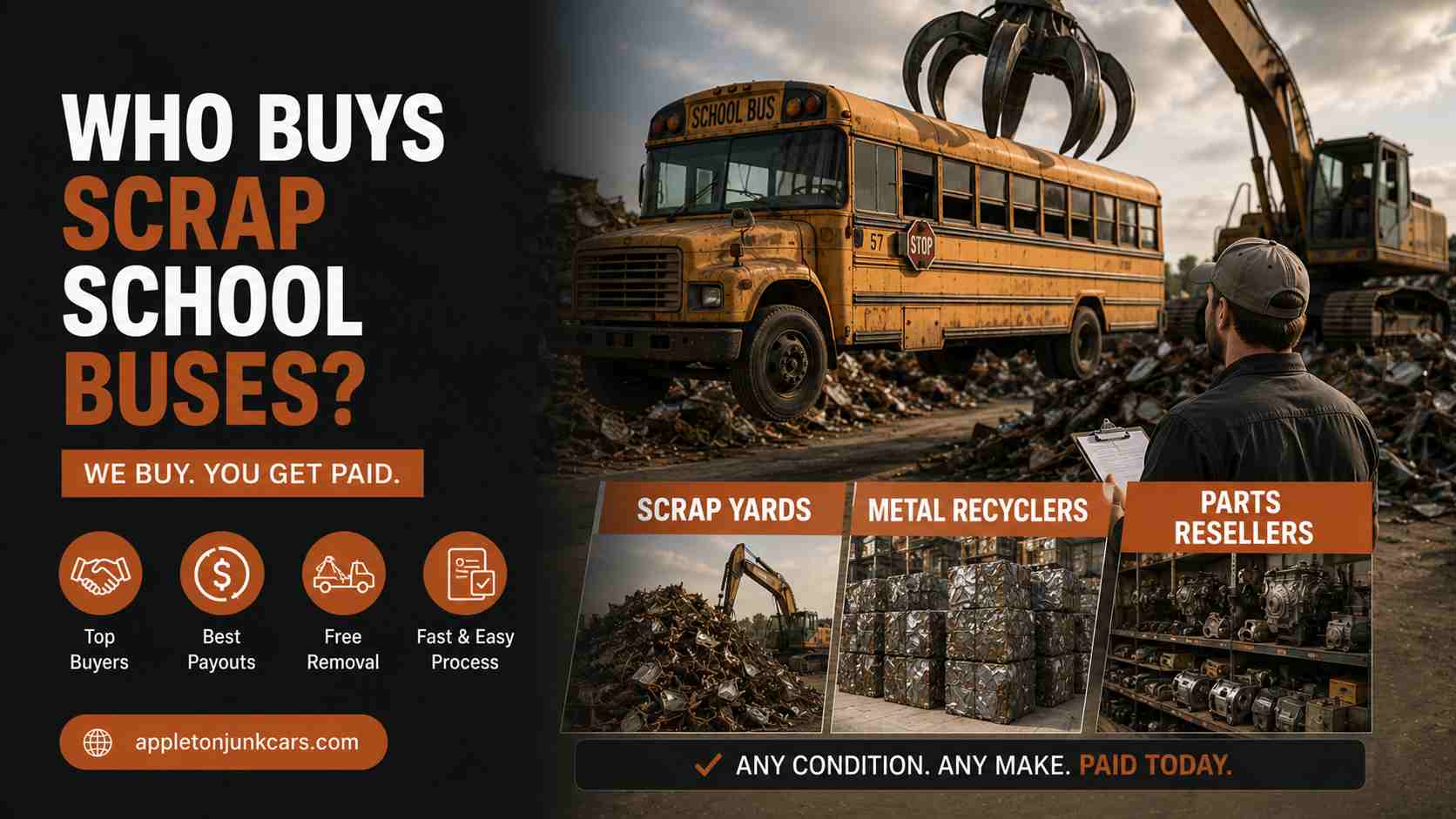
A retired school bus sitting in your yard is worth more than most sellers expect and harder to move than most sellers initially find. The obvious first call, the scrap yard, is rarely the best call. A structurally sound full-size conventional bus with a tired engine and aging paint can pull two to four times its scrap metal value from the right buyer if you know who those buyers are and how to describe what you have.
The market for retired school buses is more segmented than the passenger car market. Each buyer type values completely different aspects of the vehicle: one wants the raw steel, another wants the running diesel engine, another wants nothing but the structural frame with every seat removed. Understanding which buyer fits your specific bus determines not just the price but how long you wait and how complicated the transaction is.
This guide covers every category of buyer for retired school buses, realistic price ranges by bus type and condition, the one buyer segment that consistently pays the most and is most often overlooked, and the practical steps to reach each type of buyer from wherever you are located.
What a Retired School Bus Is Actually Worth Before You Make a Single Call
Price ranges for retired school buses vary significantly based on bus type, engine condition, structural integrity, and which buyer segment you reach. The table below reflects realistic cash offers from active buyers, not auction estimates or dealer retail.
Bus Type | Scrap Metal Value | Conversion Buyer Value (Running or Rebuildable) | Running, Operational Condition |
|---|---|---|---|
Full-size conventional (Type C, 35 to 40 ft) | $900 to $1,800 | $3,000 to $9,000 | $6,000 to $20,000 |
Transit-style flat-nose (Type D, 35 to 40 ft) | $900 to $1,800 | $3,000 to $8,000 | $5,500 to $18,000 |
Mini school bus (Type A, cutaway van chassis) | $400 to $900 | $1,500 to $4,500 | $3,500 to $9,000 |
Activity bus / passenger coach (35+ ft) | $700 to $1,600 | $2,500 to $8,000 | $6,000 to $22,000 |
Wheelchair-equipped transit bus | $800 to $1,600 | $3,500 to $10,000 | $8,000 to $25,000 |
The scrap value column is the floor. Any buyer other than a straight scrap metal yard should offer more if the bus has a functional diesel engine, solid structural frame, or specialty equipment such as a wheelchair lift. The conversion buyer column reflects what the bus conversion community (the skoolie market) will pay for a unit they can work with. These are the buyers who most consistently pay above scrap for buses that are not currently running.
The Conversion Community: The Highest-Paying Buyer Most Sellers Never Reach
The school bus conversion movement, known widely as the “skoolie” community, has grown into one of the most active specialty vehicle markets in the country. Buyers in this community convert retired school buses into mobile homes, off-grid tiny homes, music venues, workshops, food trucks, and event spaces. They seek out retired buses specifically for their structural characteristics: heavy-gauge steel frames, high ceilings, flat floors, and large interior volumes that are expensive to replicate in any other vehicle class.
What these buyers look for and prioritize:
Feature | Why It Matters to Conversion Buyers | Impact on Offer |
|---|---|---|
Full-size layout (35 to 40 ft) | Maximum living or working space | Strongest demand and highest offers |
Diesel engine (Cummins, International, Detroit) | Fuel efficiency, durability, DIY-accessible repair | Running diesel adds $2,000 to $5,000 to offer |
Solid structural frame (no significant rust-through) | Foundation for conversion; expensive to repair if compromised | Frame condition is the primary make-or-break factor |
Intact flat floor | Conversion starts from the floor; rot means major cost | Good floor adds buyer confidence and offer value |
Thomas Built, Blue Bird, or IC Bus brand | Known for frame quality and parts availability | Moderate premium over lesser-known brands |
Clean or transferable title | Legal ownership transfer required | Required by almost all buyers |
Conversion buyers will purchase non-running buses if the engine is rebuildable and the rest of the bus is structurally sound. A seized engine on an otherwise solid full-size bus is not a deal-breaker for this market: they budget for engine replacement as part of the conversion cost and adjust their offer accordingly.
How to reach them: Facebook groups are the single most effective channel. Groups with 20,000 to 70,000 members dedicated specifically to skoolie conversions respond to listings within hours. Post with detailed photos of the frame condition, floor condition, engine type, mileage, and dimensions. Be specific about what works and what does not. This buyer community is highly experienced and rewards honest listings with fast, serious offers.
Scrap Metal Yards and Commercial Vehicle Dealers: The Volume Buyers
A full-size school bus is a heavy vehicle. A conventional Type C or Type D bus weighs between 14,000 and 26,000 pounds depending on length, engine, and whether it carries additional equipment. At current commercial scrap steel rates, that weight produces $900 to $1,800 in pure metal value. This is the guaranteed floor for any bus regardless of condition.
Scrap metal yards that accept commercial vehicles will purchase a retired school bus in any condition: non-running, no catalytic converter, stripped interior, rusted body. They need proof of ownership and may require fluid drainage before acceptance. Most do not offer free pickup for a vehicle this size; you may need to arrange a transport and deduct that cost from your effective sale price. Get the transport logistics confirmed before agreeing to a price.
Commercial vehicle dealers and export buyers occasionally purchase retired school buses for resale in developing markets, rural charter operations, or organizations with less restrictive age and condition requirements. These buyers need a running vehicle in the most basic sense: able to start, move under its own power, and carry passengers safely for at least a short period. They typically pay more than a scrap yard but less than the conversion community for running buses.
Fleet Maintenance Shops and Parts Buyers: The Overlooked Commercial Market
School bus fleet operators, transportation departments, and the maintenance shops that service them are consistent buyers of retired buses for parts. The components on school buses are expensive when purchased new and often have long service lives that outlast the bus itself.
High-Value School Bus Component | Typical Used Part Value | Who Needs It |
|---|---|---|
Wheelchair lift (functional) | $800 to $2,500 | Transit agencies, medical transport operators |
Air brake system components | $300 to $1,200 | Fleet maintenance shops for same bus type |
Cummins or International diesel engine (rebuildable) | $2,000 to $6,000 | Engine rebuilders, fleet operators |
Allison automatic transmission | $1,500 to $4,000 | Fleet maintenance shops, rebuilders |
Front axle assembly (Dana or Meritor) | $400 to $1,200 | Body shops, fleet maintenance |
Emergency door mechanisms and hardware | $150 to $600 | Schools and transit agencies needing compliance parts |
School bus seats (sets of 20+, good condition) | $500 to $2,500 per set | Charter operators, new bus builds |
Parts buyers will rarely purchase the entire bus. Instead, they negotiate to purchase specific components, which means you must either remove and sell parts individually and dispose of the remainder separately, or find a single buyer who will take the whole bus and account for the part values in their offer. The all-in-one approach is typically more practical unless you have a place to store the bus while you pull and sell parts over time.
Charter Companies, Nonprofits, and Institutional Buyers
Charter transportation companies, rural churches, summer camps, and nonprofit organizations regularly purchase retired school buses for low-intensity, short-duration transport use. These buyers are not purchasing for conversion or parts. They need a vehicle that starts, moves passengers, and passes the minimum inspection required to operate it legally in their context.
This buyer segment is particularly active in rural areas and in states without strict commercial vehicle age limits for certain classes of operations. A 20-year-old bus that would never pass a modern school district inspection may be perfectly serviceable for a camp shuttle running three months per year. These buyers pay more than scrap and often less than the conversion community: typically $2,000 to $7,000 for a running bus in basic functional condition.
Reach them through Craigslist in rural areas, through regional nonprofit networks, through church bulletin boards and denominational buyer groups, and through classified platforms like PublicSurplus and GovPlanet that institutional buyers monitor regularly for fleet vehicles.
How to Prepare Your Bus for Sale Without Spending Money You Won’t Recover
School buses require some basic preparation before sale that costs nothing but time and significantly improves buyer interest and offer quality.
Document the engine: Take a short video of the engine starting (if it runs), note the engine model and serial number from the data plate, and record the odometer reading. Engine identity matters enormously to the conversion community and to parts buyers. A Cummins ISB or ISL commands more buyer interest than an older mechanical injection engine, and buyers in both segments want to know exactly what they are getting before they drive to inspect.
Photograph the frame and floor: The structural integrity of the frame rails and the condition of the floor are the two things serious buyers inspect most carefully. Crawl underneath and photograph the main frame rails from front to rear. Photograph the interior floor from every seating row, looking for soft spots or rot. These photos either confirm buyer confidence or reveal problems early, either way saving everyone time.
Locate and organize the title: A school bus with a title sells faster and for more money than one without. If the bus is owned by a school district, municipality, or organization, the title transfer process may involve a public agency surplus approval. Get that process started early. Government-owned vehicles often require surplus declaration and competitive bid before private sale is authorized.
Do not spend money on cosmetics: Fresh paint, new tires, or repaired body panels on a bus being sold for conversion or scrap do not add proportional value. Buyers for these categories are pricing the asset they plan to transform, not the asset as it currently appears. Invest in documentation and accurate disclosure rather than cosmetic improvements.
What Sellers of Retired School Buses Consistently Report
People who have sold retired school buses share consistent patterns. The most common mistake: calling a general junk car buyer or scrap yard first and accepting their offer without ever contacting the conversion community. Junk car buyers have no framework for a school bus and frequently offer scrap weight value at best. The conversion buyer market, reached through the right Facebook groups, regularly produces offers two to four times higher for the same bus from a buyer who responds within 24 hours.
The second consistent finding is that photos of the frame and floor do more to move a bus than photos of the exterior or the engine bay. Conversion buyers know what a bus looks like on the outside. What they need to see, and what most sellers never photograph, is the condition of the main structural components underneath and inside. Sellers who provided detailed frame photos closed deals faster and with fewer dropped negotiations than those who posted exterior-only listings.
Government and school district sellers face a separate challenge: surplus disposal requirements that add steps and time to the process. Sellers in this category consistently report that starting the surplus authorization process early, before actively marketing the bus, resulted in a much smoother transaction. Buyers who found the bus through online channels but had to wait weeks for surplus approval frequently moved on to other listings.
Frequently Asked Questions
How much is a scrap school bus worth?
The pure scrap metal value of a full-size school bus ranges from $900 to $1,800 depending on weight, current steel prices, and whether the catalytic converter and other non-ferrous metals are intact. However, this is the floor, not the typical selling price. The conversion buyer community, fleet parts buyers, charter operators, and nonprofits all pay more than scrap value for buses that are running or rebuildable. Getting multiple buyer type quotes before calling a scrap yard almost always produces a better result.
Who buys retired school buses?
The main buyer categories are school bus conversion builders (the skoolie community), scrap metal yards, fleet maintenance shops and parts buyers, charter and transportation companies, nonprofit organizations, and commercial vehicle export dealers. The conversion community typically pays the most for full-size conventional buses with diesel engines and solid frames. Scrap yards pay the least but accept any condition. Charter operators and nonprofits fall in the middle and need running buses.
Do school bus buyers offer free pickup?
It depends on the buyer type and the bus location. Conversion buyers almost always arrange their own transport and expect to pick the bus up themselves or hire a driver. Scrap metal yards may offer free pickup for large vehicles because the metal weight justifies the transport cost. Fleet parts buyers and charter operators may or may not have the transport resources. For any buyer type, confirm who handles and pays for transport before agreeing on a final price, as it directly affects the net amount you receive.
What is a skoolie and why does the conversion community pay more?
A skoolie is a school bus converted into a mobile home, tiny house, food truck, event space, or workshop. The conversion community has grown significantly over the past decade alongside the tiny home movement. These buyers pay more than scrap because they are not buying metal weight: they are buying a structural platform with a heavy-gauge steel frame, a high ceiling, a flat floor, and a large interior volume that is difficult to replicate in any other vehicle. A bus that would bring $1,200 at a scrap yard might bring $5,000 from a motivated skoolie builder who specifically needs that size and engine type.
Can I sell a school bus without a title?
Selling without a title is significantly more difficult. Most legitimate buyers, including conversion builders and commercial vehicle buyers, require a clean title for legal ownership transfer. Scrap yards in some states will accept a vehicle without a title with additional ID verification, but this varies by state law and yard policy. Government-owned buses often carry a fleet title rather than an individual vehicle title, and the surplus disposal process through the owning agency generates the transferable title documents needed for a private sale.
What school bus models are worth the most?
Thomas Built Buses and Blue Bird are the most sought-after brands in the conversion market because of their documented frame quality and the wide availability of replacement parts through the school bus service network. IC Bus (International) and Collins are also well-regarded. Engine brand matters as much as body brand: buses equipped with Cummins or Detroit diesel engines command premiums from both conversion buyers and parts buyers because these powertrains are well-documented, widely serviced, and have strong remanufactured parts availability.
How do I find buyers for a school bus in my area?
For conversion buyers, Facebook groups dedicated to skoolie builds are the fastest channel regardless of your location, as these buyers regularly travel hundreds of miles for the right bus. For local buyers, Craigslist in the commercial vehicles section, PublicSurplus for institutional sellers, and GovPlanet for government surpluses are the most active platforms. Commercial vehicle dealers who handle fleet sales occasionally broker retired buses and may know buyers in your area. Calling active charter companies in your region is another direct channel.
Is it better to part out a school bus or sell it whole?
For most sellers, selling whole is the more practical outcome. Parting out requires removing and storing components, listing them individually, managing multiple buyers, and arranging final disposal of the stripped chassis. The total revenue from a thorough part-out exceeds a whole-bus sale, but the process takes months rather than days and requires significant space and time. The exception is a bus where one very high-value component, such as a low-mileage engine or a functional wheelchair lift, can be removed and sold quickly to a known buyer before the rest of the bus is sold or scrapped.
The Bottom Line
A retired school bus is not a single-buyer asset. It has different values to different buyers based on what each buyer plans to do with it, and the spread between the lowest offer (scrap) and the highest offer (motivated conversion buyer or parts specialist) is large enough to make reaching the right buyer worth meaningful effort.
For most full-size conventional buses with diesel engines and solid frames, the conversion community is the place to start. They pay the most, they respond quickly, and they are easy to reach through established online communities. A well-documented listing in the right Facebook group generates serious offers faster than almost any other channel.
For buses that are structurally compromised, missing their engine, or stripped of their high-value components, scrap is often the realistic outcome. But even in those cases, calling two or three buyer types before the scrap yard confirms that the scrap offer is genuinely the best available rather than simply the easiest. That confirmation is worth 30 minutes of calls.