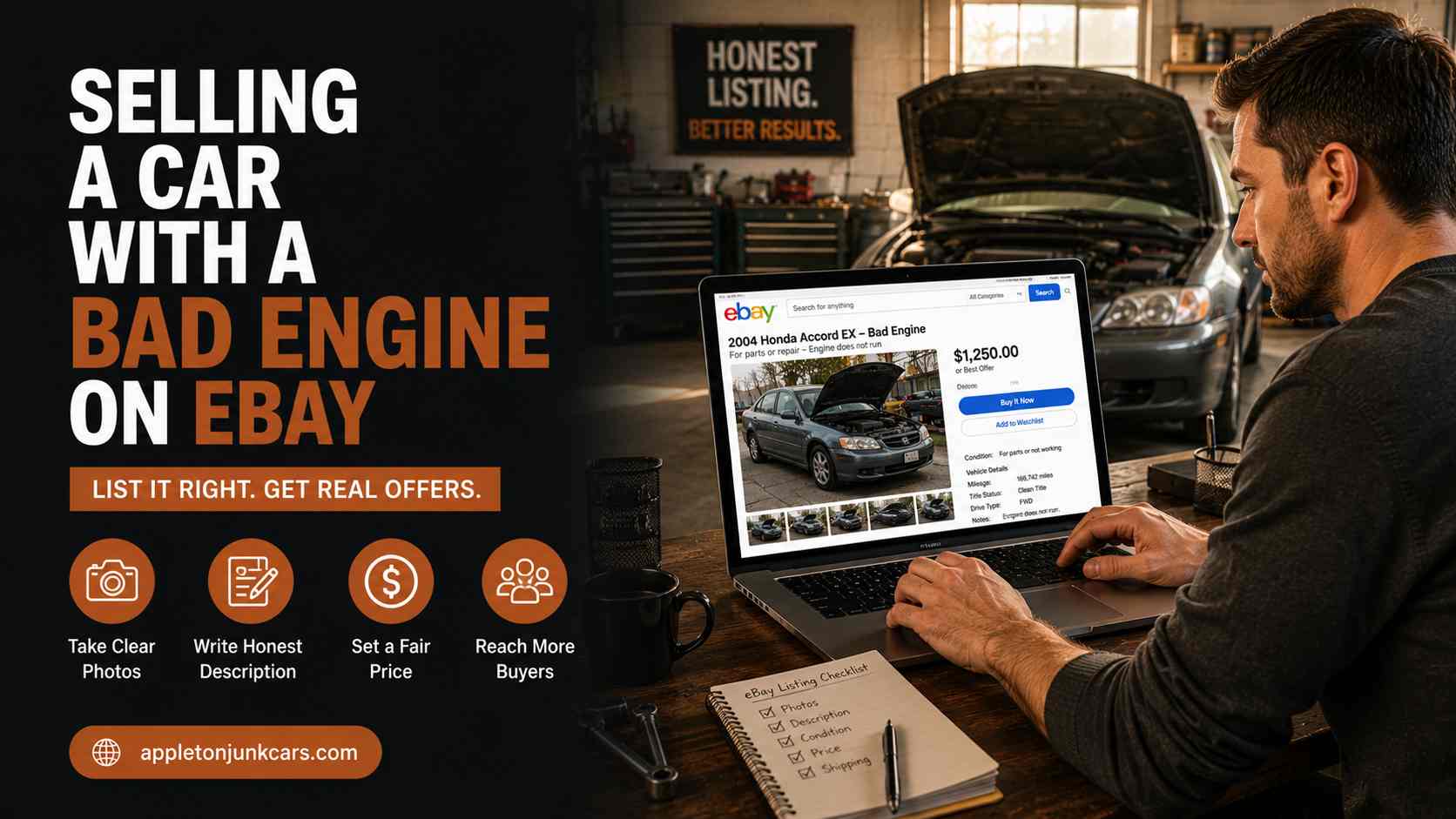
Most platforms give you nowhere to go with a car that does not run. Facebook Marketplace buries your listing under hundreds of working vehicles. Craigslist draws lowball offers and no-shows. CarMax hands you a number that reflects the metal value at best. eBay Motors is different, and understanding why makes all the difference in how you approach the sale.
eBay Motors consistently moves non-running and mechanically compromised vehicles because it reaches a national audience of buyers who specifically want them: engine swappers, restorers, salvage title rebuilders, mechanics looking for a cheap daily driver project, and parts pullers who need an entire car for one specific component. These buyers know what a bad engine costs to replace. They factor it into a real bid. They are not trying to lowball you out of ignorance; they are pricing the project accurately.
Getting a good result on eBay with a bad engine vehicle comes down to three things: an honest and detailed listing that builds confidence, a price that reflects what the market will actually bear for that specific car in that specific condition, and a clear plan for how the buyer gets the vehicle once the auction ends. This guide covers all three.
Why eBay Motors Reaches Buyers That Other Platforms Simply Don’t
The practical reason eBay works for non-running cars is geography. A local Facebook Marketplace or Craigslist listing reaches buyers within 50 to 100 miles. Most of those buyers want a car they can drive away. A national eBay listing reaches buyers in every state, and the buyer who specifically wants your year, make, and model for a swap project may be 800 miles away. That buyer does not exist in your local market but does exist on eBay.
The second reason is buyer intent. eBay Motors has established categories for non-running and parts-only vehicles. Buyers browsing those categories have already self-selected. They are not surprised to find a car that does not run. They came looking for one. That changes the entire dynamic of the negotiation.
The third reason is price discovery. An auction format lets the market set the price rather than requiring you to guess correctly upfront. If you set a reasonable reserve and list accurately, competition between buyers will often push the final price higher than you would have asked in a private listing. This is especially true for vehicles with in-demand bodies, rare trim levels, or engines that have a strong swap following.
Who Is Actually Buying Non-Running Cars on eBay Motors
Knowing who your buyer is shapes every decision about how you list the car.
Engine Swap Builders
These buyers want the body, frame, transmission, interior, and electrical system. They already have the engine or plan to source one separately. If your car is a desirable chassis: a sport compact, a classic truck, or a muscle car with a good body, swap builders will bid competitively. The specific engine failure matters less to them than the condition of everything else.
Salvage and Rebuild Specialists
Buyers who purchase salvage-title or mechanically failed vehicles and rebuild them for resale are a consistent eBay market segment. They can price a repair accurately, they move quickly, and they often prefer local pickup because they transport vehicles regularly. They are experienced buyers who have read hundreds of listings and can spot an incomplete disclosure immediately, which is why honesty in the listing is not just an ethical choice: it is a strategic one.
Parts Pullers
Some buyers are not interested in the whole car. They need one specific part: a transmission, a rear axle, a dashboard, a set of doors. They will bid on the whole vehicle if the price makes the target part worth extracting. These buyers often ask detailed questions about specific components before the auction ends. Answering quickly and accurately keeps them engaged.
Project and Budget Buyers
Mechanics, hobbyists, and buyers who enjoy wrenching regularly shop eBay for cheap project vehicles. They plan to fix the car themselves and either drive it or flip it. For them, a bad engine is an opportunity if the price is right and the rest of the car is solid. These buyers respond well to listings that are honest about the problem and specific about everything else.
How to Price a Non-Running Car for eBay Without Leaving Money Behind
Pricing a car with a bad engine requires looking at two numbers: what the car is worth running, and what the engine repair or replacement costs. The difference between those two numbers is the maximum a knowledgeable buyer will pay. Your job is to price close enough to that ceiling to attract serious bidders without setting a reserve so high that the car never sells.
Engine Problem Type | Typical Buyer Discount Off Running Value | Notes |
|---|---|---|
Blown head gasket | 30% to 45% off running value | Larger discount if overheating caused further damage |
Seized engine (needs replacement) | 45% to 60% off running value | Discount depends on engine availability and swap cost |
Rod knock or spun bearing | 40% to 55% off running value | Often treated same as seized; engine considered scrap |
Timing chain or belt failure | 25% to 40% off running value | Less discount if interference engine damage is ruled out |
High compression loss on one cylinder | 20% to 35% off running value | May be rebuildable; smaller discount for good body |
Engine oil or coolant contamination | 35% to 50% off running value | Severity determines buyer discount calculation |
The most reliable pricing method: find three to five recently sold eBay listings for the same year, make, and model in similar condition. Filter by completed listings and sold items to see actual sale prices, not asking prices. That data tells you what the real market has been paying, not what sellers hoped to get.
Set your reserve at the low end of the realistic range. Setting it too high produces no bids and wastes a listing cycle. Starting with a low opening bid with a realistic reserve creates urgency and attracts watchers who may push the final price above your floor.
Writing a Listing That Gets Bids Instead of Questions
The listings that perform best on eBay Motors for non-running vehicles share a specific structure. They lead with the problem, cover everything that works, and give the buyer enough information to make a confident decision without messaging you first.
The Title
Lead with the year, make, model, trim, and mileage. Include “bad engine,” “runs rough,” “engine knocks,” or whatever accurately describes the condition. Include a positive if the body is clean or the interior is excellent. A title like “2014 Honda Accord EX 112k Bad Engine Clean Body Clean Title No Reserve” tells the buyer everything they need to decide whether to click.
The Description
Open with what is wrong and be specific. “The engine has a rod knock that is audible at idle and worsens under acceleration. The car starts but I would not drive it more than to move it in a driveway.” That level of specificity builds trust. It signals that you know the car and are disclosing honestly.
Then cover everything that is right. Body condition panel by panel. Interior condition seat by seat. Tires, brakes, transmission behavior, electrical systems, HVAC, stereo, windows. Buyers are not buying a bad engine; they are buying a project. They need to know what they are getting beyond the engine.
List the VIN and include the vehicle history report link if you have one. Note whether the title is clean, salvage, rebuilt, or otherwise. Confirm whether the car is sold as-is.
Photos
Photograph everything. Engine bay open. Every body panel. Every wheel. The interior from all four door positions. The odometer. Any damage, rust, dents, or cracks. The title. Buyers for non-running vehicles know they cannot test drive the car. Photos are their only inspection. Sparse photos equal low confidence and low bids.
Shipping, Local Pickup, and How Payments Work for Non-Running Vehicles
Non-running vehicles require a flatbed or rollback tow truck for transport. That cost typically runs $200 to $600 for local pickup within 50 to 100 miles and $700 to $1,500 or more for longer distances. Who pays for transport is part of the deal structure and should be specified clearly in the listing.
Offering local pickup only is the simplest approach. You do not deal with shipping logistics, the buyer arranges and pays for transport, and the transaction is complete once they pick up the vehicle. Most successful non-running car listings on eBay are local pickup with the buyer responsible for transport.
If you want to attract a national buyer pool, note in the listing that you will work with the buyer’s transport company and that the vehicle must be picked up within a set number of days after auction end, typically 7 to 10 days. Be specific about what access you can provide for the tow truck.
For payment, eBay’s managed payments system handles the transaction. Do not release the title until payment is confirmed. For local pickup transactions, many sellers receive cash or certified check in person while the tow truck is loading. Confirm with your bank before accepting a personal check for any amount.
The Listing Mistakes That Consistently Kill eBay Sales for Non-Running Cars
Common Mistake | Why It Kills the Sale | What to Do Instead |
|---|---|---|
Vague engine description (“engine issues”) | Buyers cannot price the project accurately and skip the listing | Describe the specific symptom: knock, smoke, no start, seizure |
Too few photos | Buyers assume the worst about what you are not showing | Minimum 20 photos covering all panels, interior, engine, wheels |
Reserve set too high | No bids, listing expires, relisting fees accumulate | Set reserve at realistic floor based on completed sales data |
No mention of title status | Serious buyers skip immediately; title is critical information | State title status clearly in first paragraph of description |
Listing under wrong category | Wrong buyers see the listing; right buyers never find it | Use eBay Motors non-running or parts/not running category |
Slow response to buyer questions | Engaged buyers lose interest and bid on other listings | Check messages twice daily; answer within 4 hours during active auction |
The single most damaging mistake is an incomplete disclosure that surfaces after the sale. If a buyer discovers post-purchase that the damage was worse than described, eBay’s dispute resolution process typically sides with the buyer. Disclose everything upfront, even the unflattering details. An honest listing that sells is worth far more than a withheld detail that results in a reversed transaction.
What eBay Sellers of Non-Running Cars Consistently Report
Sellers who have successfully moved non-running vehicles on eBay Motors share a few consistent findings. The listings that attracted the most bidders and the highest final prices had one thing in common: extraordinary detail. Not a long description for its own sake, but specific, honest information about every part of the vehicle beyond the engine. Buyers bid confidently when they have enough information to price the project accurately. They sit on their hands when they have doubts.
The second consistent finding is that the auction format outperforms a fixed-price listing for non-running vehicles in most cases. A fixed price requires the seller to guess the market correctly. An auction lets multiple buyers compete, and competition pushes prices up. Sellers who started with a low opening bid and a reasonable reserve consistently reported final prices 15 to 30 percent higher than they expected based on their initial research.
Those who listed in the non-running or parts-only category rather than the standard vehicle listing also reported better outcomes. The right buyers browse the right categories. Getting in front of buyers who came specifically looking for a non-running vehicle produces a different result than hoping a buyer looking for a running car will scroll past your listing and decide the project is worth it.
Frequently Asked Questions
Can you sell a car with a bad engine on eBay?
Yes, and eBay Motors is one of the more effective platforms for doing it. eBay has a dedicated category for non-running and parts-only vehicles that connects sellers with a national audience of buyers who specifically want project cars, engine swap candidates, and salvage rebuilds. The key is an accurate and detailed listing that gives buyers enough information to price the project confidently.
How much can I get for a car with a blown engine on eBay?
Final prices depend on the vehicle’s make, model, year, mileage, body condition, and the severity of the engine failure. As a general guide, expect 40 to 60 percent below the vehicle’s running market value for a car with a seized or blown engine. A clean body, a clean title, and low mileage on the rest of the vehicle narrow that gap. Searching eBay’s completed and sold listings for your specific vehicle gives the most accurate price data available.
Do I need a reserve price on eBay for a non-running car?
A reserve is optional but generally recommended for vehicles worth more than $500. The reserve protects you from being obligated to sell at a price that does not make sense. Set it at the realistic low end of the market range based on completed sales data, not at your ideal price. A reserve set too high discourages bidding and produces no sale. A realistic reserve creates confidence without limiting the upside.
How do I ship a non-running car sold on eBay?
Most sellers of non-running vehicles list as local pickup only, with the buyer responsible for arranging and paying for transport. If you want to offer shipping, you will need to work with a flatbed or rollback transport company. Websites like uShip allow you to get competing quotes from carriers. Typical enclosed or open transport for a non-running vehicle runs $300 to $1,500 depending on distance. Always specify the pickup terms and timeline clearly in the listing.
What category should I list a non-running car under on eBay?
Use the eBay Motors category for non-running vehicles, sometimes listed as Parts Only or Not Running under the Passenger Vehicles section. Listing in this category ensures your listing is seen by buyers who are specifically looking for non-running vehicles or parts sources. Listing under standard vehicle categories can work but puts your listing in front of buyers who are looking for a car they can drive, which reduces relevant interest.
How many photos do I need for a non-running car listing on eBay?
eBay allows up to 24 photos on most listings. Use as many as possible. Photograph every exterior panel, all four wheels, the engine bay with the hood open, the interior from all four door openings, the odometer, the dashboard, any damage or rust, and the title. Buyers of non-running vehicles cannot inspect or test drive the car. Photos are their only way to assess what they are buying. Listings with fewer than 12 to 15 photos consistently underperform those with comprehensive photo coverage.
Should I disclose all engine problems when selling on eBay?
Yes, always. Incomplete or misleading disclosure is the most common cause of post-sale disputes on eBay Motors. If a buyer can demonstrate that the vehicle’s condition was materially different from what the listing described, eBay typically sides with the buyer and the sale can be reversed. Beyond the platform rules, an accurate listing attracts buyers who are pricing the project correctly, which means they are more likely to complete the transaction and less likely to be disappointed after pickup.
Is eBay Motors better than Craigslist for selling a car with engine problems?
For most non-running vehicles, yes. Craigslist is limited to local buyers, which dramatically narrows the pool of buyers who specifically want a project car of your make and model. eBay reaches a national audience and has a dedicated category for non-running vehicles, which puts your listing in front of buyers who came looking for exactly what you have. The auction format also tends to produce higher final prices than fixed-price local listings for in-demand vehicles, because competition between buyers drives the price up.
The Bottom Line
Selling a car with a bad engine on eBay Motors works when you approach it the way a knowledgeable seller would: with full disclosure, comprehensive photos, accurate pricing based on real sold data, and a clear pickup plan. The buyers who shop this category are not looking for surprises. They are pricing projects. Give them the information they need and the right price, and the auction will do its job.
Set your reserve based on completed sales for your specific vehicle, not on what you hope to get. Check the non-running or parts-only category listings for your make and model, filter by sold, and let the actual market data guide your floor. Starting with a realistic reserve and a low opening bid consistently produces better final outcomes than a high reserve that discourages bidding.
The difference between a listing that sells and one that expires unsold is almost always in the details. Every panel, every system, every honest disclosure about the engine failure builds the buyer’s confidence. That confidence is what turns watchers into bidders and bidders into a completed sale. Put the work into the listing and the platform will find you the right buyer.