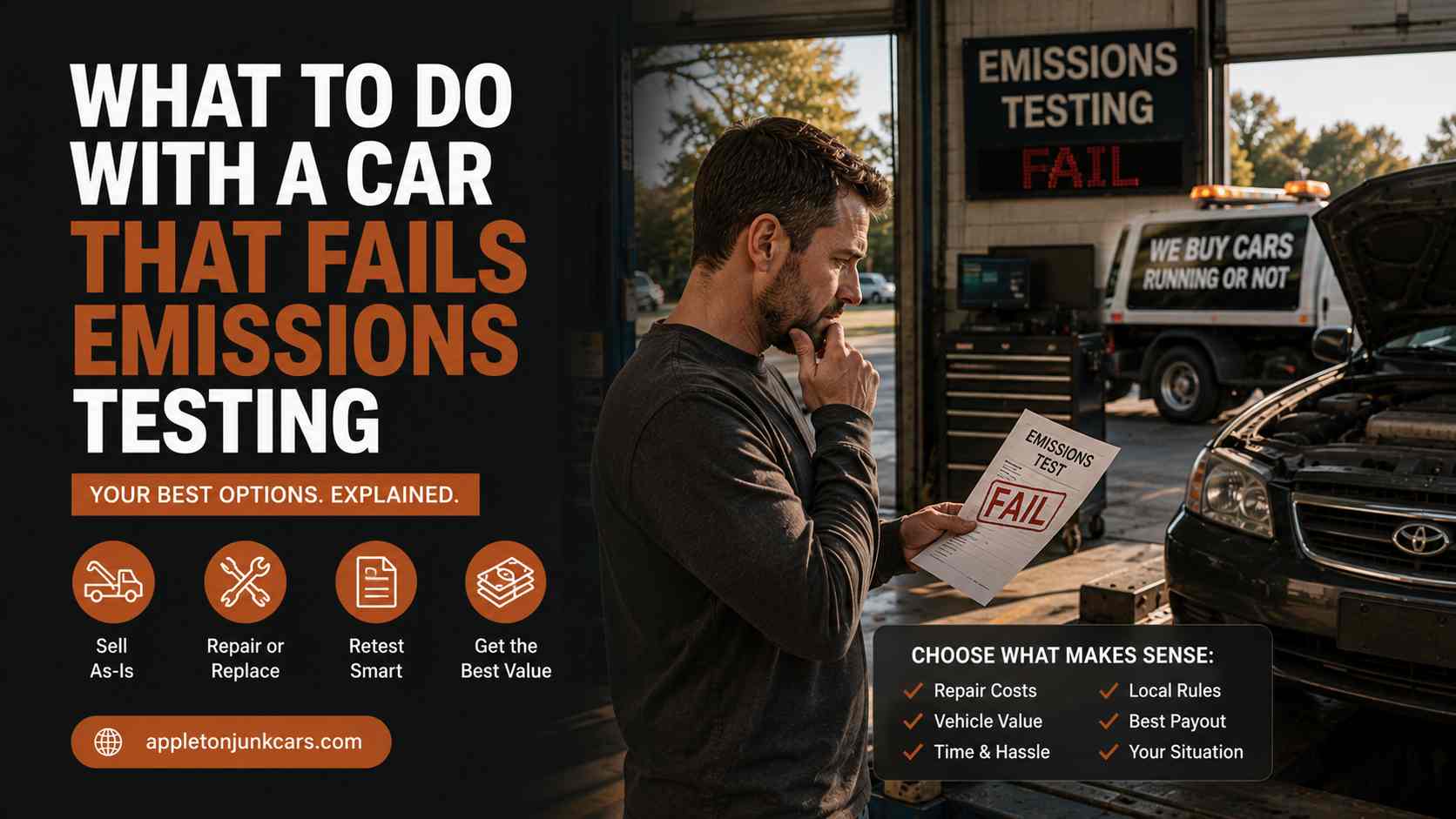
The inspector hands you the failure report and the options start narrowing fast. You already know something is wrong with the car. What you probably do not know yet is exactly which repairs are worth doing, which alternatives actually exist under your state’s rules, and when cutting your losses is the smarter financial call. Most drivers in this situation have more options than they think, and fewer of those options require an expensive repair than most shops suggest.
An emissions failure does not automatically mean the car is done. It means the vehicle is producing exhaust above the legal threshold for your state, or that a related onboard diagnostic system is flagging a fault. The root cause determines everything: whether a repair is cheap or costly, whether a waiver is available, and whether selling the car as-is makes more sense than spending money on a fix.
This guide walks through every realistic path forward, what each one costs, and how to decide which one fits your situation. Start with the repair cost estimate. Everything else follows from that number.
What an Emissions Failure Actually Tells You About the Car
An emissions test is checking two things: the chemical content of the exhaust your vehicle produces, and the status of the onboard diagnostic system (OBD-II) that monitors engine performance in real time. Failing either one produces a failure report.
Tailpipe failures mean your exhaust contains too much carbon monoxide, hydrocarbons, or nitrogen oxides. These are typically caused by a malfunctioning catalytic converter, a rich fuel mixture from a faulty oxygen sensor or fuel injector, or an engine that is running poorly from worn rings or valve seals.
OBD-II failures are triggered by a stored trouble code or by a readiness monitor that has not completed its drive cycle. The most common cause of an OBD-II failure is a recently disconnected battery or a cleared code that removed the readiness data before the test.
Why the distinction matters: OBD-II failures caused by a recently reset system may require nothing more than driving the car for 100 to 200 miles through a complete drive cycle before retesting. That costs nothing. Tailpipe failures from a dead catalytic converter or a badly running engine are a different and more expensive situation entirely.
Which Repairs Are Worth Doing and Which Ones Cost More Than the Car
Before authorizing any repair, get the diagnostic codes pulled and ask the shop specifically what part is causing the failure. The code alone is not the repair. An oxygen sensor code might mean the sensor is bad, or it might mean the catalytic converter has failed and is damaging the sensor. The diagnosis determines the real cost.
Common Emissions Failure Cause | Typical Repair Cost | Worth Repairing If Vehicle Is Worth… |
|---|---|---|
Oxygen sensor replacement | $150 to $300 | Almost always worth it |
EVAP system leak (gas cap, purge valve) | $20 to $350 | Almost always worth it |
Catalytic converter (aftermarket) | $300 to $900 | Worth it if car is worth $3,000+ |
Catalytic converter (OEM or CARB-compliant) | $800 to $2,500 | Worth it if car is worth $5,000+ |
EGR valve replacement | $150 to $400 | Worth it on most vehicles |
Mass airflow sensor | $100 to $400 | Worth it on most vehicles |
Engine rebuild (worn rings, valve seals) | $2,500 to $5,000+ | Usually not worth it |
Multiple failed systems combined | Varies widely | Get total estimate before deciding |
The threshold most experienced mechanics use: if the combined repair cost exceeds 50 percent of the vehicle’s post-repair market value, the repair is difficult to justify financially. Get the full estimate in writing before authorizing anything.
State Waivers and Cost Exemptions: What Qualifies and How to Apply
Most states with emissions testing programs have a cost waiver provision. If you have spent a minimum amount on repair attempts and the vehicle still fails, you may qualify for a temporary registration without passing the test. The minimum repair spend to qualify for a waiver is typically $150 to $200 in some states and $450 to $800 in others.
Waivers are not a permanent fix. They allow you to register the vehicle for one additional year, usually with the expectation that the problem will be addressed before the next test cycle. They are a useful bridge if you are waiting on a part, need more time financially, or plan to sell or scrap the vehicle within the year.
How to Apply for an Emissions Waiver
Gather your repair receipts from a certified emissions repair facility. The shop must be licensed for emissions work in your state. Bring those receipts to your state motor vehicle office along with your failure report. In most states, a waiver is granted on the spot if the paperwork meets the minimum spend requirement. Some states require a second emissions test at a state-certified station after the waiver is issued.
Vehicles That Qualify for Automatic Exemptions
Some vehicles are exempt from emissions requirements entirely or are tested on a different cycle. These typically include vehicles 25 or more years old (many states use a rolling cutoff), electric vehicles, certain hybrid systems, and vehicles registered as farm equipment or historic. Check your state DMV website for the specific cutoff year and category rules. If your vehicle qualifies for an exemption, the emissions failure becomes irrelevant for registration purposes.
Selling a Car That Won’t Pass Smog: What Buyers Will and Won’t Pay
Selling a vehicle that has failed emissions testing is legal in most states. The disclosure requirements vary: some states require you to inform the buyer of the failure in writing, others require no specific disclosure beyond what is implied by an as-is sale. Check your state’s exact rule before listing.
The buyer pool for a car that won’t pass smog is smaller than for a clean vehicle, but it exists. Three categories of buyers regularly purchase non-compliant vehicles.
Private buyers who are mechanically inclined or planning a repair: These buyers often offer more than scrap value and less than a repaired vehicle’s market value. They know the failure code, price the repair themselves, and build that cost into their offer. The gap between what you receive and what the car is worth to them is their margin.
Junk car buyers and scrap yards: These buyers do not care about emissions compliance at all. They price the vehicle on weight, scrap metal rate, and recoverable parts. For a car whose repair cost exceeds its value, this is often the realistic ceiling.
Out-of-state buyers: In states without emissions testing or with different testing requirements, your vehicle may be fully compliant and registerable. Listing on platforms that reach national buyers, including eBay Motors or Craigslist with a broad location, can surface buyers from non-testing states. The buyer handles transport at their cost.
Trading In vs Scrapping a Non-Compliant Vehicle
Option | Expected Payout | Speed | Ease | Best For |
|---|---|---|---|---|
Repair and keep | Preserves vehicle value | Slow (1 to 4 weeks) | Complex | Vehicles worth $5,000+ with isolated failure |
State emissions waiver | No payout; buys time | Fast (same day) | Easy | When repair is pending or temporary relief needed |
Trade-in at dealership | Below private sale value | Fast (same day) | Very easy | Convenience over maximum payout |
Private sale as-is | Moderate payout | Medium (1 to 3 weeks) | Moderate | Newer vehicles with simple repair needed |
Junk car buyer / scrap | Scrap metal value | Very fast (24 to 48 hrs) | Very easy | Older vehicles where repair cost exceeds value |
Dealerships will accept trade-ins on non-compliant vehicles. They typically offer wholesale auction value, which is the lowest number in the range. The advantage is that the transaction is immediate, paperwork is handled, and the trade value applies toward a new purchase. If convenience matters more than maximum payout, this is the path of least resistance.
For older vehicles or those with expensive failure causes, a junk car buyer is consistently the fastest and most predictable outcome. There is no inspection delay, no negotiation over the failure code, and no question about whether the deal will go through.
Registering or Titling in a Non-Testing State: The Reality
Moving a vehicle to a state that does not require emissions testing sounds like a simple workaround. In practice, it involves enough complexity that it only makes sense in specific circumstances.
If you have a legitimate reason to register in another state, such as a move, a second home, or a family member who lives in a non-testing state, this can work. The vehicle will need to meet that state’s registration requirements, which vary but are generally less strict on emissions. The buyer or recipient pays transport costs and handles the title transfer.
If the plan is simply to register in another state to avoid testing while living in a testing state, most states have rules against this. Using a non-resident address for registration when you are a resident of a testing state is considered fraud in most jurisdictions. It is not a viable long-term solution.
What Drivers Who Have Been Through This Consistently Say
Drivers who have navigated an emissions failure report a few consistent patterns. The most common mistake is authorizing a repair without a written estimate and a clear explanation of what part is causing the failure and why. Multiple drivers reported approving sensor replacements that did not fix the underlying problem, then facing a second repair bill for the catalytic converter that should have been diagnosed first.
The most successful outcomes came from drivers who asked one specific question before authorizing any work: “If I pay for this repair, do you guarantee this vehicle will pass the next emissions test?” Shops that answer yes in writing typically do a more complete diagnostic upfront because they are on the hook for the outcome.
Drivers who chose to scrap or sell non-compliant vehicles consistently said the process was faster and less stressful than they anticipated. Several noted that they received offers higher than expected from private buyers who understood the repair and factored it in accurately. The market for non-passing vehicles is smaller but real, and it tends to reward sellers who disclose the issue honestly and price the vehicle accordingly.
Frequently Asked Questions
Can I sell a car that failed emissions?
Yes, in most states you can sell a car that has failed emissions testing. You are generally required to disclose the failure to the buyer, particularly in a private sale. Selling as-is with full disclosure is legal in most jurisdictions. Junk car buyers, private buyers planning a repair, and out-of-state buyers in non-testing states are the most common purchasers of non-compliant vehicles.
How much does it cost to fix a car that fails emissions?
The cost ranges from under $50 for a faulty gas cap to $2,500 or more for a catalytic converter replacement. The actual cost depends entirely on which component is causing the failure. An oxygen sensor or EVAP system leak is typically inexpensive. A failed catalytic converter on a late-model vehicle is one of the more expensive common repairs. Always get the specific diagnostic code and a written estimate before authorizing any work.
What happens if I drive a car that failed emissions?
In most states, you can continue to drive the vehicle but you cannot renew your registration until it passes or qualifies for a waiver. Driving with an expired registration carries fines that typically range from $100 to $500 depending on the state and the duration. The vehicle itself will usually continue to operate normally, particularly if the failure was an OBD-II readiness issue rather than a serious mechanical problem.
How many times can I fail an emissions test?
There is no universal limit on how many times you can test, but most states require that you repair the vehicle between test attempts. Some states limit the number of free retests included with the initial test fee. After failing, you typically have a set number of days to make repairs and retest without paying the full fee again. Check your state DMV for the specific retest window and fee structure.
Does a catalytic converter replacement fix an emissions failure?
It depends on why the catalytic converter is failing. If the converter itself has worn out over age and mileage, replacing it will typically resolve the failure. If the converter has been damaged by a separate underlying issue, such as a misfiring engine or a leaking head gasket that is pushing coolant or oil through the exhaust system, replacing the converter without fixing the root cause will result in the new converter failing again, often quickly.
Can I get a waiver to register my car without passing emissions?
Most states with emissions programs offer a cost-based waiver. You must have spent a minimum amount at a certified emissions repair facility, typically $150 to $800 depending on the state, and still be unable to pass. The waiver allows registration for one additional cycle. It is not automatic and requires documentation of your repair attempts. Contact your state DMV or check their website for the exact requirements and minimum spend threshold.
Will a junkyard buy a car that failed emissions?
Yes, without question. Junk car buyers and scrap yards do not care about emissions status at all. They price the vehicle on weight, metal content, and recoverable parts. An emissions failure has no impact on a junk car offer. For a vehicle whose repair cost exceeds its market value, selling to a junk buyer is a fast and straightforward way to recover the scrap value without dealing with the repair.
Is it worth fixing an old car to pass emissions?
The answer depends on the repair cost relative to the vehicle’s post-repair market value. If the repair costs less than 30 to 40 percent of what the car is worth running, fixing it is usually the right financial move. If the repair approaches or exceeds half the vehicle’s value, selling or scrapping it is the more sensible outcome. The vehicle’s age alone is not the deciding factor. A 15-year-old car in great overall condition can be worth repairing. A 10-year-old car with multiple problems may not be.
The Bottom Line
An emissions failure is a decision point, not a death sentence for the car. The right path forward depends on one question first: what is actually causing the failure and what does it cost to fix? Once you have that in writing from a certified shop, every other decision becomes straightforward.
If the repair is cheap relative to the car’s value, fix it. If the repair cost is significant but the car is worth meaningfully more afterward, use the 50 percent rule and get a second estimate before committing. If the repair cost approaches or exceeds the car’s value, consider the waiver as a bridge while you sell the vehicle, or go directly to a junk car buyer and recover the scrap value without additional cost.
Most drivers in this situation spend too much time focused on the failed test and not enough time focused on the car’s actual value. An honest answer to that question resolves the decision faster than any other factor. Know what the car is worth, know what the repair costs, and the right move becomes clear.