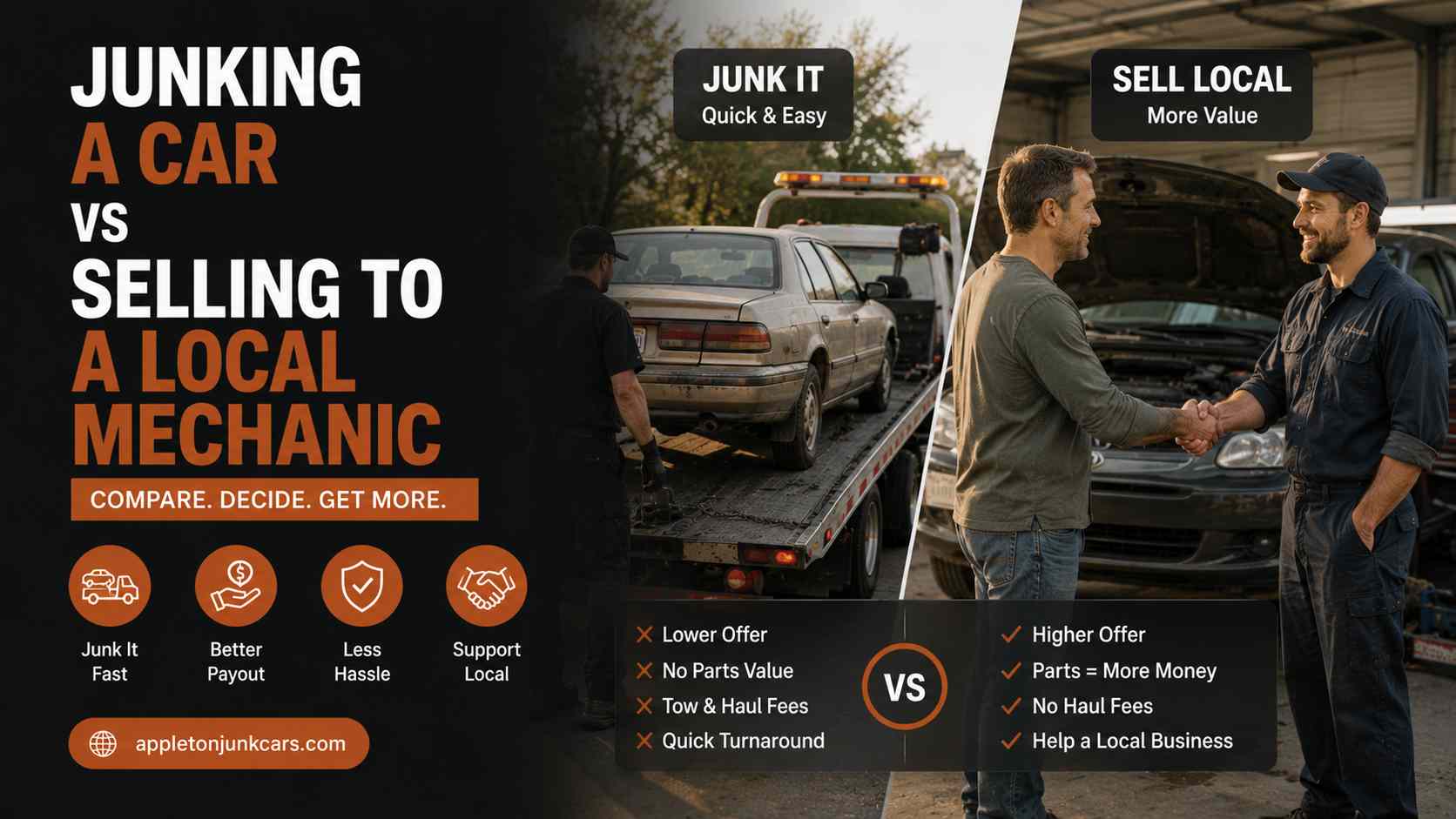
You have a car that does not run right and two buyers telling you they want it. The junkyard is quoting a flat rate based on weight and metal value. The mechanic down the street is offering what sounds like a more personal and possibly higher number. Before you take either deal, there are a few things each buyer is not volunteering that can shift the final outcome by hundreds of dollars.
The honest answer is that neither option is universally better. It depends on the vehicle, its condition, what parts hold value, how fast you need it gone, and whether you have a clean title in hand. Most sellers assume the mechanic will always offer more. That assumption is often wrong, and it costs them money.
This guide breaks down how each buyer actually calculates value, the hidden factors most sellers miss, and the specific conditions where one route consistently beats the other. By the end you will know which call to make first.
Why Local Mechanics Buy Non-Running Vehicles and What That Reveals About Their Offer
A local mechanic who offers to buy your non-running car is almost always doing one of two things: buying it to repair and resell for a profit, or buying it for parts to use in their own shop inventory. Understanding which one determines how much room they have to negotiate.
When a mechanic buys to flip, they calculate repair cost plus their time against the resale price in the local market. Their offer to you is the difference between the expected sale price and their total cost of getting the car there, including parts, labor at their internal shop rate, and a profit margin. That margin is typically 20 to 35 percent of the resale value. The car has to be worth significantly more running than broken for this math to produce a meaningful offer to you.
When a mechanic buys for parts, they need specific components that are expensive or hard to source new. In this case they may pay more for a vehicle with a clean engine, a solid interior, or rare OEM parts. But they may also offer less if the parts they specifically need are the ones that are broken or missing.
The key detail most sellers miss: always ask the mechanic what they plan to do with the car. Their answer tells you whether there is room to negotiate upward and what aspects of the vehicle they actually value.
How Scrap Yards Price a Vehicle vs How a Mechanic Arrives at a Number
Scrap yards use a straightforward formula: vehicle weight multiplied by the current scrap steel rate, with adjustments for whether the catalytic converter, battery, and aluminum components are still in place.
The average passenger car weighs 3,000 to 4,500 pounds. Current scrap steel rates typically run $150 to $300 per ton, which puts the base metal value of most cars between $225 and $675. The catalytic converter alone can add $50 to $500 depending on the vehicle and the current price of platinum group metals. A car with all its original components intact and a working battery will always yield more than one that has been stripped.
Pricing Factor | Junk Car Buyer / Scrap Yard | Local Mechanic |
|---|---|---|
Primary value driver | Weight plus scrap metal rate | Resale value minus repair cost |
Catalytic converter | Included in standard offer | May or may not be factored in |
Vehicle condition | Minimal impact on price | Major impact on price |
Mileage | Minimal impact | Significant impact on resale value |
Make and model | Some impact | Major impact on marketability |
Time to offer | Same day, often in minutes | Varies; may take several days |
Pickup and towing | Usually free | Usually not included |
Title flexibility | More flexible | Usually requires clean title |
Local mechanics arrive at their number differently. They look up what a comparable running vehicle sells for locally, estimate repair cost honestly, subtract their expected margin, and offer somewhere below that ceiling. A car worth $6,500 running that needs $2,000 in repairs might get you $3,000 to $4,000 from a motivated mechanic, assuming they have a buyer in mind and want the vehicle.
The Hidden Costs Most Sellers Do Not Factor Into the Comparison
When comparing offers, most sellers focus only on the headline dollar amount. The true comparison includes several other variables that can flip which option actually puts more money in your hand.
Title Requirements
Most junk car buyers will purchase a vehicle without a clean title, though they may reduce the offer slightly. Many local mechanics will not buy without one. If you have a lien on the vehicle, a lost title, or a salvage title on record, the mechanic option may not be available to you at all.
Towing and Pickup Costs
Established junk car buyers include free towing in their offer. That is part of the standard transaction. A local mechanic may or may not pick up the vehicle. If they do not, you are arranging and paying for a tow, which typically runs $75 to $200 depending on distance. That cost comes directly off any advantage the mechanic’s offer might have had.
Time and Certainty
Junk car quotes can be finalized and the car picked up within 24 to 48 hours. Negotiating with a mechanic can take days or weeks, and deals fall through regularly when their shop estimate comes in higher than they initially thought. Time spent waiting is time your car is sitting, depreciating further, and potentially getting ticketed if it is on a public street.
The Situations Where a Mechanic’s Offer Actually Comes Out Ahead
A local mechanic will beat the scrap yard offer in specific, identifiable circumstances. Knowing these in advance helps you target the right buyer first.
The vehicle has a valuable engine or drivetrain in good condition. If the mechanical failure is unrelated to the engine and the engine is solid, a mechanic who works on that platform regularly may offer substantially more than scrap value because they know exactly what that engine is worth to them.
The car is a make or model the mechanic specializes in. An independent shop that moves three or four of the same model every month has a faster path to resale and can afford to offer more. Their offer reflects efficiency, not just margin.
The vehicle body, interior, and trim are in excellent condition. For a car with a mechanical failure but an immaculate body and a clean interior, a mechanic planning an engine swap can price the vehicle more generously than a scrap yard that is only counting the steel.
The car is relatively new with a large gap between its broken and repaired value. A four-year-old vehicle with a serious mechanical failure still has strong resale value once repaired. That gap gives the mechanic room to offer meaningfully more than the metal is worth.
The Situations Where the Scrap Yard Is the Smarter Move
Junk car buyers and scrap yards are the consistently better option in most of the common scenarios sellers face.
Your Situation | Best Option | Why |
|---|---|---|
Car is old, high-mileage, or worn throughout | Junk car buyer | Mechanic margin leaves little for you |
Title is missing, salvaged, or has a lien | Junk car buyer | Most mechanics require a clean title |
Vehicle needs to be gone within 48 hours | Junk car buyer | Free pickup, fast payment, no negotiation |
Car has flood, fire, or severe collision damage | Junk car buyer | Resale value too low for mechanic math to work |
Car is newer with a solid body and interior | Local mechanic (negotiate) | Gap between broken and repaired value is real |
Engine is sound but another system failed | Local mechanic (negotiate) | Mechanic may pay premium for the drivetrain |
When in doubt, call both. Getting a junk car offer takes 10 minutes online or over the phone. That quote becomes your floor in any conversation with a mechanic and gives you a clear baseline for what the car is worth without any negotiation.
How to Get the Best Price From Whichever Buyer You Choose
The negotiation approach is the same regardless of which route you take.
Get at least three quotes before accepting any offer. With junk car buyers, this is quick: most provide estimates online or by phone in minutes. With mechanics, you may need to let them inspect the vehicle first, which takes more time but produces a more accurate offer.
Know your floor before any conversation starts. The scrap yard quote is your baseline. No buyer should receive the vehicle for less than that number. If a mechanic offers below scrap value, decline and move forward with the junk buyer.
Mention your other offers directly. Telling a mechanic “I have a scrap buyer offering $625” gives them a concrete number to beat if they want the car. Most will either match it or explain why they cannot, which saves everyone’s time.
Keep the catalytic converter on the vehicle. Removing it before selling reduces your offer from most buyers. Both junk yards and mechanics factor the converter into the vehicle’s value. Leaving it in place protects the full offer.
What Sellers Who Tried Both Options Consistently Report
Sellers who have been through this situation share a consistent set of findings. Those who accepted the first offer from a mechanic without checking scrap value almost always later discovered they left money on the table. The mechanic’s offer tends to feel higher because it arrives through a personal conversation rather than a standard market rate, but it frequently reflects the mechanic’s margin more than the vehicle’s true worth.
Those who called multiple junk car buyers consistently received final offers $100 to $300 higher than the first quote on a car worth $500 to $800. Junk car pricing varies more than most sellers expect, and the spread between the lowest and highest offer for the same vehicle is almost always worth the extra 20 minutes of calls.
The sellers who came out best followed the same approach: they got three junk buyer quotes, got one or two mechanic offers, and let each side know what the other was willing to pay. In most cases, the competition moved the final number higher than any single offer would have been. It takes an afternoon, but the outcome is consistently the best price the market will support for that specific vehicle in that specific condition.
Frequently Asked Questions
How much will a junkyard pay for my non-running car?
Most junk car buyers pay between $200 and $800 for a typical non-running passenger vehicle, depending on weight, the current scrap metal rate, whether the catalytic converter is intact, and the buyer’s local market. Larger vehicles such as trucks and SUVs pay more because of their greater metal weight. Calling three buyers and comparing quotes typically yields a final offer 15 to 25 percent higher than the first quote received.
Will a mechanic pay more for my broken car than a junkyard?
Sometimes, but not usually. A mechanic will pay more only when the car’s repaired market value significantly exceeds the cost of repairs, and when the vehicle has components they specifically need. For older, high-mileage, or heavily damaged vehicles, the mechanic’s margin calculation often produces an offer at or below scrap value. The only way to know is to get both quotes and compare.
Do I need a title to sell a car to a mechanic?
Most local mechanics require a clean title before they will buy a vehicle. Without a title, they cannot resell or register the car, which eliminates the flip option entirely. Junk car buyers are generally more flexible about title situations, including missing titles, salvage titles, and vehicles with liens, though they may reduce the offer slightly to account for the added complexity.
Do junk car buyers really offer free towing?
Yes, free towing is standard practice among established junk car buyers. It is part of the offer, not an additional service. The tow truck driver typically brings the payment and the paperwork at the same time. If a buyer asks you to pay for towing, that is a red flag. Either decline or negotiate to have the towing cost added back into the offer.
How do I know if my car’s catalytic converter adds value to the offer?
All vehicles have catalytic converters and all of them contain some amount of platinum group metals. The value depends on the vehicle make and engine size. Trucks, SUVs, and luxury vehicles typically have converters worth $150 to $500 or more at current precious metal prices. Economy cars run lower. Leave the converter on the vehicle when you sell. Removing it yourself before the sale almost always reduces the offer by more than you would recover selling the converter separately, and it creates legal complications in some states.
Can I sell a car with a lien on it to a junkyard?
You can attempt to, but most reputable junk buyers will ask you to pay off the lien first or will handle the transaction in a way that satisfies the lienholder. You cannot legally transfer ownership of a vehicle with an active lien without the lienholder’s involvement. Contact your lender first to find out the payoff amount and whether they will release the title to a junk buyer directly.
How fast can I sell a non-running car?
Selling to a junk car buyer is typically the fastest option. Most buyers can schedule pickup within 24 to 48 hours of accepting a quote. Payment is made at pickup, usually in cash or check. Selling to a mechanic takes longer because it involves inspection, negotiation, and often multiple conversations before a deal is reached. When speed matters, junk car buyers are consistently faster and more predictable.
Should I part out my car instead of selling it whole?
Parting out a car almost always yields more total money than selling it whole, but it takes significantly more time, effort, and space. You need to remove and list individual components, store the vehicle while parts sell, and dispose of what remains after the valuable pieces are gone. For most sellers with a single non-running car, the extra income from parting out rarely justifies the weeks or months required. Selling whole to a junk buyer or a mechanic is a more practical outcome for most situations.
The Bottom Line
For most sellers with a non-running or heavily damaged vehicle, calling a junk car buyer first is the right move. It gives you a concrete baseline offer, comes with free towing and same-day pickup, and requires no negotiation or title complications in most cases. That baseline then becomes your leverage in any conversation with a local mechanic.
A mechanic’s offer is worth pursuing when the car is newer, the body is solid, and the mechanical failure is isolated to something the mechanic can fix efficiently. In those cases, the gap between the broken value and the repaired value is real enough that they can offer more than the scrap yard and still make their margin. Outside of those conditions, the junk yard offer is typically as good or better once towing costs and time are factored in.
Get three quotes from junk car buyers before you commit to anything. Take 30 minutes to make those calls or fill out those online forms. That step alone is worth $100 to $300 more in most transactions, and it makes every subsequent conversation with a mechanic more productive because you already know your floor.