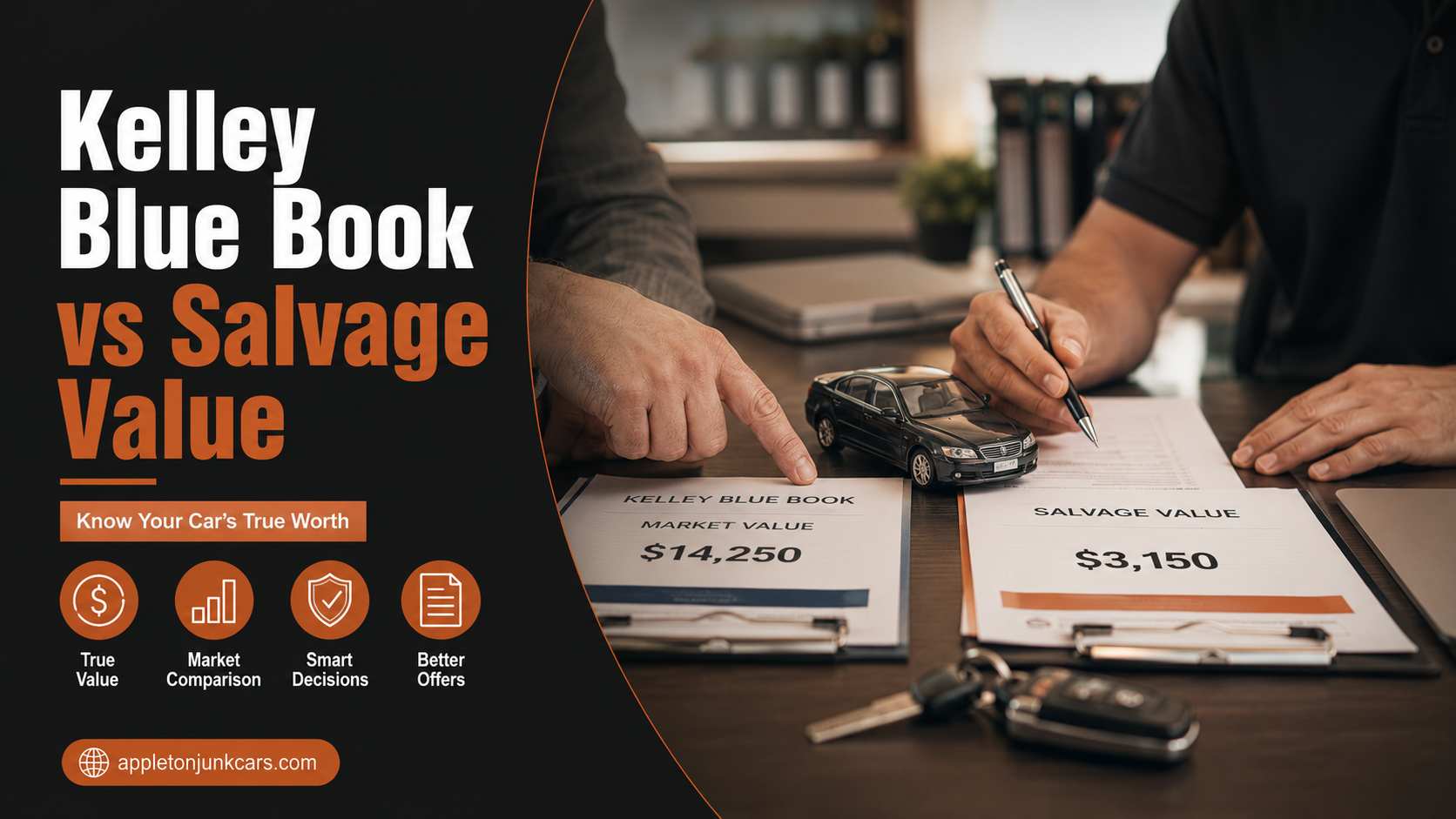
A junk car buyer offers $475. Kelley Blue Book says the car is worth $2,800 in poor condition. Those two numbers are not measuring the same thing, and the gap between them is not evidence that the buyer is trying to cheat you. It is evidence that KBB and salvage value use different inputs, serve different markets, and reflect fundamentally different assumptions about what happens to the vehicle next. Understanding exactly why they differ tells you which number actually applies to your situation and how to use each one correctly.
Kelley Blue Book estimates the price a vehicle would command in a consumer retail or private party transaction, where the buyer intends to drive the vehicle. Salvage value estimates the price a vehicle commands when it is sold for its components or metal content, where the buyer does not intend to drive it. These are not competing estimates of the same thing. They are answers to different questions about different markets with different buyers and different intended uses.
The confusion arises because both numbers describe the same physical vehicle, and sellers naturally expect them to be in the same ballpark. They are rarely in the same ballpark. This guide explains exactly why, and more practically, it explains when KBB is the right reference to use and when it actively misleads you.
What Kelley Blue Book Actually Measures
Kelley Blue Book (kbb.com) publishes estimated market values for vehicles based on actual transaction data from dealerships, auctions, and private party sales. KBB’s methodology aggregates real sale prices from the market and models them against vehicle attributes to produce estimates for specific year, make, model, trim, and condition combinations.
The KBB condition scale classifies vehicles into four categories: Excellent, Good, Fair, and Poor. These categories are defined by specific criteria about mechanical functionality, cosmetic condition, and maintenance history. The critical definition for junk car sellers is what KBB means by “Poor condition,” because this is often the category sellers check when they have a non-running or heavily worn vehicle.
KBB’s “Poor” condition definition assumes: the vehicle runs and drives; there are some mechanical issues that have been noted but the vehicle is operational; cosmetic condition shows significant wear or damage; the car requires more than routine maintenance. KBB “Poor” explicitly describes a driveable vehicle with known issues. It does not describe a vehicle that does not run, that has engine failure, or that is at end of life. KBB has no published condition category for a vehicle that is non-running, mechanically failed, or going to a salvage yard.
What Salvage Value Actually Measures
Salvage value, in the context of junk car buying, is the price a buyer will pay for a vehicle when the intended use is parts recovery, metal recycling, or both, rather than road use. Salvage value is calculated from two inputs: the value of the recoverable parts that have buyer demand, and the scrap metal value of the remaining material.
Parts value depends entirely on which components are intact and in demand for that specific make and model. A 2015 Honda Accord with a seized engine has parts value in its transmission, suspension components, interior, cooling system, body panels, and electronics. A 2002 Chevrolet Cavalier with a seized engine and 220,000 miles has very limited parts value because the components have limited buyer demand and the vehicle’s age means that few mechanics are sourcing used Cavalier parts.
Scrap metal value is the absolute floor: the commodity value of the steel, aluminum, and other metals in the vehicle at current market prices. This is typically $150 to $600 for a passenger vehicle depending on weight and current steel prices. Salvage value from a buyer who recovers parts is always at or above scrap value; the question is how far above it the parts premium puts the offer.
Why the Same Car Has Completely Different KBB and Salvage Values
Factor | Kelley Blue Book | Salvage Value |
|---|---|---|
What it measures | Consumer market transaction price for a vehicle that will be driven | Recovery value of parts and metal for a vehicle that will not be driven |
Assumes vehicle… | Runs and drives, at minimum in Poor condition | May not run; condition affects parts value, not fundamental applicability |
Primary inputs | Actual retail and private sale transaction prices by region | Scrap steel price plus parts market demand for that make and model |
Who uses it | Buyers and sellers of driveable vehicles; insurance companies for pre-loss value | Junk buyers, salvage yards, insurance companies for total loss settlements |
Geographic variation | Regional market prices reflected in estimates | Local scrap prices and buyer competition affect offer |
Effect of non-running status | KBB has no category for non-running; “Poor” assumes runs | Non-running reduces salvage offer only if parts viability is affected |
Effect of popular make/model | Higher demand vehicles have higher KBB values | Higher demand vehicles have larger parts premiums above scrap floor |
The most important row in that table is “Assumes vehicle runs.” KBB’s lowest published value, “Poor” condition, still assumes the vehicle starts and drives. A car that does not run does not fit within KBB’s condition framework at all. Using KBB “Poor” as a reference for a non-running vehicle produces a number that has no market basis for the transaction you are actually trying to complete.
What KBB “Poor Condition” Actually Means vs Junk Car Reality
The gap between KBB “Poor” and junk car reality is best illustrated with a specific example. Consider a 2013 Toyota Camry.
KBB “Poor Condition” Scenario for This Camry
The vehicle starts and runs. The engine has an oil leak that requires attention but the car is operational. The transmission shifts with some hesitation. There is visible rust on the quarter panels, a cracked bumper, and significant interior wear. The car needs brakes and probably needs a significant mechanical repair within the next few thousand miles. A private buyer who knows the history and is comfortable with the condition might pay $3,800 for this car. KBB “Poor” for this vehicle might show $3,200 to $4,000 as a reasonable reference.
Salvage Value Scenario for a Non-Running Camry
The same vehicle. The engine seized at 185,000 miles. The car was towed to the driveway where it has sat for eight months. The body is in fair condition, no significant rust, two cracked interior panels. A Toyota salvage yard will offer $500 to $900 for this car because they can recover the transmission, doors, interior panels, catalytic converter, and cooling system for resale to mechanics. A scrap yard will offer $280 to $380 based on the vehicle’s weight at current steel prices.
The KBB “Poor” number ($3,200 to $4,000) and the salvage offer ($500 to $900) describe the same physical vehicle but different market realities. Neither is wrong. The KBB number describes what a similar driveable vehicle in the worst condition KBB measures would sell for. The salvage number describes what this specific non-running vehicle is worth to the buyers who will actually purchase it in its current state.
When KBB Is the Right Reference and When It Is Not
Use KBB When… | Do Not Use KBB When… |
|---|---|
The vehicle runs and drives, even poorly | The vehicle does not run or start |
You are selling to a private buyer who will drive it | You are selling to a junk buyer, salvage yard, or scrap facility |
You are trading in at a dealership (KBB trade-in value applies) | You are evaluating a junk car offer against a reference number |
Your insurance is settling a pre-loss value claim | Your insurance is settling a total loss claim (ACV applies, which differs from KBB) |
You want to know the retail market value of a similar running vehicle | You want to know what a junk buyer should offer for your non-running vehicle |
Junk car buyers are not negotiating against KBB. Their offers are based on scrap prices, parts market demand, and operational costs. Presenting a KBB number to a junk car buyer as evidence that their offer is too low is a misapplication of the reference. KBB does not apply to that market, and a buyer who explains this to you is giving you accurate information, not making excuses.
How to Use Both Numbers to Your Advantage
The productive way to use KBB alongside salvage value is to use KBB to determine whether you are actually in the junk car market or the private sale market. If your car runs and the KBB “Fair” or “Poor” value is substantially higher than junk car offers, the car may have more value as a private sale to someone who will drive it than as a salvage transaction. Running cars with cosmetic issues or minor mechanical problems often sell privately for more than any junk buyer will offer.
If the car does not run, or if the repair cost to make it run exceeds the KBB “Poor” value, you are in the salvage market and KBB no longer applies. Use scrap metal prices and salvage buyer quotes as your reference instead. The scrap quote from a local yard is the most accurate floor for your actual transaction.
For insurance total loss situations, neither KBB nor junk buyer quotes are the definitive number. Insurance companies use their own Actual Cash Value (ACV) methodology, which is similar to but distinct from KBB. ACV typically reflects actual sale prices of comparable vehicles in your region more precisely than KBB does and is the number your insurer uses to calculate your settlement.
What Sellers Who Compared These Numbers Consistently Report
Sellers who have junked cars after initially consulting KBB share a consistent experience. The most common: genuine confusion and frustration at the gap between the KBB “Poor” number and junk car offers, before understanding that KBB does not apply to non-running vehicles. Once the distinction was explained, most sellers accepted that the junk car offer was not unreasonably low and completed the transaction.
The sellers who used the gap between KBB and salvage value most productively were those with running vehicles in very poor cosmetic condition. These sellers correctly identified that their car was still in KBB’s market (driveable, even if rough), listed it privately with honest condition disclosure, and received offers in the $1,500 to $3,000 range that significantly exceeded the $500 to $900 they had been quoted by junk buyers. For a running vehicle, the private buyer market and the junk buyer market produce very different results, and KBB correctly signals which market is more likely to produce the better outcome.
Those who had non-running vehicles and came to understand that KBB was not their reference reported relief rather than disappointment. Knowing that junk car pricing is based on a completely different formula from KBB made the offers they received feel accurate rather than arbitrary, and several reported that understanding the formula helped them negotiate more effectively by focusing on the right variables: catalytic converter presence, specialty buyer pools for their make, and competing quotes from different salvage operations.
Frequently Asked Questions
Why is the junk car offer so much lower than Kelley Blue Book?
Because KBB and junk car offers measure different things. KBB estimates what a driveable vehicle would sell for in a consumer retail or private sale market. Junk car offers reflect the salvage value: the price of the vehicle’s recoverable parts and metal content. KBB’s “Poor” condition category still assumes the vehicle runs and drives; junk car buyers are pricing a vehicle that will not be driven again. These two markets have fundamentally different price levels.
Should I use Kelley Blue Book when selling my junk car?
Not as a reference for junk car offers. KBB values assume the vehicle is driveable and is being sold to a buyer who intends to drive it. If your vehicle does not run, or if you are selling to a junk buyer or salvage yard, KBB does not describe the relevant market. Use scrap metal prices and salvage buyer quotes as your reference instead. KBB is relevant if your vehicle runs and you are considering a private sale or dealer trade-in.
What does Kelley Blue Book “Poor” condition mean?
KBB “Poor” condition assumes the vehicle runs and drives, has significant mechanical issues that have been disclosed, shows substantial cosmetic wear or damage, and requires more than routine maintenance. It is not a category for non-running vehicles. A vehicle that will not start or has a major engine failure is below KBB’s published condition scale; KBB does not publish values for end-of-life or non-running vehicles.
What is salvage value and how is it calculated?
Salvage value is the price a vehicle commands when sold to a buyer who intends to use it for parts recovery or metal recycling rather than road use. It is calculated from two components: the value of usable parts that have demand in the repair market for that specific make and model, and the scrap metal value of the vehicle’s remaining material. Salvage value is always at or above scrap metal value, with the parts premium above scrap depending on market demand for that vehicle’s components.
Can I use Kelley Blue Book to negotiate with a junk car buyer?
KBB is not an effective negotiation tool with junk car buyers because junk buyers do not price against KBB. Their offers are based on scrap steel prices, parts market demand, and their operational costs. A junk car buyer cannot pay KBB value for a non-running car because there is no buyer in their market who would pay them KBB value for it. More effective negotiating tools are competing quotes from other junk buyers, the scrap yard’s floor price, and specific information about high-demand components on your vehicle.
My car runs but is in rough shape. Should I sell it privately or junk it?
Check KBB for your vehicle in “Fair” or “Poor” condition and compare that to junk car offers you receive. If the KBB value is significantly higher than junk offers, the car has more value in the private market than the junk market, and a private listing with honest condition disclosure is worth pursuing. If the repair cost needed to make the car safe and operational exceeds the difference between KBB value and the junk offer, the junk sale is the more practical outcome.
What is the difference between KBB trade-in value and private party value?
KBB publishes two separate values for most vehicles: trade-in value (what a dealer would offer when you trade the vehicle toward another purchase) and private party value (what you might reasonably receive selling directly to a private buyer). Trade-in value is typically 10 to 20 percent lower than private party value because dealers build their profit margin and reconditioning cost into the trade offer. Neither of these values applies to junk car transactions; both assume the vehicle is driveable.
How does insurance determine total loss value versus KBB?
Insurance companies use Actual Cash Value (ACV) to calculate total loss settlements, which is their own calculation of the vehicle’s pre-loss market value. ACV is similar to but distinct from KBB: insurers typically use data from actual recent sales of comparable vehicles in your region, which may produce values above or below KBB depending on local market conditions. If you believe an insurer’s ACV is too low, requesting the comparable vehicle data they used and presenting alternative comparable sales is the standard dispute process.
The Bottom Line
Kelley Blue Book and salvage value measure different things, serve different markets, and answer different questions. Using KBB to evaluate a junk car offer is like using a restaurant’s menu price to evaluate what a grocery store would pay for raw ingredients: the comparison is not meaningful because the transaction context is completely different.
KBB is the right reference when your vehicle runs, when you are selling to a buyer who intends to drive it, or when you are comparing your car’s consumer market value against replacement options. Salvage value is the right reference when the vehicle does not run, when you are selling to a junk buyer or salvage yard, or when the repair cost makes keeping or selling the car as a driver impractical.
The practical action: use KBB to determine which market you are in. If your car runs, KBB tells you whether the private market is worth pursuing before defaulting to a junk buyer. If your car does not run, check scrap prices and get two or three junk buyer quotes instead. Those are the numbers that actually apply to your transaction.