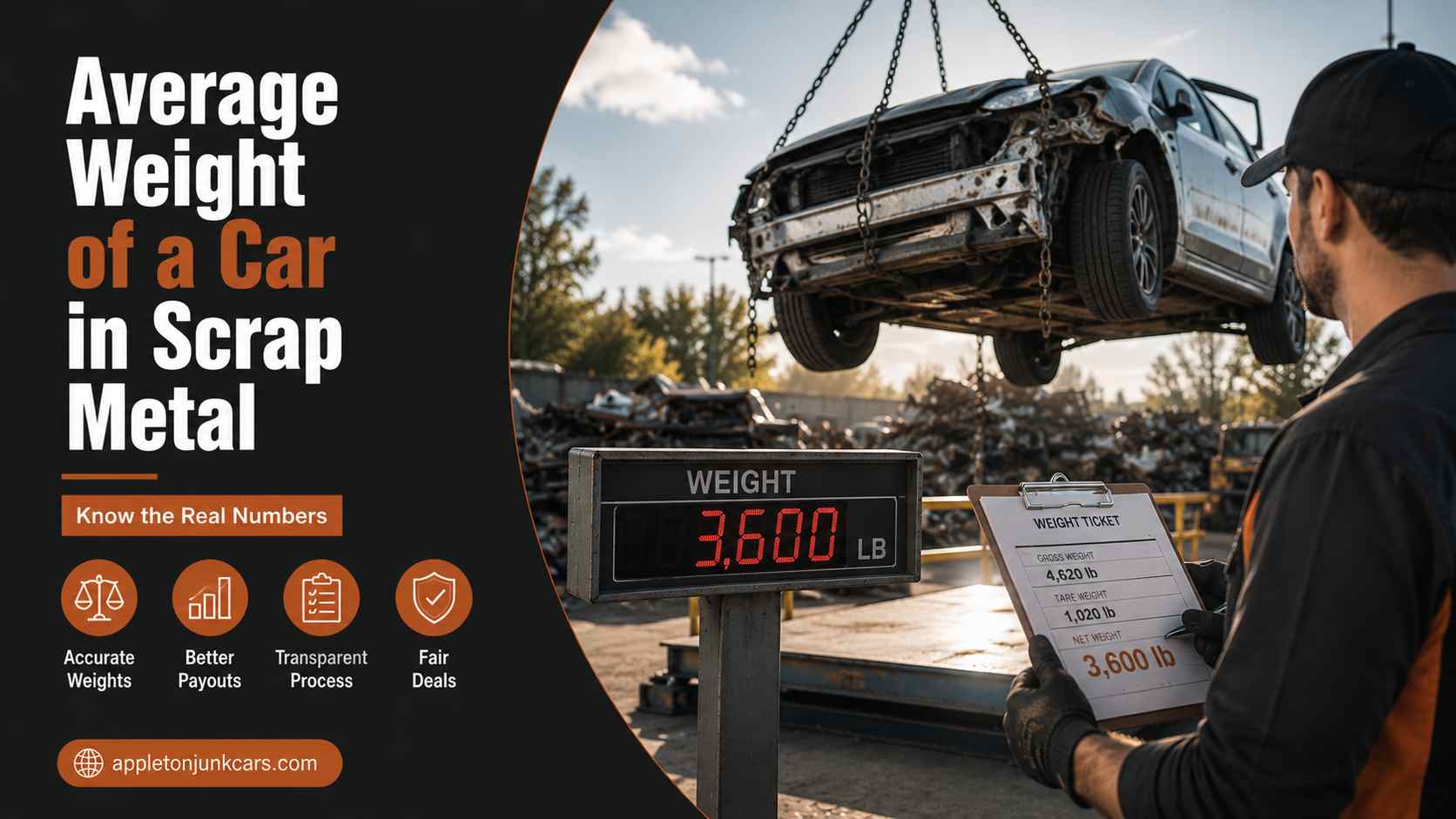
The average passenger vehicle yields approximately 2,200 to 2,400 pounds of recyclable scrap metal, representing roughly 60 to 70 percent of its total curb weight. The rest of the car, the plastics, glass, rubber, and fluids, is not scrap metal and either gets recycled through separate streams or disposed of as automotive shredder residue. Understanding this breakdown is what allows you to accurately estimate what your specific vehicle is worth before you call a single junkyard.
Why Weight Is What Scrap Yards Are Actually Buying
When a scrap yard quotes you a price for your car, they are buying metal by weight. The body of the vehicle, the engine block, the chassis rails, the doors, the hood, and every other metallic component all get weighed at intake and priced according to their metal type.
This is why the condition of the car matters less than most people expect for the basic scrap transaction. A rusted-out frame with a seized engine sitting on flat tires is worth almost the same per pound as a cleaner version of the same vehicle, because the pounds of steel and aluminum are still there. What does affect the offer significantly is which high-value components are present or missing, specifically the catalytic converter, engine, and transmission, and whether the yard can verify ownership through proper documentation.
Knowing the approximate weight of your car’s scrap metal content, and which portions are ferrous versus non-ferrous, gives you a clear picture of the floor value of the vehicle before any negotiation begins.
Understanding the Materials Breakdown
A typical passenger vehicle with a curb weight of around 4,000 pounds contains three distinct categories of material, each handled differently by the recycling industry.
Material Category | Approx. Weight | % of Total | Examples |
|---|---|---|---|
Ferrous Metals (Steel & Iron) | ~2,100 lbs | ~52% | Body, chassis, engine blocks, doors |
Non-Ferrous Metals | ~300 lbs | ~8% | Aluminum, copper, lead, PGMs |
Non-Metal Waste | ~1,600 lbs | ~40% | Plastics, glass, rubber, fluids |
Total Curb Weight | ~4,000 lbs | 100% | Full vehicle as delivered |
The non-metal waste category is significant. Nearly 40 percent of the average vehicle’s curb weight is material that scrap yards do not price as metal. Plastic dashboards, seat foam, rubber weather stripping, glass windows, floor carpeting, and the fluids still in the cooling and hydraulic systems all add weight to the car you drive to the yard without adding metal value to the transaction. This is why scrap yards weigh vehicles and calculate payouts based on their own intake weight rather than simply trusting the vehicle’s listed curb weight.
Categorizing the Scrap Metals: Ferrous vs. Non-Ferrous
Scrap yards separate incoming metal into two primary categories because they command vastly different market prices and are processed through entirely different recycling chains. Understanding which category your car’s components fall into helps you understand why the payout is structured the way it is.
1. Ferrous Metals (Magnetic)
Ferrous metals are iron-based metals that respond to a magnet. Steel and cast iron are the primary ferrous materials in an automobile. They make up the overwhelming majority of the vehicle’s metal weight and are the foundation of the scrap metal payout.
Ferrous Metal Details | Information |
|---|---|
Total Weight per Vehicle | Approximately 2,000 to 2,200 pounds |
Key Components | Car body panels, chassis and frame rails, engine block and heads, transmission casing (steel), doors, hoods, trunk lids, suspension arms, brake rotors, fuel tank |
Market Value | Lowest price per pound (roughly $0.05 to $0.15/lb for shredder-grade steel), but makes up the bulk of total weight and therefore the majority of the total payout |
How Yards Handle It | Shredded or crushed and sold to steel mills for recycling into new steel products |
The low per-pound price of steel is offset entirely by volume. At 2,100 pounds of steel in a standard vehicle, even a modest per-pound rate adds up to the majority of the car’s base scrap value. A vehicle that brings $300 in total scrap value typically has $200 or more of that coming from the ferrous metal content alone.
2. Non-Ferrous Metals (Non-Magnetic)
Non-ferrous metals do not contain iron and do not respond to a magnet. They are worth significantly more per pound than ferrous metals because they are less abundant, more expensive to mine, and in higher demand for specific industrial applications. Despite making up only 250 to 350 pounds of the typical vehicle, the non-ferrous components contribute disproportionately to the total scrap value.
Metal | Approx. Weight | Location in Vehicle | Current Scrap Rate* |
|---|---|---|---|
Aluminum | ~250 lbs | Engine cylinder heads, wheels, radiators, intake manifolds, alternator housing | $0.50 to $0.90/lb |
Copper | ~50 lbs | Starter motor windings, alternator windings, wiring harnesses, AC compressor | $3.00 to $4.00/lb |
Lead | ~30 lbs | Primarily in the 12-volt battery; also in older wheel balancing weights | $0.20 to $0.40/lb |
Precious Metals (PGMs) | <1 lb total | Catalytic converter substrate (platinum, palladium, rhodium) | $800 to $3,000+/oz |
*Rates are approximate and fluctuate with global commodity markets. PGM values vary significantly by vehicle make and converter type.
The catalytic converter is the most disproportionately valuable component in any junk car, despite contributing less than one pound of precious metal to the total vehicle weight. The platinum, palladium, and rhodium inside a single converter can account for $100 to over $1,000 of the vehicle’s total scrap value depending on the vehicle. This is also why catalytic converter theft is so prevalent, and why scrap yards now require proof of ownership before purchasing them.
How Weight Varies by Vehicle Type
The 4,000-pound average applies to a typical mid-size passenger sedan. Vehicle weight, and therefore scrap metal yield, varies significantly by body style, size class, and construction era.
Vehicle Type | Typical Curb Weight | Est. Scrap Metal Yield | Est. Ferrous Content |
|---|---|---|---|
Small/compact car | 2,500 to 3,000 lbs | 1,500 to 2,000 lbs | 1,300 to 1,700 lbs |
Mid-size sedan/crossover | 3,500 to 4,500 lbs | 2,100 to 3,000 lbs | 1,800 to 2,500 lbs |
Full-size SUV | 4,500 to 6,000 lbs | 2,800 to 4,000 lbs | 2,400 to 3,400 lbs |
Full-size pickup truck | 4,500 to 6,500 lbs | 2,800 to 4,300 lbs | 2,400 to 3,700 lbs |
Heavy-duty truck (3/4 ton+) | 6,000 to 8,000+ lbs | 3,600 to 5,500 lbs | 3,200 to 4,800 lbs |
Heavier vehicles produce more scrap metal and therefore higher base payouts at scrap yards pricing by weight. A full-size pickup truck at 5,500 pounds curb weight may contain twice the recyclable metal of a compact sedan, which translates directly into a meaningfully higher offer before any parts value is considered.
Executing the Scrap Valuation Plan
If you are planning to scrap a vehicle, following these steps in order maximizes the financial return from the transaction. The preparation steps are easy and the difference between a prepared and unprepared vehicle can be $50 to $150 on the total payout.
Step 1: Check Component Completeness
The base weight of the vehicle determines the floor price. The presence or absence of key high-value components determines how far above that floor the offer goes.
- Locate and verify core parts: The engine, transmission, and catalytic converter are the three components that most significantly affect the offer beyond base metal weight. Confirm whether these are present and intact before getting quotes. A vehicle with all three in place will receive a higher offer than one that has been stripped.
- Assess missing items honestly: If valuable parts have already been removed, disclose this upfront when calling for quotes. A buyer who arrives expecting a complete car and finds an engine bay has been stripped will reduce the offer at pickup, creating friction and wasted time. Accurate descriptions produce firm quotes that hold at pickup.
Step 2: Clean the Vehicle
- Remove personal trash: Clear out all garbage, personal belongings, and non-vehicle material from the interior and trunk before the pickup or before driving to the yard. Excess garbage adds non-metal weight that yards may deduct from their payout calculation. More importantly, clearing the interior is how you find valuable items you did not know were still in the car.
- Drain hazardous fluids where appropriate: Some yards pay a slight premium for vehicles that have been properly drained of motor oil, coolant, and fuel because it reduces their fluid handling requirements. Ask whether your specific yard offers a drained-vehicle premium before going through the effort. Not all yards offer this, but for those that do, it can add $10 to $30 to the offer.
Step 3: Verify Ownership Documents
- Find the title: Most legitimate scrap yards require a valid vehicle title in the seller’s name to complete the transaction. A title-less sale is possible at some yards for older vehicles or under specific state rules, but having the title always produces a cleaner transaction and often a higher offer because the buyer has full flexibility in what they can do with the vehicle.
- Prepare identification: Bring a government-issued photo ID to complete the sale. Most states now require yards to record seller identification alongside the transaction as part of anti-theft reporting requirements. This is standard practice at any legitimate operation.
Evaluating Hidden Blind Spots
Three factors consistently catch sellers off guard in scrap car transactions. Knowing them upfront prevents unpleasant surprises at the yard or at the time of payment.
The Dirty Weight Deduction. Scrap yards do not buy tires, glass, plastic seats, rubber weather stripping, or floor carpeting. All of these materials are present in every vehicle and add real weight to the car, but they are not scrap metal and yards account for this in their pricing. Most yards apply a standard deduction for non-metal content rather than physically stripping and re-weighing the vehicle. Understanding this deduction is why the scrap metal yield of a 4,000-pound car is roughly 2,200 to 2,400 pounds rather than the full 4,000 pounds. You are not being cheated. The yard is simply not paying for the 1,600 pounds of non-metal material that came along with the metal.
Fluctuating Market Prices. Scrap metal prices, particularly for steel, aluminum, and copper, trade on global commodity markets and change daily. A quote you receive today may be different from one you receive in two weeks. Factors that move scrap metal prices include steel mill demand, energy costs, global manufacturing output, currency exchange rates, and trade policy. Checking a current scrap price tracking site before calling yards gives you a market context for evaluating whether the quotes you receive are competitive for that day’s conditions.
Towing Fees. If the vehicle cannot be driven and requires a tow truck, the towing cost may be deducted from your final payout rather than paid separately. This varies by buyer. Some services advertise free towing, meaning the tow is genuinely included in the quoted price. Others quote a high price and deduct a towing fee from it at payment, netting you less than the original number suggested. Ask specifically: is towing included in the quoted amount, or will it be deducted at pickup? Getting this confirmed before agreeing to anything prevents a common source of frustration.
How to Estimate the Cash Value of Your Specific Vehicle
With the weight and price frameworks above, you can now estimate the scrap value of any specific vehicle before making a single call. Here is how the math works.
Step 1: Find the vehicle’s curb weight. Look it up in the owner’s manual, on the manufacturer’s website, or on a specifications database by year, make, and model. Use the base curb weight for the configuration closest to what your vehicle actually is.
Step 2: Apply the metal content percentage. Multiply the curb weight by 0.60 to estimate the low end of recyclable metal content, and by 0.70 for the high end. A 4,200-pound SUV contains roughly 2,520 to 2,940 pounds of recyclable metal.
Step 3: Estimate the steel value. About 85 to 90 percent of the recyclable metal is ferrous. Multiply the estimated recyclable weight by 0.87 to get approximate steel content. Apply the current steel scrap rate (typically $0.06 to $0.15 per pound depending on market conditions and yard type). This gives you the floor price.
Step 4: Add the non-ferrous component value. The catalytic converter, aluminum components, and copper wiring are priced separately and more favorably. For a typical intact vehicle, add $100 to $400 depending on the catalytic converter type, vehicle size, and how much copper and aluminum is present.
The total from Steps 3 and 4 is your realistic floor estimate for the vehicle at current market rates. Actual offers will vary based on yard, location, and the specific market for your vehicle’s parts.
A worked example: A 2010 Ford F-150 with a curb weight of 4,685 pounds. Recyclable metal: 2,811 to 3,280 pounds. Steel portion: roughly 2,400 to 2,800 pounds at $0.08/lb = $192 to $224. Non-ferrous and catalytic converter: approximately $200 to $400 for an intact V8 truck. Total estimated range: $392 to $624. This aligns with typical junk car offers for this vehicle at current market prices.
Frequently Asked Questions
How much scrap metal does the average car contain?
The average passenger vehicle contains approximately 2,200 to 2,400 pounds of recyclable scrap metal, representing 60 to 70 percent of its total curb weight. The remainder is non-metal material including plastics, glass, rubber, and fluids that are handled through separate recycling or waste streams.
What is the most valuable metal in a junk car?
By per-pound value, the precious metals in the catalytic converter, platinum, palladium, and rhodium, are by far the most valuable. Though they weigh less than one pound combined per vehicle, they can represent $100 to over $1,000 of the car’s total value depending on the vehicle. By total contribution to payout, the steel and iron make up the largest share of the dollar value simply due to volume.
Does a heavier car get more money at the scrap yard?
Generally yes. A heavier vehicle contains more metal by weight and therefore generates a higher base scrap payout. A full-size truck or heavy SUV will almost always receive a higher scrap offer than a compact sedan, assuming comparable component completeness. The key qualifier is that the weight must be metal weight, not added non-metal weight from full fuel tanks or water intrusion.
How do scrap yards weigh a car?
Most scrap yards have a drive-on truck scale at the entrance. Vehicles are weighed at intake, and the yard calculates the payout based on that measured weight minus their standard deduction for non-metal content. Some yards apply a flat deduction per vehicle rather than physically separating and re-weighing the metal, which is why the quoted weight may differ from the vehicle’s listed curb weight.
Does removing fluids before scrapping a car increase the offer?
Sometimes. Some yards offer a modest premium for vehicles with drained fluids because it reduces their environmental handling requirements. The premium is typically $10 to $30. Other yards accept vehicles with full fluid systems and handle the draining themselves. Ask the specific yard whether they offer a drained-vehicle bonus before going through the effort.
What happens to the non-metal parts of a junk car?
After metal components are removed, the remaining material, called automotive shredder residue or fluff, includes plastics, foam, rubber, glass, and mixed debris. This residue was historically landfilled in large quantities. Modern processing has improved recovery rates, and some plastics and rubber components are now recycled. However, approximately 20 to 25 percent of a vehicle’s total mass still ends up as waste in the landfill after recycling.
The Bottom Line
The average car yields 2,200 to 2,400 pounds of scrap metal, with roughly 85 to 90 percent of that being steel and iron and the remaining 10 to 15 percent being more valuable non-ferrous metals including aluminum, copper, lead, and the precious metals in the catalytic converter.
The key insight for anyone planning to scrap a vehicle: the base metal weight determines the floor, but the high-value components, especially the catalytic converter, engine, and transmission, are what push the offer significantly above that floor. A vehicle with all three intact and a clean title in the seller’s name will always produce a better offer than one that has been stripped, even if both weigh the same.
Prepare properly, verify ownership documents, ask about the towing fee upfront, and get at least three quotes on the same day so you are comparing current market rates. The math is straightforward once you know it, and knowing it means no one can give you an unreasonable number and have it go unquestioned.