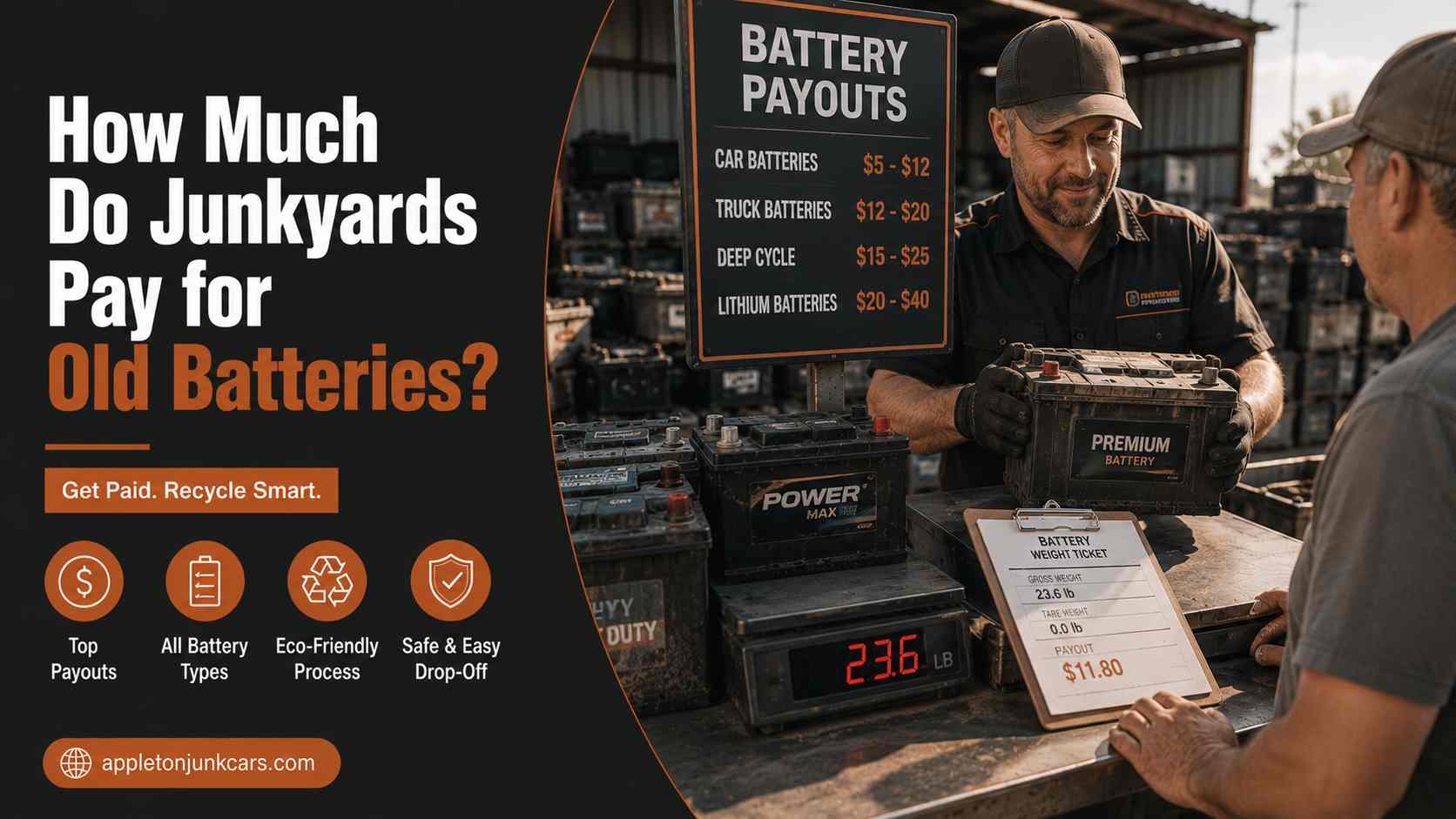
Junkyards and scrap facilities typically pay $5 to $20 for a standard 12-volt lead-acid car battery, with the exact amount determined by the battery’s weight and the current commodity price for scrap lead.
That range is narrower than most sellers expect, and in many cases, an auto parts store will pay more for the same battery through their core exchange credit program than a scrap yard will for the raw lead it contains.
The lead-acid car battery is one of the most actively recycled products in the country, but “actively recycled” does not mean “highly paid for in small quantities.” The value of a single battery in the scrap market reflects only the commodity value of the lead inside it at current market prices. Understanding how that value is calculated, and where alternative collection channels pay more, helps you make the most practical decision about where to take an old battery.
Lithium-ion and hybrid vehicle battery packs are a completely different category with a different market, much higher value when functional, and specific handling requirements. This guide covers both, starting with the lead-acid battery that is in almost every conventional vehicle and then addressing the EV and hybrid battery market.
What Junkyards Pay Is Based on Lead Commodity Prices, Not the Battery Brand
A standard 12-volt lead-acid car battery contains approximately 18 to 22 pounds of lead in its plates, grid structure, and posts. The rest of the battery weight is the polypropylene case, the sulfuric acid electrolyte, and separators. When a scrap yard purchases a battery, they are buying the lead content and nothing else.
Scrap lead prices fluctuate with the commodity market but typically run $0.20 to $0.40 per pound for automotive battery lead at most recycling facilities. This translates to $4.00 to $8.80 for the lead in a standard battery at typical market rates. Buyers add a small margin to their posted battery prices, producing the $5 to $20 range you will see quoted at most facilities. Heavier batteries, such as those from trucks, vans, and marine applications, pay more because they contain more lead.
The battery brand, age, or original purchase price has no effect on the scrap value. A new die-hard from a major brand and a generic economy battery of the same group size are worth exactly the same at a scrap facility: the weight of the lead inside.
Battery Values by Type and Size
Battery Type | Typical Weight | Estimated Lead Content | Scrap Yard Pay Range | Auto Parts Store Core Credit |
|---|---|---|---|---|
Standard car battery (Group 35, 47, 51) | 35 to 45 lbs | 18 to 22 lbs lead | $5 to $15 | $10 to $18 (credit on new purchase) |
Truck or large vehicle battery (Group 65, 75, 78) | 40 to 55 lbs | 22 to 28 lbs lead | $8 to $20 | $12 to $22 |
Marine / deep cycle battery | 50 to 70 lbs | 28 to 40 lbs lead | $10 to $25 | Not typically accepted without purchase |
RV dual-purpose battery | 50 to 75 lbs | 28 to 42 lbs lead | $10 to $28 | Not typically accepted without purchase |
AGM (absorbed glass mat) battery | 40 to 60 lbs | 22 to 32 lbs lead | $8 to $22 | $12 to $25 |
Commercial truck battery (Group 4D, 8D) | 80 to 135 lbs | 45 to 75 lbs lead | $18 to $50 | Varies by retailer |
Commercial and heavy vehicle batteries are the highest-value single units in the lead-acid scrap market because of their weight. An 8D battery weighing over 100 pounds produces $22 to $50 in scrap value. For fleets or businesses disposing of multiple commercial batteries, aggregating them for a single bulk pickup from a licensed battery recycler typically produces better per-unit prices than individual drop-offs.
Why Auto Parts Stores Often Pay More Than Scrap Yards
The core exchange system used by auto parts retailers produces a better financial outcome for most battery sellers than a scrap yard does. When you purchase a new battery at AutoZone, O’Reilly, Advance Auto Parts, NAPA, or similar retailers, the store charges a core deposit of $10 to $22. This deposit is refunded in full when you return the old battery, regardless of whether you made the new purchase at that store.
The refund is structured as a credit against any purchase or, at many stores, as a straight cash refund at the register. The $10 to $22 core credit typically exceeds the $5 to $15 a scrap yard would pay for the same battery’s lead content. The auto parts retailer collects the core, ships it to a battery distributor or manufacturer, and recovers its core deposit through their supply chain. The result for you is the same: more money than the scrap market value.
To maximize battery value at an auto parts store without making a new purchase: call ahead and confirm the store accepts core returns without a corresponding purchase. Most major chain stores do, though policies vary by location and region. Bring the battery in with the terminals up and the case intact. A cracked case with leaking acid may be declined or accepted at a reduced credit.
Lithium-Ion and Hybrid Battery Packs: A Completely Different Market
Hybrid and electric vehicle battery packs are not lead-acid batteries and are not valued on the scrap lead market. These packs use lithium-ion, nickel-metal hydride, or lithium iron phosphate chemistry and contain no lead. Their value is based on the lithium, cobalt, nickel, and manganese they contain, on their remaining charge capacity, and on demand from battery refurbishers and replacement part buyers.
A functional Toyota Prius NiMH hybrid battery pack (the module that powers the hybrid system, not the 12V auxiliary battery) is worth $200 to $800 to a hybrid battery rebuilder or a private buyer who needs a replacement. A degraded pack with some functional modules is worth $50 to $200 for cell recovery. A completely failed pack with no functional modules has minimal recovery value.
Tesla, Chevy Bolt, Nissan Leaf, and other full EV battery packs are worth $2,000 to $15,000 or more in functional condition to battery refurbishers, salvage specialists, and EV owners who need replacements. These packs should never be taken to a standard scrap yard without prior inquiry, because the scrap yard’s standard pricing does not reflect the lithium-ion chemistry value and a functional pack would be dramatically undervalued. Contact an EV-specific salvage operation or a battery refurbishment company for accurate valuation.
The Best Places to Take Old Car Batteries for the Most Money
Destination | What They Pay | Best For | Notes |
|---|---|---|---|
Auto parts store (core credit) | $10 to $22 credit | Standard 12V lead-acid from any vehicle | Highest recovery for a single standard battery; no purchase required at most chains |
Battery retailer (Interstate, Batteries Plus) | $8 to $18 credit or cash | Standard and specialty batteries | May pay cash or store credit; call ahead |
Scrap metal yard | $5 to $20 cash | Any lead-acid battery; best for volume | Lower per-unit than core credit but accepts any quantity without purchase requirements |
Licensed battery recycler | $5 to $25 | Volume lots; specialty and commercial batteries | Best for large quantities; may offer pickup for commercial volumes |
EV battery specialist | $200 to $15,000+ | Hybrid and EV battery packs | Required for accurate valuation of lithium chemistry packs |
Municipal hazardous waste collection | $0 (disposal service) | Any battery type; guaranteed acceptance | Not a payment channel but universal acceptance for any battery |
The practical recommendation for most individuals: take the battery to an auto parts store for the core credit if you are in the market for any auto supplies. If you are not purchasing anything, call ahead to confirm the store accepts standalone core returns. For hybrid or EV battery packs, contact a specialist before accepting any offer from a general buyer who may not understand the chemistry value.
What Sellers Consistently Report About Battery Recycling
People who have gone through the process of recycling old car batteries share consistent findings. Those who went directly to a scrap yard and accepted the posted battery price almost always later discovered that the same battery would have earned more at an auto parts store through the core credit program. The auto parts route is consistently worth $5 to $10 more per battery and requires no more effort.
Those with multiple old batteries from a fleet or a garage cleanout found that licensed battery recyclers with bulk pickup programs offered better per-unit rates than individual scrap yard drop-offs, particularly for commercial-grade batteries. Several reported that the pickup was free for loads over ten batteries, making the net recovery higher than driving multiple trips to a scrap yard.
Hybrid vehicle owners who were not aware of the hybrid battery replacement market reported significant undervaluation when they accepted general scrap yard prices for NiMH hybrid packs. A Prius battery accepted for $15 at a general scrap yard was later discovered to be worth $400 to $600 to a hybrid battery rebuilder who was actively buying the same pack. Specialty battery packs require specialty buyers.
Frequently Asked Questions
How much do junkyards pay for old car batteries?
Junkyards and scrap facilities typically pay $5 to $20 for a standard 12-volt lead-acid car battery, based on the battery’s weight and the current scrap lead price of $0.20 to $0.40 per pound. Heavier commercial and truck batteries pay more. Auto parts stores typically pay $10 to $22 as a core credit for returning an old battery, which is usually more than a scrap yard’s lead-based price for the same unit.
What is the most money I can get for an old car battery?
The most you can typically get for a standard 12-volt lead-acid battery is $10 to $22 through an auto parts store core credit program. Scrap yards pay $5 to $15 for the same battery based on lead content. For hybrid or EV battery packs, the value is dramatically higher: $200 to $800 for functional hybrid packs and $2,000 to $15,000 for EV battery packs, obtainable from specialized battery refurbishers and EV salvage operations.
Do I need to go to an auto parts store to get money for a battery?
No, but it is often the best option for a standard car battery. Auto parts stores pay the highest amounts for standard 12V batteries through their core credit programs and accept batteries from any vehicle regardless of whether you are purchasing a replacement. Scrap yards pay less but are also a valid option, particularly for larger volumes or commercial battery sizes.
Are hybrid car batteries worth anything?
Yes. A functional Toyota Prius or Honda Insight NiMH hybrid battery pack is worth $200 to $800 to hybrid battery rebuilders and private replacement buyers. Partially functional packs with some good modules are worth $50 to $200 for cell recovery. These are very different values from the $5 to $20 a standard scrap yard might offer for the same pack without understanding its chemistry value.
Can I throw an old car battery in the trash?
No. Disposing of a car battery in household trash or a dumpster is illegal in all 50 states. Lead-acid batteries contain lead and sulfuric acid, both of which are toxic and hazardous. Car batteries are accepted for free recycling at auto parts stores, scrap yards, battery retailers, and municipal household hazardous waste programs. Every community has accessible, free collection options that eliminate any reason to improperly dispose of a battery.
Does it matter if the battery is dead when scrapping it?
No. A completely dead battery that holds no charge has the same scrap value as one that holds some charge. Scrap yards and auto parts store core programs price batteries on weight and lead content, not electrical function. The battery casing must be intact (no cracks or significant acid leakage) for most programs to accept it at full value, but a dead battery is fully accepted at standard scrap prices.
What is a battery core charge?
A battery core charge is a deposit of $10 to $22 collected by auto parts retailers when a new battery is purchased without returning an old one at the same time. The deposit is refunded when an old battery is returned. The core system financially incentivizes battery return and supports the closed-loop recycling supply chain where battery manufacturers recover lead from returned cores and use it in new batteries.
Can I get cash for my old car battery without buying a new one?
Yes, at most major auto parts retail chains. AutoZone, O’Reilly, Advance Auto Parts, and most NAPA locations accept battery returns for core credit or cash refund without requiring a concurrent new battery purchase. Call ahead to confirm the policy at your specific location, as some stores have slightly different procedures for standalone core returns.
The Bottom Line
For standard 12-volt lead-acid batteries, the auto parts store core credit is almost always the highest-recovery option, paying $10 to $22 compared to the $5 to $15 a scrap yard pays for the same lead content. The difference in effort is minimal: both require a trip to drop off the battery. The difference in payout is $5 to $10 per battery.
For hybrid and EV battery packs, the specialist market is the only accurate valuation channel. A general scrap yard quote for a hybrid battery or an EV pack dramatically understates the value of those units to the buyers who actually want them. Contact a hybrid battery rebuilder or an EV salvage specialist before accepting any general scrap price for these packs.
The one universal rule that applies to all battery types: never put a car battery in the regular trash. Every community has free collection options, and the legal exposure from improper battery disposal is real. The auto parts store, the scrap yard, and the municipal hazardous waste program are all easy access points that eliminate any reason to create that exposure.