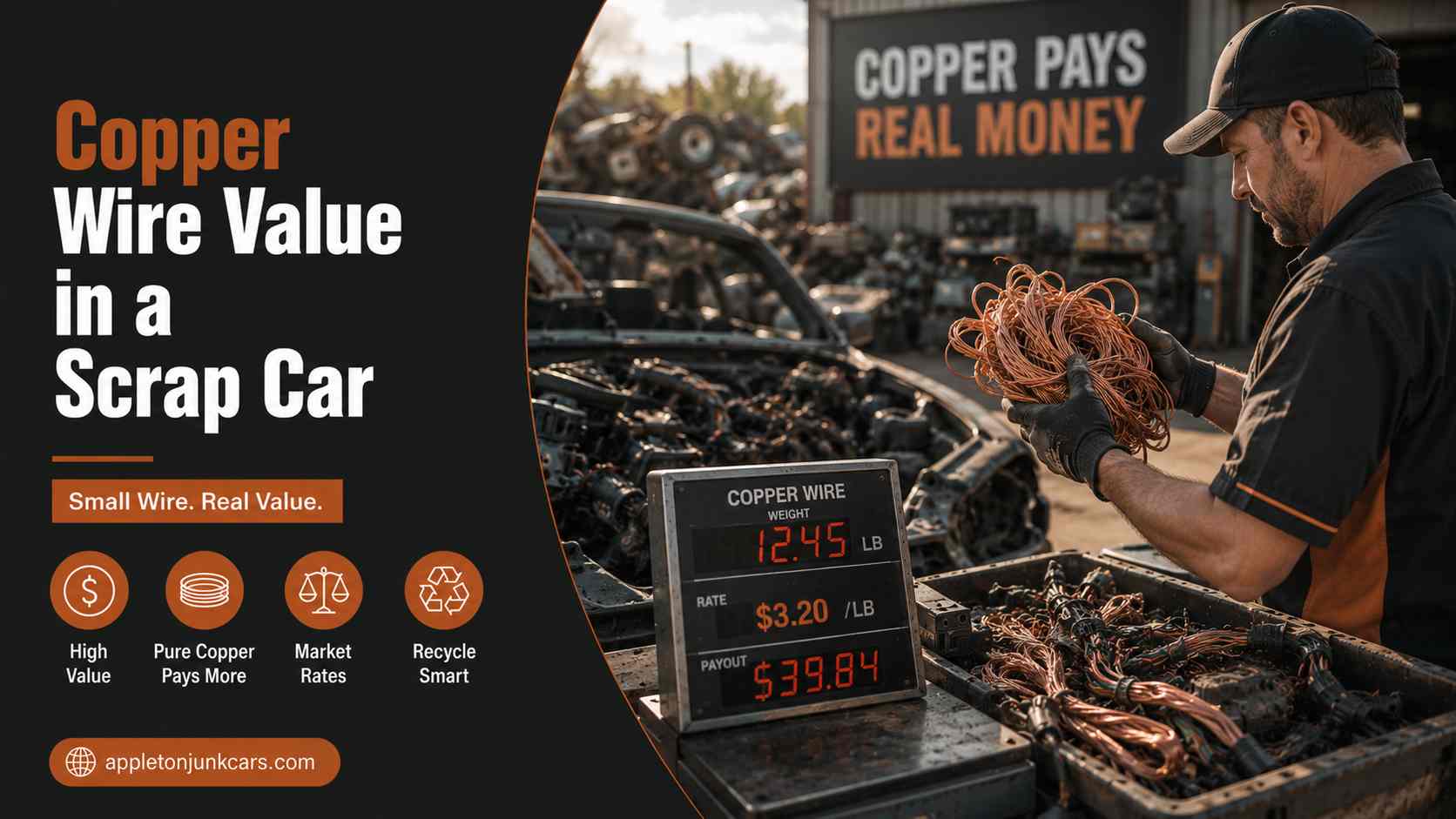
The copper wiring in a typical passenger car weighs between 25 and 55 pounds and would be worth $50 to $165 at current bare copper scrap prices if every strand could be separated and sold cleanly. In practice, insulated automotive wire, which is what is actually in your car, sells for $1.00 to $2.00 per pound, making the realistic value $25 to $110 for the complete wiring harness.
The labor required to remove a wiring harness from a vehicle ranges from four to eight hours for someone experienced and longer for someone who is not. The math on removing copper wire from a junk car almost never works out in the seller’s favor.
This does not mean the copper in your car is worthless. It means the copper is already reflected in what a salvage buyer pays for the complete vehicle, and the process of separating it yourself produces less total recovery than leaving it in place. Understanding exactly how much copper is in your vehicle, what it contributes to the overall scrap calculation, and what actually moves the needle on junk car offers gives you the right framework for deciding where to spend your time before the tow truck arrives.
Electric vehicles are a different story. The copper content in an EV is two to four times that of a conventional vehicle, and the copper in motor windings, battery interconnects, and charging systems is a meaningful fraction of the vehicle’s total material value.
How Much Copper Wire Is in a Typical Car
Copper is the primary conductor material in automotive electrical systems because of its excellent conductivity, flexibility, and resistance to corrosion. In a modern passenger vehicle, copper appears in the main wiring harness (the large bundled cable run that connects virtually every electrical system), body harnesses for each door and trunk, engine harness, chassis ground cables, battery cables, and individual component connections throughout the vehicle.
Vehicle Type | Approximate Copper Content | Notes |
|---|---|---|
Economy car (compact, subcompact) | 25 to 35 lbs | Less complex electrical system; fewer features |
Standard sedan or hatchback | 30 to 45 lbs | Mid-range electrical complexity |
Luxury sedan or SUV (heavy electronics) | 45 to 65 lbs | More sensors, larger harnesses, premium audio and convenience systems |
Full-size pickup truck (gas) | 35 to 55 lbs | Trailer wiring and accessories add to base content |
Hybrid vehicle | 50 to 80 lbs | High-voltage interconnects add to standard wiring |
Full electric vehicle (BEV) | 80 to 180 lbs | Motor windings, battery pack interconnects, fast charging systems substantially increase copper content |
The EV copper content is the most significant outlier. The copper in an electric motor’s windings alone can weigh 15 to 40 pounds. The battery management system interconnects and high-voltage cabling add another 20 to 50 pounds. This is part of why wrecked EVs with intact drivetrains carry significant non-battery material value beyond what scrap steel weight alone would suggest.
What Automotive Copper Wire Is Actually Worth
The scrap copper market distinguishes between different grades of copper material based on purity and cleanliness. Bare bright copper, the highest-grade material consisting of clean, uncoated copper wire, currently prices at approximately $3.00 to $4.50 per pound. This is the price that makes copper seem valuable.
Automotive wiring, however, is not bare bright copper. It is insulated copper wire, where PVC or cross-linked polyethylene insulation coats every conductor. Insulated copper wire sells for approximately $1.00 to $2.00 per pound at most scrap facilities, with the price depending on the insulation thickness relative to the conductor size. Thicker insulation (more plastic per pound of copper) produces lower prices per pound because the scrap yard must strip the insulation to recover the metal.
A wiring harness contains multiple conductors of varying gauge, bundled together in protective loom and wrapped with tape. The actual copper content of a wiring harness by weight is approximately 60 to 70 percent of the total harness weight; the remaining 30 to 40 percent is insulation, loom, tape, and connectors. At $1.50 per pound for insulated wire, a complete 35-pound wiring harness from a standard sedan yields approximately $52.50. The labor to remove that harness from a fully assembled vehicle ranges from 4 to 8 hours.
The Economics of Removing Copper Wire Before Scrapping
The core economic question: does removing the wiring harness and selling it separately produce more total recovery than selling the intact car to a salvage buyer who prices it as a complete unit?
The answer for almost every conventional vehicle is no. A salvage yard that purchases a complete intact vehicle prices the copper wiring, the catalytic converter, the battery, and all other components into their offer as a whole. They achieve the extraction cost-effectively because they have the right tools, the experience to do it in one to two hours rather than four to eight, and the buyer relationships to move the recovered material at scale. Selling the car intact to this buyer typically produces more than separately selling each component at retail scrap prices, because the buyer’s efficiency allows them to pay more for the whole unit.
The exception is salvage yards that specifically do not buy for parts recovery and are purchasing purely for shredder feedstock. A pure scrap buyer who prices only on weight does not fully credit the copper in the vehicle’s wiring, because the copper will end up in the shredder stream rather than being separately recovered. If the buyer is a straight scrap yard rather than a dismantler who recovers parts, the copper value is partially lost in the shredding process. In this specific case, understanding the copper contribution to total value is more relevant.
How Scrap Yards Handle Copper in the Shredding Process
When a vehicle hull passes through an industrial auto shredder, the resulting material is a mixture of steel, aluminum, copper, and non-metallic materials. After ferrous metal is removed by magnetic separation, the remaining non-ferrous fraction passes through eddy current separators and other sorting systems.
Copper from vehicle wiring harnesses does not emerge from the shredder as clean insulated wire. The shredder granulates the material, and the resulting copper fraction appears as small irregular pieces mixed with fragments of insulation. Some copper is recovered through the downstream separation process. Some copper ends up in the shredder residue (ASR) or in the non-ferrous mixed fraction that receives a blended price below pure copper value.
The practical implication: a vehicle processed through a shredder recovers some of the copper value but not all of it. A vehicle processed by a dismantler who removes and sells the wiring harness as a complete unit recovers more of the copper value but through a more labor-intensive process. The dismantler’s higher efficiency relative to the individual seller is why the complete car sale almost always produces better outcomes than seller-side copper removal.
Electric Vehicles: Where the Copper Equation Changes
In electric vehicles, the copper content is high enough that it becomes a meaningful independent consideration rather than a background factor in the overall car value. EV motor windings, which are precision-wound copper coils that generate the electromagnetic fields driving the motor, contain 15 to 40 pounds of high-purity copper in a relatively accessible form. EV high-voltage wiring is also heavier gauge than conventional automotive wiring, reflecting the higher currents it must carry.
For wrecked or end-of-life EVs, the motor winding copper is specifically sought after by electric motor rebuilders and copper recyclers who can process it more efficiently than standard wiring harnesses. However, accessing EV motor windings requires disassembling the electric drive unit, which is a specialized task requiring knowledge of high-voltage systems and specific tools.
The realistic path for most EV sellers is to sell the complete vehicle to an EV-specific salvage buyer who has the expertise and equipment to efficiently recover the full copper value, rather than attempting to extract individual components. EV salvage specialists price the motor, battery pack, and associated copper-intensive components into their whole-vehicle offer.
What Actually Moves the Needle on Your Scrap Car Offer
Component | Contribution to Offer | Action to Maximize |
|---|---|---|
Catalytic converter (intact, OEM) | $50 to $600 | Leave it in place; it is already included in every buyer’s offer |
Lead-acid battery (present and complete) | $8 to $20 | Leave in the car unless it is new and worth removing for separate resale |
Copper wiring (all intact) | $25 to $110 theoretical; usually included in whole-car price | Leave the harness; removal does not typically increase your net |
Vehicle weight (heavier = more) | $0.07 to $0.14 per pound for steel | Do not remove structural components; weight contributes to scrap floor |
Parts market demand for your make | $100 to $2,000+ above scrap | Call a make-specific salvage yard; this is where real money lives |
Aftermarket accessories (stereo, hitches) | $100 to $1,500 if appropriate brands | These ARE worth removing separately; they are not in the buyer’s formula |
The copper wiring is in the “leave it” category alongside the catalytic converter and the battery for most conventional vehicles. The aftermarket accessories, fifth wheel hitches, and service bodies are in the “remove separately” category because a whole-car buyer does not fully credit their market value. This distinction is what matters for maximizing total recovery.
Frequently Asked Questions
How much copper wire is in a car?
A typical passenger car contains 25 to 55 pounds of copper in its wiring harnesses, motor connections, and electrical components. Luxury vehicles with more complex electronics are toward the high end. Electric vehicles contain 80 to 180 pounds of copper due to motor windings, battery pack interconnects, and high-voltage charging systems.
What is automotive copper wire worth?
Insulated automotive copper wire, which is what wiring harnesses consist of, sells for approximately $1.00 to $2.00 per pound at scrap facilities. A complete wiring harness from a standard passenger car weighing 30 to 40 pounds is worth approximately $30 to $80. Bare bright copper without insulation sells for $3.00 to $4.50 per pound but requires stripping the insulation, adding labor cost.
Is it worth removing copper wire from a car before scrapping?
For most conventional vehicles, no. The four to eight hours of labor required to remove a wiring harness from an assembled vehicle rarely produces enough additional recovery to justify the time. A salvage buyer who purchases the complete vehicle already prices the copper content into their offer and can extract it more efficiently than an individual seller. The exception may apply to EVs where the copper content is much higher.
Do scrap yards pay extra for cars with copper wire?
Scrap yards that purchase vehicles as dismantlers and recover parts separately do credit the copper wiring in their whole-car offer, though not at the full retail copper scrap price. Scrap yards that purchase for shredder feedstock only partially recover the copper value through downstream material separation. Calling a dismantler rather than a pure scrap buyer produces a higher offer that reflects more of the vehicle’s copper value.
How much copper is in a Tesla or electric vehicle?
Electric vehicles contain 80 to 180 pounds of copper, compared to 25 to 55 pounds in a conventional vehicle. The additional copper comes from electric motor windings (15 to 40 lbs per motor), high-voltage battery pack interconnects and cables (20 to 50 lbs), and charging system components. This higher copper content is one of several reasons that wrecked EVs command higher salvage values than equivalent conventional vehicles in non-running condition.
What is the best component to remove from a junk car to get more money?
The catalytic converter should never be removed before sale as it is already priced into every offer. The highest-value components worth removing separately are aftermarket accessories with standalone market value: a name-brand double-DIN head unit with CarPlay ($80 to $300), an aftermarket amplifier or subwoofer ($100 to $500), a fifth wheel or gooseneck hitch ($400 to $1,200), or a service body or flatbed ($1,500 to $5,000). Copper wiring is not in this category for most vehicles.
Does the copper wiring affect how much a junkyard pays for my car?
Yes, indirectly. A dismantler who recovers parts prices the complete vehicle’s copper wiring into their offer as part of the total recoverable value. A pure scrap yard prices primarily on steel weight, and the copper contributes less because it goes into the shredder stream rather than being separated and sold at full copper scrap value. This is one reason why a dismantler typically offers more for an intact vehicle than a scrap yard: they recover more value from every component, including copper.
What happens to copper wire in a car that gets shredded?
When a vehicle hull is processed through an auto shredder, the copper wiring is fragmented and mixed with other non-metallic materials. After ferrous metals are removed magnetically, the non-ferrous fraction (including copper fragments) is separated by eddy current systems and further sorted. Some copper is recovered as a mixed non-ferrous fraction. Some ends up in the shredder residue. The overall copper recovery rate through shredding is lower than through dismantler-side wiring harness removal.
The Bottom Line
Copper is present in meaningful quantities in every car, but the economics of recovering it independently almost never favor the seller. A salvage buyer who prices the complete vehicle has already incorporated the copper wiring value into their offer, and they can extract it at lower cost than you can because they have the tools, the experience, and the established buyer relationships.
The time you would spend removing a wiring harness is better invested in getting three competing quotes from different buyer types, confirming that the catalytic converter is intact and credited in every offer, and identifying genuine accessory items like aftermarket audio equipment or towing hardware that buyers do not price but the private market does.
For electric vehicles, the copper equation is different enough to warrant contacting an EV specialist rather than a conventional salvage buyer. The copper content is higher, more concentrated, and more accessible, and an EV specialist’s offer will reflect that content more accurately than a general junk buyer’s formula.