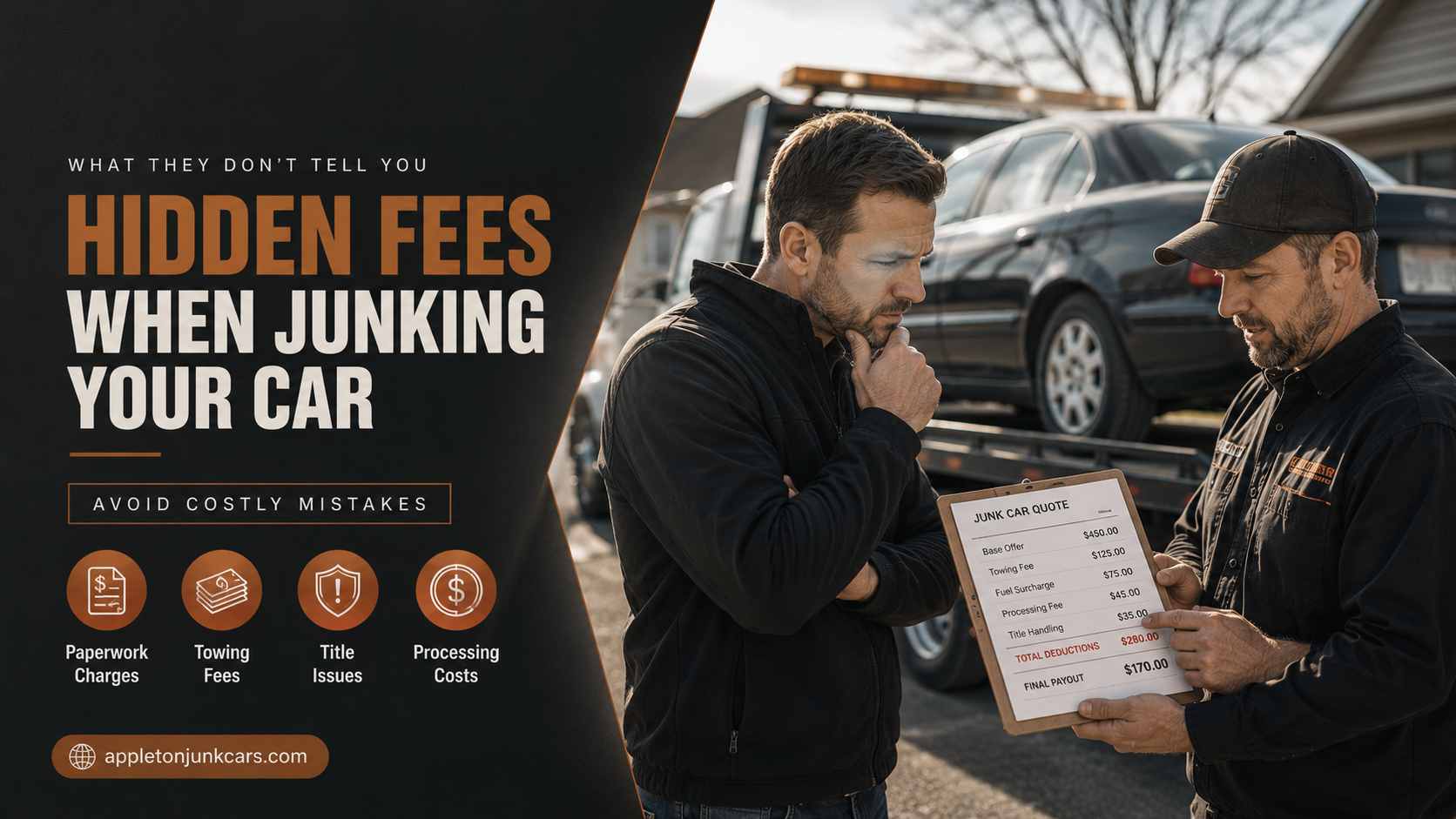
Yes, hidden fees are a real problem in the junk car industry, and they cost sellers hundreds of dollars every single day. Some buyers advertise strong offers and then quietly reduce the payout at pickup using fees most people have never heard of. Others are completely transparent and charge nothing beyond what was quoted. Knowing the difference before you commit protects your money and your time. This guide walks through every fee tactic used in this industry, the questions to ask before you agree to anything, and the red flags that tell you to walk away.
The Fee That Catches the Most People Off Guard
The most common hidden fee in the junk car industry is not a fee at all in the traditional sense. It is a price reduction that happens at the door.
Here is how it works. You call a junk car buyer, describe your car over the phone, and receive an offer of, say, $450. You agree, schedule a pickup for the next morning, and feel good about the deal. The driver shows up, spends a few minutes looking at the car, and then tells you the car is worth less than quoted. Maybe he says there is more rust than expected. Maybe he says the tires are flat. Maybe the quote was based on different information. The new offer is $300.
At this point, most people accept. The driver is already there. The car is still sitting in your driveway. Calling another buyer means waiting another day or two. The time pressure created by that moment is not accidental. It is a tactic, and it works reliably on sellers who are not prepared for it.
The protection against it is simple: get your quote in writing and confirm explicitly that the written number is the amount you will receive at pickup, with no deductions unless something materially different is found. We will cover exactly what to ask in a later section.
The Hidden Fee Tactics Used in the Junk Car Industry
1. The Price Drop at Pickup
Already described above, but worth expanding on. The price drop at pickup is the most widely reported complaint among junk car sellers. The buyer gives a competitive quote to secure the appointment, then reduces it in person using vague justifications about condition or market changes. Legitimate buyers do occasionally need to adjust an offer if something genuinely different from the description is found, such as a missing engine or a completely crushed frame. That is reasonable. What is not reasonable is a buyer who routinely adjusts quotes downward as a standard business practice rather than as a response to genuine discrepancies.
If a buyer drops the price at pickup without a clear, specific reason tied to something you did not disclose, you are within your rights to decline the sale and call another buyer.
2. Towing Fees Deducted From the Offer
Many junk car buyers advertise free towing, and reputable ones genuinely do include it. But some buyers offer a quote that sounds competitive and then deduct a towing fee at the time of payment. A $400 offer with a $125 towing deduction nets you $275, which may be lower than what another buyer would have paid upfront with no deduction. Always confirm in writing that towing is included in the quoted amount and that no towing fee will be deducted at pickup.
If a buyer tells you towing is free verbally but the written paperwork shows a towing line item, do not sign anything until that is resolved.
3. Condition Deductions That Were Never Mentioned
Some buyers present a standard list of deductions they apply for various conditions but never mention these upfront. Common examples include deductions for flat or missing tires, a cracked windshield, missing catalytic converter, missing battery, or interior damage. Each deduction can run anywhere from $25 to $200 depending on the buyer.
These deductions are not inherently unfair. A car missing its catalytic converter genuinely is worth less. What is unfair is when a buyer uses these deductions to surprise you at pickup after quoting a price that appeared to include all those factors. A buyer who asks thorough questions upfront, including about the catalytic converter, tires, and interior, and then gives you a quote, should not be applying additional condition deductions on the day of pickup for the same things they already knew about.
When you call for a quote, be as detailed as possible about the car’s condition and ask the buyer whether their offer accounts for everything you have described.
4. Missing Parts Charges Beyond What Is Reasonable
A related tactic is applying parts deductions for items that were either already factored into the quote or were not material to the car’s value. Some buyers present a list of missing parts at pickup and assign values to each one, collectively reducing your payout by a significant amount.
The honest version of this is legitimate: if you told the buyer the car was complete and it turns out the engine is missing, that affects the offer. The dishonest version is assigning dollar amounts to minor missing items like a hubcap or a spare tire that any buyer would have priced into the offer from the beginning.
Ask specifically whether the quote assumes all major components are present and what the buyer’s policy is if something is missing.
5. Administrative or Title Transfer Fees
Some buyers charge an administrative fee or title processing fee that is deducted from your payout. These fees are typically $25 to $75 but can be higher. In most cases, a reputable buyer handles all title transfer paperwork at no cost to you. It is part of doing business.
Occasionally a legitimate charge applies, such as if your state requires the seller to file a specific DMV form that carries a small state fee. That is different from a buyer charging you for their own internal paperwork. Ask upfront whether any administrative or title fees will be deducted from your payment.
6. Distance or Mileage Fees
If your car is located far from the buyer’s nearest operating area, some buyers apply a distance fee that reduces your payout. This is more common with smaller local operations than with national services. The fee might be presented as a fuel surcharge, a long-haul towing fee, or simply a location adjustment.
Whether this is fair depends on how it is presented. A buyer who tells you upfront that your location is outside their standard service area and adjusts the quote accordingly is being transparent. A buyer who quotes a strong number and then reveals a location deduction at pickup is not.
When you call for quotes, always confirm that the driver can reach your location and ask whether the quote accounts for your specific address.
7. Weight Measurement Tricks
This one is less common but worth knowing because it is a genuine industry tactic. Scrap is priced per ton, and there are two different definitions of a ton in use. A short ton is 2,000 pounds, which is the standard US measurement. A long ton is 2,240 pounds, which is used in some international contexts.
Some buyers quote based on long tons rather than short tons without disclosing this. Since a long ton is 12 percent heavier than a short ton, using it quietly reduces your effective payout. When a buyer mentions weight-based pricing, ask specifically which unit of measurement they are using.
8. Cancellation or Rescheduling Fees
A small number of buyers charge a cancellation fee if you accept an offer and then back out before pickup. These fees are not common among reputable national buyers, but they do appear in some contracts. Before signing any agreement or accepting a written offer, read any terms about cancellation.
Most legitimate junk car buyers do not require a signed contract before pickup and do not charge cancellation fees. If a buyer asks you to sign paperwork before they have even seen the car or asks you to commit in a way that carries financial penalty if you change your mind, that is a red flag.
9. Weekend or After-Hours Pickup Fees
Some buyers offer free pickup during business hours but apply a surcharge for weekend or evening pickups. If your schedule requires a weekend pickup and the buyer has not mentioned this fee, you may find a deduction applied at payment.
If you are scheduling a pickup outside standard weekday hours, ask specifically whether any timing surcharge applies.
10. Unpaid Registration or Ticket Deductions
This one varies by state and buyer, but some buyers will check a vehicle’s registration status or outstanding ticket history before completing the purchase. If the car has unpaid registration fees or unresolved traffic violations attached to the plate or VIN, some buyers factor these into what they are willing to pay, since they may eventually deal with these issues in the title transfer process.
Legitimate buyers typically do not deduct these from your payout since the title transfer process handles liability separately. Be cautious of any buyer who presents unpaid fees as a reason to significantly reduce your offer without a clear explanation of why those fees affect them.
Fees That Are Actually Legitimate
Not every fee or adjustment is a scam. Some are genuine and reasonable, and knowing the difference keeps you from being suspicious of fair buyers.
Genuine condition adjustments. If you told the buyer the car has a working engine and the driver arrives to find the engine has been removed, a price adjustment is fair. You cannot accurately price a car based on inaccurate information. Be honest and detailed in your description upfront so adjustments are minimal.
State DMV filing fees. In some states, sellers must pay a small fee to file a release of liability or vehicle disposal notice with the DMV. This is a government charge, not a buyer charge. These are typically under $20.
Distance-based adjustments disclosed upfront. If a buyer tells you at the time of quoting that your location is at the edge of their service area and the offer reflects that, the adjustment is transparent and fair. What is not fair is learning about a location surcharge for the first time at pickup.
Deductions for major missing components that were not disclosed. If you forgot to mention that the catalytic converter is missing and the buyer discovers it on arrival, a deduction for that is reasonable. This reinforces the importance of describing the car accurately and completely when requesting quotes.
Questions to Ask Before You Commit to Any Buyer
These questions take about five minutes total and can save you from every fee tactic covered in this guide. Ask them on the phone or in writing before agreeing to any pickup.
- Is towing included in the quoted amount? Will any towing fee be deducted from my payment at pickup?
- Is this the amount I will receive at pickup, assuming the car matches my description? Will anything be deducted on the day unless something materially different is found?
- Are there any administrative, title, or processing fees? Will any fees be deducted from my payment?
- Does the quote account for all the conditions I have described, including the flat tires, missing parts, or damage I mentioned?
- Is there any fee for a weekend or evening pickup?
- Can I get the offer in writing before pickup day?
- What is your cancellation policy? Is there any fee if I need to reschedule or cancel?
A buyer who answers all of these clearly and without hesitation is worth working with. A buyer who becomes evasive, vague, or impatient with these questions is telling you something important.
Quick Reference: Hidden Fee Red Flags vs. Legitimate Adjustments
Situation | Red Flag or Legitimate? | What to Do |
|---|---|---|
Price drops at pickup without specific reason | Red flag | Decline the sale, call another buyer |
Towing fee deducted from payout | Red flag if not disclosed upfront | Confirm free towing in writing before agreeing |
Condition deduction for something you described | Red flag | Point out you disclosed it and push back |
Deduction for missing engine you forgot to mention | Legitimate | Be thorough in your description next time |
Administrative or title processing fee | Red flag if buyer-imposed | Ask upfront whether any fees apply to your payout |
Distance surcharge disclosed at time of quote | Legitimate | Acceptable if you were told before agreeing |
Distance surcharge revealed at pickup | Red flag | Decline, this should have been disclosed upfront |
Small state DMV filing fee | Legitimate | This is a government charge, typically under $20 |
Weekend or after-hours surcharge not mentioned | Red flag | Ask about timing fees before scheduling |
How to Protect Yourself From Pickup Day Surprises
Getting a quote in writing is the single most effective protection. A written offer forces the buyer to commit to a number and eliminates the ambiguity that allows price drops to happen without accountability. When you request a written offer, ask that it specify the offer amount, that towing is included, that no additional fees will be deducted unless something materially different from your description is found, and what the definition of materially different means.
Get at least three quotes before agreeing to any pickup. The range of offers for the same car is often surprising, and comparing multiple quotes quickly reveals whether a first offer is competitive or whether it is being padded to allow room for a significant pickup-day reduction.
Be thorough and honest in your description when calling for quotes. Describe the car’s condition, note what is missing or damaged, and mention any known issues. A buyer who prices the car accurately based on complete information has no legitimate grounds to reduce the offer at pickup. The more accurate your description, the less room exists for condition-based surprises.
Take photos of the car before pickup. If a buyer claims the car’s condition is significantly different from what you described, photos dated before the pickup document the car’s actual condition at the time of the sale.
Do not feel pressured to accept a reduced offer on pickup day. The car is still in your possession until you sign the title. You can decline the new offer, call other buyers, and schedule another pickup without any legal or financial obligation, as long as you have not signed anything committing you to the original buyer.
What Real Sellers Have Experienced
Owners who have gone through the junk car selling process share consistent experiences when they discuss what caught them off guard.
The most frequent complaint is exactly the pickup-day price drop. Sellers describe accepting a phone quote, making arrangements to be home for pickup, and then watching the offer shrink by $75 to $200 on the spot. Those who push back or say they want to call another buyer often report that the driver suddenly finds room to raise the offer back toward the original number. That pattern reveals that the initial reduction was a test, not a genuine reappraisal.
A second common experience involves towing fees that were not mentioned on the call. Sellers describe assuming towing was included because it was not mentioned and feeling blindsided when $100 or more was deducted from their payment at pickup. Several people who have gone through this say the fix was simple in hindsight: just ask the question directly and get the answer in writing.
A third pattern involves buyers who ask what the seller is hoping to get before giving a quote. This question is designed to anchor your expectations low before the buyer makes an offer. Sellers who name a number first often receive an offer near or just below that number, even if the market rate for their vehicle is higher. Give descriptions, not target prices, when talking to buyers. Let the buyer name their number first.
Red Flags That Signal a Problematic Buyer
Some warning signs are worth knowing before you ever pick up the phone.
- No written offer. Any reputable buyer can provide a written offer. A buyer who will only communicate verbally is not giving you accountability.
- Pressure to decide immediately. A legitimate offer does not expire in the next two hours. Urgency tactics are designed to prevent you from comparing quotes.
- Asking what you want before giving a quote. This anchors your expectations before the buyer shows their hand. Name your car’s condition, not your target price.
- Vague answers to direct questions about fees. If a buyer cannot clearly answer whether towing is included or whether additional fees apply, that ambiguity is intentional.
- No verifiable reviews or licensing information. Reputable buyers have a reviewable presence. Check Google, Yelp, or the Better Business Bureau before committing to a less familiar company.
- Cash-only payment with no receipt. Professional junk car buyers pay by check or provide a receipt for cash payments. No paper trail protects neither party.
- Driver arrives without a tow truck. If a buyer shows up in a personal vehicle to look at your car before bringing a truck, that is an unusual step that some scammers use to assess the vehicle before attempting a significant lowball offer in person.
Frequently Asked Questions
Do junk car buyers charge towing fees?
Reputable junk car buyers include free towing as part of their service. That said, not every buyer operates this way. Some deduct a towing fee from your payout without disclosing it upfront. Always ask whether towing is included in the quoted amount and get the answer in writing before agreeing to any pickup.
Is it normal for a junk car buyer to lower the offer at pickup?
Occasional adjustments based on genuine discrepancies between your description and the actual car are normal and fair. What is not normal is a systematic practice of quoting high and reducing at pickup regardless of condition. If the car matches your description and the buyer still wants to drop the price, that is a bait-and-switch tactic and you should decline and call another buyer.
What fees are actually legitimate when junking a car?
Legitimate adjustments include price reductions for major components you failed to disclose, small state DMV filing fees where required by law, and distance-based adjustments that were disclosed at the time of quoting. Any buyer-imposed administrative fee, title fee, or processing fee that reduces your payout and was not disclosed upfront is worth questioning.
What should I do if a buyer tries to lower the price at pickup?
Ask for a specific reason tied to something you did not disclose. If the reason is vague or based on conditions you already described on the phone, you can decline the sale. The car is yours until you sign the title. Tell the driver you need to think about it, and call at least one other buyer to compare. In many cases, the driver will call back with a revised offer closer to the original.
Can I get a junk car offer in writing?
Yes, and you should. Reputable buyers will provide a written offer either by email or text before the pickup day. This gives you documentation of the agreed price and protects you if the driver tries to reduce it on arrival.
How do I know if a junk car buyer is reputable?
Look for verifiable online reviews on Google or the Better Business Bureau. Ask direct questions about fees and towing upfront. Choose buyers who answer clearly and without hesitation. Established national services generally have more accountability than small local operations with no online presence, though there are excellent local yards as well. The questions you ask matter more than the size of the company.
Is there any fee for canceling a junk car pickup?
Most reputable buyers do not charge cancellation fees. A few smaller operations or contracts may include them. Read any written agreement before signing and ask directly whether a cancellation fee applies before you commit.
The Bottom Line
Hidden fees in the junk car industry are real, they are common, and they are almost entirely avoidable once you know what to look for. The most expensive mistake sellers make is not asking questions upfront and then feeling trapped when a price drops at pickup.
The protection is straightforward. Describe your car honestly and in detail. Get at least three written quotes. Confirm in writing that towing is included and that no fees will be deducted unless something genuinely different from your description is found. Ask about administrative fees, distance fees, and weekend surcharges before you agree to any appointment.
Buyers who operate honestly welcome these questions because they have nothing to hide. Buyers who become vague or evasive when you ask direct questions about fees are, in that moment, showing you exactly what the pickup day experience will look like. That information is worth more than any quote they give you over the phone.
Take your time, compare your options, and do not let time pressure push you into accepting a number you did not agree to.