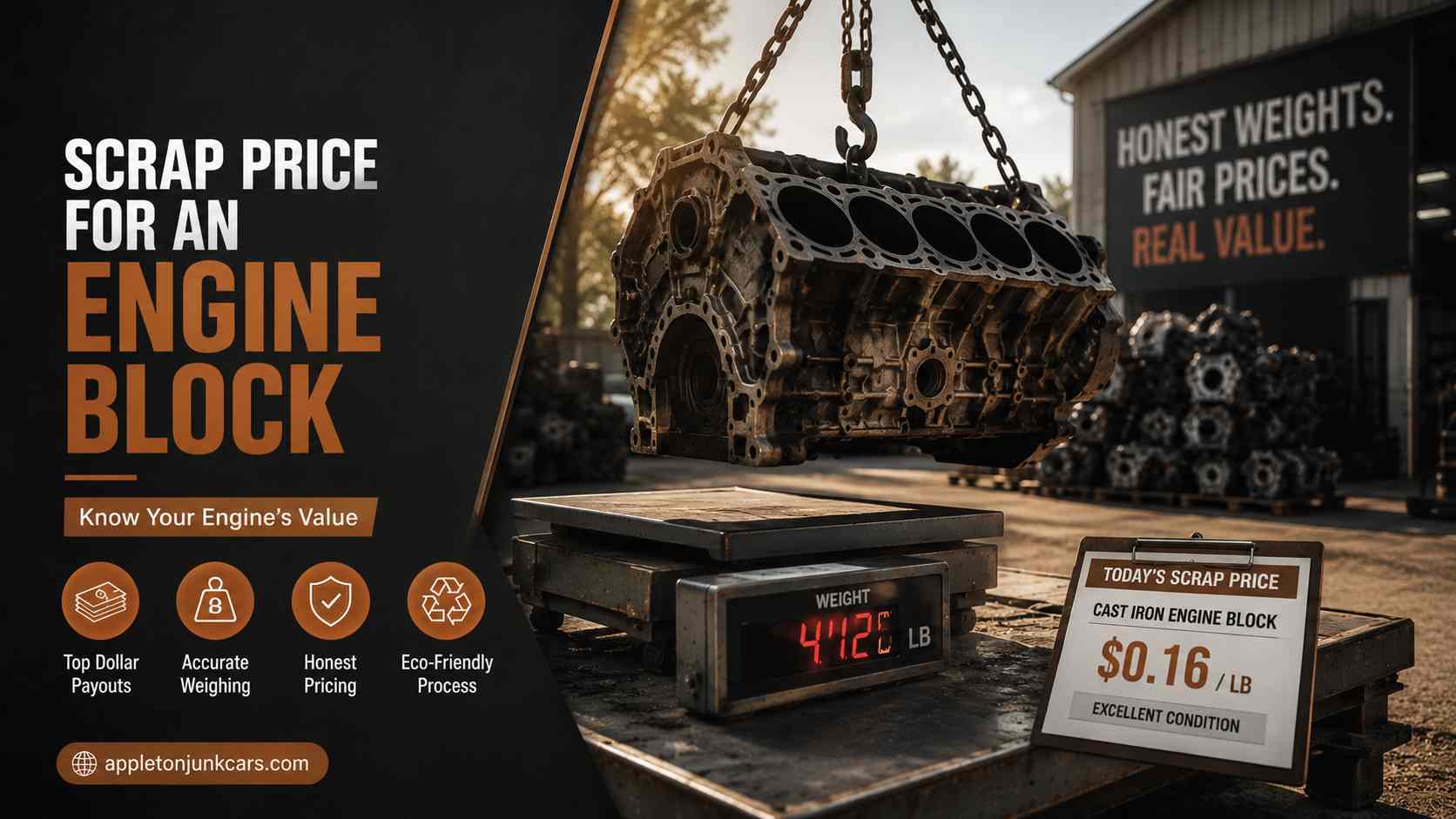
An engine block is worth between $9 and $87 in scrap, depending on whether it is aluminum or cast iron, how much it weighs, and how thoroughly it has been prepared before delivery.
Those two variables, metal type and preparation, determine which price bracket your specific block falls into, and the gap between the lowest and highest outcomes is meaningful enough to be worth understanding before you load anything onto a truck.
To get the exact scrap value for your engine block, you need to know the specific metal, its weight, and how local scrap yards categorize it. This guide covers all three, plus the preparation and documentation requirements that determine whether a yard will accept the block at all.
Metal Type and Market Rates
Scrap yards sort engine blocks into specific metal categories, and the category determines the per-pound rate. Prices fluctuate daily based on global commodity markets, but the relative ranking between clean aluminum, dirty aluminum, and cast iron stays consistent. What changes is where each category sits on any given day.
Category | Rate per Pound | Condition Required |
|---|---|---|
Clean Aluminum | $0.20 to $0.58/lb | All steel, iron, plastic, and brass fully removed |
Dirty Aluminum | $0.12 to $0.25/lb | Aluminum block with attached steel bolts, iron sleeves, or bearings |
Cast Iron | $0.06 to $0.10/lb | Categorized as heavy melting steel or auto cast |
Clean Aluminum: $0.20 to $0.58 per Pound
This is the premium category and applies only to aluminum engine blocks that have been fully stripped of all dissimilar metals. Every steel bolt, every iron cylinder sleeve, every brass plug, and every plastic component must be removed before the block qualifies for the clean aluminum rate. Yards that pay the clean rate are recovering high-purity aluminum alloy that goes directly to smelters without additional sorting. If a yard has to sort through or process what you bring, they will not pay the clean rate.
Getting a block to clean aluminum status requires tools and time. You need to remove all iron cylinder liners if present, pull all remaining steel fasteners, clean off any plastic timing cover remnants, and ensure no coolant passages are blocked by brass freeze plugs. For sellers willing to do this work, clean aluminum is roughly double the per-pound rate of dirty aluminum.
Dirty Aluminum: $0.12 to $0.25 per Pound
Dirty aluminum applies when the block is aluminum but still has steel bolts, iron sleeves, or other contaminants attached. Most engine blocks that arrive at a scrap yard fall into this category because the full cleaning process is time-consuming and most people do not complete it before selling.
Yards that buy dirty aluminum process it through a shredder or smelter that separates materials, but the additional processing step is reflected in the lower price they pay. Dirty aluminum is still significantly more valuable per pound than cast iron, but it pays roughly half of what clean aluminum commands.
Cast Iron: $0.06 to $0.10 per Pound
Cast iron blocks, common in older vehicles, diesel engines, and heavy-duty truck applications, are categorized by scrap yards as heavy melting steel or auto cast. This is the lowest per-pound rate of the three categories, but cast iron blocks are also the heaviest, which partially compensates for the lower price per pound.
Cast iron weighs approximately 0.26 to 0.28 pounds per cubic inch. An old V8 cast iron block can weigh 300 pounds or more, which at $0.08 per pound is still $24 in scrap value despite the low rate. The weight is what carries the transaction for cast iron.
Weight Estimations by Engine Type
Because scrap yards pay strictly by weight, the size and construction of your engine determines your final payout. Here are realistic weight ranges and the resulting scrap value at current market rates.
Engine Type | Est. Weight | Scrap Value Range | Metal Category |
|---|---|---|---|
4-Cylinder Aluminum (Modern) | 70 to 100 lbs | $14 to $58 | Dirty to clean aluminum |
V6 / V8 Aluminum (Modern) | 110 to 150 lbs | $22 to $87 | Dirty to clean aluminum |
4-Cylinder Cast Iron (Older / Diesel) | 150 to 200 lbs | $9 to $20 | Heavy melting steel / auto cast |
V8 Cast Iron (Classic / Truck) | 250 to 350 lbs | $15 to $35 | Heavy melting steel / auto cast |
The wide spread within each range reflects the difference between clean and dirty preparation for aluminum blocks, and between current market low and high rates for cast iron blocks. A V6 aluminum block that arrives at the yard fully stripped of attachments at a strong aluminum market day can reach the upper end of its range. The same block arriving dirty at a weaker market day lands near the bottom.
A practical example: A 2015 Chevrolet Silverado 5.3L V8 aluminum block weighs approximately 130 to 140 pounds. Arriving dirty at $0.18/lb: approximately $23 to $25. Arriving clean at $0.45/lb: approximately $58 to $63. The two hours of cleaning work to achieve the clean rate is worth $35 to $40 on a single block. Whether that trade-off makes sense depends on your time and whether you have the tools to do it efficiently.
Clean vs. Dirty Aluminum: Is the Cleaning Worth It?
This is the most practical question most sellers face with an aluminum block. The math above shows the rate difference, but the real question is whether the labor of achieving clean aluminum status produces a net positive return.
For most individuals selling a single engine block, the answer is probably not. Getting a modern aluminum block to true clean status requires removing all iron cylinder liners, which are pressed in and require a hydraulic press or significant mechanical effort, pulling all remaining hardware, and ensuring nothing non-aluminum remains. On a single block worth $25 in dirty aluminum, spending two hours and potentially needing shop tools to get to $55 clean may not make economic sense.
For automotive businesses, machine shops, or recyclers processing multiple blocks regularly, the math changes. At volume, investing in the tools and process to clean blocks before selling consistently returns the rate premium and compounds across every transaction.
If you are not going to fully clean the block, make sure at minimum that you have drained all fluids and removed any obvious plastic components. Even partial preparation keeps you in the higher end of the dirty aluminum range rather than the bottom of it.
Critical Yard Rules and Requirements
Before hauling your engine block to a scrap yard, you must meet specific preparation and legal requirements. Showing up without meeting these can result in your load being refused, the price being significantly reduced, or the transaction failing to complete entirely.
Fluid Drainage
Yards will reject engines containing oil, coolant, or transmission fluid due to environmental laws. You must drain the block completely before delivery.
This is the single most common reason engine blocks are rejected at scrap yards. Environmental regulations prohibit yards from accepting metal contaminated with oil, coolant, or other automotive fluids because these fluids must be handled as hazardous waste and cannot simply drain onto the yard’s ground or into their processing equipment.
To drain an engine block properly: remove the oil drain plug and drain pan to empty remaining oil from the block passages, remove the coolant drain plug or pull the lower radiator hose location on the block to drain coolant galleries, and if any transmission fluid is present, drain that as well. Tipping the block in multiple directions after draining helps clear remaining fluid from internal passages.
Some yards have a drill press available at intake and will drill the oil pan themselves for an additional fee. Ask the yard before you arrive whether they offer this service or whether you must drain the block beforehand. If you arrive with a wet block at a yard that does not accept them, you will need to load it back up and come back.
Identification
You must bring a valid government-issued photo ID to complete the transaction. Most states and provinces now require scrap yards to log the full name, address, and ID number of every person who sells metal, particularly automotive powertrain components.
This requirement exists because engine theft is a real and documented problem. Thieves who steal engines from vehicles need to sell them somewhere, and requiring identification creates an audit trail that law enforcement can use. Legitimate sellers are not affected by this requirement beyond needing to bring their ID, which is a minor inconvenience in exchange for a system that reduces the market for stolen components.
Ownership Proof
Some jurisdictions require a vehicle title or a bill of sale to scrap major powertrain components including engines and transmissions. This requirement is more common in states and provinces that have experienced high rates of catalytic converter theft and have extended their anti-theft protections to other major components.
Even where not legally required, having a title or bill of sale documenting that you legitimately obtained the engine significantly smooths the transaction. A yard that has doubts about the provenance of a component may decline to buy it entirely. Documentation eliminates those doubts.
If you removed the engine from a vehicle you own, the vehicle’s title is your proof. If you purchased the engine separately, a bill of sale from the seller serves the same purpose. If the engine was given to you or came from a vehicle you no longer have title to, check with the yard beforehand about what documentation they accept for your specific situation.
Scrap vs. Selling as a Used Part: The Decision That Matters Most
Before you call a scrap yard, one question is worth asking first: is this engine worth more as a used part than as scrap?
An engine block with minor damage or high mileage that failed for a non-catastrophic reason, such as a timing chain that jumped or a head gasket that blew, may still have significant used part value. A rebuilt or salvage engine for a popular vehicle can sell for $400 to $1,500 on Facebook Marketplace or Craigslist, compared to $25 to $87 as scrap.
The used part path applies when: the engine is from a popular make and model with active demand for used parts, the internal damage is limited to a specific component rather than a catastrophic failure across the engine, the block itself is not cracked or warped, and you have the time to list, photograph, and manage an individual sale.
The scrap path makes more sense when: the engine experienced catastrophic failure with extensive internal damage such as a spun bearing, thrown rod, or overheating that warped the block, the vehicle is an uncommon model with limited used part demand, or you simply want it gone today without listing and waiting.
For most damaged engines, a quick check of eBay Motors completed listings for your specific engine will tell you within five minutes whether a realistic used part market exists. If comparable units are listed and selling in the $300 to $800 range, the used market is worth pursuing. If listings are sparse or prices are very low, scrap is the practical choice.
How to Get the Best Scrap Price for Your Engine Block
Getting the maximum value from an engine block at the scrap yard comes down to a sequence of straightforward steps.
- Drain all fluids completely before delivery. This is non-negotiable at most yards and is the most common reason blocks are rejected.
- Identify your block material before calling for quotes. Aluminum vs. cast iron determines everything about the price conversation. Run a magnet over the block: if the magnet sticks, it is iron. If it does not stick, it is aluminum.
- Weigh the block if possible before you call. A bathroom scale or a basic hanging scale is enough. Knowing the approximate weight lets you calculate the expected payout at each yard’s rate and identify whether the quote you are receiving is reasonable.
- Ask specifically about clean vs. dirty aluminum rates if your block is aluminum. Some yards offer both and will take the block either way at the appropriate rate. Others only buy clean aluminum. Knowing this before you arrive prevents a wasted trip.
- Call at least two or three yards on the same day. Rates for the same grade of metal can vary meaningfully between operations based on their refinery relationships, current inventory, and pricing model. Three calls take fifteen minutes and regularly surface a better number.
- Bring your ID and documentation regardless of whether your state legally requires it. A yard that asks for it and you do not have it creates delays. Having it ready makes the transaction smooth.
How Scrap Metal Prices for Engine Blocks Fluctuate
The per-pound rates quoted throughout this guide are current market approximations. They will be different, sometimes meaningfully so, in a few weeks or months. Understanding what drives price changes helps you evaluate timing.
Aluminum prices move with global industrial demand, particularly from the automotive and packaging sectors. When vehicle production is strong, aluminum demand is high and scrap prices follow. When manufacturing slows, aluminum prices drop. Energy costs also significantly affect aluminum prices because aluminum smelting is energy-intensive.
Cast iron and steel scrap prices move with steel mill demand. When construction activity is strong and steel mills are producing at high capacity, they need more raw material, which drives scrap prices up. Global factors including tariffs, trade policy, and major infrastructure programs affect this market regularly.
For most individual sellers with a single engine block to move, timing the market is not practical. The difference between a strong market and a weak market on a single engine block may be $10 to $20. For that amount, selling promptly and getting the cash in hand is almost always more sensible than waiting weeks for a market shift that may or may not materialize.
For shops and recyclers moving engine blocks regularly in volume, monitoring aluminum and steel spot prices and timing larger deliveries around favorable market conditions is worth the effort and can add up to significant money over a year.
Frequently Asked Questions
How much is an engine block worth as scrap?
An engine block typically brings $9 to $87 in scrap depending on whether it is cast iron or aluminum, how much it weighs, and whether it is fully cleaned of attachments. Cast iron blocks bring less per pound but weigh more. Aluminum blocks bring more per pound but may be classified as dirty aluminum, reducing the rate, if steel and iron components are still attached.
Is aluminum or cast iron worth more as scrap?
Aluminum is worth significantly more per pound than cast iron. Clean aluminum brings $0.20 to $0.58 per pound versus $0.06 to $0.10 per pound for cast iron. However, cast iron blocks are much heavier, so a large cast iron block can produce a comparable total dollar amount to a smaller aluminum block despite the lower rate.
Do I need to drain the oil before scrapping an engine block?
Yes. Nearly all scrap yards require engine blocks to be fully drained of oil, coolant, and any other fluids before they will accept them. Environmental regulations prohibit processing fluid-contaminated metal. Arrive with fluids still in the block and most yards will reject the load. Drain all fluid passages completely and tip the block in multiple directions to clear internal galleries before delivery.
Do I need a title to scrap an engine block?
In some states and jurisdictions yes, in others no. Requirements for ownership documentation on major powertrain components vary by location. Even where not legally required, having a title or bill of sale documenting legitimate ownership smooths the transaction. Call the yard beforehand to ask what documentation they require for your area.
How do I know if my engine block is aluminum or cast iron?
Use a magnet. Cast iron blocks are magnetic and a standard refrigerator magnet or shop magnet will stick firmly. Aluminum blocks are non-magnetic and the magnet will not stick. This is the fastest and most reliable way to determine block material without any technical knowledge.
Can I get more money selling an engine block as a used part instead of scrap?
Often yes, for engines that are complete, rebuildable, or simply failed from a non-catastrophic cause. Used engine prices on Facebook Marketplace and Craigslist for popular vehicles often range from $300 to $1,500, far above scrap value. Check completed listings for your specific engine before committing to scrap. If the used market is active for your engine, a few extra days of selling effort can return ten to twenty times the scrap value.
What should I do if the yard refuses my engine block?
If a yard refuses your block due to fluids, call ahead to confirm drainage requirements before your next attempt. If they refuse due to missing documentation, contact your state DMV about replacement title or documentation options. If they refuse due to suspected stolen provenance, provide whatever documentation you have about how you obtained the engine. If one yard declines, others may have different requirements, so calling ahead before transport prevents multiple wasted trips.
The Bottom Line
An engine block at the scrap yard is worth $9 to $87, with the specific number driven almost entirely by two factors: the metal it is made of and how thoroughly it has been prepared. Cast iron blocks pay the least per pound but weigh the most. Clean aluminum blocks pay the most per pound but require the most preparation. Dirty aluminum blocks sit in the middle and are where most sellers end up.
Before you haul anything anywhere, drain the block completely, identify the material with a magnet, weigh it if you can, and call two or three yards on the same day to compare their current rates. If the engine is from a popular vehicle and failed non-catastrophically, spend five minutes checking the used market first. A $50 scrap payout and a $500 Facebook Marketplace sale are both on the table depending on the engine, and knowing which applies before you make the call is worth the five minutes.