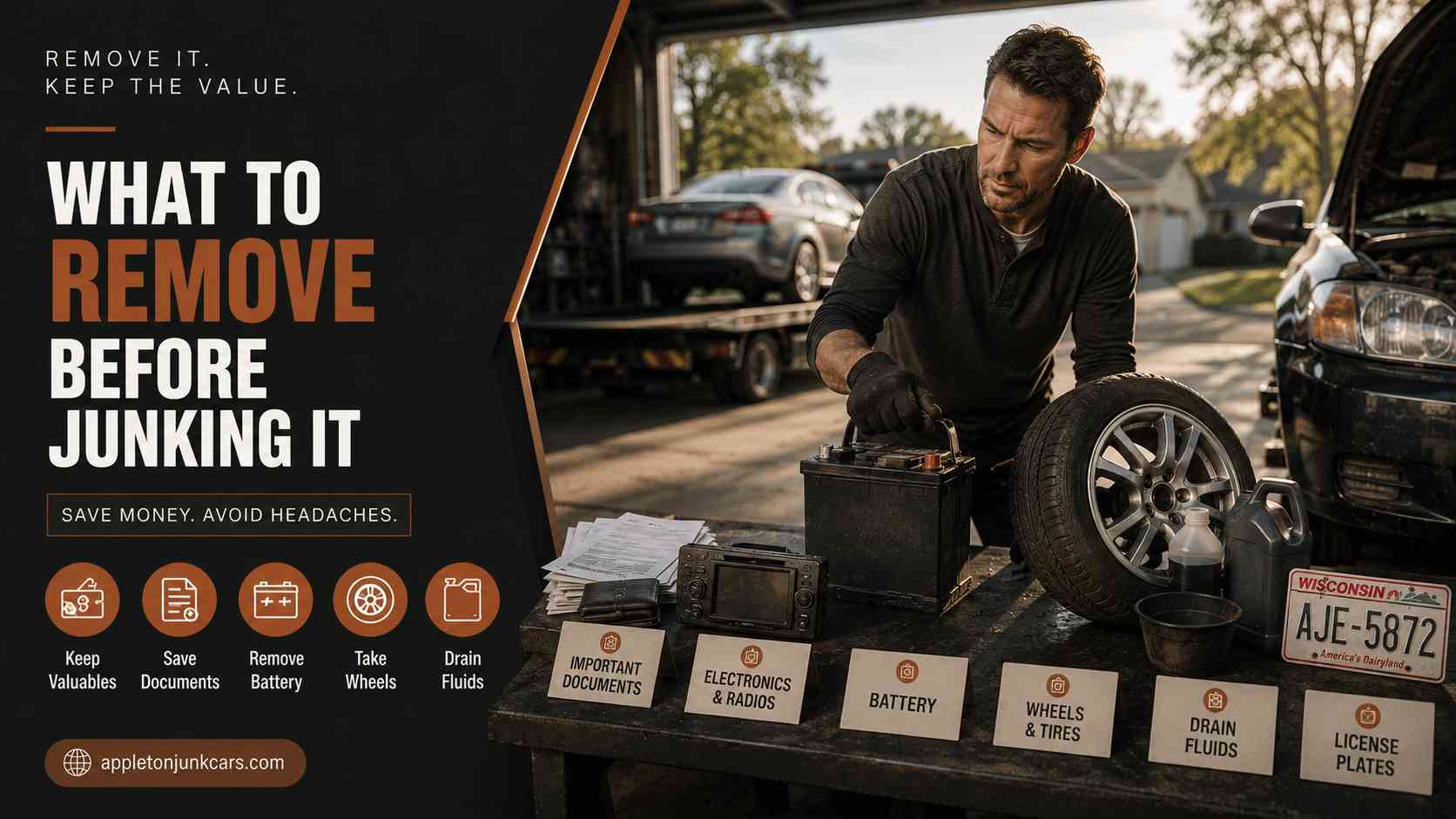
Before the tow truck arrives, there are three categories of things you need to remove from a car before junking it: items that are legally or administratively required, personal items that create privacy and financial risk if left behind, and valuable components that are worth more money sold separately than they add to the junk car offer.
This guide covers all three categories in full. It includes a complete checklist table, specific resale value ranges for parts worth pulling, the hidden digital risks most people completely overlook, and one major counterintuitive exception: the item almost everyone assumes they should remove before junking but usually should not.
Go through this guide before the tow truck shows up. Once the car leaves your property, nothing left inside it is coming back.
Items You Are Required to Remove or Must Handle Before the Pickup
These are not optional. Leaving them in place creates ongoing financial liability, legal exposure, or administrative problems that continue long after the car is gone.
Your license plates
In most U.S. states, license plates belong to the registered owner, not to the vehicle. When you junk a car, the plates go with you, not with the car. Remove both plates before the tow truck arrives.
Why this matters: if the car passes through tolled roads during transport with your plates still attached, those tolls come to you. If the junkyard moves the car internally with your plates on, any citations go to you. In some states, law enforcement can run your plate and generate traffic or parking violations tied to your record. None of this resolves quickly or easily.
What to do with the plates after removal depends on your state. Most states let you return them to the DMV to cancel the registration and potentially receive a partial refund on prepaid fees. Many states also allow you to transfer the plates to your next vehicle. Check your state DMV website or call ahead to confirm which option applies.
The title, registration, and insurance documents
Take the title with you. You will need it to complete the sale. Most junk car buyers ask you to sign the back of the title at the time of pickup to transfer ownership. If you signed the title separately and left it in the glove box, you have now given the buyer an unsigned title with your signature on it, which creates a document fraud risk.
Remove everything from the glove box: the registration, your insurance card, any receipts, service records, or inspection paperwork. These documents contain your name, address, and vehicle ownership history. Once the car is in the yard’s lot, you have no way of knowing who handles it or what happens to the paperwork inside it.
Cancel your insurance on the day of pickup
Call your insurer and cancel the policy for that specific vehicle on the day it is picked up. If you delay even a few days, you are paying premium on a car you no longer own. More importantly, some states require proof of insurance cancellation to close out the registration properly. Notify your insurer, request the cancellation confirmation in writing, and note the effective date for your records.
File a Notice of Transfer with your state DMV
Once the car is gone, file a Notice of Transfer or Release of Liability (the name varies by state) with your DMV online or by mail. This officially removes the vehicle from your name in the state’s records. Until you file it, the car is still registered to you in the system. If it gets cited, towed, or involved in any incident before the paperwork clears, you may receive notices tied to your name and address.
Personal Belongings to Search For Before Pickup
Cars accumulate years of personal items in places most people stop actively noticing. Before the tow truck arrives, go through the car systematically rather than quickly.
Search every location, not just the obvious ones
The glove box and center console are the obvious spots. But the items people most often leave behind are in the less-obvious places:
- Under the front and rear seats (coins, chargers, earbuds, sunglasses, pens)
- Inside seat back pockets on both front seats
- Door pockets on all four doors
- The trunk, including under the cargo floor where the spare tire sits
- The overhead sunglasses holder, if the car has one
- Behind and under the floor mats
- The visor pockets
- Cup holders and the slot between the center console and the seat
- The cargo area of SUVs and trucks, including behind the third row if applicable
- Any compartments in the pickup truck bed
If the car has a multi-disc CD changer (typically in the trunk), remove all discs from it. If it has a single-disc player or tape deck, check that too. People find cash, jewelry, medications, and important mail in these spaces routinely. The yard will not notify you of anything found after pickup.
Sports gear, tools, and trunk cargo
It is common for car owners to store sporting equipment (golf clubs, camping gear, exercise equipment), seasonal items, emergency supplies, and tools in the trunk semi-permanently. These travel with you, not with the junk car. Do a complete trunk sweep and check under the cargo liner where the spare tire sits. Spare tires, jacks, and factory tool kits all have resale value and belong to you.
The Digital Items Most People Never Think to Remove
This section covers the category that most junk car checklists miss entirely: the sensitive personal data stored in the car’s electronic systems and the physical devices that keep collecting charges after the car is gone. These are not minor inconveniences. Some of them create real financial and security exposure.
Toll transponders (EZPass, SunPass, FasTrak, TxTag, and others)
A toll transponder left in a junked car will keep charging your account for every toll road, bridge, and tunnel the car passes through after it leaves your property. This includes the tow truck route to the yard, any moves within the yard, and if the car is resold at auction, the new owner’s travels.
Remove the transponder from the windshield before pickup. If you no longer need it, call your tolling authority to deactivate the account. If you want to use it on another vehicle, call to transfer it. Do not assume the charges stop when the car leaves. They do not.
The garage door opener and HomeLink
If your car has a garage door opener remote clipped to the visor, remove it before pickup. This one is obvious. Less obvious is the HomeLink system, which is built into the visor and windshield area of most vehicles made in the last two decades. HomeLink is a programmable transmitter that can open your home garage, gate, or lighting system. When the car is junked, those codes go with it.
Before junking the car, reprogram your garage door opener to delete any codes that were paired to that vehicle. Most garage door opener units have a “Learn” button on the motor housing that you hold for a few seconds to erase all paired remotes. Doing this takes under a minute and removes the risk entirely.
Paired phone data and infotainment history
Modern infotainment systems store significantly more of your personal data than most people realize. When you pair a phone via Bluetooth, the car’s system can download and store your full contacts list, recent calls, text message previews, app login tokens, and account data from apps you used while connected. Navigation systems store your saved home address, work address, and recent destinations.
The Federal Trade Commission recommends wiping a car’s electronic systems before disposing of it. Perform a factory reset on the infotainment head unit. The process varies by manufacturer, but it is typically found in the Settings menu under “System” or “Privacy.” For a manufacturer-specific walkthrough, search “[your car brand] infotainment factory reset” and follow the official instructions. The reset takes two to five minutes and erases all stored contacts, paired devices, navigation history, and account data.
OBD port devices and telematics dongles
If you have an insurance telematics device (from Progressive Snapshot, Root Insurance, or a similar program), a fleet tracker, or a personal OBD reader plugged into the OBD-II port (usually under the left side of the dashboard), remove it before pickup. These devices collect and transmit driving behavior, location history, and vehicle diagnostics. Leaving them plugged in after the sale means a stranger’s driving continues to write to your insurance or fleet account.
Dashcam
Dashcams record video footage that may contain footage of your home, your commute, your daily routine, and in some models, the interior of the vehicle. Take the dashcam and its memory card. Even inexpensive dashcams sell for $30 to $100 on Facebook Marketplace or eBay. The footage on the card should be wiped before the device leaves your hands.
Parts Worth Removing to Sell Separately
Some components in a junk car are worth more money sold independently than they add to the overall junk car offer. The key word is some. Removing the wrong parts will lower the junkyard’s offer more than you gain from selling them separately. This section covers which parts are worth the effort and which are not.
One important note before you start pulling anything: get your junk car quotes first, before removing any parts. Tell buyers the car is complete, get their offer, then decide whether removing a specific item and selling it separately nets you more total money. If you remove parts first and then call for a quote, the buyer prices the car as incomplete and gives you a lower offer. Always establish the full-car offer as your baseline.
Aftermarket stereo and audio components
If the car has a stereo you installed yourself, it is yours to keep. Aftermarket head units from brands like Pioneer, Alpine, Sony, Kenwood, or JVC sell easily on Facebook Marketplace and eBay. Current resale values range from $50 for a basic unit to $400 or more for a quality double-DIN touchscreen. Aftermarket speakers, tweeters, amplifiers, and subwoofers also sell well to car audio buyers.
Before you remove the head unit, check whether you have the original factory radio. If you do, reinstall the factory unit so the car presents with a working radio, which maintains its appeal to the buyer. If you do not have the factory unit, remove the aftermarket stereo but be aware that some buyers may note the missing radio in their offer.
Battery (if it is relatively new)
A car battery under two years old is worth removing. New car batteries retail for $80 to $220 depending on size and brand. A used one under two years old with good cold cranking amps sells for $30 to $100 to private buyers or can be traded in at AutoZone or Advance Auto Parts for a $10 to $30 store credit. Dead batteries still have scrap value because of their lead content, typically $5 to $15 from a recycler.
If you remove the battery, the car can still be towed with a flatbed truck. Most junk car services use flatbeds for non-running vehicles specifically because they do not require the vehicle to be powered. Confirm this with the buyer before removing the battery.
Wheels and tires (if they are aftermarket or in excellent condition)
Aftermarket wheels and premium tires are worth significantly more sold as a set than they add to a scrap metal offer. A set of four quality aftermarket wheels can sell for $200 to $1,500 depending on brand, size, and condition. Even a well-known OEM wheel set (like factory Ford F-150 aluminum wheels or Honda Civic alloys in good shape) can bring $150 to $500 on the used market.
If you decide to remove the wheels, you must put something on the car so it can be towed. Ask a mechanic to find a set of steel spare rims for the correct bolt pattern, or contact a u-pull-it yard about buying a set of used steel wheels for $20 to $60. Do not leave a car sitting on bare brake rotors. The flatbed driver will not load it, and you will have created a new problem trying to resolve the first one.
Do the math before you pull the wheels. If the car’s full-car junk offer is $400, and removing the wheels drops the offer to $280, you need to sell the wheels for at least $120 to break even, and more than that to actually come out ahead.
Spare tire, jack, and emergency kit
The spare tire, factory jack, and lug wrench live under the cargo floor and are easily overlooked. A usable full-size spare tire sells for $30 to $80 separately. A compact spare (“donut”) sells for $15 to $40. The factory jack and lug wrench kit is worth $15 to $40 on eBay or at a swap meet. These take under five minutes to remove and are often left behind simply because sellers forget they are there.
Removable GPS unit
If the car has a portable GPS device mounted on the windshield (like a Garmin or TomTom unit), it is a separate personal device, not part of the car. Take it and perform a factory reset to wipe your saved locations before selling or keeping it. Working portable GPS units sell for $30 to $120 on eBay depending on age and model.
The One Part You Should Almost Never Remove: The Catalytic Converter
This section exists because it addresses one of the most common mistakes people make before junking a car, and it runs counter to what many people assume.
Catalytic converters contain platinum, palladium, and rhodium, and a single converter can be worth $50 to $700 depending on the vehicle. It sounds like an obvious thing to remove and sell separately. But for most sellers, removing the catalytic converter before calling junk car buyers reduces the total amount of money you receive, not increases it.
Here is why: every junk car buyer prices the catalytic converter into the offer they give you for the complete vehicle. When the buyer shows up and the converter is missing, they reduce the offer by $200 to $500 to account for the missing part. Meanwhile, the loose converter you removed may only fetch $50 to $250 from a local scrap buyer because you do not have specialized equipment to identify its exact precious metal loading, and most scrap yards pay a flat rate for detached converters rather than the full precious metal value.
In most scenarios: you lose $200 to $500 from the car offer, and gain $50 to $250 from the loose converter. That is a net loss of $50 to $350.
There is one exception. If you have already identified a specialized catalytic converter recycler who uses XRF analysis equipment to measure actual precious metal content, and you have confirmed that their individual converter price exceeds what the junkyard is building into the whole-car offer, then removing it may make financial sense. This requires research, multiple quotes, and a confirmed buyer for the converter before you cut it off. For most people without these specifics in place, leave the converter on the car.
Additionally, selling a detached catalytic converter now requires proof of vehicle ownership in more than 30 states following a wave of anti-theft legislation. Some states require a waiting period or a notarized affidavit. Washington State passed a law in 2025 making it a Class C felony to possess seven or more unmarked detached converters without a valid recycler’s license. The legal complexity alone makes selling the car whole with the converter attached the simpler and usually more profitable option.
Complete Removal Checklist: Remove, Leave, or It Depends
Use this table as a reference before pickup day. “Remove before junking” means do it no matter what. “Leave it” means removing it will cost you more than you gain. “Check the math” means evaluate your specific situation using the guidance in this guide.
Item | Action | Resale Value (if Removed) | Why It Matters |
|---|---|---|---|
License plates | YES — always | N/A (keep or return to DMV) | Required in most states. Plates stay with the owner, not the vehicle. Leaving them on can generate tolls, tickets, and liability after the sale. |
Personal documents | YES — always | N/A | Title, registration, insurance cards, pay stubs, medical paperwork. All carry personally identifiable information. |
Toll transponder (EZPass, SunPass, FasTrak, TxTag) | YES — always | N/A (return to account) | Will keep charging your account for every toll the car passes after junking. Call your tolling authority to deactivate it. |
Garage door opener / HomeLink | YES — always | N/A (reprogram opener) | HomeLink buttons stored in the visor can open your garage. Reprogram or disable the transmitter from your opener controller before the car leaves. |
Paired phone and app data | YES — always | N/A | Factory reset the infotainment system to erase paired contacts, call history, saved home and work addresses, and app login tokens. |
GPS device (removable unit) | YES — always | $50 to $150 | Standalone GPS units contain home and work addresses. Remove and factory-reset before selling the unit separately or keeping it. |
OBD port device | YES — always | $20 to $80 | Insurance telematics dongles, dash OBD readers, or company fleet trackers collect driving and location data. Remove immediately. |
Aftermarket stereo | YES — if valuable | $50 to $500+ | Aftermarket head units from brands like Pioneer, Alpine, or Kenwood sell well on eBay and Facebook Marketplace. Replace with the factory unit if you have it, or leave blank. |
Aftermarket speakers / sub | YES — if valuable | $30 to $400 per set | Quality speaker sets and subwoofers sell to audio enthusiasts. Component speakers from reputable brands hold resale value well. |
Car battery (if new or recent) | YES — consider it | $20 to $150 | A battery under 2 years old is worth keeping or selling. The junkyard will price the battery separately anyway. AutoZone and Advance Auto buy used batteries. |
Wheels and tires (aftermarket) | YES — if premium | $200 to $1,500 per set | Aftermarket or premium OEM wheels sell well. Replace with steel rims or junker wheels so the car can still be towed. Do not leave a car on bare rotors. |
Dashcam | YES — always | $30 to $300 | Even budget dashcams are worth keeping. The recorded footage may contain sensitive location data as well. |
Spare tire and jack | YES — consider it | $30 to $120 | A usable spare and full-size jack kit have resale value, particularly for popular vehicle platforms. The junkyard will scrap the spare for metal. |
Emergency kit and tools | YES — always | $20 to $100 | First aid kits, jumper cables, tow straps, and any tools are yours. The yard will not return anything left in the trunk. |
Child car seat | YES — always | $0 (do not resell) | Car seats left in junked vehicles are gone. Never resell a used car seat; they may have hidden damage from minor impacts. Recycle or replace them. |
Factory radio (original) | LEAVE IT | N/A | Original factory head units are worth very little on the used market. Removing them without the replacement stereo reduces the car’s appeal and may lower some buyers’ offers. |
Catalytic converter | LEAVE IT — almost always | See notes | If removed, the buyer deducts $200 to $500 from the offer for the missing converter. Only remove if you have a specialized buyer lined up at a verified premium price. See the full section on this below. |
Airbags (undeployed) | LEAVE IT | N/A | Airbag removal requires professional tools and carries serious injury risk. Leave all airbag components in place. |
Engine and transmission | LEAVE IT | N/A | Unless you are a mechanic with buyers already lined up, the cost and effort of removal is not worth it. The powertrain factors heavily into your offer. |
What the Yard Does With Everything You Leave Behind
Once the car is on the lot, the yard begins its own process. For vehicles they plan to part out, a technician drains all fluids (engine oil, coolant, brake fluid, transmission fluid, refrigerant) to meet environmental regulations. They photograph and catalog reusable components, pull high-demand parts, and post them to their online inventory or parts locating network.
Personal items left in the car are not sorted, cataloged, or held for you. They go in the bin. Documents go in the bin. The garage door opener goes in the bin. The toll transponder continues charging your account until you deactivate it. None of this gets communicated back to you, and reaching the yard after the fact to retrieve something is usually not possible once the car has been processed.
This is not the yard’s negligence. It is simply how the business operates. The responsibility for clearing the car before pickup is entirely yours.
How Much Extra Money Removing Parts Actually Adds
Many people overestimate how much a thorough pre-junk strip-down adds to their total payout. Here is a realistic picture.
For most people with an average junk car, the realistic additional money from strategic parts removal, beyond what the junkyard would have offered for the complete vehicle, is:
- Aftermarket stereo (if quality): $80 to $300 additional
- Battery (if under 2 years old): $30 to $80 additional
- Spare tire and tools: $40 to $80 additional
- Dashcam: $30 to $100 additional
- Premium aftermarket wheels (replaced with junker wheels): $150 to $800 additional depending on brand
Total additional income from a thorough but realistic pre-junk sweep is typically $100 to $400 for the average vehicle, assuming you already have buyers lined up or plan to list the parts online. This does not include the value of personal items you might have otherwise lost. The value of those is whatever they would have cost to replace.
For sellers who simply do not have the time to list parts or find buyers, the better use of that energy is to get more junk car quotes and let competing buyers push the offer up. The spread between the lowest and highest offer for the same vehicle is often $100 to $400 all by itself, without any parts removal required.
What People Forget and What Goes Wrong
Leaving a toll transponder in the car
This is the most financially damaging oversight on this list. EZPass and similar transponders charge by the trip, and a car in transit to a yard, through a yard, and potentially to an auction can rack up $20 to $80 in tolls before anyone notices. The account keeps charging until you deactivate it. Remove it from the windshield before the driver arrives.
Not performing a factory reset on the infotainment system
Paired phone contacts, saved navigation destinations, Bluetooth device history, and app account tokens are all still on the car’s system when it drives away. The salvage yard resells parts, and an infotainment screen with a working touchscreen interface sells to another vehicle owner who now has access to everything your system stored. A two-minute factory reset eliminates this entirely.
Removing parts before getting quotes
If you remove the battery, pull the stereo, and take the wheels off before calling any buyers, you have already lowered every offer you will receive. Get your quotes first on the complete vehicle. Use those as your baseline. Then decide whether selling specific components separately is worth the additional effort.
Assuming the junkyard will hold anything you forgot
Some sellers call the yard after the pickup and ask whether their golf clubs, child’s booster seat, or CD collection was found. The answer is almost always no. Once the car is processed, personal items are discarded. There is no lost-and-found procedure at a salvage yard. Do the sweep before pickup, not after.
Not canceling insurance immediately
Continuing to pay insurance on a car you no longer own is a direct financial loss. Call your insurer the same day the car is picked up. Some sellers cancel it days or weeks later and lose money on premiums they paid on a vehicle already at the yard. Some insurers will prorate the refund, but the sooner you cancel, the more you get back.
Leaving the child seat in the car
Child car seats left in junked cars are gone. They also should not be resold used under any circumstances: a seat involved in even a minor impact may have hidden structural damage that renders it unsafe but visually undetectable. If the seat was in a car being junked after a crash, retire it and replace it with a new one regardless of appearance.
Cutting the catalytic converter off without a buyer lined up
This is covered in detail in an earlier section, but it deserves a mention here too: removing the catalytic converter without a confirmed specialized buyer and a price in hand will almost certainly reduce your total payout. The junkyard deducts more than you gain from a loose converter sale in most situations.
Questions People Ask Before Junking Their Car
Do I have to remove the license plates before junking my car?
Yes, in most states. License plates belong to the registered owner, not to the vehicle. Remove both plates before the tow truck arrives. Return them to the DMV to cancel the registration, transfer them to your next vehicle, or check your state’s rules for what to do with them. Leaving plates on a junked car can result in tolls, citations, and registration notices continuing to arrive in your name after the sale.
What happens if I leave personal items in the car?
They are gone. Once the car is at the salvage yard and enters the processing workflow, personal items are discarded. The yard does not sort, hold, or catalog personal belongings from incoming vehicles. There is no system for contacting sellers about found items. Remove everything before the pickup, because nothing left inside is retrievable after.
Should I remove the catalytic converter before junking the car?
In most cases, no. When you remove the catalytic converter, the junk car buyer reduces their offer by $200 to $500 for the missing part. That deduction typically exceeds what you can get for the converter sold loose at a general scrap buyer. Only remove the converter if you have a specialized recycler confirmed with an XRF-based price quote that clearly exceeds what the junkyard was building into the whole-car offer. For most sellers, leaving the converter attached nets more total money.
Do I need to clean the car before junking it?
No. The yard does not care about dirt, trash, or cosmetic condition. You do need to remove your personal belongings, but you do not need to vacuum, wash, or detail the vehicle before pickup. The time is better spent removing items with resale value and checking the less-obvious storage areas.
Can I remove the tires before junking the car?
Technically yes, but the car still needs to be towable. If you remove the tires, you need to put something on the hubs so the car can be loaded onto a flatbed. Bare brake rotors will not work. If you plan to sell premium aftermarket wheels, find a set of used steel rims at a u-pull-it yard first and mount those before the pickup day. If the car has standard factory wheels with worn tires, it is usually not worth the effort.
What documents do I need to have ready for the junk car pickup?
The title, signed in the seller section, is the primary document. Some buyers also ask for a valid photo ID and current registration. If you do not have the title, the process becomes more complicated but is still possible in many states. See your state DMV for the specific alternative documentation process. Have the title ready and remove it from the vehicle before the driver arrives; do not leave it inside the car.
Should I drain the gas from the tank before junking the car?
Only if there is a significant amount of gasoline in the tank that has monetary value to you. The junkyard will drain all fluids during their environmental demanufacturing process regardless. If the tank has a quarter tank or more and the car is not drivable, siphoning it out before pickup lets you keep fuel you paid for. If the car still runs, simply drive it until the tank is near empty. Some yards also require partially emptied tanks on vehicles being transported long distances.
What is the difference between what I should remove for money versus what I must remove for other reasons?
Must-remove items regardless of money: license plates, all personal documents, toll transponder, garage door opener/HomeLink, and digital data from the infotainment system. These have nothing to do with maximizing payout. They protect you from ongoing liability, financial charges, and privacy risk. Remove them unconditionally. Worth-removing items for money: aftermarket stereo, recent battery, premium wheels (if replaced), spare tire and tools, and any personal electronics or dashcams. Do the math on these before pulling them to make sure the separate sale actually nets you more than leaving them in the car.
Can the junk car buyer see what was left in my car?
Yes, everything that was in the car when it arrived at the yard is visible to the technicians who process it. This includes any documents, electronics, personal items, or account-linked devices. There is no confidentiality around this. The only protection is removing sensitive items before the car is picked up.
Is it worth trying to sell individual parts before junking the car?
It depends on the car and your available time. Parts that are clearly worth the effort: aftermarket stereo, premium wheels, a new battery, and the spare tire kit. Parts rarely worth the effort for the average person without mechanical expertise: engine components, suspension parts, body panels, airbags, and any part that requires specialized tools or carries safety risks to remove. If you have a popular model like a Honda Civic, Ford F-150, or Toyota Camry and the parts are in good condition, check eBay sold listings for what they actually sell for before assuming removal is worthwhile.
What happens to the title after I sign it over at pickup?
The buyer becomes the legal new owner of the vehicle and is responsible for properly transferring or destroying the title with the state. To protect yourself, file your Notice of Transfer or Release of Liability with your state DMV on the same day as the pickup. This officially removes the vehicle from your name in the state’s records, regardless of what the buyer does with the title paperwork afterward.
Your Pre-Pickup Action Plan
Work through this list in order before the tow truck arrives. Each step takes only a few minutes.
- Get your junk car quotes first, with the car described as complete. Do not remove any parts before establishing the baseline offer. Use that number to decide whether removing specific components is worth the extra effort.
- Remove the license plates. Both front and rear. Store them or prepare to return them to the DMV depending on your state’s rules.
- Clear out the glove box, center console, and all storage compartments. Check door pockets, seat back pockets, under seats, behind the visor, under floor mats, and the trunk including under the cargo liner.
- Remove the toll transponder from the windshield. Call your tolling authority to deactivate or transfer it. Do not leave this step for later.
- Disable the HomeLink garage door system. Press the Learn button on your garage door opener motor housing for a few seconds to erase all paired transmitters, including the one in the car.
- Perform a factory reset on the infotainment system. Settings > System or Privacy > Factory Reset. This erases all paired phones, contacts, navigation history, and app data from the car’s system.
- Remove any OBD port devices. Check the OBD-II port under the left side of the dashboard for plugged-in dongles, telematics devices, or fleet trackers.
- Decide which parts to remove for separate sale. Aftermarket stereo, new battery, premium wheels (replace with junker wheels), spare tire, and any dashcam. Only proceed if the separate sale clearly nets more than the whole-car offer would have included.
- Do not cut the catalytic converter off. Unless you have a specialized buyer confirmed with a verified price above what the junkyard was including in their offer.
- Sign the title and have it ready for pickup. Do not leave the title inside the car.
- Cancel your insurance on pickup day. Call your insurer and request the cancellation to be effective the day the car is collected.
- File a Notice of Transfer with your state DMV on the same day as the pickup. This removes the car from your name in the state’s system.
The sellers who walk away from a junk car sale with the most money and zero follow-on problems are the ones who treated the pre-pickup process as seriously as the sale itself. The junk car offer is only part of the equation. Everything else, from the toll charges that never stop to the garage codes that go out the door, is determined entirely by what you did in the hour before the tow truck arrived.