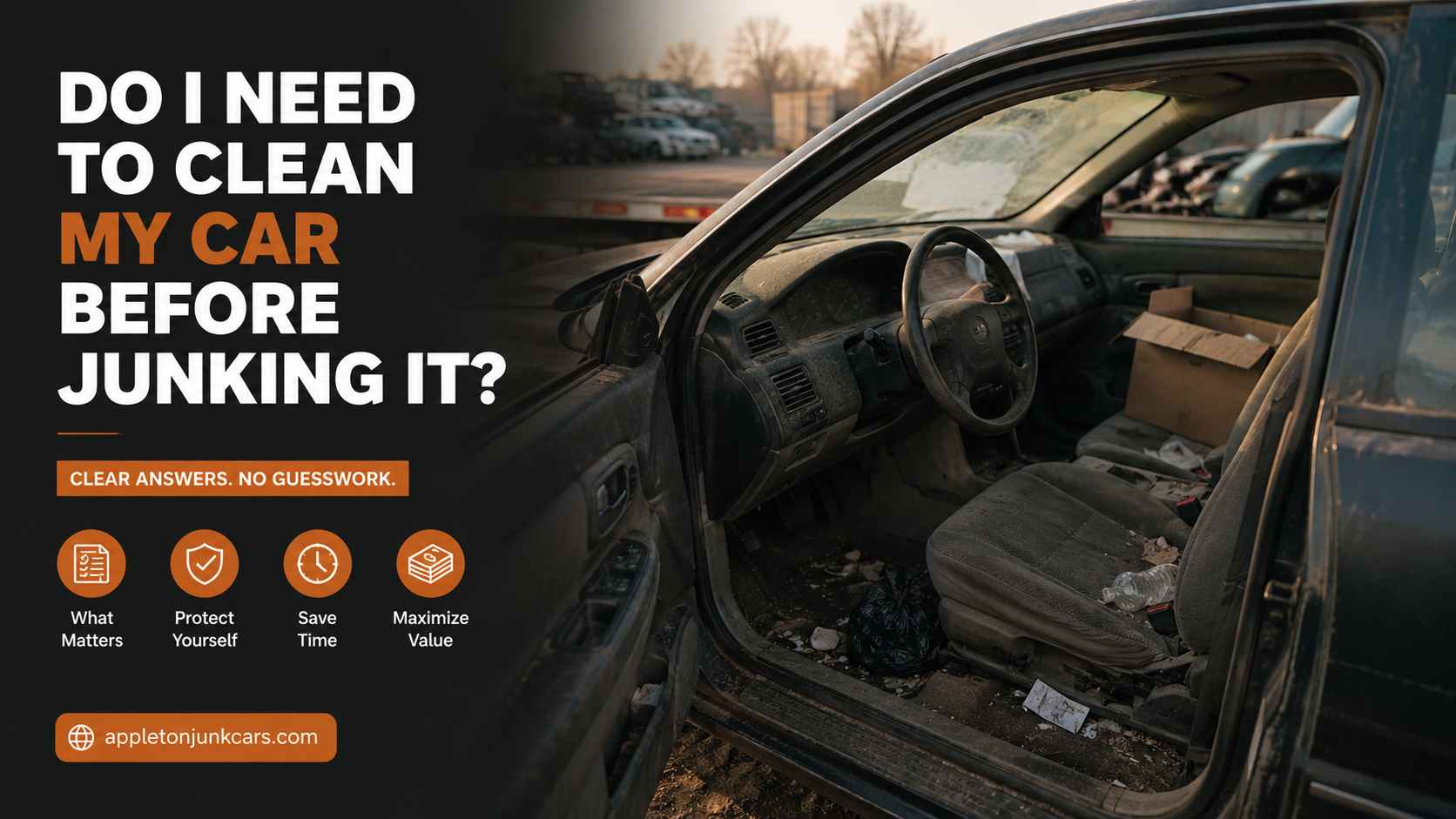
No, you do not need to clean your car before junking it. Junk car buyers pay based on the vehicle’s weight, its metal content, and the value of any usable parts. A spotless interior has zero effect on what they offer you. That said, there are specific things you absolutely should do before the pickup truck arrives, and skipping them can cost you money, create legal headaches, or leave you losing items you actually care about. This article draws a clear line between what matters and what is a waste of your time.
What Junk Car Buyers Actually Pay Attention To
Understanding what drives a junk car offer helps explain why cleaning has no impact on the price.
Weight. The heavier the vehicle, the more scrap metal it contains, and the higher the payout. A washed exterior does not change weight. A detailed interior does not add a single pound.
Metal composition. Aluminum parts bring more per pound than steel. The presence of copper wiring, aluminum engine components, or a stainless exhaust affects value. The cleanliness of the upholstery does not.
Usable parts. Buyers look at whether the engine runs, whether the catalytic converter is present, whether the transmission is intact, and whether there is demand for parts from your specific make and model. A freshly vacuumed floor has nothing to do with any of this.
Title and paperwork. A clean title in your name is worth more to a buyer than a freshly washed car without one. Documentation matters enormously. Cleanliness does not matter at all.
What a junkyard or junk car buyer does the moment your vehicle arrives: they drain the fluids, strip the usable parts, crush or shred the remaining metal, and send it to a recycling facility. Not one step in that process involves the state of your floor mats.
What You Should Do Before Junking the Car
While cleaning is not necessary, there are tasks that genuinely matter. None of them involve soap or a vacuum.
Remove All Personal Belongings
This is the one thing that is truly non-negotiable. Check every possible storage space before the car leaves your possession. People consistently report finding things they forgot they had: spare change in the cup holders, an old phone in the center console, sunglasses in the visor pocket, important mail in the door pocket, and in some cases, documents, medications, or items of sentimental value tucked under seats.
Once the car is on the tow truck, it is gone. There is no coming back for something you left inside. The buyer owns everything in that vehicle once the title changes hands.
Run through this checklist systematically:
- Glove box: registration, insurance cards, owner’s manual, receipts, personal documents
- Center console: coins, phone chargers, sunglasses, medications
- Door pockets: maps, receipts, pens, small items
- Under all seats: check front and rear, including the space under floor mats
- Sun visor pockets and overhead storage if present
- Trunk and cargo area: tools, jumper cables, emergency kits, spare clothing
- Trunk subfloor: spare tire area often hides forgotten items
- Any aftermarket additions: dash cams, GPS units, phone mounts, custom audio equipment
Remove Your License Plates
This step is easy to forget and easy to regret skipping. In most states, license plates belong to you, not the vehicle. They should be removed before the car is picked up and either transferred to your next vehicle or returned to your DMV.
Leaving plates on the car creates ongoing liability. If the vehicle somehow ends up on a road with your plates still attached, any violations or incidents tied to those plates come back to you. Remove them before pickup, not after.
Gather Your Title and Documents
A valid title in your name is required for a legal junk car sale in most states. If you cannot locate the title, apply for a duplicate through your DMV before scheduling a pickup. Missing paperwork is one of the most common reasons junk car transactions get delayed or fall apart at the last moment.
Keep any maintenance records you have on hand. They rarely affect the junk car price significantly, but they can support a higher offer in occasional cases where a buyer wants to verify the vehicle’s history before committing to a number.
Cancel Your Insurance and Notify the DMV
Once the sale is complete and the title has transferred, contact your insurer to remove the vehicle from your policy. If you paid your premium ahead, you may be owed a refund on unused coverage.
Separately, file a release of liability with your state DMV to formally record that the vehicle is no longer in your possession. This protects you from any future tickets, tolls, or incidents tied to that VIN after the sale.
Remove Any Valuable Aftermarket Parts You Paid For
If you added aftermarket equipment to the car, you have the right to remove it before selling. This includes custom stereo systems and amplifiers, upgraded wheels and rims, aftermarket navigation systems, dash cameras, and any other accessories you paid for separately that are not original to the vehicle.
A note of caution: removing parts can reduce the junk car offer if the buyer has already factored those parts into their quote. If the buyer quoted the car with custom wheels, and you remove them before pickup, expect the offer to be adjusted. Be upfront about what will and will not be present when you call for quotes.
The One Situation Where a Basic Cleanup Actually Helps
There is exactly one cleaning-related scenario where a little effort can have a financial impact: excessive trash inside the cabin.
A junk car full of fast food containers, bags of garbage, or general debris is not just an eyesore. Some buyers will use it as a reason to reduce the offer, citing cleanup costs. This is not a common tactic from reputable buyers, but it does happen. More importantly, a car loaded with trash also makes it harder for you to properly check for personal belongings, which means items you care about are more likely to get missed.
The practical approach is to remove any obvious trash as part of clearing out your personal items. You do not need garbage bags and a shop vacuum. You need ten minutes to pull out anything that is clearly rubbish and leave the rest to the buyer. That is the extent of cleaning that ever makes sense for a junk car.
Biohazard situations are a separate case. If the vehicle has been the site of something genuinely hazardous, such as a death, serious accident with bodily fluids, or extended exposure to mold or chemical contamination, some buyers will reduce the offer or require documentation of professional remediation. This is a narrow situation that most junk car sellers never encounter.
What Is Genuinely a Waste of Time and Money
People sometimes feel a sense of obligation to present the car in the best possible condition, even for junking. That instinct is understandable but misplaced when it comes to actual cleaning. Here is what you should skip entirely.
Car wash or exterior detail. The scrap yard is going to crush this car. A clean exterior changes nothing about its value, its weight, or how it is processed. Save the money and the hour.
Interior vacuuming or shampooing. Same logic applies. The interior is going to the crusher alongside everything else. A vacuumed carpet adds zero dollars to your payout.
Minor repairs or cosmetic fixes. Some people consider fixing a broken window or replacing a worn tire before junking, thinking it will improve the offer. It almost never does by enough to justify the cost. Junk car buyers price based on the weight and parts value of the car as-is. Spending $150 to fix a tire on a car that will be crushed next week does not add $150 to your offer.
Mechanical repairs. Unless the car runs and you are considering selling it to a private buyer instead of junking it, mechanical repairs before junking are money thrown away. A running car is worth more than a non-running one in the junk market, but only if the repair cost is a fraction of the value difference it creates. For most junk-level vehicles, that math does not work out in your favor.
Professional detailing. Professional detailing on a junk car can cost $75 to $600 and takes several hours. There is no version of this math where spending $200 on detailing adds $200 or more to a junk car offer. It never happens. Do not do this.
What Happens to the Car After Pickup
Knowing what happens to your vehicle after the tow truck leaves helps explain why its cleanliness is irrelevant.
The vehicle goes to a salvage yard or processing facility where trained technicians drain all fluids, including motor oil, transmission fluid, coolant, brake fluid, and any gasoline remaining in the tank. These fluids are collected and disposed of or recycled according to environmental regulations.
Usable parts are then stripped: catalytic converters, engines and transmissions that still have viable life in them, alternators, starters, batteries, tires in good condition, and body panels with demand in the used parts market. None of these parts are valued based on how clean the car was.
The remaining shell is then crushed or shredded into scrap metal, which is sold by weight to steel mills and aluminum recyclers. The car that arrives at this point could have been immaculate or completely filthy inside. The shredder treats them identically.
What People Who Have Junked Cars Commonly Regret
The most frequently mentioned regret among people who have junked cars is not about cleaning. It is about personal items left behind.
Cash and coins left in the cup holder or console are the most common forgotten items. Enough loose change across the whole interior of a car can add up to more money than you might expect. More significant: people report finding their vehicle’s spare key, a backup phone, prescription glasses, and in some cases, irreplaceable sentimental items like photographs or jewelry, too late to retrieve them.
A second common experience is leaving behind aftermarket equipment. People forget that the custom stereo they paid $400 for is now in a car they just signed over. That stereo belongs to the buyer now. Removing it before the pickup is a simple step that too many people skip because they are focused on the transaction rather than the car itself.
Nobody has ever reported regretting that they did not wash the car before junking it.
A Simple Pre-Pickup Checklist
Use this before the tow truck arrives. It takes 20 to 30 minutes and covers everything that actually matters.
- Walk through every storage area and remove everything that belongs to you.
- Remove your license plates from front and rear.
- Remove any aftermarket accessories you want to keep: stereo, dash cam, GPS, custom wheels.
- Locate and set aside the title and any supporting documents for the transaction.
- Pull out any obvious trash as part of clearing your belongings, but do not spend additional time cleaning.
- Recover any remaining fuel if there is a meaningful amount in the tank and you have the means to do so.
- Take photos of the car before pickup for your own records.
- Confirm access for the tow truck, clearing any obstacles in the driveway or pickup area.
Frequently Asked Questions
Will cleaning my car get me a higher offer from a junk car buyer?
No. Junk car buyers price based on weight, metal composition, and usable parts. A cleaner car does not weigh more or contain more valuable metal. The offer will be the same regardless of how clean the interior or exterior is.
Do junk car buyers care if there is trash inside the car?
Most reputable buyers do not reduce offers based on interior clutter as long as it is ordinary household trash and not a genuine hazard. A few less scrupulous buyers use excessive trash as a reason to justify a price reduction at pickup. Clearing out obvious rubbish as part of removing your personal belongings handles this without any additional effort.
What happens if I leave personal items in the car?
Once the car is picked up and the title transfers, everything inside legally belongs to the buyer. There is generally no recourse to retrieve items left behind. The buyer has no obligation to hold or return them. This is why a thorough search before pickup is the one task that genuinely matters.
Should I wash the outside of the car before the junk car buyer comes?
No. The exterior condition has no impact on the offer, the process, or the outcome of the sale. Skip it.
Do I need to remove the spare tire before junking?
If the spare is in good condition and you want to keep it, yes, remove it before pickup. A usable spare tire has value you might as well keep or sell separately. If it is a worn or flat spare, it makes no meaningful difference either way.
Can I leave the car’s manual and service records inside?
Service records you want to keep should come with you. The owner’s manual has no resale value in the junk market. Leaving it inside is fine. Leaving your actual maintenance receipts or any documents with personal information is not recommended.
What if the car has mold or a very bad smell inside?
Standard mold from a car that has been sitting is handled routinely by salvage yards. You do not need to address this before junking. A car that has had hazardous biological contamination, such as from a serious accident or a death inside the vehicle, is a different situation and may require documentation or affect the offer. In ordinary cases of musty smell or surface mold, no action is needed on your part.
The Bottom Line
You do not need to clean your car before junking it. No amount of washing, vacuuming, or detailing will change the price you receive. Junk car buyers are buying metal and parts, not presentation.
What does matter is spending 20 to 30 minutes before pickup to remove your personal belongings, take off your license plates, pull any aftermarket equipment you want to keep, and have your title ready. Those are the steps with real consequences if skipped.
The car is going to be crushed or shredded. Send it off with your belongings out of it and your paperwork in order. That is everything you actually need to do.