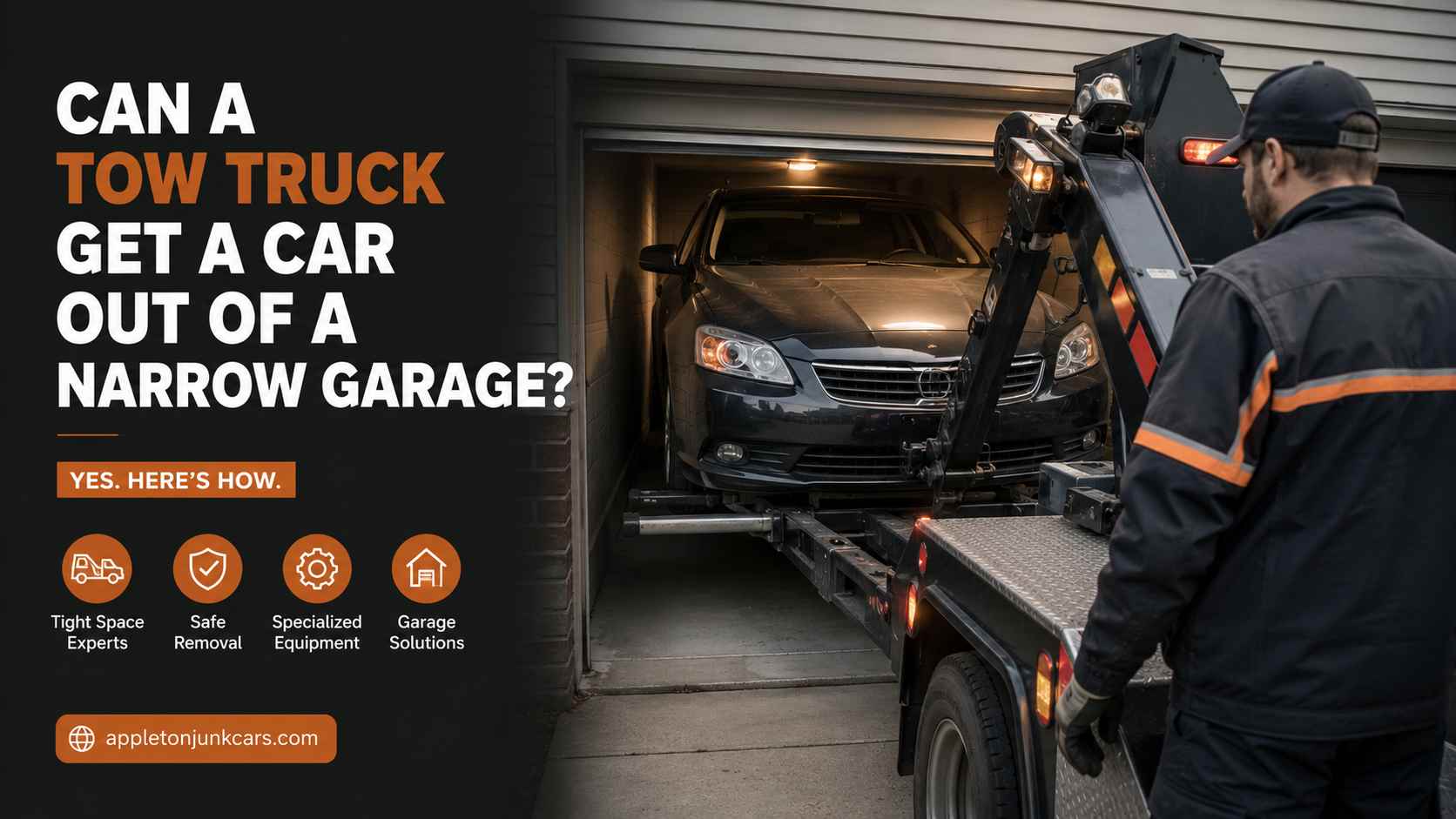
Yes, in most cases a tow truck can get a car out of a narrow garage, but not with the truck you typically picture on the highway.
Standard flatbeds and heavy-duty wreckers are far too wide and too tall for most residential garages. What makes the difference is the type of equipment the company sends and whether the operator has experience with confined-space extractions. The right crew, with the right tools, can work around surprisingly tight situations. This guide explains exactly how it works, what information to give when you call, and when the truck cannot physically enter but can still get the car out anyway.
Why a Standard Tow Truck Often Cannot Enter a Narrow Garage
Most people picture a tow truck as a large flatbed or a heavy wrecker. Those vehicles are impressive on the highway but completely impractical inside a residential single-car garage or a tight underground parking structure.
A standard flatbed tow truck is typically 96 inches or more in width, around 8 feet tall at the cab roof, and sometimes 30 to 40 feet in total length. A standard single-car residential garage opening is about 8 to 9 feet wide and 7 feet tall. Even before accounting for maneuvering room, the math does not work. A full-size flatbed cannot fit through most residential garage doors at all.
Beyond width and height, flatbeds need to angle their loading ramp, which requires clearance behind the vehicle and enough room to drive forward and load. Inside most residential garages, none of that room exists.
This is not a failure of the towing industry. It is simply the reason that specialized equipment and techniques exist for exactly this situation.
The Types of Tow Trucks and Which One Works in a Tight Space
Flatbed Tow Trucks
The most common type on roads. A flatbed has a hydraulic platform that tilts and slides to load a vehicle from the rear. It provides excellent protection for the towed vehicle. However, it requires significant length to operate, needs a wide turning radius, and the loading process requires room behind the vehicle that a garage almost never provides. Flatbeds are not suitable for narrow garage extractions in most situations.
Wheel Lift Tow Trucks
A wheel lift truck uses a metal yoke that slides under either the front or rear wheels and lifts that end of the car. The other two wheels roll on the ground during transport. These trucks are significantly more compact than flatbeds. They can often fit through standard residential garage openings and have a tighter turning radius that makes maneuvering inside possible.
Wheel lift trucks are the go-to option for most parking garage and residential garage extractions. A skilled operator can position the yoke, lift the car, and pull it out with only a few feet of working clearance on either side. If any standard tow truck can enter your garage, it is likely a wheel lift.
Low-Profile and Low-Clearance Specialty Trucks
Some towing companies operate a fleet of purpose-built low-clearance trucks specifically designed for underground parking structures and other confined spaces. These vehicles are engineered to clear ceiling heights as low as 6 feet 6 inches, the minimum clearance found in older parking structures. They are narrower than standard trucks and carry specialized equipment such as go-jacks and wheel skates as standard kit.
If you are dealing with an underground parking garage or a garage with an unusually low ceiling, ask the towing company specifically whether they have low-clearance equipment. Not every company does, and sending the wrong truck wastes everyone’s time.
When the Truck Cannot Fit Inside At All
Sometimes the garage is simply too narrow, too low, or too obstructed for any truck to enter. This does not mean the car is stuck. Experienced towing operators have several tools designed precisely for this situation.
Winching from Outside
Every tow truck carries a winch with a cable that can extend 50 to 100 feet or more. If the truck cannot enter the garage but can position at the door, the operator feeds the cable inside, attaches it to the car’s frame, and winches the vehicle out to where the truck can load it.
This works well when the car can roll freely and the path from the vehicle to the garage door is reasonably straight. A sharp turn inside the garage or obstacles in the path can complicate winching, but a skilled operator can often manage this with proper rigging and an additional cable at an angle to steer the car as it moves.
Wheel Dollies and Go-Jacks
Go-jacks and wheel dollies are low-profile devices that slide under individual wheels and allow the vehicle to be moved in any direction, including sideways, without rolling on its own tires. A single person can reposition a vehicle on dollies with surprisingly little effort on a smooth garage floor.
When a car is stuck in an awkward position, such as turned at an angle, blocking its own exit path, or parked against a wall with no room to maneuver, an operator can place dollies under all four wheels and manually push and steer the car into a position where winching or a wheel lift can take over. This technique is standard practice for tight-space recoveries and is far gentler on the vehicle than dragging or forcing it.
Manual Push to the Doorway
For vehicles that can be put into neutral and that have functional steering, sometimes the simplest approach is manually pushing the car to the garage door where the truck can then properly connect and load. The operator will assess whether the car can roll, unlock the steering if possible, and guide it out with hands and a push bar. This is only viable on relatively flat ground and when the path is clear.
Coordinated Two-Step Extraction
In some cases, especially in underground parking structures, the operator uses a combination of the above: dollies to reposition the vehicle to a more accessible spot, winching to pull it to the ramp, and then a truck waiting at street level to load and transport. Each stage hands the car off to whatever tool fits that space. A good operator plans the full route before moving anything.
What Makes a Narrow Garage Extraction More Difficult
Every extraction situation is different. These are the factors that consistently make a tight-space tow more complicated and that the operator will assess when they arrive.
Locked steering. If the car’s ignition is off and the steering column is locked, the front wheels are fixed in one direction. Getting a car with locked steering around a corner using dollies or winching requires careful rigging to avoid scraping walls. Tell the dispatcher whether you have the keys and whether the steering can be unlocked.
All-wheel drive and four-wheel drive vehicles. AWD and 4WD vehicles cannot be towed on two wheels without engaging the drivetrain, which can cause serious damage to the transfer case and differentials. These vehicles typically need all four wheels either on a flatbed or on dollies during movement. This matters in tight spaces because dollies take more room to operate than a wheel lift, and a flatbed may not fit. Make sure the company knows the drivetrain type when you call.
Low ceiling with obstacles. Pipes, sprinkler heads, light fixtures, and structural beams that hang below the main ceiling height create additional clearance challenges. An operator arriving at a 7-foot garage will walk the route first to check for anything hanging lower before bringing in equipment.
The car’s position relative to the exit. A car parked nose-in and running perfectly straight out to the door is the easiest possible situation. A car that is angled, parked with doors open against a wall, or blocked by another vehicle requires more problem-solving before anything can move.
Fluid leaks on the floor. A car leaking oil, coolant, or transmission fluid creates a slippery surface for both the operator and the dollies. Tell the dispatcher if there is any visible fluid under or around the vehicle.
Width of the garage door opening. The door opening is the bottleneck for any equipment entering the garage. A standard residential single-car garage door is typically 8 to 9 feet wide. Most wheel lift trucks are 7 to 8 feet wide, making it tight but often manageable. Anything narrower than 8 feet may limit what equipment can enter at all.
Quick Reference: Garage vs. Truck Dimensions
Measurement | Typical Range | What It Affects |
|---|---|---|
Standard flatbed truck width | 96 to 102 inches (8 to 8.5 ft) | Cannot fit through most single-car garage doors |
Wheel lift truck width | 80 to 96 inches (6.7 to 8 ft) | Can fit through many standard garage doors |
Low-clearance specialty truck height | Under 6.5 feet | Designed for underground parking structures |
Single-car residential garage door width | 8 to 9 feet | Determines what truck, if any, can enter |
Typical residential garage ceiling height | 7 to 8 feet | Limits overhead clearance for truck and equipment |
Older underground parking clearance | 6.5 to 7 feet | Requires specialized low-clearance equipment |
What Information to Give the Dispatcher When You Call
The dispatcher needs specific information to send the right equipment. Giving vague answers wastes time and can result in a truck showing up that cannot help. Be as precise as possible about the following.
- Garage door opening width. Step it off or measure if you can. Even an approximate figure like ‘about 8 feet’ is more useful than ‘it’s a normal single-car garage.’
- Ceiling height inside the garage. Stand inside and estimate the height from floor to the lowest obstacle, including any pipes, beams, or fixtures.
- Whether the car can roll. If you can put it in neutral and it rolls freely, say so. If the brakes are seized, a wheel is locked, or the car has structural damage preventing rolling, tell them.
- Whether you have the keys. Keys allow the operator to unlock steering and potentially use the car’s own systems during extraction.
- The car’s drivetrain: front-wheel drive, rear-wheel drive, AWD, or 4WD. This determines whether a wheel lift can be used or whether all four wheels need support.
- Any obstacles between the car and the door. A shelving unit, a second vehicle, a pillar, or anything else that narrows the path needs to be mentioned.
- Whether the car is on a slope. Garages with a significant slope add complexity to winching and dolly work.
Questions to Ask the Towing Company Before They Arrive
Not every towing company has experience with confined-space extractions. Asking the right questions upfront avoids sending a crew that cannot help.
- Do you have wheel lift trucks, not just flatbeds?
- Have you done garage extractions before? Do you have go-jacks or wheel dollies on hand?
- What is the narrowest opening your truck can fit through?
- If your truck cannot enter, can you winch the car out from the doorway?
- Is there an additional charge for a confined-space or garage extraction?
A company that handles these situations regularly will answer these questions without hesitation. Hesitation or vague answers are a signal to call another company.
Will the Tow Operator Damage the Garage or the Car?
This is a legitimate concern, and the honest answer is that risk of damage exists but is manageable with the right operator. A skilled professional will inspect the full route before moving any equipment, measure the clearances, and plan the extraction to minimize contact between equipment and walls, pillars, or other vehicles.
The most common points of damage in garage extractions are the garage door frame when the truck enters, the car’s bumpers if it is being winched without proper padding, and the garage floor if the vehicle is being dragged rather than rolled on dollies.
To protect yourself and the car, ask the operator to walk you through the plan before they start. Take photos of the car and the surrounding garage area before any equipment is connected. Document the existing condition so there is no ambiguity if a damage claim comes up afterward.
Reputable companies carry liability insurance that covers incidental damage during a tow. Ask for confirmation of coverage before the work begins if the garage or vehicle is particularly valuable.
What People in This Situation Have Experienced
People who have needed a car extracted from a tight or narrow garage share a few consistent observations afterward.
The most common frustration is calling a general towing company that sends a full-size flatbed, which arrives, cannot enter, and leaves without solving anything. The time is lost, sometimes a fee is charged for the wasted call, and you are back to square one. The lesson: ask specifically about garage extraction capability before confirming any appointment.
A second pattern is underestimating how effective the winch method is when the truck cannot enter. Many people assume that if the truck cannot get inside, the car is stuck until something changes. In reality, an experienced operator with a long winch cable can often extract the car from outside with the vehicle rolling on its own wheels right to the doorway, where loading takes about five minutes.
Third, people with AWD vehicles who did not mention the drivetrain consistently report complications. A wheel lift operator who does not know the car is AWD may lift only the rear wheels and attempt to tow it, damaging the drivetrain in the process. This is preventable entirely by mentioning the drivetrain type when you call.
Frequently Asked Questions
Can a tow truck fit through a standard single-car garage door?
Sometimes, depending on the truck type. A standard single-car garage door is typically 8 to 9 feet wide. Wheel lift trucks range from 80 to 96 inches (6.7 to 8 feet) in width, meaning many can fit through with limited clearance. Full-size flatbeds are typically too wide. Call ahead and give the dispatcher the door opening width so they can determine which equipment to send.
What if the tow truck cannot fit inside my garage?
The operator can often still retrieve the car using a winch cable fed inside from the doorway, or by using wheel dollies to manually push the car to a point where the truck can access it from outside. The car being stuck inside does not automatically mean it is unreachable.
My car is AWD. Can it be towed from a garage?
Yes, but the method matters. AWD vehicles should not be towed on only two wheels, as this can damage the drivetrain. The operator will typically use wheel dollies on all four wheels or load the vehicle fully onto a flatbed once it is outside the garage. Make sure to tell the dispatcher your car is AWD when you call.
Will the tow truck damage my garage door or walls?
A skilled operator will measure clearances and plan the extraction before moving anything. Damage is possible but not typical when the right equipment is used and the operator is experienced with confined-space work. Take photos before work begins as a precaution.
My car is not in neutral and the steering is locked. Can it still be extracted?
This is more complex but still manageable. The operator can sometimes unlock steering with the key, or use wheel dollies that allow the car to move in any direction regardless of steering angle. A winch can pull a car with locked steering in a straight line if the path is clear. Describe the situation to the dispatcher accurately so they arrive with the right equipment.
How much more does a garage extraction cost than a regular tow?
Most companies charge a higher rate for garage extractions due to the additional time, equipment, and technical skill involved. Prices vary significantly by company and complexity. Get a quote that specifically covers the confined-space extraction before confirming the service, so there are no surprises at payment.
Can a junk car company come pick up a car from inside a garage?
Yes, most junk car pickup services have dealt with this situation and can either coordinate a tow company capable of garage extraction or send their own equipment. When you call to schedule pickup, specifically mention that the car is inside a garage and describe the garage door width and ceiling height. This allows them to send the right equipment and avoid wasting a trip.
The Bottom Line
A tow truck can get a car out of a narrow garage in most situations, but the type of truck and operator experience matter enormously. Standard flatbeds are almost never the right tool for a residential garage. Wheel lift trucks, low-profile specialty trucks, winches, and wheel dollies are what actually solve these problems.
When you call, give the dispatcher the door opening width, the ceiling height, and the car’s drivetrain type. Ask directly whether the company has garage extraction experience and what equipment they will send. A company that answers confidently and specifically is one that has done this before.
And if the truck cannot physically enter, do not assume the situation is hopeless. A winch cable, a set of go-jacks, or a coordinated push to the doorway has gotten cars out of far tighter spots than a standard residential garage. The right operator will assess the full situation and find the path that works.