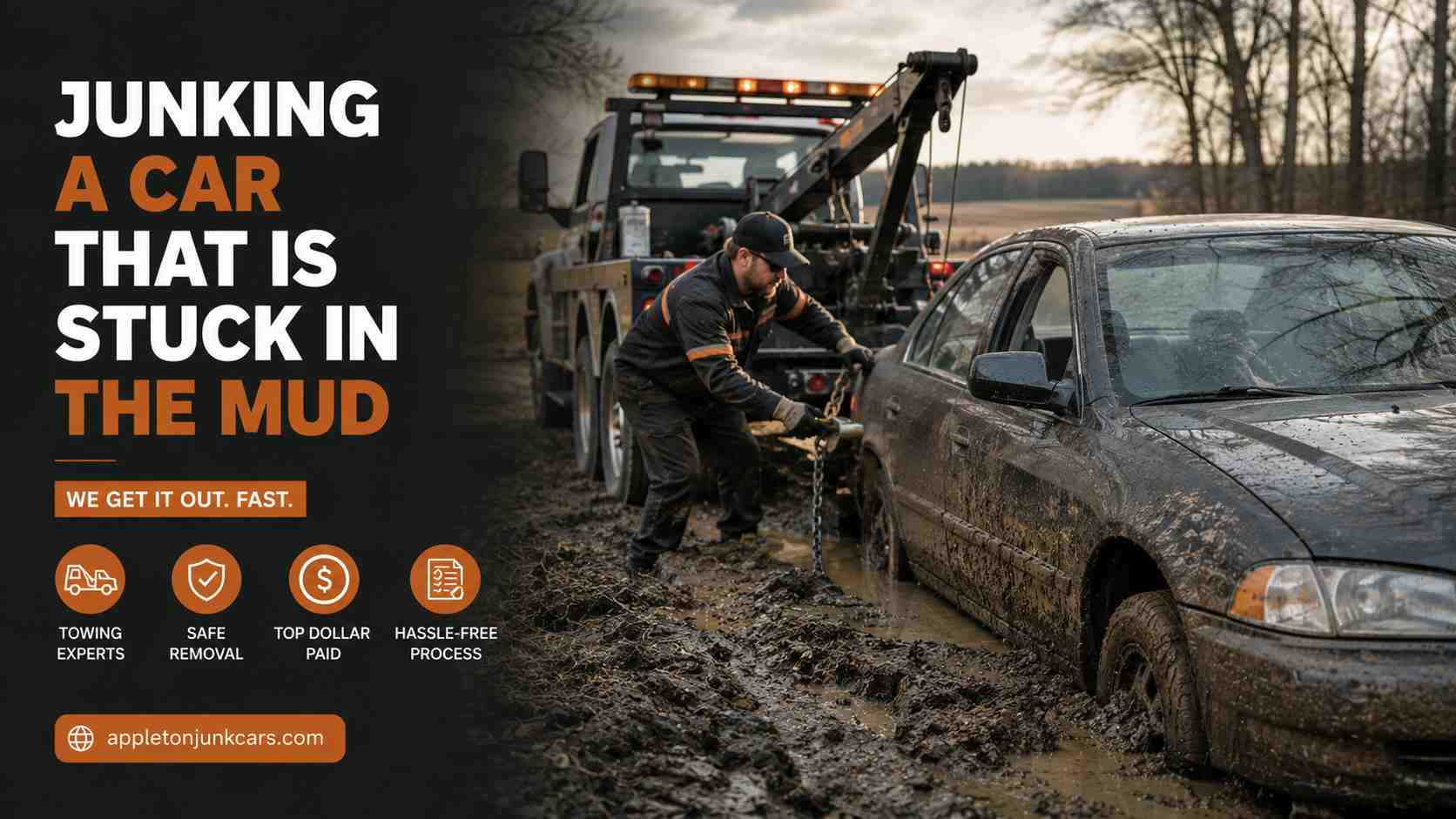
The car has been sitting in a field, a muddy lot, or a low-lying corner of the property for months or possibly years. It has sunk far enough that the tires are partially buried. A standard flatbed tow truck cannot reach it without getting stuck itself, and attempting to drive or roll the car to a more accessible location is not an option. Most sellers in this situation assume the car is therefore worthless because no buyer can reach it. The car is not worthless. The logistics just require a different approach.
Junking a car that is stuck in the mud is a solvable problem that comes up regularly for junk car buyers, salvage yards, and tow operators who work in rural and semi-rural areas. The equipment and techniques for extracting a stuck vehicle exist and are widely available. What changes compared to a standard junk car pickup is the logistics cost, which typically reduces the offer by $50 to $250 depending on the situation, and the type of equipment needed to complete the extraction.
This guide covers how to assess what type of stuck situation you have, what equipment can extract each type, how to prepare the site to reduce extraction cost, how to find buyers who handle difficult pickups, and how to negotiate the offer when access complexity is a factor.
Assessing What Type of Stuck Situation You Are Dealing With
Not all stuck cars are equal. The type of stuck determines which solution applies and what the realistic logistics cost is. Before calling any buyer, assess the situation accurately so you can describe it precisely and receive a realistic quote.
Situation Type | Description | Likely Solution | Offer Impact |
|---|---|---|---|
Surface stuck (soft mud, flat tires, vehicle can be winched) | Car is on soft ground but not deeply sunk; tires may be flat or partially buried but the frame is accessible | Standard heavy-duty tow with winch; may need ground boards for the tow truck | Minimal; $25 to $75 reduction |
Moderately sunk (axles close to ground level) | Vehicle has settled significantly; door sills near mud level; difficult but not impossible to winch | Heavy-duty winch truck plus ground support equipment; may need hand-shoveling first | $75 to $150 reduction |
Deeply sunk or submerged (frame in ground) | Vehicle has sunk substantially over years; significant excavation or tracked equipment required | Excavator or tracked skid steer to excavate before winching; complex operation | $150 to $300 reduction |
Surrounded by debris, vegetation, or structures | Access to the car is blocked regardless of ground condition | Clearing required before any tow operation can begin | $50 to $200 reduction depending on clearing needed |
Frozen into the ground (winter conditions) | Ground has frozen around the vehicle in cold climates | Wait for thaw or use heating equipment; frozen extraction rarely practical | May need to wait for seasonal conditions to change |
The most important assessment: can a heavy-duty tow truck or a winch truck reach the general area of the car without itself becoming stuck? If the ground is soft enough that a 30,000-pound recovery vehicle cannot approach, the extraction requires tracked equipment that distributes weight more effectively. Identifying this limitation accurately prevents a situation where a tow truck is dispatched, discovers it cannot reach the car, and charges a dry-run fee.
What Equipment Can Extract a Car From Mud
Winch Truck or Wrecker
A heavy-duty wrecker or recovery truck equipped with a winch can extract vehicles stuck in surface mud and moderate sinking situations if the truck itself can reach firm ground within the winch cable’s reach (typically 100 to 200 feet for medium-duty recovery winchs). The winch cable is attached to the stuck vehicle’s frame or tow hooks, and the truck winches the car to its position. Ground boards or recovery tracks (aluminum or plastic traction boards) can be placed under the tow truck’s wheels if the ground is soft but the truck can still approach the area.
Tracked Equipment: Excavator or Skid Steer
When a wheeled tow truck cannot reach the stuck vehicle without getting stuck itself, tracked equipment is the correct tool. A mini or full-size excavator or a compact track loader (Bobcat with rubber tracks) can traverse soft or waterlogged ground that would swallow a wheeled vehicle. The tracked equipment can be used to excavate mud from around a sunk vehicle, create a traction surface by laying gravel or boards, and provide a solid anchor point for winching.
Recovery Straps and Hi-Lift Jacks
For surface-stuck vehicles where the situation is muddy but not deeply sunk, a combination of high-lift jacks (to raise the vehicle enough to place boards under the tires), recovery straps (to connect to another vehicle or anchor point), and traction boards can sometimes free a vehicle without specialized equipment. This approach is practical for sellers who have access to basic recovery equipment and want to move the car to a more accessible position before the junk buyer arrives.
How to Prepare the Site Before Calling Any Buyer
Site preparation that you do before calling reduces the difficulty assessment buyers apply to the pickup and directly improves the offer you receive. Every hour of preparation work you do translates to more than an hour’s value in reduced offer discount because it also reduces the risk premium buyers add for unknowns.
Clear the path: if the route from a roadway or driveable area to the stuck car is blocked by vegetation, fencing, or equipment, clear it. A tow operator who can drive straight to the car and run a winch line without having to navigate obstacles charges significantly less than one who must cut a path or make multiple repositioning attempts.
Stabilize the approach: if the ground between a driveable surface and the car is soft, laying plywood sheets, pallets, or gravel on the path creates a trackway that allows a lighter vehicle to approach without getting stuck. Even a rough trackway that supports a small tractor or ATV allows the tow operator to pre-position anchoring equipment closer to the car.
Dig out if accessible: if the car is moderately sunk and you have a shovel, clearing mud from directly around the tires reduces the extraction force required and allows the car to roll more freely once freed. Clearing the area around all four tires to expose the tread contact area before calling the buyer is a preparation step that costs effort but no money and consistently improves the pickup outcome.
Finding Buyers Who Handle Difficult Pickup Situations
Not every junk car buyer has the equipment or the willingness to extract a stuck vehicle. Standard junk car buying services that use contracted flatbed tow trucks will typically decline the pickup or send a truck that cannot complete the job. Finding the right buyer is the most important step.
Call local heavy-duty tow and recovery companies directly rather than national junk car platforms for this situation. Recovery companies that handle rollover accidents, commercial vehicle recoveries, and farm equipment extractions have the winch trucks and tracked equipment needed for stuck vehicles. Many of these companies also purchase junk vehicles or have established relationships with salvage yards and can facilitate a combined extraction and sale transaction.
Contact local salvage yards and junk buyers directly rather than through online platforms, and specifically ask: “The car is stuck in mud and will need extraction before it can be picked up. Do you handle this type of situation, and what equipment do you use?” Buyers who answer this question with specific equipment information (they have a winch truck, they work with a recovery company, they have a tracked loader) are telling you they can handle the job. Buyers who hesitate or give vague answers likely cannot.
Scrap yards in rural areas are more likely to have encountered and solved this problem than those in urban areas. A scrap yard that serves farming communities regularly deals with abandoned farm equipment and vehicles in fields and has the equipment relationships to handle unusual extraction situations.
How a Stuck Car Affects the Offer You Receive
Access difficulty reduces the offer because it increases the buyer’s time and equipment cost to complete the pickup. The reduction is roughly proportional to the complexity of the extraction: a surface-stuck car that can be winched in 30 minutes adds minimal cost and produces a small or no offer reduction. A deeply sunk car requiring tracked equipment and excavation adds multiple hours of equipment time and produces a more significant reduction.
The offer reduction is negotiable and worth discussing explicitly. Ask the buyer: “How much are you reducing the offer because of the access situation?” If the reduction is larger than the realistic equipment cost, there is room to negotiate. If you have done site preparation that reduces the difficulty, describe that preparation specifically before accepting any reduction.
Getting three quotes even for a stuck car is worth doing. Buyers who have extraction equipment in-house quote differently from those who would need to hire outside recovery services. The buyer who owns a winch truck has a lower marginal cost for the extraction and can afford to apply a smaller reduction while still covering their costs.
What Sellers With Stuck Cars Consistently Report
Sellers who have junked cars in difficult-to-access positions share consistent experiences. The most common: calling a national junk car platform and having the pickup fail when the dispatched flatbed could not reach the car, requiring a rescheduled pickup with different equipment and sometimes a revised offer. The lesson repeated was to describe the stuck situation precisely on the first call rather than hoping the standard tow truck would manage.
Those who found local heavy-duty recovery companies directly reported faster resolution and more straightforward transactions. These companies deal with stuck and disabled vehicles professionally; a car buried in six inches of mud in a field is a moderate challenge for a recovery operator, not a special situation requiring unusual accommodation.
Sellers who prepared the site (cleared vegetation, laid boards on the approach path, dug out around the tires) consistently reported smaller offer reductions than those who called buyers with no preparation done. The preparation signals to the buyer that the extraction is planned and manageable rather than an unknown, which reduces the risk premium buyers apply when they cannot see the situation before quoting.
Frequently Asked Questions
Will a junk car buyer pick up a car that is stuck in mud?
Many local junk car buyers and salvage yards will pick up a car stuck in mud, but they need to be informed about the situation in advance so they can bring appropriate equipment. Standard flatbed tow trucks cannot reach vehicles in soft ground or extract stuck vehicles. Heavy-duty recovery trucks with winches, or tracked equipment for deeply sunk vehicles, are required. Always describe the stuck situation precisely when calling for quotes.
Does a car stuck in mud affect how much I get for it?
Yes, but the reduction depends on the severity of the situation. A surface-stuck car that can be winched by a standard recovery truck may produce a $25 to $75 reduction in the offer. A deeply sunk car requiring tracked excavation equipment may reduce the offer by $150 to $300. Site preparation that reduces extraction difficulty reduces the offer discount. Getting multiple quotes from buyers who own their own extraction equipment versus those who must hire recovery services typically produces a better outcome.
How do I move a car that is stuck in mud to sell it?
If the car is surface-stuck and you have access to another vehicle or a tractor, recovery straps and high-lift jacks can free the car enough to drive or tow it to a more accessible position before the junk buyer arrives. For more deeply stuck vehicles, a heavy-duty winch truck or tracked equipment is required. Alternatively, prepare the site (clear the path, lay boards, dig out the tires) and find a buyer who brings recovery equipment as part of their standard pickup service.
Can I junk a car that has been sitting in a field for years?
Yes. Cars that have been sitting in fields for years are regularly purchased by junk buyers and salvage yards. The value depends on the vehicle’s make, model, condition of the major components, and the scrap metal price. Long-term outdoor storage typically means rust, non-functioning systems, and flat or rotted tires, but these factors affect the offer without eliminating it. The access challenge of reaching a field-stored vehicle is managed through the buyer’s extraction equipment and factored into their offer.
What equipment is used to extract a stuck car?
A heavy-duty wrecker with a winch is the standard tool for surface-stuck vehicles where the ground is soft but the tow truck can reach firm ground within winch cable distance. Tracked equipment including mini excavators and compact track loaders (Bobcats with rubber tracks) are used when wheeled vehicles cannot reach the stuck car without getting stuck themselves. In very severe situations, a full-size excavator may be required to physically excavate around a deeply sunk vehicle.
Should I try to drive a junk car that is stuck in mud to a more accessible location?
Only if the car runs, the tires hold enough air, and the ground condition is such that driving is realistic. Attempting to drive a non-running vehicle or driving on flat tires can cause additional damage and may make the extraction more difficult. For non-running vehicles or those in soft ground, the safer approach is to prepare the site and let the buyer bring appropriate extraction equipment.
How do I find a junk car buyer who can handle a stuck car?
Call local heavy-duty tow and recovery companies rather than national junk car platforms. Ask specifically whether they handle vehicle extraction from soft or muddy ground and what equipment they use. Contact local salvage yards directly and describe the situation; ask whether they have in-house extraction capability or a recovery company they work with. Rural salvage yards that serve farming areas are particularly likely to have dealt with this situation regularly.
How much does it cost to have a stuck car extracted before selling it?
If the extraction is handled by the junk buyer or salvage yard as part of the pickup transaction, the cost is deducted from the offer rather than billed separately, typically reducing the offer by $50 to $300 depending on the situation. If you hire a recovery company independently to extract the car before calling a junk buyer, a winch recovery costs $150 to $400 for a standard stuck vehicle and more for complex situations requiring tracked equipment.
The Bottom Line
A car stuck in mud is a logistics challenge, not a deal-killer. The equipment and expertise to extract it exist and are accessible through local heavy-duty recovery companies and experienced salvage yards. The stuck situation reduces the offer, but the reduction is proportional to the extraction complexity and is negotiable based on the site preparation you do before the buyer arrives.
The most important preparation steps are describing the situation accurately to every buyer you call, so they bring the right equipment rather than discovering the complication on arrival, and doing whatever site preparation is accessible to you before the first quote call. Cleared paths, boards on soft approaches, and dug-out tire areas consistently produce smaller offer reductions.
Local buyers with heavy-duty recovery equipment are the right channel for stuck cars, not national online platforms that dispatch standard flatbeds. Finding those buyers with a direct call to a local recovery company or salvage yard, and describing the situation precisely, produces a smoother transaction than any other approach.