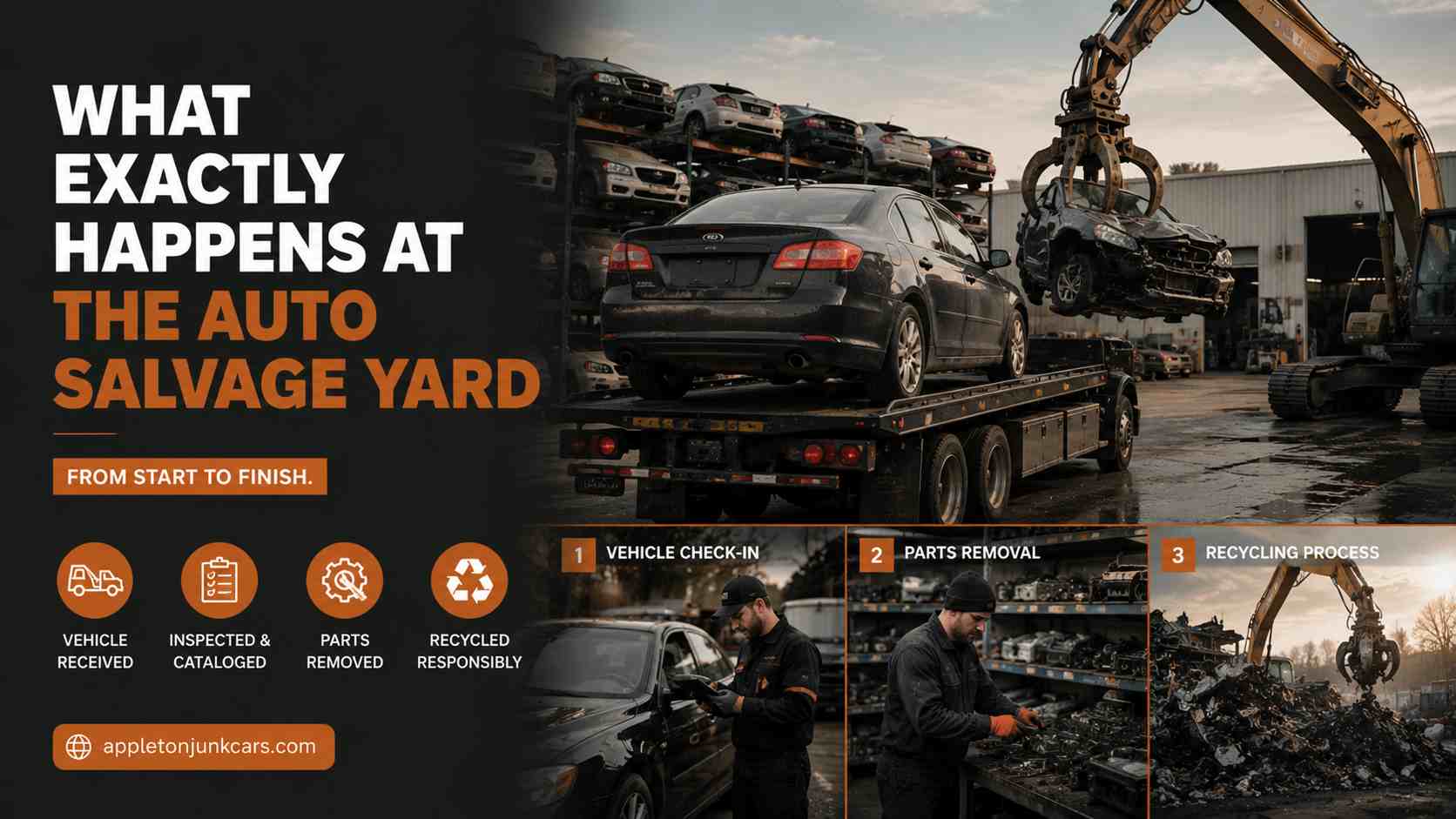
The moment a car enters an auto salvage yard, it begins a structured, legally regulated, production-line process that ends months later as recycled steel being poured into a new car body, a building beam, or a kitchen appliance. It does not simply sit in a field and rot. Every stage has a purpose, a sequence, and in most cases a legal requirement attached to it.
This guide walks through the entire process from the intake gate to the shredder, explains what the yard does with every fluid, component, and piece of scrap the car contains, covers how self-service and full-service yards operate differently, and answers every question a seller or parts buyer typically has about what happens behind the fence.
The Industry Behind the Fence
Auto salvage is not a small or informal business. In the United States alone, between 12 and 15 million vehicles reach the end of their useful life each year and are processed by the recycling industry. Globally, that number exceeds 27 million vehicles annually. Automotive recycling is the 16th largest industry in the United States, generating roughly $25 billion per year and employing more than 140,000 people across 9,000-plus licensed salvage yards.
The vehicles themselves are the most recycled consumer product on earth. Approximately 80 percent of a vehicle by weight is recoverable as reusable parts or recyclable material. About 75 percent of a vehicle’s weight is metal that goes directly back into the scrap steel supply chain. The remaining 20 to 25 percent, a mixture of plastics, textiles, glass, and rubber collectively called auto shredder residue, ends up in landfills.
Every year, U.S. salvage yards safely recover an estimated 5 to 10 gallons of toxic fluids from each vehicle processed, preventing those fluids from leaching into groundwater. The cumulative volume of fluids captured by the auto recycling industry annually is equivalent to eight times the volume of oil spilled in the Exxon Valdez disaster. This is not incidental. It is one of the core regulatory functions the industry performs.
A Step-by-Step Guide to the Auto Salvage Yard Process
Stage 1: The Car Arrives at the Gate
Before a single bolt is turned, the yard has legal obligations to satisfy. Processing a stolen vehicle, a vehicle with an active lien, or a vehicle with a forged title can result in criminal prosecution for the yard operator and the loss of their state operating license. The intake process exists specifically to prevent this.
Title verification and NMVTIS reporting
The first thing a yard does when a vehicle arrives is verify the paperwork. A technician or intake clerk checks the title against the Vehicle Identification Number stamped on the dashboard plate and the door jamb sticker. The name on the title must match the seller’s ID. Any discrepancy stops the process until it is resolved.
Once the title is verified, the yard is legally required under the Anti-Car Theft Act of 1992 to report the vehicle to the National Motor Vehicle Title Information System (NMVTIS). This federal database, administered by the Department of Justice, tracks every vehicle that enters a junk or salvage yard in the country. Reporting must happen at least monthly, and the penalty for non-compliance is a $1,000 civil fine per violation. The required information includes the VIN, the date the vehicle was obtained, the name of the seller, and the yard’s intended disposition of the vehicle (crushed, parted out, or sold for export).
NMVTIS serves two purposes. First, it flags any vehicle that was previously reported stolen, ensuring the yard does not process it and inadvertently launder stolen property. Second, it creates a permanent record that the VIN has been retired, preventing thieves from using that VIN number to create a cloned vehicle and sell it to an unsuspecting buyer.
Initial inspection and inventory
With the legal clearance done, an inspector walks the vehicle and evaluates its condition. This is not a casual glance. The inspector is building an asset list: which parts are intact and saleable, which components are damaged beyond resale, what the mileage shows, and whether there are any high-value items that need to be secured immediately rather than left on the lot.
The findings go into the yard’s digital inventory system, usually built around the Hollander Interchange database, which assigns every part a standardized identification number and cross-references it against other vehicles that use the same component. This is how a yard clerk can tell you in seconds whether the transmission from a 2015 Honda CR-V fits a 2017 Acura RDX without looking at a single manual. Parts go into the system by condition grade (excellent, good, fair) and mileage bracket. Customers searching the yard’s online inventory or calling to ask about a part are drawing on this database.
Stage 2: Draining Every Hazardous Fluid From the Car
A car is not just metal. It contains a collection of toxic and environmentally regulated liquids that must be removed before the vehicle can be moved to the open yard, sold for parts, or sent to the crusher. Federal and state environmental regulations require salvage yards to drain all fluids through an EPA-compliant process before the vehicle enters general inventory. Skipping this step is an environmental violation that carries significant fines.
The draining typically happens at a specialized eco-station, a covered, sealed work bay with fluid capture systems built into the floor.
What gets extracted and how
High-powered vacuum lines tap into the vehicle’s fluid reservoirs to remove each of the following:
- Engine oil (usually 4 to 7 quarts depending on the vehicle)
- Transmission fluid (4 to 12 quarts depending on transmission type)
- Coolant and antifreeze (typically 1 to 2 gallons)
- Brake fluid from the master cylinder reservoir
- Power steering fluid
- Gasoline or diesel remaining in the fuel tank
- Air conditioning refrigerant, which must be recovered using EPA-certified equipment and technicians
For the average vehicle, 5 to 10 gallons of combined fluids are recovered during this stage. Technicians also physically remove the 12-volt lead-acid battery and any mercury switches present in the vehicle. Mercury switches were common in vehicles manufactured before the early 2000s and are found in hood-activated underhood lights and in some anti-lock braking components. Both mercury and lead are heavy metals that contaminate soil and groundwater at extremely small concentrations. The EPA estimates that approximately 40 million mercury switches exist in the U.S. vehicle fleet, and their safe removal at salvage yards is one of the primary mechanisms for keeping them out of landfills.
Where the fluids go after removal
Nothing extracted at the eco-station is simply thrown away. Each fluid has its own destination:
- Engine oil: filtered and reused to run the yard’s own equipment, or sent to an oil recycler for re-refining into lubricant-grade base oil
- Gasoline and diesel: filtered of water and debris, then burned in the yard’s on-site machinery or transferred to fuel recyclers
- Antifreeze and coolant: cleaned through a glycol recycling unit and resold at a discount, or processed by a coolant recycler
- Brake fluid and power steering fluid: consolidated and sent to licensed hazardous waste processors
- Refrigerant: captured in EPA-certified recovery equipment and either recycled in-house for recharge use or returned to refrigerant manufacturers for reclamation
- Battery: sent to a lead-acid battery recycler. Lead-acid batteries are one of the most successfully recycled products in the world, with more than 97 percent of a standard 12-volt car battery being recyclable
Yards that do not properly drain, capture, and dispose of these fluids face EPA enforcement actions, state environmental fines, and potential liability for contaminated soil remediation, which can cost millions of dollars. Compliance is not optional.
Stage 3: The High-Value Parts Come Off Before Anything Else
With the fluids extracted and the battery removed, the yard moves to the most financially critical step: pulling the high-value components that are both most likely to be stolen and most damaged by exposure to weather. These parts do not go to the open yard. They go to secure storage.
The catalytic converter goes straight to a locked vault
The first component any experienced yard worker reaches for is the catalytic converter. As we covered in the previous article on scrap aluminum pricing, a catalytic converter contains platinum, palladium, and rhodium in concentrations that make it worth $50 to $700 depending on the vehicle. Catalytic converter theft is one of the most prolific property crimes in the country precisely because of this value.
Salvage yards remove the converter immediately after intake and store it in a locked, secured area, separate from the general yard. The serial number stamped on the converter housing is logged into the yard’s pricing database to establish its precious metal loading and resale value. Converters are sold to specialized recyclers who use X-ray fluorescence (XRF) analysis to measure the exact gram weight of each precious metal before purchasing. The yard’s converter inventory is typically one of its most valuable liquid assets.
Powertrain components
After the converter, workers typically address the engine, transmission, and transfer case. These are the highest-value parts in the average vehicle, and leaving them exposed to rain, frost, and direct sun accelerates seal and gasket deterioration, reducing their resale value.
If the engine and transmission are running and in serviceable condition, they are often pulled, cleaned, and wrapped in plastic for indoor warehouse storage. A complete running engine from a popular platform sells for $300 to $1,200. A serviceable automatic transmission sells for $200 to $800. These parts are sold to independent mechanics, repair shops, engine rebuilders, and online buyers through the yard’s website or the Car-Part.com network, which aggregates inventory from thousands of salvage yards in real time.
The alternator, starter motor, and major sensors are also pulled at this stage if they test as functional. Alternators from working units bring $75 to $200. Starters bring $30 to $80. These go to the warehouse shelving alongside the powertrain parts.
Electronics, modules, and infotainment systems
Modern vehicles contain dozens of electronic control units. The Engine Control Module (ECM), Transmission Control Module (TCM), Body Control Module (BCM), and Advanced Driver Assistance Systems (ADAS) computers are expensive to replace new and in high demand in the used parts market. A BCM from a late-model GM vehicle can sell for $150 to $400. An ECM from a 2018 or newer truck or SUV can bring $200 to $600 depending on the platform.
Infotainment screens, navigation head units, digital instrument clusters, and backup camera systems are removed and tested before being placed in warehouse storage. A working OEM touchscreen infotainment unit from a popular make can sell for $200 to $800 online or through the yard’s counter. These parts are sold to shops doing tech upgrades on older vehicles and to owners who need to replace a failed OEM unit at a fraction of the dealer replacement cost.
Airbag modules are handled with particular care. Undeployed airbag assemblies have real resale value to body shops, but they contain sodium azide propellant, which is classified as a hazardous material. Improperly stored or handled airbag units are a safety risk. Yards either store them in designated hazardous materials areas or sell them specifically to licensed vehicle recyclers equipped to handle the propellant.
Stage 4: The Shell Goes to the Yard and Customers Come In
Once the fluids are gone, the hazardous materials are removed, and the high-value components are secured in the warehouse, the remaining car body and interior, now significantly lighter and stripped of its most profitable components, moves to the open lot. This is the car you see when you walk through the rows of a salvage yard.
At this point, the yard operates one of two models depending on its business structure: self-service or full-service. Some large operations run both simultaneously at the same location.
How self-service (u-pull-it) yards work
In a self-service or u-pull-it yard, customers pay an entry fee (typically $2 to $5 per person per visit) and walk the rows with their own tools to remove whatever parts they need. The yard provides no labor. You identify the vehicle you want to pull from, verify the part fits, remove it yourself, and pay for it at the exit checkout. The yard’s price list is posted at the entrance and sometimes online, with prices set by part category regardless of the vehicle make.
The pricing model works in the customer’s favor. Because the yard is not paying labor to extract parts, it can sell used components at 30 to 60 percent below retail new part prices. A water pump that costs $120 new might be $25 to $40 at a u-pull-it yard. A complete door assembly that costs $400 new might be $60 to $100. For mechanically capable buyers willing to spend 20 to 40 minutes in the yard, the savings are substantial.
Major self-service chains like LKQ Pick Your Part, Pull-A-Part, and U-Pull and Pay publish live online inventory updated daily. When a new vehicle arrives on the lot, the yard adds it to the system with photographs. This lets experienced buyers check online before driving to the yard, prioritize the newest arrivals (before popular parts are picked off), and plan their extraction before they enter.
How full-service yards work
Full-service yards do not allow customers into the lot for safety and liability reasons. Instead, a customer comes to the counter, describes or looks up the part they need using the Hollander Interchange number or their vehicle information, and the yard’s staff goes out to the lot to extract the part. This adds labor time, usually 20 minutes to a few hours depending on complexity, but removes the need for the customer to bring tools or spend time in the yard.
Full-service parts are priced higher than self-service equivalents because of the extraction labor. A water pump that is $25 to $40 at a u-pull-it yard might be $60 to $90 at a full-service yard. Many full-service yards also offer limited warranties on used parts, typically 30 to 90 days, which is something u-pull-it yards rarely provide. For buyers who are not mechanically confident, or who need a large, difficult-to-extract component (like a door with intact wiring harness), the full-service model is worth the higher price.
Car-Part.com is the primary online marketplace aggregating full-service yard inventory nationwide. You can search by part number, vehicle year, make, and model and see which yards near you have the part in stock, at what grade and mileage, and for what price. Many yards list parts on eBay and their own websites as well.
How long does a car sit in the yard?
According to Pull-A-Part, one of the major national u-pull-it chains, vehicles are generally on the yard between 60 and 90 days before being crushed. The actual timeline depends on how quickly customers strip the vehicle. Popular models (Honda Civics, Ford F-150s, Toyota Camrys) get picked clean of the most sought-after parts within the first two to three weeks. Less popular or unusual vehicles may sit considerably longer.
The practical implication for parts buyers: the newest arrivals in the yard will have the most complete inventory, and the best parts go fast. If a yard posts a vehicle you need on Monday, Tuesday morning is when you want to be there. By the following weekend, the catalytic converter is already gone (the yard pulled it at intake), the battery is gone, the airbags are gone, and anyone who got there ahead of you has picked the good mechanical components. What remains is typically body parts, interior trim, and non-mechanical components.
Self-Service vs. Full-Service Salvage Yards: What to Expect
The table below compares the two yard types across the factors that matter most to buyers and sellers.
Feature | Self-Service (U-Pull-It) | Full-Service Yard |
|---|---|---|
Customer yard access | Yes. You walk the rows with your own tools. | No. Staff only access the lot. You order at the counter. |
How parts are extracted | You unbolt, unclip, and pull the part yourself. | A yard technician goes out with tools, torches, or saws and extracts the part for you. |
Entry fee | $2 to $5 per person, per visit. Charged even if you find nothing. | No separate entry fee. Cost is rolled into the part price. |
Pricing | Generally 30 to 60 percent below retail new part prices. The cheapest option available for used OEM parts. | 40 to 60 percent below dealer prices. More expensive than u-pull, but includes extraction labor. |
Tools required | Yes. Bring your own sockets, ratchets, pry bars, and specialty bits. | No. The yard supplies all tools and extraction equipment. |
Warranty on parts | As-is in most cases. No return policy after installation. Test before you leave when possible. | Many full-service yards offer a 30- to 90-day limited warranty on used parts. |
Part condition | Varies. You see and inspect the part before removing it. | You rely on the staff description until the part arrives. Reputable yards grade parts before sale. |
Best for | Mechanically confident buyers willing to spend time for the lowest price. | Buyers who want the part ready to install, or who need a large or difficult-to-extract component. |
Payment timing | Pay at checkout when you exit with the part. | Pay upfront or on delivery, depending on yard policy. |
Part search | LKQ Pick Your Part, Pull-A-Part, and most u-pull-it yards publish live online inventory updated daily. | Car-Part.com aggregates parts from thousands of full-service yards nationwide. Search by part, year, make, model. |
Stage 5: The Crusher, the Shredder, and the Steel Mill
After 60 to 90 days in the yard, or sooner if the vehicle has been completely stripped and is taking up space without generating revenue, the car reaches the final stage of its life cycle. At this point it is essentially a bare metal shell. The usable parts are gone. The fluids are gone. The hazardous materials are gone. What remains is a large block of scrap ferrous and non-ferrous metal.
The compactor
A yard forklift or front-end loader picks up the bare shell and carries it to a hydraulic car crusher. The compactor uses thousands of pounds of hydraulic pressure to flatten the car into a dense rectangular block typically about 18 inches thick. Compression happens in seconds. The resulting cube or block is easy to stack, efficient to transport, and reduced to roughly one-tenth its original volume.
Some yards operate their own on-site crusher. Others accumulate stripped shells and call in a mobile crushing service that travels from yard to yard with truck-mounted crushing equipment. The compacted blocks are worth the current shredder steel price per ton, which runs $100 to $130 per ton at a recycling facility, less than the per-ton price for better-grade scrap because the block still contains mixed materials that the shredder must sort.
The industrial shredder
The compacted blocks are loaded onto flatbed semi-trucks or rail cars and shipped to a regional industrial shredder facility. These are massive operations. A large industrial shredder can process over 450 cars per hour. The shredder tears the compressed metal into fist-sized chunks in seconds using a hammermill rotating at high speed. The torn metal pieces travel through a series of sorting systems: giant overhead magnets pull ferrous steel away from the stream, air separators blow away light plastics and textiles, and eddy current separators push non-ferrous metals like aluminum and copper out of the flow using a magnetic repulsion effect.
The output is three streams: sorted steel and iron, sorted non-ferrous metals (aluminum, copper, zinc), and auto shredder residue (ASR). The steel and iron stream is the largest by far, making up roughly 65 to 70 percent of the total vehicle weight. The non-ferrous metals represent another 5 to 10 percent. Auto shredder residue, the plastics, textiles, glass, and rubber that cannot be economically separated or recycled, represents the remaining 20 to 25 percent and goes to landfill.
What the steel actually becomes
The sorted ferrous steel goes to an electric arc furnace at a steel mill. The process uses electrical energy to melt the scrap steel into liquid form at temperatures exceeding 3,000 degrees Fahrenheit. The liquid steel is cast into slabs, billets, or blooms and then rolled into the products end manufacturers need: sheet steel for new vehicle body panels, structural beams for construction, wire rod for fencing and industrial fasteners, pipe for plumbing and infrastructure, and steel for appliances.
The auto recycling industry’s steel contribution is significant. Each year, salvage yards in the U.S. and Canada supply enough recycled steel to produce approximately 13 million new vehicles. The industry also saves roughly 85 million barrels of oil annually compared to what would be needed to produce the same steel from virgin iron ore. Recycling steel requires about 75 percent less energy than producing it from raw materials.
How Much of a Car Actually Gets Recycled
Approximately 80 percent of a vehicle by weight is recyclable or reusable. Here is how that breaks down across the major material categories:
- Steel and iron (about 65-70% of vehicle weight): nearly all recovered by shredder magnets and sent to steel mills
- Aluminum (about 8-10%): recovered by eddy current separators at the shredder; used in secondary aluminum production for new castings
- Copper (about 1-2%): recovered from wiring harnesses and sold to copper smelters at a significant premium over steel ($3.80-4.20/lb in 2026)
- Fluids (5-10 gallons per vehicle): almost entirely recovered and reprocessed or neutralized during eco-draining at the yard
- Reusable parts (variable by vehicle condition): sold back into the used auto parts market, extending the service life of other vehicles
- Auto shredder residue (about 20-25%): the portion that cannot currently be economically recovered; goes to landfill
The 95 percent end-of-life vehicle recycling rate in the U.S. is among the highest for any product category in the consumer economy. Automobiles are the most recycled consumer product in the world by volume, not because of altruism, but because the economic value locked inside them makes recovery profitable at every stage of the process.
What to Expect if You Are Selling a Car to a Salvage Yard
If you are planning to sell your vehicle to a yard, understanding the process helps you set realistic expectations and avoid common misunderstandings about how offers are calculated.
The yard’s intake team is looking at your vehicle from the perspective of the formula we covered in the previous article: weight times scrap steel price, plus parts value above scrap, minus their operating costs. They are not guessing. They are running through a structured internal assessment. The more of the car that is intact, the higher the offer.
Several things happen on the day of pickup that sellers often are not expecting:
- The driver checks the title against your ID before handing over payment. If the title and ID names do not match, the transaction stops.
- Some buyers inspect the vehicle on pickup and may adjust the offer if the car’s actual condition differs significantly from what was described when you called for a quote. Always describe the car accurately when getting a quote.
- Payment is made at pickup. Standard payment is cash or a check handed to you before the tow truck leaves. If a buyer insists on paying later, walk away.
- The car is yours until you sign the title. Do not sign anything or hand over the keys before you have payment in your hand.
What to Expect if You Are Buying Parts From a Salvage Yard
For parts buyers, the salvage yard experience depends almost entirely on preparation. The buyers who find what they need quickly and leave with the right part are the ones who did their research before arriving.
- Search the yard’s online inventory before driving there. Most large yards post new arrivals daily. Confirm the vehicle you need is on the lot and has not been there long enough to be stripped of the part you need.
- Know the Hollander Interchange number for your part if possible. This tells the yard clerk exactly what you need across compatible vehicles, which may open up additional donor cars you had not considered.
- At a u-pull-it yard, bring the right tools. The most useful basic kit is a socket set (metric and standard, 3/8 inch drive), a set of screwdrivers, a trim panel removal tool, pliers, and penetrating oil. For suspension or exhaust work, add a 1/2 inch drive breaker bar and impact sockets.
- Inspect the part carefully before removing it at a u-pull-it yard. Look for cracks, corrosion, damaged connectors, worn threads, or signs of a prior repair that may affect function. You have no recourse after the part is installed.
- At a full-service yard, ask about the part’s grade, mileage, and any warranty terms before committing to the purchase.
What Slows the Process Down for Sellers and Buyers
Title problems at intake
The most common cause of a delayed or cancelled sale is a title issue: the title is in someone else’s name, a lien is still showing as active, the VIN on the title does not match the car, or the title has been reported as lost to the DMV without a replacement being issued. Resolve all title issues before the tow truck arrives. Anything the yard cannot immediately verify at intake gets flagged, and transactions with flagged documentation do not proceed until the issue is cleared.
Missing high-value components discovered at pickup
If the catalytic converter, battery, engine, or other high-value components have been removed before the buyer arrives, the offer will be adjusted downward on the spot to reflect the missing parts. This is not negotiable. The original quote assumed a complete vehicle. If the car is no longer complete, the valuation changes.
Parts inventory not matching online listings
At u-pull-it yards, the online inventory system shows what the yard received, not what the customer before you already took. A car shown as “in yard” may have the part you need or may have had it pulled by someone who arrived earlier that morning. Always call the yard to confirm availability if you are driving a significant distance. Experienced buyers check inventory at night and arrive first thing when the yard opens the next day.
Weather and yard conditions
U-pull-it yards operate outdoors. Rain, ice, and extreme heat affect both the yard conditions and the difficulty of extracting parts. Fasteners rusted from years of exposure, lines frozen to brackets, and wiring harnesses made brittle by heat cycles all slow down extraction. Penetrating oil applied the night before a yard visit (if you can get access to the part that early) can save significant time.
Questions People Ask About What Happens at a Salvage Yard
Does a salvage yard just let cars sit and rust?
No. An incoming vehicle is processed in stages: legal clearance and inventory logging, fluid draining at an eco-station, high-value parts removal and secure storage, placement in the open yard for customer access, and eventually crushing and transport to a shredder. It is a production-line operation, not a parking lot. The average vehicle spends 60 to 90 days in the yard before being crushed.
How does the yard make sure the car is not stolen?
The yard verifies the VIN on the vehicle against the title and the seller’s ID at intake. The VIN is also run through the NMVTIS database, which shows the vehicle’s title history and any stolen status flags. The yard is federally required to report the vehicle to NMVTIS under the Anti-Car Theft Act of 1992. Failure to report or accepting a stolen vehicle creates criminal liability for the yard.
What happens to all the fluids in the car?
All fluids are extracted at a covered eco-draining station before the vehicle goes anywhere else. Engine oil and fuel are filtered and reused in yard machinery or sent to recyclers. Antifreeze is cleaned and resold. Brake fluid and power steering fluid go to hazardous waste processors. Refrigerant is captured using EPA-certified equipment. The battery goes to a lead-acid battery recycler. Nothing is dumped.
What is the difference between a u-pull-it yard and a full-service yard?
In a u-pull-it or self-service yard, you pay a small entry fee, walk the rows, bring your own tools, and remove the part yourself. Prices are lower because no labor is included. In a full-service yard, customers are not allowed in the lot. You order at the counter and yard staff extracts the part for you. Prices are higher, but many full-service yards offer limited warranties on used parts.
What parts does the yard pull before I can get to the car?
The yard removes the catalytic converter immediately and locks it in secure storage. The battery is pulled during eco-draining. If the engine and transmission are in working condition, they may be pulled for warehouse storage as well. High-value electronics like airbag modules and ECM computers may also be pulled early depending on the yard’s operations. What remains for customer access is typically the body, interior, glass, non-core mechanical parts, and trim.
Can I go to the yard and buy parts the same day?
At a u-pull-it yard, yes, as long as the vehicle you need is currently in the yard and still has the part you are looking for. Check the yard’s online inventory the night before, confirm availability by phone, arrive when the yard opens, and bring the right tools. At a full-service yard, parts for common vehicles can sometimes be available immediately if the yard has already pulled and shelved the part. Complex or low-demand parts may require the yard to pull them from the lot, which takes additional time.
How does the yard figure out what my car is worth when I sell it?
Using a three-part formula: the vehicle’s weight multiplied by the current local scrap steel price per ton, plus the resale value of any intact parts the yard can extract and sell, minus their operating costs for towing, fluid draining, and dismantling. This formula is covered in full detail in the “How Salvage Yards Calculate Car Value” article in this series.
What happens to the car after it is crushed?
The compacted block is transported by flatbed truck or rail to an industrial shredder facility. The shredder tears the block into fist-sized chunks and separates the metal streams using magnets and eddy current separators. The sorted steel is sent to electric arc furnace steel mills where it is melted and cast into new steel products. The industry supplies enough recycled steel each year to produce approximately 13 million new vehicles.
Does everything in a salvage yard get recycled?
About 80 percent by weight. Steel and iron, aluminum, copper, and other recoverable metals are recycled. Fluids are reprocessed. Usable parts are resold. The remaining 20 to 25 percent, auto shredder residue consisting of plastics, textiles, glass, and rubber that cannot be economically separated, goes to landfill. The auto recycling industry’s roughly 95 percent end-of-life vehicle processing rate makes automobiles the most recycled consumer product category in the world.
Is the catalytic converter available for me to buy when I visit the yard?
Almost always no. The yard pulls the catalytic converter at intake and stores it in a secure area due to its high theft risk and precious metal value. It is sold to specialized converter recyclers separately, not through the general parts counter. If a yard advertises converters for sale, they are typically marketing complete exhaust assemblies, not the converter itself.
What is the Hollander Interchange and why does the yard use it?
The Hollander Interchange is the auto recycling industry’s universal parts database. It assigns a unique number to every group of confirmed-compatible parts across all makes, models, and years. When two vehicles share the same Hollander number for a part, that part is confirmed to be a direct fit. Every major salvage yard in North America uses Hollander’s Powerlink yard management system to log incoming inventory, and the EDEN network connects yards’ inventories so a buyer can search for a part at thousands of locations simultaneously.
Do salvage yards take cars that are completely destroyed or burned?
Yes, with limitations. A completely destroyed or burned vehicle still has scrap metal value and will be accepted by most yards for the scrap weight price. However, a fire-damaged or flood-damaged vehicle has very few resalable parts, so the offer will reflect scrap weight only rather than any parts premium. If a flood-damaged vehicle’s title has been branded (also called a “flood” or “water damage” title), the yard must report that brand to NMVTIS along with the intake report.
Your Plan Whether You Are Selling or Buying
Use this list depending on which side of the transaction you are on.
If you are selling a car to a salvage yard:
- Check your title first. Confirm it is in your name, free of liens, and that the VIN matches the car. Resolve any discrepancy before calling for a quote.
- Remove your personal items and digital data. Everything covered in the “What to Remove Before Junking” guide applies here. Once the car leaves, it is gone.
- Get at least three quotes. Describe the car completely and accurately. Tell buyers what works, not just what does not. The offer formula responds to accurate parts information.
- Confirm the offer includes free towing. If not, either negotiate the towing deduction or arrange your own transport to improve the payout.
- Have the signed title ready at pickup. Payment happens when the driver arrives. Sign the title over and receive cash before the truck leaves.
- File a Notice of Transfer with your state DMV the same day. This removes the car from your name in the state’s system.
If you are buying parts from a salvage yard:
- Search the yard’s online inventory the night before. Confirm the vehicle you need is currently on the lot.
- Know the Hollander Interchange number for your part. Look it up at Car-Part.com or call the yard and give them your year, make, and model. This opens up compatible donor vehicles beyond your exact car.
- Arrive early. The best parts on newly arrived vehicles go within the first two or three days. If the car just posted to the inventory, get there the next morning.
- Bring the right tools for a u-pull-it yard. Socket set (metric and standard), screwdrivers, trim removal tool, pliers, and penetrating oil. Add a breaker bar for suspension or exhaust work.
- Inspect the part before removing it. Check for cracks, corrosion, damaged connectors, and worn threads. You cannot return a part at most u-pull-it yards after it is installed.
- Ask about warranty terms at full-service yards before committing to the purchase. Many offer 30 to 90 days on parts they extract and sell.
The auto salvage yard is one of the most efficient recycling systems operating anywhere in the consumer economy. The 60-to-90-day life a vehicle spends on the lot, from the moment it clears the gate to the moment it is flattened and shipped to a shredder, involves a regulated, sequential process that recovers nearly every dollar and every gram of material the vehicle contains. Knowing how that process works puts you in a much stronger position on both sides of the transaction.