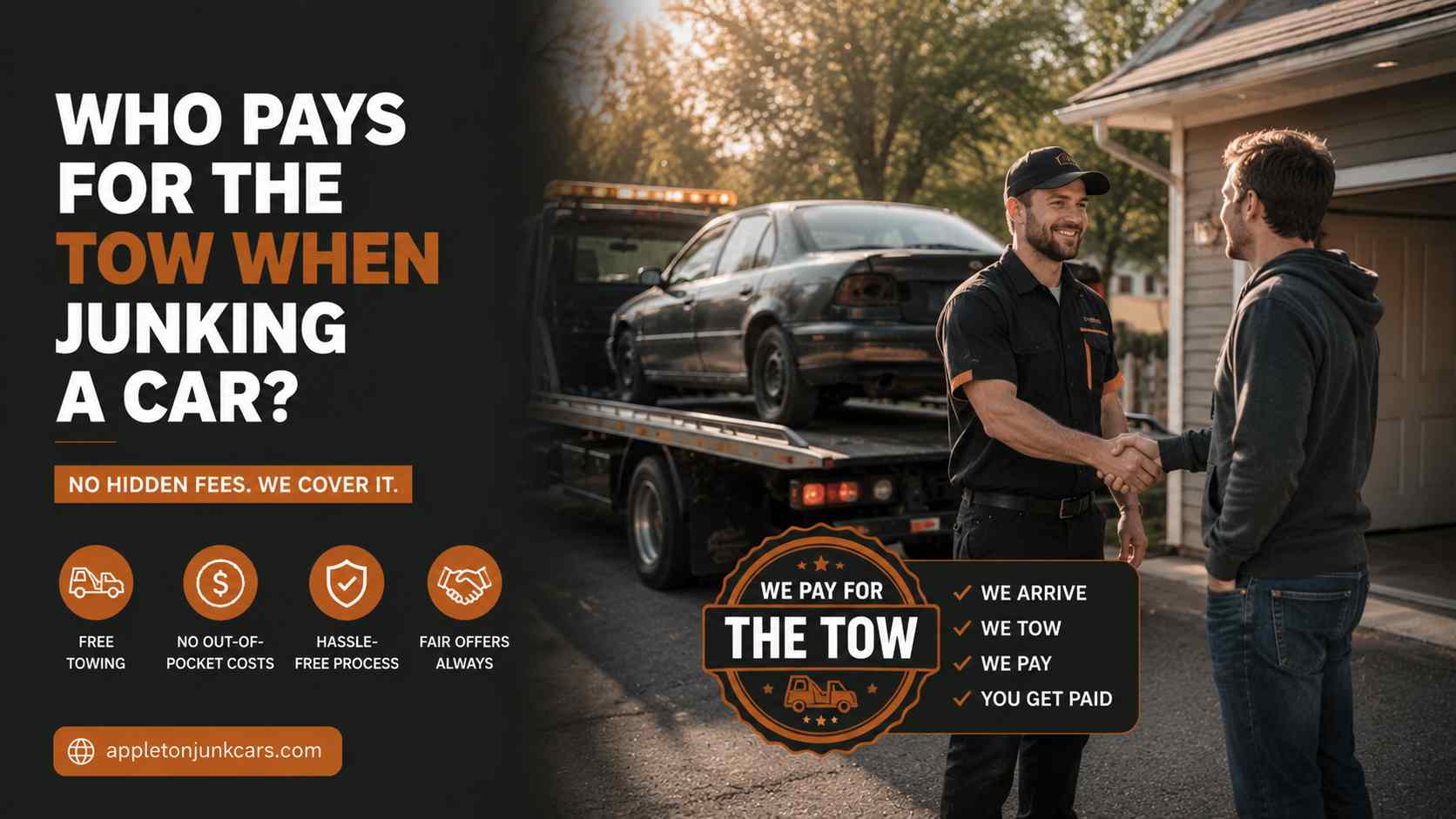
In the vast majority of junk car transactions, the buyer pays for towing. Free towing is standard practice among established junk car buyers, salvage yards, and national junk vehicle platforms that purchase non-running cars regularly. The tow cost is built into the buyer’s pricing model, not added on top of it. If a buyer is offering to purchase your vehicle and asking you to pay for towing separately, that arrangement is worth examining closely before you agree.
The phrase “free towing” can be misleading because nothing in a commercial transaction is actually free. The tow cost is absorbed into the buyer’s offer. A buyer who can tow from your location efficiently has factored that cost into their margin. A buyer who cannot reach your location without significant expense may reduce their offer to compensate. Understanding how this works lets you recognize a fair deal, spot a bad one, and negotiate when the terms are not what they should be.
This guide covers when free towing is genuinely standard, the specific situations where sellers pay for or share the tow cost, the warning signs that a towing offer is part of a bait-and-switch, and how to negotiate the tow cost into the deal when it is not being offered.
What Free Towing Actually Means in a Junk Car Transaction
Free towing in a junk car context means the buyer dispatches and pays for the tow truck as part of completing the purchase. The seller does not write a check, does not hand cash to the driver, and does not arrange the towing separately. The tow truck arrives, the driver completes the paperwork with the seller, the car is loaded, and the payment for the car changes hands on the spot or shortly after. That is the complete standard transaction.
What is actually happening financially is that the buyer has a contracted rate with a towing company, typically a flat regional fee, and that cost is one of several expenses factored into the offer. A buyer operating at scale might pay $75 to $125 per tow for a vehicle within a 25-mile service radius. A vehicle 60 miles from the buyer’s lot costs more to move and may produce a slightly lower offer to compensate, even within a stated “free towing” policy.
This is normal and expected. The phrase “free towing” means the seller pays nothing to the tow driver. It does not mean towing cost has no influence on the offer. Understanding that distinction helps you interpret offer differences across buyers in different locations relative to your car.
When You Should Expect Free Towing Without Negotiation
Free towing is reliably standard in these situations:
Situation | Towing Outcome | What to Expect |
|---|---|---|
Selling to a national junk car buying platform (online quote) | Free, included in the transaction | Tow truck dispatched within 24 to 48 hours of accepted offer. Driver brings paperwork and payment. |
Selling to a local salvage yard within their standard service radius (typically 25 to 50 miles) | Free, included in the offer | Yard dispatches own or contracted tow. May take 2 to 5 days depending on schedule. |
Car is in a standard accessible location (driveway, lot, street) | Free without complication | No access surcharge. Standard tow equipment handles the pickup. |
Vehicle is non-running but has four inflated tires | Free; standard flatbed used | No additional equipment needed. |
Vehicle is within a metro area with many junk buyers competing | Free; buyers compete on offer | More buyers means more competition; sellers in major metros have most leverage. |
Car is far outside any buyer’s service area (100+ miles from the nearest buyer) | Free may not apply; expect lower offer | Remote locations reduce competition. Buyers may reduce offer to cover transport or decline entirely. |
Car is in a hard-to-access location (mud, steep grade, enclosed garage with limited clearance) | May carry a surcharge | Standard flatbed cannot access all locations. Special equipment costs more. |
If you are in a standard metropolitan or suburban location and selling to any established buyer, expecting free towing is entirely reasonable and you should not accept a deal that asks you to pay for it.
The Situations Where the Seller Legitimately Pays for Towing
There are specific scenarios where paying for towing yourself, or contributing to it, makes financial sense and is not a sign of a bad deal.
Delivering to a Scrap Yard Yourself for a Higher Offer
Some scrap metal yards and salvage operations offer a higher price per vehicle if you deliver it versus requiring them to arrange pickup. The difference is typically $50 to $100 for passenger vehicles and $100 to $200 for heavier vehicles. If you can arrange delivery through a borrowed truck and trailer or a flat-rate tow company that charges less than the price premium, delivering yields more net cash. This is a seller choice, not a buyer-imposed cost.
Selling to a Private Buyer Who Does Not Tow
Private buyers on Facebook Marketplace or Craigslist are not in the towing business. If a private buyer offers you $800 for the car and you agree, arranging the tow is your responsibility unless the buyer specifically offers to handle it. Private sales for non-running cars frequently require the seller to either arrange a tow to the buyer’s location or agree to an on-site pickup where the buyer arranges and pays. Clarify this before accepting any private offer.
Selling to an Out-of-Area Buyer for a Premium Price
Occasionally, a buyer in another region will offer a premium price for a specific vehicle but cannot absorb the transport cost from your location. In these cases, the seller may pay for transport and still net more than any local buyer offered. This scenario is uncommon for standard junk cars but more frequent for desirable vehicles with specific parts demand.
How Distance and Vehicle Location Affect the Offer
Distance is the most direct variable in whether a buyer can truly offer free towing and still make the transaction profitable. A buyer 10 miles away absorbs a $60 to $80 tow cost comfortably. A buyer 80 miles away absorbs a $250 to $350 transport cost, which directly compresses the offer.
Distance from Buyer | Typical Tow Cost to Buyer | Impact on Offer to You |
|---|---|---|
Under 25 miles | $60 to $100 | Minimal; full offer applies |
25 to 50 miles | $100 to $180 | Small reduction possible; still typically free to you |
50 to 100 miles | $180 to $350 | Offer may be $50 to $150 lower than metro rate for same car |
Over 100 miles | $350 to $600+ | Significant offer compression; some buyers decline pickup entirely |
The solution to distance-related offer compression is getting quotes from multiple buyers, including national platforms that have regional tow networks rather than dispatching from a single location. A national junk buyer with a regional tow network may offer you the same as a local buyer 10 miles away because they contract tow services locally regardless of where their buying office is located.
Red Flags: When a Towing Offer Is Actually a Scam
The tow truck is one of the most common tools in junk car price manipulation because it arrives at your door, the driver is a tangible presence, and the moment creates pressure to complete the transaction. Recognizing these specific patterns protects you.
Warning Sign | What It Signals | What to Do |
|---|---|---|
Driver arrives and immediately offers less than the quoted price | Bait-and-switch. The low offer arrives when you are least likely to refuse. | Decline the revised offer. The quoted price is what was agreed. Send the driver away and report the buyer. |
Driver asks for a cash “tow release fee” before handing over payment | Not standard. No legitimate transaction includes a fee paid by the seller to receive their own payment. | Refuse and end the transaction. |
Buyer quotes high online, then calls back with a lower “final” number before dispatch | Offer lowering before pickup is a common pre-visit bait technique. | Ask if the new number is firm. If so, get a competing offer first before agreeing. |
Driver says the car “has issues they can’t see online” as justification for a lower offer | Sometimes legitimate. Often manufactured. You can ask for specifics. | Ask them to identify the specific issue in writing. If it is cosmetic or not structural, push back. |
Buyer asks you to pay for towing separately from the sale | Not standard for established buyers. May be legitimate for distant or private buyers. | Ask why. Legitimate buyers explain. Scammers redirect. |
The clearest protection against offer manipulation is getting at least three competing quotes before accepting any single offer. When you have a documented offer from a second buyer, a driver attempting a last-minute reduction faces immediate refusal and loses the vehicle. Buyers who rely on pressure tactics cannot compete with a seller who has options.
Negotiating the Tow Into the Deal When It Is Not Being Offered
If a buyer offers a strong price but does not include towing, there are two negotiation approaches that work without damaging the deal.
The first approach: ask directly. “Can you include towing in this offer?” is a clear question that costs nothing to ask. Many buyers will accommodate the request, particularly if you are accepting their quote over a competitor’s. Some will split the difference: “We can add $50 to the offer if you arrange the tow” or “We cover towing within 30 miles; you are 40 miles out, so we can split the additional cost.”
The second approach: get a flat-rate tow quote independently and use it as part of your negotiation. If the buyer’s offer is $800 and towing would cost you $120, the effective value is $680. If a competing buyer is offering $720 with free towing, the competing offer nets more. Presenting the towing cost explicitly in the conversation often prompts the buyer to reconsider including it rather than losing the deal entirely.
What Sellers Report About Towing in Junk Car Transactions
Sellers who have junked cars through multiple channels report consistent patterns. Those who used established national junk car platforms reported universally that towing was arranged, dispatched, and completed without any cost to them, with drivers arriving within the confirmed window and completing paperwork on site. These transactions matched expectations set at the time of the quote.
Sellers who encountered problems almost always identified the issue the same way: the offer made over the phone or online was different from the offer made in person. The most frequent gap was a $50 to $150 reduction at the time of pickup justified by “condition” issues that were either not real or were known from the seller’s original description. Sellers who had their original quote in writing, either a text confirmation or an email, were more likely to successfully hold the buyer to the agreed price or decline and keep the car.
The practical lesson from every report: confirm the offer in writing, confirm that towing is included and who arranges it, and have one backup buyer’s contact information ready before the scheduled pickup. That preparation converts a pressure moment at the door into a straightforward transaction where the terms were set before anyone drove to your location.
Frequently Asked Questions
Do junk car buyers pay for towing?
Yes, in the vast majority of cases. Established junk car buying services, national platforms, and local salvage yards include towing in the transaction as a standard practice. The tow cost is built into the buyer’s offer rather than billed separately. If a buyer asks you to pay for towing on top of a purchase offer, that is not standard and should prompt you to ask for an explanation or get a competing quote.
Is free towing actually free when junking a car?
Free towing means the seller pays nothing to the tow driver. However, the tow cost is a real expense that the buyer factors into their offer. A buyer who must tow from a long distance or a difficult location may offer slightly less than a buyer who can tow cheaply. “Free” means no payment from the seller at the time of pickup, not that towing cost has no influence on the offer.
What should I do if the junk car buyer lowers the offer when the driver arrives?
You have the right to refuse the revised offer and keep your car. If you have the original quote in writing (email, text, or website confirmation), show it to the driver and state that you are holding to the agreed price. If the driver insists on the lower number, end the transaction and contact the buyer’s main office. If the issue is not resolved, contact a competing buyer with your original quote documentation and accept their offer instead.
How long does towing take after accepting a junk car offer?
Most national junk car platforms and established local buyers schedule pickup within 24 to 48 hours of an accepted offer. Some buyers can dispatch same-day in major markets. Rural or remote locations may require three to five days for scheduling. Ask for a pickup window at the time you accept the offer rather than waiting for the buyer to contact you.
Do I need to be present when the junk car is towed?
In most states, yes. The title transfer requires the seller’s signature, and most buyers want the signature completed in person at the time of pickup to prevent title complications. Some buyers allow you to pre-sign the title and designate another adult to be present if you cannot be there, but confirm this arrangement with the buyer in advance.
Can I drop off my car at a junk yard instead of having it towed?
Yes, and some buyers pay more for delivered vehicles than for pickups because it eliminates their towing cost. Call the salvage yard or junk buyer and ask whether delivering the car rather than having it towed increases the offer. The difference is typically $50 to $150 for a standard passenger vehicle. You would need a flatbed or a tow truck of your own to deliver a non-running car.
What happens if the junk car buyer does not show up for pickup?
Contact the buyer directly and request a new pickup window. Established buyers track their dispatch schedules and can typically rebook within 24 to 48 hours. If a buyer repeatedly fails to show without notice, that is a reliability signal. If you have accepted an offer from a buyer who is not following through, contact a competing buyer with your documentation of the accepted offer and request a comparable quote.
Does the tow driver bring the payment for the junk car?
Yes, for most transactions with national and established local junk car buyers, the driver brings payment at the time of pickup in cash or check. Some larger national platforms process payment by check mailed after the title is processed, which takes three to seven business days. Confirm the payment method and timing before the driver arrives so there are no surprises.
The Bottom Line
In a legitimate junk car transaction, the buyer pays for towing. That is the industry standard, and it is reasonable to expect it from every established junk car buyer, salvage yard, and national platform. The tow cost is part of their operating model, not an expense they pass to sellers.
The situations where you pay for towing are specific and usually seller-initiated: delivering yourself for a higher offer, selling to a private buyer who has no tow capacity, or accepting a trade-off where paying for transport nets more than any buyer with free towing offers. These are choices, not requirements.
The one situation worth the most attention is the in-person offer reduction. Get your offer confirmed in writing, have a competing quote ready, and the moment a driver tries to revise the agreed number at your front door, you have everything you need to hold firm or walk away to the second buyer. Preparation is the only defense that consistently works against the most common form of price manipulation in this industry.