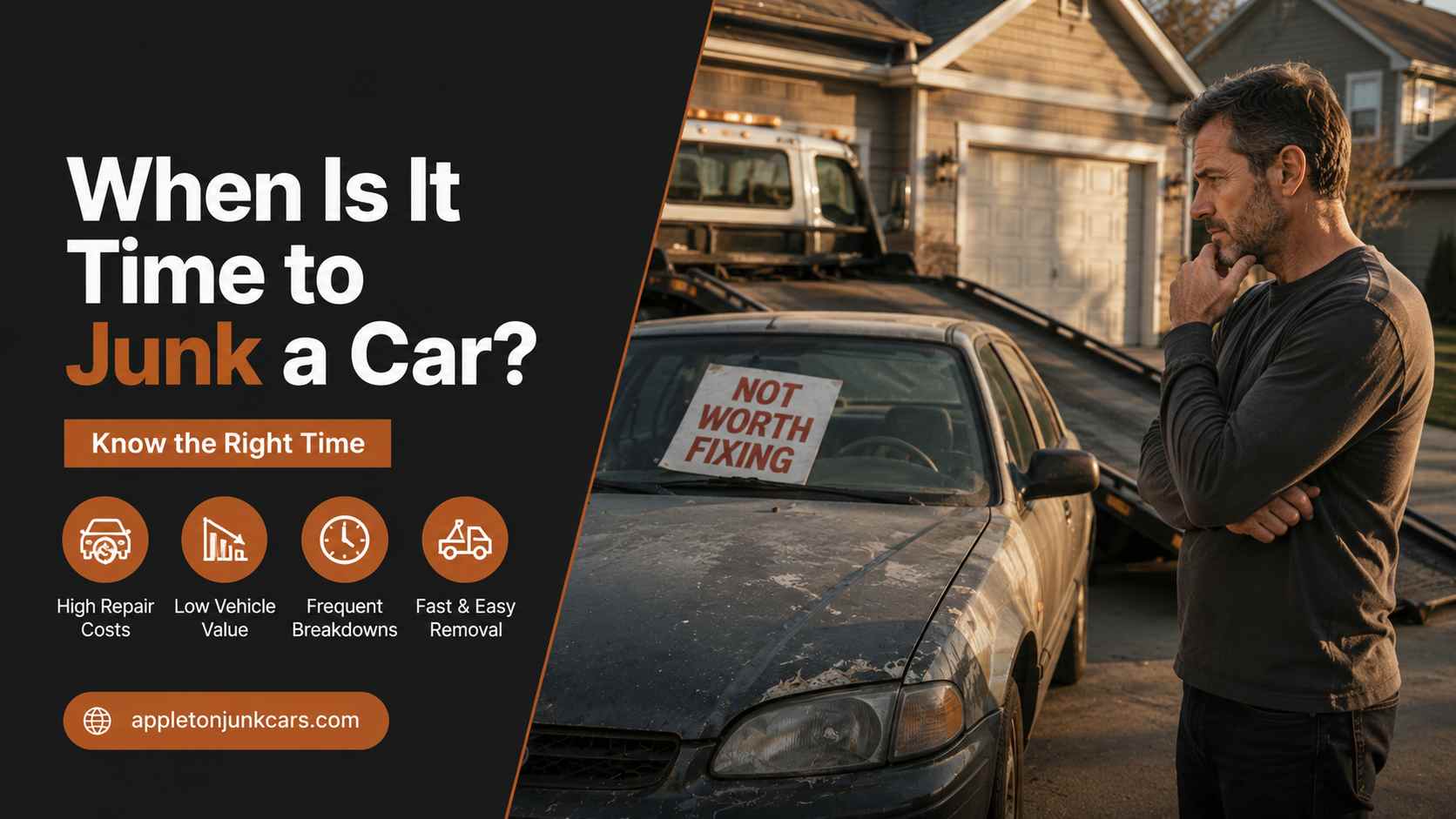
There is no single moment when junking a car becomes obviously correct. Most drivers live in a long middle period where the car costs more to maintain than they would like but has not crossed any clear threshold. Repairs come, get paid, and another one appears. The question of when to stop is genuinely difficult because it requires comparing a known cost today against uncertain future costs and uncertain future reliability.
The signals that reliably indicate the right moment are specific and mostly financial. They follow from a handful of rules that mechanics and financial advisors use to assess whether a car is worth keeping: when a single repair exceeds a defined fraction of the car’s market value, when cumulative repair spending over the past year exceeds what the car is worth, when the pattern of failures has shifted from isolated incidents to a cascade of systemic problems, or when a safety-critical system has failed in a way that is not economically worth repairing.
This guide covers each of these signals with the specific thresholds that experienced mechanics and vehicle finance experts use, the math for running the calculation on your specific car, the situations where keeping the car is actually the financially sound choice, and what drivers who made the call in each direction consistently report about the outcome.
The 50 Percent Rule: The Most Reliable Single Threshold
The 50 percent rule is the most widely used single threshold for deciding whether to repair or junk a car. The rule is: if a single repair costs more than 50 percent of the vehicle’s current market value in its pre-repair condition, the repair is not financially justified.
The math: find what the car is worth running, in its current overall condition, using Kelley Blue Book or Edmunds for the private party value. If the car runs, use the appropriate condition category. If the car does not run, use the lowest published condition level as a rough reference for the running value. Multiply that value by 0.50. If the repair estimate exceeds that number, the 50 percent threshold is crossed.
Example: a 2010 Toyota Camry with 190,000 miles is worth approximately $4,500 running in poor condition. The 50 percent threshold is $2,250. A transmission replacement quoted at $3,200 crosses the threshold. A head gasket repair quoted at $1,800 does not. The same car with a seized engine requiring replacement: the repair is $4,000 to $6,000, which far exceeds the threshold. The math points to junking.
When the Repair History Tells You More Than Any Single Bill
The 50 percent rule addresses single repair events. The cumulative cost signal addresses the pattern. When the total amount spent on repairs over the previous 12 months exceeds the car’s current market value, the car has become more expensive to own than a replacement would typically be.
Signal | Threshold | Recommended Action |
|---|---|---|
Single repair cost vs car value | Repair exceeds 50% of current market value | Strong signal to junk or sell rather than repair |
12-month cumulative repair cost | Total repairs in past year exceed car’s current value | Junk or sell; car is costing more than its worth |
Repair frequency trend | Three or more separate repairs in the past 6 months | Pattern signal: more repairs likely coming; junk now or soon |
Single repair vs car value (borderline) | Repair is 30 to 50% of current market value | Get a second estimate; consider whether other issues are pending |
Car is worth significantly more than repair cost | Repair is under 30% of car’s value; car is otherwise sound | Repair makes financial sense; keep the car |
Car has strong reliability record for remaining miles | High-value, low-mileage car on a reliable platform | Repair even at higher cost may be justified by remaining useful life |
The cumulative cost signal is particularly telling because it reflects the aggregate cost of a car whose systems are aging together. One repair in isolation might be justifiable. Five repairs in 18 months, each justified individually, are collectively telling you that the car has entered the expensive phase of its lifecycle and that the next repair is already forming.
Safety System Failures That Change the Calculation
Some mechanical failures warrant junking regardless of cost because the safety implications of driving with an unreliable or compromised safety system are not acceptable at any repair-to-value ratio. These failures move the decision from a financial analysis to a safety assessment.
Brake system failures are the clearest example. A car with failing brakes, a brake master cylinder that cannot hold pressure, or severely compromised brake lines is a safety hazard that should not be driven until repaired. If the repair cost for a comprehensive brake system restoration exceeds the 50 percent threshold on a low-value car, the choice between a dangerous car and junking becomes clear.
Suspension failures that affect steering control, tire failures from structural wheel damage, and airbag systems with confirmed faults or previously deployed modules that have not been properly rebuilt all represent safety compromises where the repair threshold calculation takes on added urgency. A car that you are afraid to drive is already signaling that the cost-to-keep calculation has been made in practice, even if the formal financial analysis has not yet confirmed it.
How to Run the Numbers on Your Specific Situation
Step 1: Find the current market value of your car. Use Kelley Blue Book (kbb.com) for the private party value in the condition that honestly reflects the car before the repair in question. The private party value is the relevant number because it reflects what you could actually sell the car for, not what a dealer would pay.
Step 2: Get a complete repair estimate in writing. Not a verbal quote: a written estimate that itemizes the specific work, parts, and labor. Get this estimate from two shops if the repair is significant, because estimates vary and a second opinion on a major repair frequently produces a meaningfully lower number.
Step 3: Apply the 50 percent rule. If the repair exceeds 50 percent of the car’s private party value, the repair is not financially justified on a purely quantitative basis. If it falls below 30 percent and the car is otherwise in sound condition, the repair makes sense. The 30 to 50 percent range is where judgment and additional factors like remaining useful life and reliability history matter.
Step 4: Ask whether this repair is isolated or part of a pattern. A single timing chain failure on a car that has been otherwise reliable for 150,000 miles is different from a fourth major repair in two years on a car with multiple aging systems. The pattern matters as much as the individual event.
When Emotional Attachment Is Affecting the Decision
Emotional attachment to a vehicle is real and not irrational. Many people have genuine relationships with cars they have owned for years and driven through important life events. Recognizing when emotional attachment is influencing a financial decision is important not because the emotion is wrong but because it can lead to spending significantly more than a purely financial analysis would support.
The clearest signal that emotion is the primary driver: when you describe the repair decision in terms of the car’s history or sentimental meaning rather than in financial terms, when you have already paid for a repair that crossed the 50 percent threshold once and are now considering another, or when family members or mechanics who are not emotionally involved in the car consistently recommend against further repair.
The practical framework: make the financial calculation separately from the emotional assessment. Run the numbers honestly. Then, if the numbers say junk it but you are inclined to keep it, make that decision consciously with full awareness of the cost. That is a different and more defensible position than spending the money without having run the calculation.
When Keeping the Car Is Actually the Right Financial Call
The decision is not always in favor of junking. Several specific situations make keeping and repairing a car the financially sound choice even when the repair cost is significant.
When the car is a reliable platform with a strong remaining service life. A Toyota Tundra or Honda CR-V at 120,000 miles with a first major mechanical failure is on a different trajectory than a 220,000-mile high-maintenance European sedan with the same failure. The remaining expected service life before the next major issue is a critical variable that the 50 percent rule does not fully capture.
When replacement cost is disproportionately high. In market conditions where used car prices are elevated, the cost of acquiring a comparable or better replacement vehicle may substantially exceed what the car is worth on paper. If the car would cost $12,000 to replace with something comparable and the repair is $2,500, the repair may make more financial sense than the replacement even if it crosses the 50 percent rule on the car’s current market value.
When the car is paid off and the alternative is a monthly payment. A repair that costs $2,000 as a one-time expense compares favorably to acquiring a $15,000 vehicle with $300 monthly payments if the repaired car has a reasonable expectation of providing another 12 to 18 months of reliable service.
What Drivers Who Made the Call Consistently Report
People who have junked cars share a consistent pattern of reflection. Those who junked a car that had crossed the 50 percent rule on multiple successive repairs almost universally report that they should have made the decision earlier. The most common regret: paying for a repair that crossed the threshold, then paying for another repair six months later that crossed it again, and only then deciding to junk the car. The two repair costs together far exceeded what they received for the junk car, and the car was eventually junked anyway.
Those who kept and repaired cars that were below the 50 percent threshold on reliable platforms report high satisfaction with the decision, particularly on Toyota, Honda, and similar platforms known for long-term reliability. Several noted that repairs that seemed expensive at the time represented good value in retrospect because the car ran reliably for another three to five years.
The consistent lesson: the 50 percent rule works well as a decision threshold when applied to the full picture of the car’s condition, not just the current repair. Drivers who used it to evaluate whether the car was worth keeping overall, not just whether the specific repair was worth doing, made better decisions than those who evaluated each repair in isolation without considering what else might follow.
Frequently Asked Questions
How do I know when it’s time to junk my car?
The most reliable signal is the 50 percent rule: when a single repair costs more than 50 percent of the car’s current private party market value, the repair is not financially justified and junking is typically the better choice. Additional signals include cumulative repair spending over the past 12 months exceeding the car’s current value, three or more major repairs in the past six months, or a safety system failure that is not worth repairing on a low-value vehicle.
Is it worth repairing a car that is worth more than the repair cost?
Generally yes, if the car is on a reliable platform with meaningful remaining useful life and the repair is under 30 percent of the car’s current value. If the repair is 30 to 50 percent of the car’s value, consider whether other major repairs are likely in the near term, whether the car has a strong reliability record for its remaining mileage, and whether the cost of acquiring a comparable replacement is significantly higher than the car’s current value.
At what mileage should I junk my car?
Mileage alone is not a reliable threshold for junking a car. A well-maintained Toyota or Honda at 200,000 miles may be worth keeping, while a poorly maintained vehicle at 120,000 miles may not. The relevant metrics are the current repair cost relative to the car’s current value, the pattern of recent repairs, and the reliability track record of the specific make and model at its current mileage.
Should I junk my car or trade it in?
Compare the junk car offer from a legitimate buyer against the trade-in value from a dealer. Trade-in values from dealers are typically higher than junk offers for cars that run, even in poor condition. For non-running cars, junk car buyers typically pay more than dealers because dealers cannot sell a non-running car as-is and factor heavy reconditioning costs into their trade offer. Get both numbers and compare net amounts.
What is the 50 percent rule for car repairs?
The 50 percent rule states that a repair should not be performed if the cost exceeds 50 percent of the vehicle’s current market value in its pre-repair condition. A car worth $4,000 should not receive a repair costing more than $2,000 based on this rule. The rule exists because repairs above this threshold typically cost more than the financial benefit they provide, since the repaired car is not worth significantly more than it was without the repair.
How do I decide between fixing and junking my car?
Run the 50 percent calculation: find the car’s current private party value from KBB or Edmunds, get a written repair estimate from two shops, and check whether the repair exceeds 50 percent of the value. Then consider the pattern: is this the first major repair or the third in the past year? And consider the car’s platform reliability: high-reliability brands justify repairs at the higher end of the range; vehicles with poor reliability records justify lower thresholds.
Is it better to sell a broken car or junk it?
A broken car that runs, even poorly, is usually worth more in the private market than to a junk buyer because private buyers purchase the car to drive it and value the running capability. A broken car that does not run has a narrow private market primarily interested in project or parts opportunities. For non-running cars, the junk buyer or salvage yard is typically the most efficient channel for the highest reasonable offer.
What happens if I keep repairing an old car?
Each repair on an aging car brings a return of reliability only until the next failure. As a vehicle ages, its systems age together, and repairs tend to arrive with increasing frequency because the underlying cause is systemic wear rather than isolated component failure. Keeping a car through multiple major repairs in a short period typically costs more than the car’s value justifies. The financial break-even point for continued repair eventually passes, and recognizing when that has happened is the core decision this guide addresses.
The Bottom Line
The 50 percent rule provides the clearest single threshold: when a repair costs more than half the car’s current market value, the financial case for the repair is difficult to make. When cumulative repairs over the past 12 months have exceeded the car’s current value, the pattern has already made the decision.
The situations that push against the rule are real and worth weighing: replacement cost in a high-priced used car market, the reliability track record of the specific platform, and the remaining expected service life all affect whether a repair that crosses the threshold is still worth doing. A 120,000-mile Toyota Tundra is a different case from a 220,000-mile vehicle on a platform with documented reliability problems at that mileage.
The most consistent lesson from people who have made this decision: make the full financial calculation before committing to any major repair. Run the 50 percent rule, estimate the cumulative 12-month repair cost, and assess the pattern of recent failures. If the numbers say junk it and you decide to repair anyway, make that decision consciously rather than discovering after two more repairs that the calculation was correct the first time.