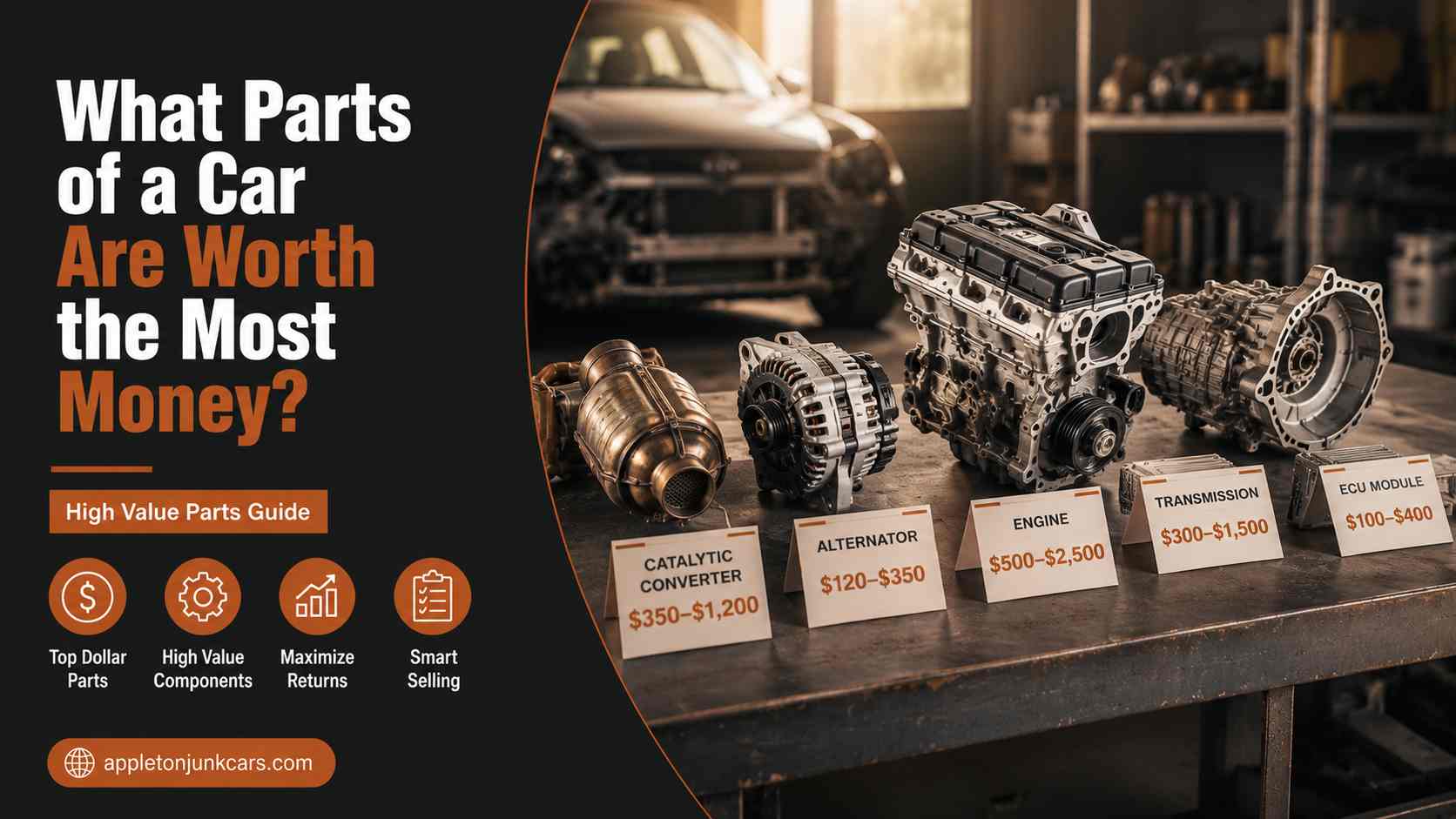
The catalytic converter is the single most valuable part on most cars when sold to a recycler, worth $50 to $600 or more based on the vehicle, but the engine and transmission command the highest prices when sold to a buyer who needs them for a repair: with running engines from popular vehicles selling for $300 to $3,000 and transmissions for $200 to $1,500 depending on make and mileage.
Every other part falls somewhere between these benchmarks, and knowing which components have genuine buyer demand changes how you approach selling a junk car or parting one out.
This guide ranks automotive components by their realistic market value in two contexts: as scrap (sold by material weight and content) and as used parts (sold to buyers who need them to repair another vehicle of the same type). The two markets value the same parts differently, and knowing which market to target for each component is the practical difference between a $400 junk car sale and a $1,200 parted-out result.
The Catalytic Converter: Highest Consistent Scrap Value Per Pound
A catalytic converter contains a ceramic or metallic substrate coated with platinum, palladium, and rhodium: platinum-group metals that are among the most expensive commodities by weight in industrial use. These metals are recovered by precious metal refiners and sold back into manufacturing supply chains.
Why it tops the scrap list: The converter weighs only 3 to 7 pounds but contains enough platinum-group metal to be worth $50 to $600+ at current precious metal prices. No other part of the vehicle approaches that value density.
| Vehicle Type | Catalytic Converter Scrap Value Range |
|---|---|
| Economy 4-cylinder (Civic, Corolla, Elantra) | $50 to $150 |
| Midsize 4-cylinder (Accord, Camry, Altima) | $80 to $250 |
| V6 vehicles (most midsize SUVs and sedans) | $150 to $350 |
| V8 trucks and SUVs (F-150, Tahoe, Tundra) | $200 to $500 |
| Toyota Prius (highest precious metal loading) | $400 to $1,000+ |
| Diesel trucks (different metals; DPF filter also valuable) | $200 to $600+ |
Critical note: Never remove the catalytic converter before selling a junk car. Every buyer prices it into the whole-car offer. Removing it first results in a larger offer reduction than the converter’s separate sale value in most cases, because buyers also discount for the signal that other components may be missing.
Engine: Highest Used-Parts Value When Running and In Demand
A running, low-mileage engine from a popular make and model has more used-parts market value than any other single component on the vehicle. The market for used engines is driven by repair shops and vehicle owners who need a replacement engine at a fraction of new engine cost.
Value range: $300 to $3,000 for a running engine sold to a direct buyer or salvage yard. Non-running or high-mileage engines sell for $100 to $800 as core units for rebuild shops.
| Engine Type | Used Market Value (Running) | Why |
|---|---|---|
| Honda K-series (Civic, Accord, CR-V 4-cyl) | $400 to $1,200 | Massive install base; consistent repair demand |
| Toyota 2GR-FE V6 (Camry, RAV4, Sienna) | $500 to $1,500 | Exceptional reliability reputation drives demand |
| Ford 7.3L Power Stroke diesel | $3,000 to $8,000 | Cult following; non-running trucks bought specifically for this engine |
| Ford 6.7L Power Stroke diesel | $2,500 to $7,000 | Current-generation premium diesel |
| Ram 6.7L Cummins diesel | $2,500 to $8,000+ | Highest per-engine value in the light truck market |
| GM 6.6L Duramax diesel | $2,000 to $6,500 | Strong demand especially LML and LBZ generations |
| General 4-cylinder gas (high mileage, 150k+) | $100 to $400 | Limited demand at high mileage |
Where to sell engines: Diesel-specific forums and Facebook groups, make-specific salvage yards, and direct listings on eBay Motors for high-value units. A diesel engine sold through the right channel earns two to three times what a generic junk buyer will offer for the entire vehicle.
Transmission: The Second-Most-Valuable Drivetrain Component
Like engines, transmissions are priced by whether they function, how many miles they have, and whether demand exists for that specific unit in the repair market.
Value range: $150 to $1,500 for a functional automatic transmission. Manual transmissions vary widely by application.
| Transmission Type | Used Market Value |
|---|---|
| Honda automatic (Accord, Odyssey, Pilot) | $300 to $800 |
| Toyota automatic (Camry, 4Runner) | $300 to $900 |
| Allison 1000 (Duramax trucks) | $800 to $2,000 |
| 6R80 (Ford F-150, Mustang GT) | $600 to $1,500 |
| 68RFE (Ram heavy duty trucks) | $700 to $1,800 |
| NV4500 manual (Dodge/GM trucks) | $500 to $1,200 |
| Standard high-mileage auto (180k+) | $100 to $300 |
Wheels and Tires: Underappreciated Value With Quick Private Sale
A matching set of OEM aluminum alloy wheels in good condition sells faster than almost any other automotive component on Facebook Marketplace and Craigslist because buyers replace damaged wheels regularly and prefer OEM fitment.
Value range: $100 to $800 for a full set of four OEM alloy wheels. Sets with good tires still attached earn more.
| Wheel Type | Estimated Set Value |
|---|---|
| Standard OEM alloy (15 to 17-inch, common vehicle) | $100 to $300 |
| OEM alloy (18 to 20-inch, popular crossover or truck) | $200 to $500 |
| OEM alloy (performance vehicle, Mustang GT, WRX, etc.) | $300 to $800 |
| Factory truck steel wheels | $40 to $120 |
| Aftermarket alloy (name brand, good condition) | $200 to $600 |
Where to sell: Facebook Marketplace, Craigslist, and OfferUp move wheel sets fastest. List with photos of all four faces and confirm the bolt pattern.
GPS, Infotainment, and Electronics: High Value if Recent
Late-model factory infotainment systems, heads-up display modules, digital instrument clusters, and driver assistance system cameras and sensors have active used-parts markets because factory replacements are expensive and dealers do not always have them in stock.
| Component | Used Market Value |
|---|---|
| Factory touchscreen infotainment (2018+ vehicle, good condition) | $150 to $600 |
| Heads-up display projector module | $200 to $500 |
| Adaptive cruise radar module | $150 to $400 |
| Backup camera module (late-model OEM) | $50 to $200 |
| OBD-II tuning module (if aftermarket, name brand) | $100 to $400 |
Aftermarket audio value depends on brand and recency: a Pioneer or Kenwood double-DIN unit with wireless CarPlay installed within the last three years is worth $80 to $300 on Facebook Marketplace. Factory stereos have limited demand unless the vehicle is a specific audiophile platform (Bose, Bang and Olufsen, Harman Kardon equipped).
Doors, Fenders, and Body Panels: High Value After Collision Events
When a vehicle is involved in a side impact or front-end collision, the undamaged side of the car produces body panels at full used-parts market value because collision shops need them for vehicles that had the same damage on the same side.
Value range: $50 to $500 per panel depending on vehicle and condition. Complete doors including glass, mirror, and interior trim earn more than bare door shells.
| Panel Type | Typical Used Value |
|---|---|
| Complete door assembly (late-model, paint in good condition) | $150 to $500 |
| Bare door shell (no glass, mirror, trim) | $50 to $200 |
| Hood (undamaged, late-model popular vehicle) | $100 to $350 |
| Front fender (single, good paint) | $50 to $250 |
| Trunk lid or liftgate (undamaged) | $100 to $400 |
| Bumper cover (front or rear, undamaged) | $50 to $200 |
Suspension and Steering Components
On trucks and SUVs, axle assemblies and suspension components with significant remaining life have consistent buyer demand because these components wear and need replacement on operating vehicles.
| Component | Used Market Value |
|---|---|
| Rear axle assembly (1-ton diesel truck, complete) | $800 to $2,500 |
| Transfer case (4WD truck, popular platform) | $400 to $1,200 |
| Front differential (4WD, intact) | $200 to $800 |
| Dually rear axle (Ford F-350, Ram 3500 DRW) | $500 to $1,500 |
| Steering rack (power, low miles) | $100 to $400 |
AC Compressor, Alternator, and Accessory Components
These mid-tier components have active used-parts markets at salvage yards and through online platforms.
| Component | Typical Used Value |
|---|---|
| AC compressor (functional, low mileage) | $60 to $250 |
| Alternator (tested, good output) | $40 to $150 |
| Power steering pump (hydraulic systems) | $30 to $100 |
| Starter motor | $30 to $100 |
| Water pump (low mileage unit) | $30 to $80 |
These are typically sold to salvage yards rather than private buyers because testing and warranty expectations make private sale more complicated.
The Lead-Acid Battery
A 12-volt car battery is priced as a lead commodity by scrap yards at $8 to $20 based on weight. Auto parts retailers pay $10 to $22 as a core credit: typically more than a scrap yard will pay for the same battery: making them the better destination for standalone battery recycling.
What Is Worth Almost Nothing
Not every car part has meaningful market value. Knowing what to skip saves time that is better spent on the high-value components.
| Component | Why It Has Limited Value |
|---|---|
| Interior carpet | Stained, worn, and vehicle-specific; almost no buyers |
| Headliner | Condition-sensitive; rarely in usable condition on old vehicles |
| Weatherstripping | Cheap new; buyer demand nearly zero |
| Factory floor mats (rubber) | Limited; only popular on specific vehicles |
| Seat covers (worn fabric) | No market; leather in good condition is different |
| Old steel wheels | Low scrap value; limited buyer demand |
| Most plastic interior trim (cracked or faded) | Vehicle-specific; fragile in shipping |
Frequently Asked Questions
What is the most valuable part of a junk car? The catalytic converter is the most valuable part by weight and ease of access on most vehicles. The engine and transmission command higher total prices but require more labor to remove and sell. For a quick, high-return action on any junk car, confirming the catalytic converter is intact and factored into any offer is the most important single step.
What car parts sell the fastest? Wheels and tires, catalytic converters, and late-model electronics sell the fastest in private markets. Wheels sell quickly on Facebook Marketplace and Craigslist because buyers need them immediately after a rim damage incident. Catalytic converters sell quickly to recyclers. Engines and transmissions sell quickly to make-specific salvage yards and diesel enthusiast communities when the vehicle is a popular platform.
Is it worth parting out a car yourself? Parting out a car produces more total recovery than selling it whole but requires significantly more time, storage space, and effort. The high-value components worth removing before a whole-car sale: without fully parting out: are aftermarket audio equipment, fifth wheel hitches, service bodies on trucks, and matching wheel sets. These are the components that a whole-car buyer does not fully credit but that sell quickly in private markets.
Which cars have the most valuable parts at a junkyard? Diesel trucks (Ford Power Stroke, Ram Cummins, GM Duramax) have the highest individual part values at any condition level because diesel engines and transmissions command a premium. Toyota Prius vehicles have the highest catalytic converter values. Mercedes Sprinter vans have the highest whole-vehicle premium from the conversion market. Among passenger cars, Honda and Toyota parts have the deepest buyer market because their high reliability leads owners to repair rather than replace.
Can I sell individual parts from my car myself? Yes. Facebook Marketplace, Craigslist, and eBay Motors are the primary platforms. For mechanical components, accurate description of mileage, condition, and testing is essential. For electronic components, knowing the VIN compatibility helps buyers confirm fitment. Wheels and audio equipment require the least technical knowledge and typically sell within 24 to 48 hours of listing.
The Bottom Line
The parts that are worth the most money on any car are the catalytic converter, the engine if it runs and is from a popular platform, the transmission if functional and from a vehicle with active repair demand, and matching OEM alloy wheel sets. Everything else falls below these benchmarks, though the specific value of each component depends on the vehicle make, model, mileage, and the current buyer demand in your market.
The most consistent way to leave value behind when selling a junk car is to remove none of the high-value components (the converter especially), call a buyer who specializes in your vehicle type rather than defaulting to a generic junk service, and confirm in writing that the catalytic converter and battery are included in the quoted price before the tow truck is dispatched.