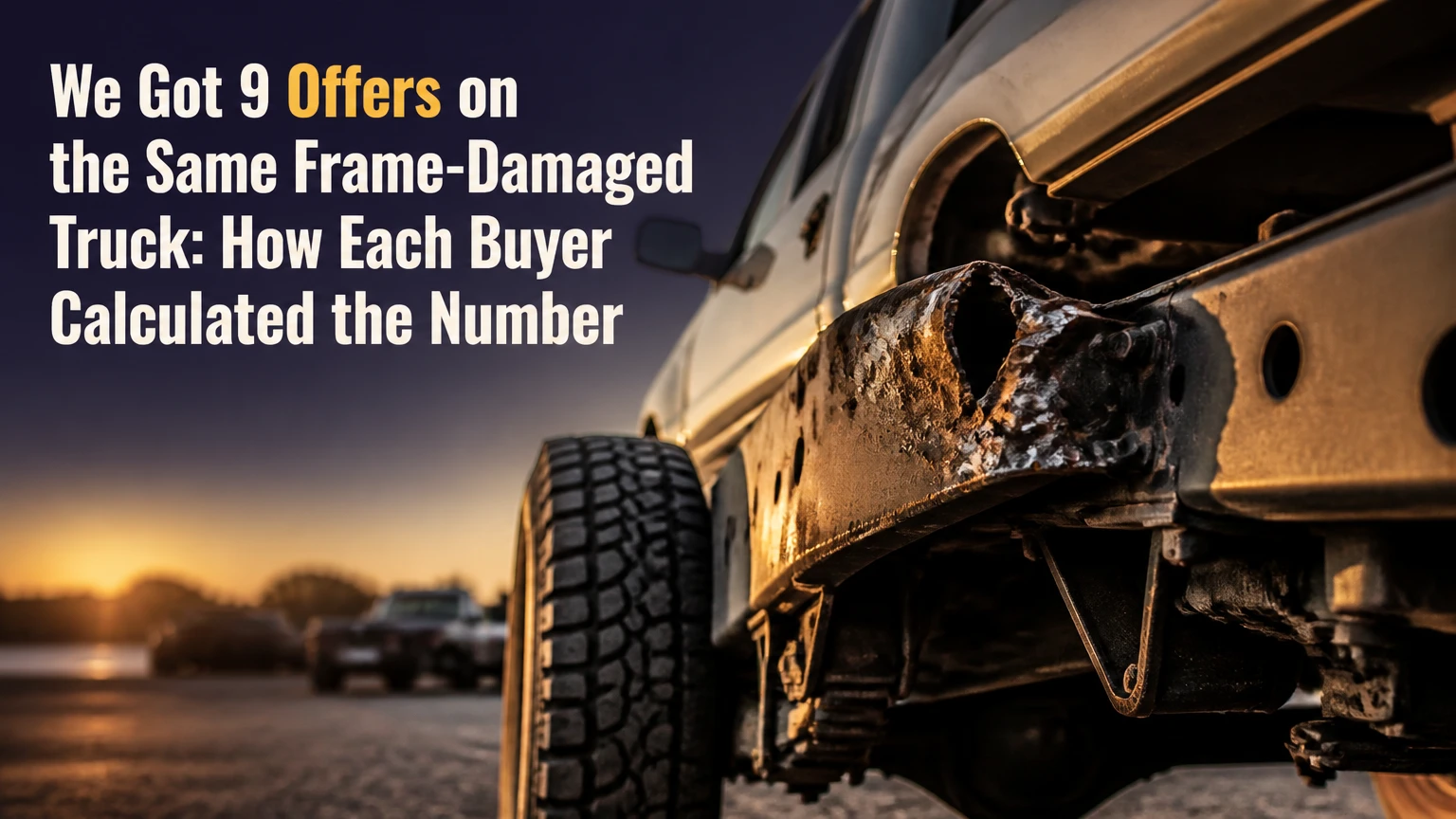
Frame damage is the phrase that ends negotiations faster than almost anything else in the used vehicle market. Say it to a private buyer and they walk. Say it to a junk buyer and they immediately start running a different calculation.
What we learned over the course of three weeks and nine offers on a 2016 Ford F-250 with a bent frame is that frame damage is not a single category: it is a spectrum, and where your truck falls on that spectrum determines whether you get scrap pricing, parts pricing, or something closer to salvage-rebuild pricing. The nine offers on this truck ranged from $420 to $4,800. Here is how each buyer got to their number.
The Truck and the Damage
Vehicle: 2016 Ford F-250 Super Duty XLT, 6.2L gasoline V8, 4WD, 88,000 miles. A frontal collision at approximately 35 mph had pushed the front crossmember back approximately 2.5 inches on the driver side. The frame rails showed visible deformation at the front section: the driver-side rail had a kink visible to the naked eye about 14 inches behind the front bumper mounting point. The passenger-side rail showed less deformation but some bowing.
What was not damaged: The engine and transmission were completely intact. The cab was undamaged. The bed was untouched. All four tires were intact. The 4WD system had been tested and functioned. The suspension components from the axles rearward were undamaged.
The frame measurement: A shop with a frame straightening machine had assessed the truck before we listed it. Their report showed: driver-side front rail deformed 2.3 inches lateral and 0.8 inches vertical from OEM spec. Passenger-side front rail deformed 0.9 inches lateral. The shop quoted $3,800 to $5,200 to straighten and certify the frame, noting that the deformation on the driver side was at the upper end of what frame equipment could correct. They were not certain they could get it to Ford specification. Insurance had declared it a total loss based on the repair estimate exceeding 75% of ACV.
Clean title at time of loss. The title had since been reissued as a salvage title by the insurance company.
How Frame Damage Changes the Buyer Pool
Before we called anyone, we spent 30 minutes understanding how different buyer types think about frame damage.
A general junkyard thinks about frame damage as: does it affect the weight of the metal we are buying? No. Does it affect whether we can pull usable parts? Depends on the damage location. For a front frame rail that does not affect the drivetrain, bed, or cab, the junkyard may still pull the engine, transmission, and cab components at full parts value. The frame damage does not reduce the parts price of what is above and behind it.
A body shop or collision rebuilder thinks about frame damage as: can we pull this on our frame machine and get it to spec? If yes, what does that cost, and does the math work for a rebuilt-title resale? They are buying a project, and their offer is a function of the repair cost and the expected rebuilt-title sale price.
A private buyer thinks about frame damage as a liability: structural integrity, safety, and resale difficulty. Most private buyers walk.
Understanding these three categories before calling anyone meant we could structure our calls to address each buyer’s specific concern.
The Nine Buyers and Their Offers
Buyer 1: National online buyer (Peddle)
Peddle’s online form does not have a frame damage category. We selected “structural damage” and described the frame deformation in the comments. The initial offer was $2,100. A follow-up call confirmed this number after we provided the frame shop’s assessment report. Peddle’s representative explained that their auction network includes buyers who specifically purchase structurally damaged trucks because the 6.2L V8 and the 4WD drivetrain command strong parts prices regardless of frame condition.
Offer: $2,100
Buyer 2: National online buyer (CarBrain)
Similar process. Initial offer $1,850 after structural damage disclosure. After we provided the frame assessment report and confirmed the engine was running, they moved to $2,000. Their representative mentioned that the salvage title reduced their offer because their auction buyers price in the cost of dealing with salvage documentation.
Offer: $2,000
Buyer 3: Local scrap yard
A yard operator who came to look at the truck spent about 10 minutes total. He checked the engine briefly, walked around the frame damage twice, and offered $420. His calculation was simple: the frame damage put the truck out of the running for any parts resale in his operation. He did not want to deal with the warranty exposure or the questions from parts buyers about frame-damaged trucks. He was buying metal at scrap weight.
“I’ll give you scrap for it,” he said. “If the frame was clean I’d pay a lot more.”
Offer: $420
Buyer 4: Regional salvage chain
The regional chain’s inspector arrived with a frame measurement reference sheet. He spent 25 minutes assessing the truck and specifically focused on whether the deformation had extended beyond the front frame section into the cab mounting area. He determined it had not: the cab mounting points on both sides were within acceptable tolerance.
“The front of the frame is damaged, but the cab, bed, and drivetrain mounts are all good,” he said. “I can pull the engine, transmission, and all four corners of the drivetrain without issue.” He offered $1,600 based on parts value.
Offer: $1,600
Buyer 5: Used truck dealer (specializing in F-250/F-350)
We found a used truck dealer 45 miles away who specializes in heavy-duty trucks. His business model includes buying accident-damaged trucks, repairing them, and reselling as rebuilt-title vehicles. This is exactly the buyer type most people never think to call.
He arrived with measuring tape, a plumb bob, and a shop inspection form. He spent 55 minutes. He was the only buyer who attempted to assess whether the frame deformation was correctable to Ford specification, rather than simply noting that it existed.
His assessment: the driver-side front rail deformation at 2.3 inches lateral is “borderline.” He had seen similar deformation corrected to spec on his frame machine, but he estimated a 70% probability of success, not a certainty. He based his offer on a recovery scenario where he gets the frame to spec, replaces the front bumper and grille, repaints the front clip, and sells the truck as a rebuilt-title F-250 6.2L 4WD at the $28,000 to $32,000 range for the market.
“I’m paying for a 70% chance at a $28,000 truck minus repair cost,” he said. He offered $4,800.
Offer: $4,800
Buyer 6: Parts buyer (found through F-250 owners’ Facebook group)
A member of an F-250 owners’ group contacted us when we posted the truck’s details seeking buyers. He was building a gasser project truck and specifically needed the 6.2L engine and the 4WD transfer case.
“I don’t care about the frame,” he said. “I need the engine and the transfer case. What do you want for those two items?” He was not buying the whole truck: he wanted a price on two components, after which the remaining shell was our problem to dispose of.
We quoted the engine at $1,800 and the transfer case at $600. He agreed to $2,200 total for both and arranged to come with an engine hoist. He pulled both components in a Saturday morning: 6 hours of work between two people. We then called a scrap yard for the remaining shell and received $310.
Effective “offer” for parts: $2,200 + $310 shell = $2,510
Buyer 7: Craigslist listing (general “project truck” listing)
We listed the truck on Craigslist as “F-250 6.2L project truck, front frame damage, salvage title, $5,500 or best offer.” Two responses. One offer of $2,000 that collapsed when the buyer saw the frame in person. One offer of $1,500 from a buyer who said he had access to frame equipment and was not concerned about the damage.
Best Craigslist offer: $2,000 (before inspection collapse), $1,500 after
Buyer 8: Commercial fleet vehicle recycler
A company that processes commercial fleet vehicles at end-of-service purchased the truck at $1,900. Their process did not involve a physical inspection: they verified the VIN, the mileage, and the salvage title status via phone and made an offer. They were not concerned about frame damage because their processing facility handles vehicles as scrap weight plus usable major components.
Offer: $1,900
Buyer 9: Body shop with frame straightening capability
A body shop that had seen our Craigslist listing called and offered $3,200. They had a Chief frame machine and said they had straightened similar F-250 frames before. Their offer was based on the same logic as the used truck dealer (Buyer 5) but at a lower price because they had less experience with the used truck resale market: their primary business was repair, not wholesale.
Offer: $3,200
The Full Offer Summary
| Buyer | Offer | Primary Calculation |
|---|---|---|
| Peddle (national online) | $2,100 | Auction floor for structural damage trucks |
| CarBrain (national online) | $2,000 | Auction floor, salvage title discount |
| Local scrap yard | $420 | Scrap metal weight only |
| Regional salvage chain | $1,600 | Parts value above frame damage zone |
| Used truck dealer (rebuilder) | $4,800 | 70% probability rebuilt-title resale math |
| Parts buyer (engine + transfer case) | $2,510 effective | Specific component value + shell |
| Craigslist best | $2,000 | Private buyer general interest |
| Fleet recycler | $1,900 | Volume commercial pricing |
| Body shop (frame equipment) | $3,200 | Repair + resale at lower margin than dealer |
We accepted the $4,800 offer from the used truck dealer.
What the Frame Assessment Report Did for Every Offer
The frame shop’s written assessment report was the most valuable document in this transaction. Without it, every buyer was guessing at the extent of the deformation. With it, buyers who understood frame straightening could make a real assessment of repair probability.
The used truck dealer who paid $4,800 specifically said the assessment report changed his confidence level from “I need to come look at it” to “I’ll come look at it and I’ll probably buy it.” That confidence got him to drive 45 miles to inspect the truck instead of declining sight unseen.
If you have a frame-damaged vehicle, have a body shop with frame equipment produce a written assessment of the deformation measurements before you call buyers. This costs $75 to $150 and will return that cost many times over in buyer confidence and offer quality.
The Decision Framework for Frame-Damaged Vehicles
Call a used truck dealer or specialty rebuilder first if: The engine and drivetrain are intact, the cab is undamaged, and the frame deformation is localized to one zone rather than distributed throughout the chassis.
Call national online buyers second: They have auction networks with buyers who specifically seek structurally damaged trucks for parts and rebuilds. Their offers are conservative but represent a reliable floor.
Call a frame equipment body shop: Any shop with a frame machine will consider buying a damaged vehicle if the numbers work. They rarely advertise this, but if you call and describe the truck, any shop owner who runs the rebuild math will tell you if they are interested.
Do not lead with the local scrap yard: The $420 scrap offer on a truck with a running 6.2L engine is leaving $4,380 on the table. The local scrap yard is the last call, not the first.
The $4,380 difference between the scrap offer and the accepted rebuilder offer came from finding one buyer who understood the repair economics and had the confidence to commit based on them. That buyer existed. It just took three weeks and nine calls to find him.
Why the Frame Assessment Report Is Worth Every Dollar
The frame shop’s written report cost $95 for the inspection and documentation. Every buyer who came in person asked for it. The rebuilder who paid $4,800 said specifically that the report changed his decision from “maybe I’ll visit” to “I’ll definitely visit.” Let us explain why that document matters so much to a sophisticated buyer.
A buyer without a written frame assessment is estimating: they look at the visible deformation, imagine how severe it might be, and price in a risk discount for what they cannot see. Every unknown costs them money in their mental calculus. A written assessment from a certified frame shop removes the unknowns. It tells them: the deformation is 2.3 inches on the driver side, 0.9 inches on the passenger side, no extension to the cab mounting points. Now the buyer is pricing a known situation, not an unknown one. Known situations carry less risk discount.
The rebuilder told us: “When a seller has the frame assessment, it tells me two things. The deformation is within a range they’re willing to share, which means it’s probably correctable. And they’ve done their homework, which means the rest of the car is probably as described.” The document did not just inform him: it signaled seller credibility, which reduces the discount he applies for general seller-description uncertainty.
At $95 for the inspection and $4,800 for the sale versus a likely $2,100 without the report, the frame assessment generated approximately $2,700 in additional offer value. That is a 2,742% return on the inspection cost. Get the assessment.
How to Find Specialty Truck Rebuilders in Your Area
The used truck dealer who paid $4,800 was not found through any normal search. We found him through three steps that most sellers never try.
First, we searched Facebook for “[your state] salvage truck buyers” and joined three groups. Within 24 hours of posting the truck’s details, we had four responses. Two were lowball offers. One was the $3,200 body shop offer. One was a referral to the used truck dealer.
Second, we called three independent used car dealers who specifically advertise rebuilt-title or salvage vehicles on their lot. One of those dealers specialized in heavy-duty trucks and was the rebuilder we ultimately sold to.
Third, we posted on a make-specific truck forum (F-250 and F-350 owners’ forum) with the truck’s details and a note that we were looking for a buyer interested in a rebuild project. Two responses, both lower than the dealer, but the process of posting there reinforced that a buyer community existed for this specific truck.
If you have a frame-damaged truck with an intact drivetrain and cab, allocate 3 to 5 days for this search before calling junk buyers. The $2,700 difference between the rebuilder’s offer and the national online platform’s offer on our F-250 is representative of what the specialty search can return compared to the general junk buyer channel.
The Disclosure Script That Gets Honest Responses From Buyers
When calling buyers about a frame-damaged vehicle, the way you describe the damage determines what kind of response you get. A vague description (“the frame got hit”) produces a vague offer. A specific description produces a specific number from buyers with the knowledge to evaluate it.
Here is the disclosure script we used: “The truck has a front-end collision. The driver-side front frame rail shows deformation of approximately 2.3 inches lateral and the passenger side shows about 0.9 inches. The damage is confined to the front frame section: cab mounting points are intact, the bed is undamaged, engine and transmission are intact and the engine starts and runs. A frame shop has provided a written assessment. Salvage title. Do you buy vehicles with frame damage in this range?”
This script does three things. It quantifies the damage so experienced buyers can assess it immediately. It clarifies what is not damaged (cab, drivetrain, bed) to establish the car’s value floor. And it asks a direct closing question that invites the buyer to either say yes (proceed to offer) or no (move to the next call without wasting time).
Buyers who respond positively to this description are buyers who know how to value frame damage. They are the buyers worth pursuing. Buyers who respond with “frame damage means we can only offer scrap weight” after receiving this specific description are giving you the same information as the local scrap yard’s $420 offer. Take note of the number, thank them, and move on.