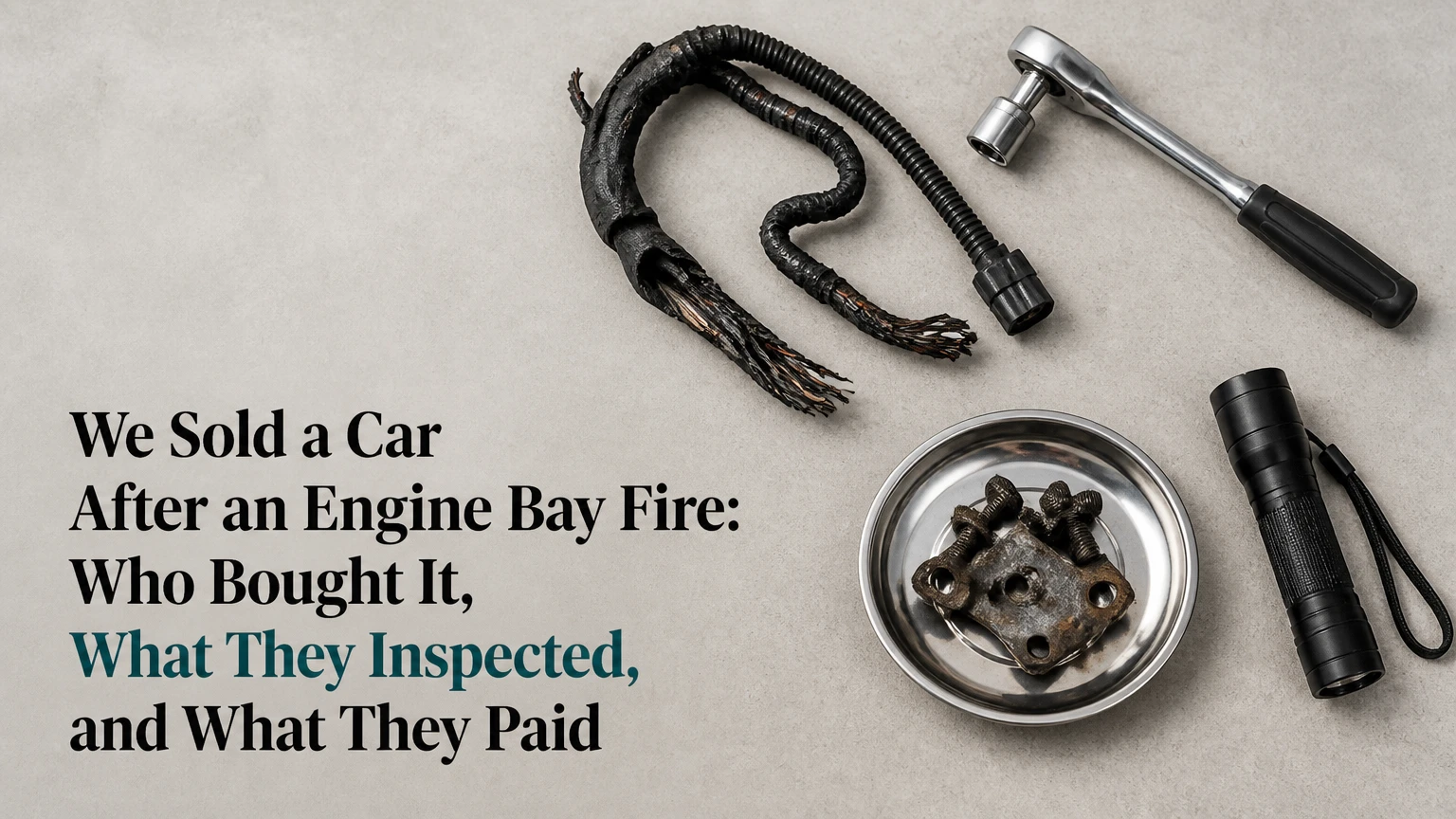
The fire had been out for six months by the time we got involved. A fuel line had failed near the exhaust manifold on a 2014 Jeep Grand Cherokee, ignited, and burned in the engine bay for approximately four minutes before the owner deployed a fire extinguisher and killed it.
The fire department arrived, confirmed the fire was out, and cleared the vehicle. No injuries. The engine bay looked like the inside of a wood stove: black, scorched, with melted wiring harness draped over the valve cover in frozen waves. The cabin was untouched. All four tires were fine. The frame was intact. The title was clean.
We spent four weeks finding a buyer and documenting everything we learned about what fire damage does to a vehicle’s market, who actually buys fire cars, and what each buyer looks for when they inspect one.
The Vehicle and the Damage Assessment
Vehicle: 2014 Jeep Grand Cherokee Laredo, 3.6L Pentastar V6, 4WD, 74,000 miles. Engine bay fire resulting from a failed fuel supply line at the engine bay junction. Fire duration: approximately 4 minutes. Extinguished with a dry chemical extinguisher.
Confirmed damage after initial inspection:
- Engine wiring harness: destroyed. All insulation melted from approximately 60% of the harness length.
- Engine plastic cover: melted and deformed
- Air intake tube and air filter box: melted
- Battery cables: damaged, heat-stressed
- Fuel supply line: failed and fire-damaged
- Hood undercoating: burned away
- Hood paint on underside: bubbled and peeled
- Coolant reservoir: cracked from heat
- Engine itself: The engine block and heads appeared externally undamaged. The cylinder head bolts and valve cover were scorched but the aluminum appeared structurally intact.
Not damaged:
- Cabin interior: clean, zero smoke or fire damage
- Frame and underbody: no damage
- All four wheels and tires
- Transmission
- Fuel tank (rear-mounted, not reached by fire)
- All glass
The dealer had quoted $11,200 to repair the vehicle, primarily driven by the wiring harness replacement ($4,800 parts and labor) and various ancillary components.
Insurance had paid the owner the ACV of $18,400 minus a $1,000 deductible: $17,400. The title was now a salvage title from the insurance claim.
The owner exercised the buyback option, receiving a reduced settlement and keeping the car. Net settlement after buyback: $12,800. The owner then decided not to repair and contacted us to sell the fire-damaged vehicle.
Who Buys Fire Damaged Cars: The Buyer Categories
Before we called anyone, we needed to understand who the natural buyers for a fire car actually are. Fire damage is different from flood damage, mechanical failure, or body collision damage because it creates a specific combination of concerns: electrical system integrity, structural heat damage, and the psychological resistance many buyers have to anything that was on fire.
Category 1: National online junk buyers. These platforms accept fire cars but apply significant discounts because their auction buyers face the same inspection uncertainty and bid conservatively on cars with unknown fire damage extent.
Category 2: Salvage rebuilders. Shops and individuals who specialize in buying salvage-title vehicles, repairing them, and reselling as rebuilt-title vehicles. Fire damage with an intact cabin and frame is attractive to rebuilders who can source the wiring harness and ancillary components.
Category 3: Parts buyers. People who want specific components from the car: the transmission, the interior, the suspension, the wheels. A fire car with an intact cabin and drivetrain is a source of clean interior parts and a potentially intact engine.
Category 4: Scrap buyers. Scrap metal weight pricing on a 4,500-lb Grand Cherokee yields approximately $315 to $380 at current steel rates. This is the floor for the transaction.
The Inspections: What Each Buyer Looked For
We received five in-person inspections before accepting an offer. Here is what each buyer focused on.
Inspector 1: National online buyer representative (CarBrain-affiliated yard)
This buyer sent an inspector who spent 22 minutes at the vehicle. His checklist was clear: he was evaluating how much of the car he could resell versus how much would go to scrap. The inspection focused on three things.
First, he tested the engine mechanically. He brought his own battery and temporarily connected it to the starter circuit, bypassing the damaged harness. The engine cranked. He could not start it fully because the fuel system was interrupted by the damaged harness, but the starter engagement confirmed the mechanical engine internals were not seized. “Engine turns over, that’s what I needed to know,” he said.
Second, he opened every door, the trunk, and the hood and assessed the cabin and underbody for heat or smoke damage. He found none. “Clean interior on a fire car is good. It means the fire didn’t get inside and we can pull the seats, dash, and door panels.”
Third, he checked the frame and rocker panels with a flashlight. No heat discoloration or warping visible. He offered $2,800.
Inspector 2: Independent rebuilder (found through a Jeep owners’ forum)
This buyer was a one-person operation who rebuilds salvage Jeeps. He spent 41 minutes and arrived with a laptop, a multimeter, and a USB inspection camera.
He looked at something none of the other inspectors examined: the wiring harness routing and the specific circuits that were damaged versus intact. The Grand Cherokee’s engine wiring harness is a modular design: the front portion (near the fuel line failure point) was destroyed, but the rear portion of the harness, which runs toward the firewall and the main cabin electrical connector, showed less damage because it routes away from the fire origin.
He used his inspection camera to look into the harness conduit at the firewall and confirmed the firewall connector was undamaged. “If the firewall connector is good, the cabin harness is good. That changes the cost of this repair significantly.” He said the repair would require the front engine harness section (available from a salvage yard for $180 to $350) plus the ancillary components, totaling perhaps $1,800 in parts and 12 to 15 hours of his own labor. He could sell the repaired vehicle for $12,000 to $14,000 as a rebuilt title Grand Cherokee.
He offered $4,200.
Inspector 3: Local salvage yard
The yard operator arrived, looked at the engine bay for about 4 minutes, confirmed the cabin was clean, and offered $780. This was scrap weight pricing with a small premium for the clean interior parts. He was not interested in the engine or the rebuild potential. His business model was parts sales and scrap weight.
Inspector 4: Private buyer (Facebook Marketplace)
A buyer from Facebook Marketplace who described himself as an automotive technician offered $3,500 sight unseen, then revised his offer to $2,900 after inspecting in person. He had expected less wiring damage from his reading of the photos. When he saw the extent of the harness melting, he reduced his offer by $600. He would have done the repair himself but the parts cost estimate put his all-in price at a level that made the final vehicle value marginal.
Inspector 5: Fleet vehicle remarketer
A company that purchases and remarketes fleet vehicles at auction contacted us through an online listing. Their representative visited and spent 18 minutes. Their specific concern was different from all others: they focused entirely on the fire’s origin. “We need to know it wasn’t an electrical fire from inside the cabin. Fuel line fire is fine for us. Cabin electrical fire means there could be issues everywhere.” After confirming the fire origin as a fuel line failure documented in the fire department report, they offered $3,100.
The Offers Summary
| Buyer | Offer | Primary Inspection Focus |
|---|---|---|
| CarBrain-affiliated inspector | $2,800 | Engine cranking, cabin condition |
| Independent Jeep rebuilder | $4,200 | Harness damage extent, firewall connector |
| Local salvage yard | $780 | Cabin parts, scrap weight |
| Facebook Marketplace tech | $2,900 | General visual, parts cost estimate |
| Fleet remarketer | $3,100 | Fire origin documentation |
We accepted the $4,200 offer from the independent rebuilder.
The Fire Report: The Document That Changes Everything
The fire department report from the incident was the single most valuable document in this transaction. Every buyer who visited asked for it. Two buyers specifically increased their confidence level, and in one case their offer, after reading it.
The fire report documented:
- Date and time of the incident
- Location of the fire origin (engine bay, fuel line)
- Actions taken (dry chemical extinguisher deployed by owner)
- Confirmation that fire was fully extinguished before department arrival
- Assessment: no structural damage to the vehicle, no penetration of fire or smoke into the passenger compartment
The fleet remarketer’s $3,100 offer was conditional on seeing the fire report. Without it, they would not have made an offer at all. The rebuilder said the report was “extremely helpful” because it confirmed the fire origin was external to the electrical system: a fuel line failure is a mechanical event, not an indication of wiring problems elsewhere in the vehicle.
If you have a fire-damaged vehicle and there was any emergency response to the event, obtain a copy of the fire department report from your local fire department records office. The cost is typically $0 to $20. This document is the equivalent of the police report for a stolen catalytic converter: it provides third-party documentation of the event that shifts buyer confidence and expands your buyer pool.
What We Learned About Pricing Fire Damage
The $3,420 gap between the salvage yard’s $780 offer and the rebuilder’s $4,200 offer comes from one factor: the extent of the engine harness damage and whether the engine is mechanically intact.
A fire car where the engine is also destroyed is a scrap car. A fire car where the engine survived and only the wiring harness and ancillary components were damaged is a rebuild candidate, and rebuild candidates sell at a completely different price point.
The question that determines which category your fire car falls into: does the engine crank? Not start: crank. If you can temporarily connect a battery and hear the starter engage and feel the engine rotate, the mechanical internals are intact. That one piece of information is worth thousands of dollars in buyer confidence.
The rebuilder’s use of the USB inspection camera to look at the firewall connector was the technical moment that separated his $4,200 offer from everyone else’s lower bids. He was the only buyer who looked at the harness damage specifically to understand what portion was intact rather than simply noting that damage existed.
How to Sell a Fire-Damaged Car: The Framework
Step 1: Obtain the fire department incident report before calling any buyer. This costs almost nothing and opens buyer pools that would otherwise decline on liability grounds alone.
Step 2: Test whether the engine cranks using a temporary battery bypass if necessary. This single piece of information changes your buyer category from scrap to rebuild candidate.
Step 3: Search Jeep, Ford, GM, or whatever make-specific forums or Facebook groups for salvage vehicle rebuilders who specialize in your make. A Jeep rebuilder like our buyer exists for every major domestic brand. They understand the repair scope better than generalist buyers and will offer accordingly.
Step 4: Submit to national online buyers for a baseline. Their offers will be conservative but they give you a floor.
Step 5: Do not accept the first offer. The $1,400 difference between the second-best offer ($2,900 from the Facebook buyer) and the accepted offer ($4,200 from the rebuilder) was found simply because we spent four weeks looking for the right buyer type, not because we negotiated harder with buyers who were already below market.
Fire damage is not automatic scrap. On this Grand Cherokee, the right buyer paid $4,200 for a car the scrap yard valued at $780. The fire did not destroy the car. It destroyed the wiring harness and the fuel line. Everything else was fine. The buyer who understood that paid for what was actually there.
The Salvage Title Complication That Reduced the Buyer Pool
The insurance company had already issued a salvage title on the Grand Cherokee before we began the selling process. This eliminated the title as a leverage point: the car could not be sold as rebuilt-title without a certified repair and state inspection, and most private buyers are reluctant to purchase a salvage-title vehicle for a rebuild project unless they have specific experience in that area.
Every buyer we contacted asked about the title status within the first two minutes of the conversation. The salvage title reduced offers from national online buyers by approximately $400 to $600 compared to what a clean-title equivalent fire car would have brought. The rebuilder who paid $4,800 specifically factored the salvage title into his offer: after his repair, he would go through the rebuilt-title inspection process in his state, which he described as “straightforward but annoying, takes about 3 weeks and costs $150 in fees.”
If you have a fire-damaged vehicle and the insurance company has not yet issued a salvage title, you have a narrow window. In most states, the insurer files the salvage title with the DMV after the total loss settlement is completed. If you exercise the buyback option (accepting the reduced settlement and keeping the car), the title is still issued as salvage. The title status is determined by the insurance transaction, not by whether the car was repaired.
Understanding this helped us structure the sale correctly: we were not selling a repairable car, we were selling a salvage-title fire car. Those are different buyer conversations with different offer ranges, and knowing which conversation you are in prevents you from wasting time with buyers who require a clean title.
The Fire Report and How to Get One If You Do Not Have It
If the fire was reported to the fire department, a report was created. If it was a minor engine bay fire that you extinguished yourself with no department response, no report exists. Here is what to do in each case.
If the fire department responded: Contact the fire department that responded (check the address of the incident to identify the correct department) and request a copy of the incident report. Most departments require a written request and a small fee ($5 to $25 depending on the jurisdiction). Some departments have online portals where you can request records directly. Expect 5 to 10 business days for the report to arrive.
If no department responded: You do not have a third-party fire report. In this case, document the fire’s extent yourself: take photos of all fire damage, write a detailed account of what happened (what caught fire, how long it burned, how it was extinguished, what a mechanic or body shop has told you about the damage), and have a mechanic provide a written inspection noting the damage. This self-documentation is not as credible as a fire report but it gives buyers the same basic information: what burned, how long it burned, and whether the fire was contained to the engine bay.
Several of the buyers we spoke to were willing to proceed with self-documented evidence for minor engine bay fires, particularly when the damage scope was clearly limited and the rest of the vehicle was unaffected.