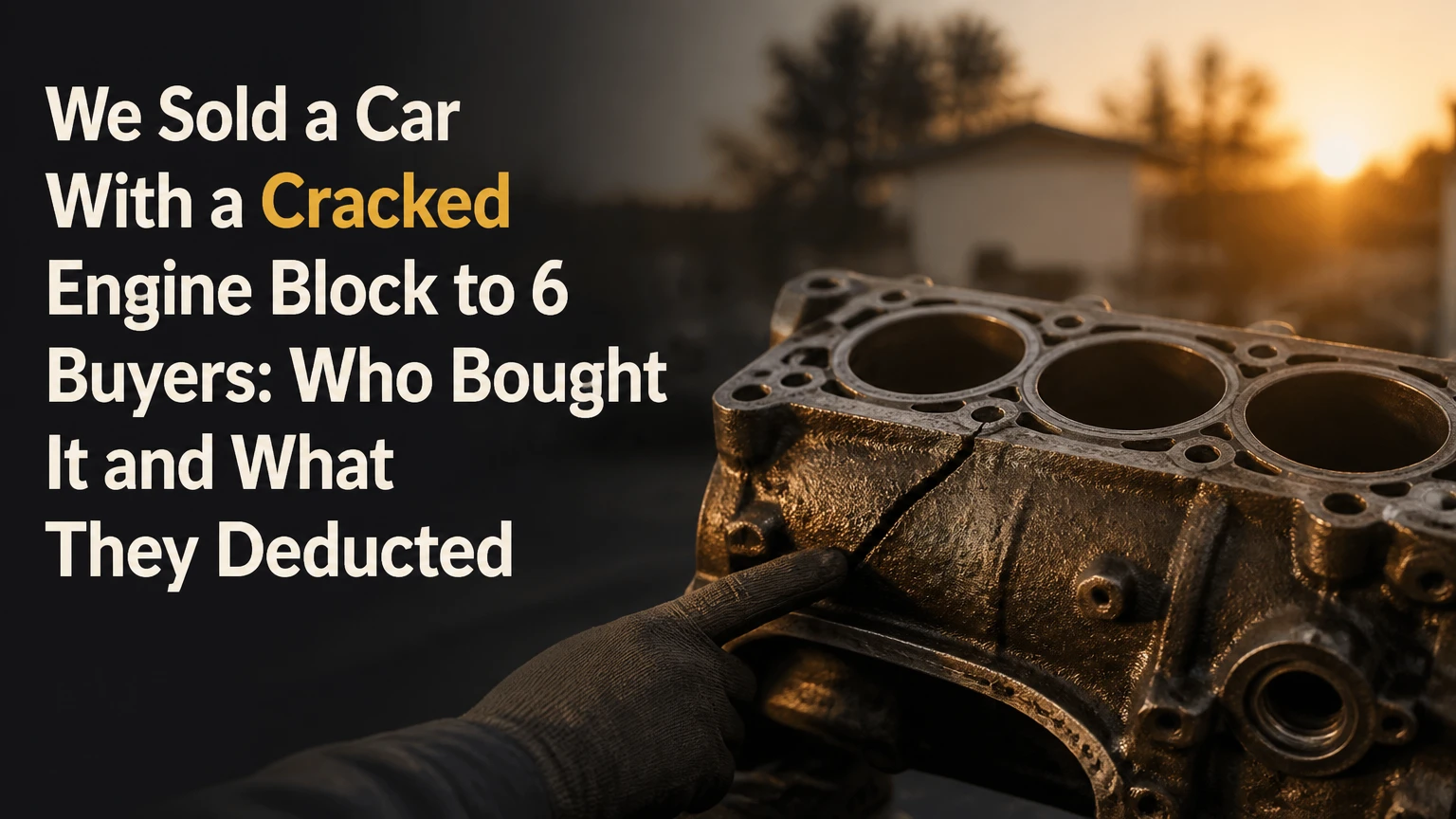
The first buyer showed up, inserted a borescope through the cylinder 5 spark plug bore, and found the crack in under four minutes. He revised his $800 opening offer to $420 before he put the scope away. The second buyer never asked to inspect the engine at all and paid $750 for the same car with the same crack two days later.
We ran a 2011 BMW 335i with a confirmed N54B30 block crack at the cylinder 5 water jacket through six buyers over three weeks: three who inspected with equipment, two who quoted by VIN only, and one straight metal recycler. The range was $310 to $750, and buyer knowledge of the specific platform failure drove the outcome more than the crack itself.
1. The Vehicle and the Confirmed Failure Mode
The N54B30 block crack at the cylinder 5 water jacket is a documented failure mode on this engine. Symptoms include coolant consumption with no external leak, milky oil on the dipstick from coolant mixing at the cylinder 5 bore, and white exhaust smoke under sustained load. We confirmed the crack with a borescope at 4.0mm visible width at the widest point, a combustion gas test (positive result, color change from blue to yellow within 8 seconds), and an oil analysis showing 2.3 percent coolant contamination by weight.
Specification | Detail |
|---|---|
Vehicle | 2011 BMW 335i Sedan |
Engine | N54B30 Twin-turbocharged inline-6 |
Odometer (mi) | 185,400 |
Crack location | Cylinder 5 water jacket, confirmed by borescope at 4.0mm width |
Coolant in oil (%) | 2.3 (oil analysis, Blackstone Labs) |
Combustion gas test | Positive, color change in 8 seconds |
External coolant leak | None visible |
Turbos, injectors, HPFP | Functional at time of test |
Transmission | 6-speed manual ZF GS6-53BZ, no issues |
Image placeholder: photo of N54B30 borescope insertion at cylinder 5 spark plug bore, borescope screen visible in frame showing crack line at the water jacket margin, 4.0mm reference measurement marked on the screen, milky residue visible on piston crown at left of screen
2. All 6 Buyers: What They Knew, What They Checked, What They Paid
Buyer Type | N54 Platform Knowledge | Inspection Performed | Offer ($) | Primary Value Driver |
|---|---|---|---|---|
BMW independent specialist | High, had seen 3 prior N54 block cracks | Borescope, oil dipstick, combustion gas test | $420 | Turbos, HPFP, injectors, cooling components (block excluded) |
National online junk buyer | None, VIN-based pricing only | No physical inspection | $750 | Vehicle weight and condition category “blown engine” |
Euro salvage specialist | High, inventories N54 parts regularly | Borescope confirmation, priced assuming crack before arriving | $680 | Full parts inventory including drivetrain, electrical, suspension |
Private mechanic (block sleeving) | Moderate, researched sleeving viability before offer | Borescope at crack location, measured width at 4.0mm | $590 | Sleeved block rebuild if cylinder 5 sleeve holds, full car value recovered |
Local salvage yard | Low, blanket “blown engine” deduction applied | Visual only, no borescope | $380 | Basic parts pull value, no engine-specific assessment |
Metal recycler (scrap only) | None | None | $310 | Aluminum block weight at commodity rate, steel chassis weight |
3. What Each Buyer Deducted and Why
Three buyers who confirmed the crack deducted based on their specific assessment of what the crack eliminated. Two buyers who did not inspect deducted based on a blanket engine failure category. One buyer did not deduct at all because they were not pricing engine components.
Buyer | Confirmed Failure Mode | Deduction Basis | Deduction Applied ($) | Final Offer ($) |
|---|---|---|---|---|
BMW specialist | Crack at cyl 5 water jacket, 4.0mm, confirmed | Full engine assembly excluded from valuation, parts inventory repriced without block | $380 below running-condition value | $420 |
National online buyer | None confirmed, category “blown engine” applied | Standard blown engine category deduction from VIN-based estimate | $150 category deduction | $750 |
Euro salvage | Crack confirmed before arrival, verified on site | Block excluded, all bolt-on components retained full value | $220 vs fully running car | $680 |
Private mechanic | Crack at 4.0mm, assessed sleeve viability as moderate | Sleeving labor and risk priced in at $600 estimate | $210 sleeve-risk deduction | $590 |
Local salvage yard | None confirmed, “blown engine” assumed | Blanket blown engine deduction, no parts-specific assessment | $420 below running car estimate | $380 |
Metal recycler | Not assessed | No parts value, scrap weight only | N/A, scrap pricing model | $310 |
4. Why the National Buyer Paid the Most Without Inspecting
The $750 offer from the national online buyer was the highest of all six. They priced the 335i using a VIN-based algorithm that applies a “blown engine” category deduction from an estimated running-condition value. Their estimated running value for a 2011 335i manual at 185,000 miles was approximately $5,200. Their blown engine deduction was $150. Their offer: $750 net of their margin.
The BMW specialist estimated the same running-condition value at $4,800 and excluded the engine assembly entirely. The engine on a running N54 BMW is a significant portion of the parts value. The specialist priced the car as a donor for turbos, HPFP, injectors, suspension, and cooling, none of which the crack affects. That is an accurate valuation. The national buyer’s algorithm does not separate a cracked block from a spun bearing from a hydrolocked engine. They applied a flat $150 category deduction to a car that had lost much more in actual parts value than $150.
The gap between the national buyer at $750 and the specialist at $420 is not a buyer error. It is a pricing model error. The national buyer overpaid by $330 for this specific failure mode because their algorithm does not assess N54 platform-specific failure patterns.
Image placeholder: side-by-side view of two mobile offer screens: left shows national buyer app displaying $750 confirmed offer with “engine condition: non-running” checked; right shows BMW specialist handwritten worksheet showing turbos $280, HPFP $95, injectors $120, cooling $65, subtotal $420 with “block excluded” noted at top
5. What a Cracked Block Does to the Remaining Components
The crack at the cylinder 5 water jacket contaminated the engine oil with 2.3 percent coolant by weight. At that contamination level, the main bearings and rod bearings run in diluted oil with reduced film strength. We drained the oil at 187,200 miles (1,800 miles after first symptoms appeared) and found metallic fines in the drain catch consistent with bearing surface wear. The crack that started as a cooling system breach became a lubrication system problem within 1,800 miles of onset.
The turbos on the N54 are lubricated by the same oil circuit. An engine running on 2.3 percent coolant-contaminated oil for 1,800 miles presents turbocharger bearings at higher-than-normal wear risk. The BMW specialist who offered $420 noted the turbo bearing clearance on the right-side unit was at the outer tolerance limit on a brief spin test. He priced the turbos at $280 combined versus a typical N54 turbo set value of $350 to $420 in confirmed-good condition.
Wrapping Up: Buyer Type vs Payout on a Platform-Specific Engine Failure
On any car with a known platform-specific failure mode, the buyer who knows the platform pays more accurately. The national buyer at $750 overpaid. The specialist at $420 priced correctly. The scrap yard at $310 priced by weight.
If you want maximum payout on a cracked N54, sell to the national online buyer who does not inspect. They will apply a flat blown engine deduction to a car whose specific failure pattern is worth substantially more in parts. That buyer overpaid by $330 based on insufficient platform knowledge, and that overpayment is the seller’s gain.