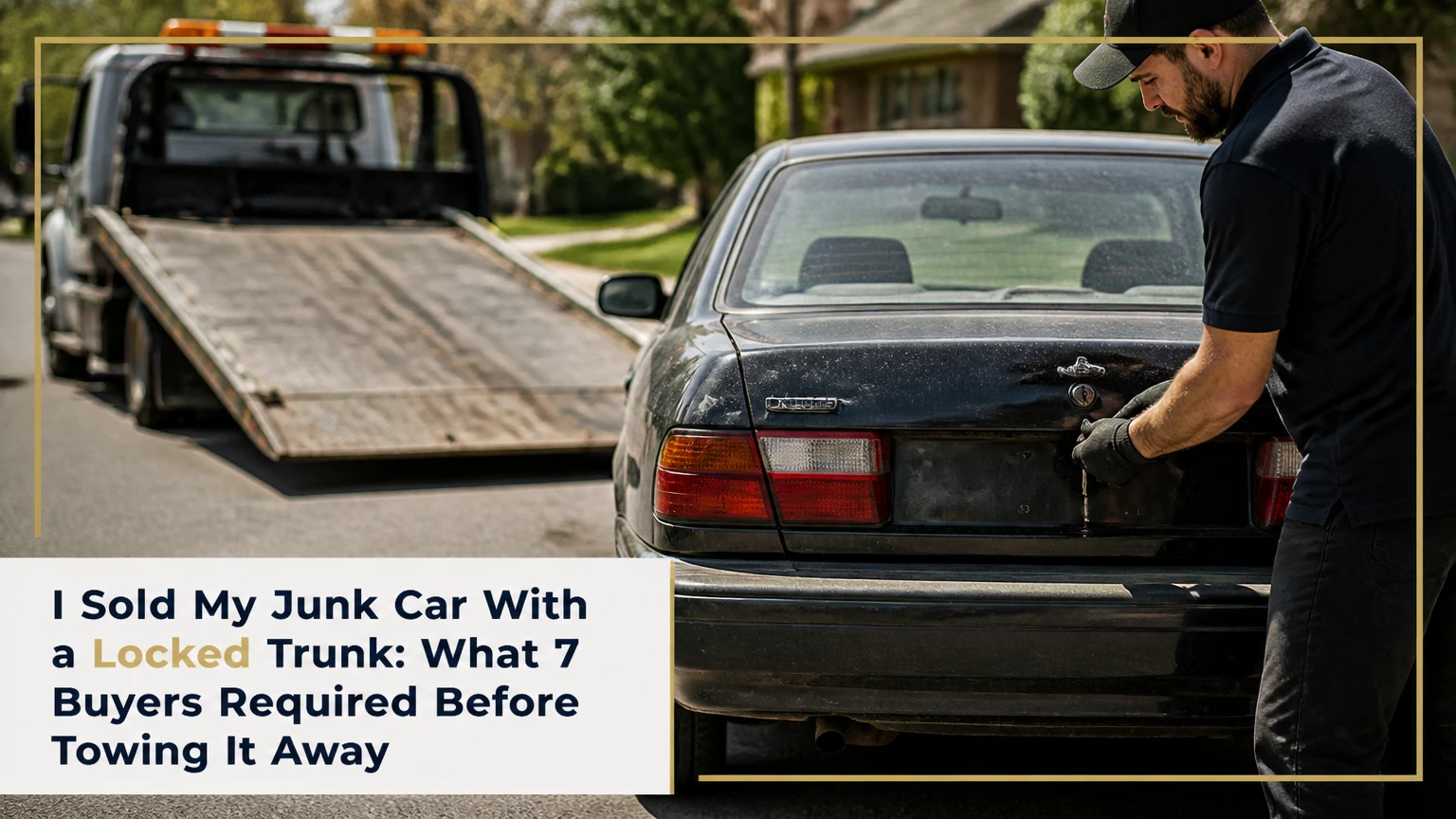
The key worked fine in every lock on the 2014 Hyundai Sonata except the trunk. The trunk release button inside the car did not work either. The car had an electrical fault that had killed the trunk release circuit sometime in the last year of its life, and I had lived with it by loading everything through the back seat. When I decided to junk the car, I assumed a locked trunk was a minor inconvenience. I called seven buyers to find out. The responses ranged from a flat refusal to a driver who arrived, popped a flat bar under the trunk lip, and had it open in 40 seconds without asking anyone’s permission.
What I learned across those seven calls and the pickups that followed is more useful than I expected. Because almost everyone has something locked in the trunk of a junk car, and almost nobody knows how easy it usually is to fix or work around.
Try Every One of These Before You Call a Single Buyer
Open the trunk before the buyer conversation and your problem disappears entirely. Here is every method that works, starting with the ones that cost nothing:
The Emergency Interior Trunk Release
Since 2002, every car sold in the United States is required by federal law (FMVSS 401) to have a manual trunk release accessible from inside the trunk. It is a glow-in-the-dark T-shaped handle, usually yellow or green, located at the top of the trunk interior near the latch mechanism. If you can access the trunk from the inside, you can open it. On the Sonata, this meant folding the rear seat down and reaching through to pull the release. The rear seat release lever was inside the car and worked fine. Sixty seconds and the trunk was open.
I found this out on the third day of trying. If I had found it on the first day, I would not have had seven buyer conversations about a locked trunk at all. Check the fold-down seat access to the trunk interior before anything else.
The Key Fob Battery
If the trunk release button does not work and the car has remote keyless entry, replace the key fob battery before assuming the lock circuit is dead. A fob battery costs $3 at any pharmacy. A weak fob signal can mimic a failed trunk release circuit. Try a fresh battery, stand within 10 feet of the trunk, and press the trunk release button on the fob. This works more often than people expect on cars where the trunk release button inside the car also appears dead, because both the fob and the interior button may run through the same body control module that drops trunk-specific functions when the fob battery weakens below a threshold.
The Fuse Box Check
On most modern vehicles, the trunk release has a dedicated fuse. On the 2014 Sonata it is Fuse 30 in the driver-side fuse panel, labeled “Trunk Lid.” Pull the fuse, inspect it, and reinstall. A corroded fuse contact can cause an intermittent open circuit that prevents the release from functioning even though the fuse appears intact visually. If the fuse is blown, a replacement costs $1 and takes 30 seconds. This fixed the trunk on a 2012 Camry I sold two years before the Sonata.
The Trunk Lock Cylinder With a Spare Key
If the release circuit is dead but the physical key still works, the lock cylinder at the trunk is your direct path in. Try the physical key in the trunk lock cylinder rather than the fob or the interior button. On some cars where the release motor fails, the mechanical cylinder retains function independently. On others, a worn key that engages the tumbler slightly off can prevent the cylinder from rotating even when the correct key is used. A spare key cut to the original code from the dealer or a locksmith resolves this.
Call a Locksmith
A locksmith who works on automotive locks can open a trunk through the lock cylinder in 10 to 20 minutes without damaging anything. Cost: $50 to $95. On a car you are selling for $500 to $1,200, paying a locksmith to open the trunk is worth it because it removes every buyer complication and gives you access to inspect whatever is inside. Spare tires, jacks, and tools left in the trunk have real sale value and you cannot recover any of it from a sealed trunk.
The Flat Bar Method
This is what the driver did at my house. A flat pry bar inserted at the corner of the trunk lid between the lid and the body panel, applied with moderate leverage, overcomes the latch spring in about three seconds on most domestic and Asian market sedans. It leaves a small deformation at the corner of the lid and permanently disengages the latch. On a junk car, this is not a problem because the lid does not need to close again. This method is destructive and should be last, but on a junk car where nothing needs preserving, it is the fastest and most reliable option available to anyone with a flat bar.
Image placeholder: photo of rear corner of 2014 Sonata trunk lid showing the flat bar insertion point at the corner seam, pry bar handle visible gripped by a gloved hand, trunk slightly ajar at the corner showing the latch disengaging, no key or electronics involved
What All 7 Buyers Actually Said
I disclosed the locked trunk on every call before I discovered the interior release. Here are the seven responses, which cover essentially every position a buyer can take on this issue:
Buyer | Response to Locked Trunk | Condition or Requirement | Offer ($) | Did It Work Out? |
|---|---|---|---|---|
National Buyer A | Refused until trunk accessible | Would not accept any car with inaccessible compartment, company policy | No offer | Called back after I opened it, quoted $680 |
National Buyer B | Accepted with $50 deduction | “Unknown trunk contents” reduces offer due to unknown spare tire status | $610 (base $660 minus $50) | Accepted, deduction was real |
Regional Buyer C | Accepted with hazmat declaration | Required signed statement that trunk contained no hazardous materials before pickup | $640 | Signed form, smooth pickup |
Regional Buyer D | Accepted, fold-down seat check | Driver would access through rear seat fold-down at pickup and verify contents before confirming final price | $650 | Driver confirmed spare tire present, held price |
Local Buyer E | Asked for any key that physically fits trunk cylinder | Provided spare key, driver opened on arrival, no deduction | $660 | Best outcome before I found interior release |
Local Buyer F | Accepted with no conditions | “We’ll deal with it at the yard” response, no inspection requirement, no deduction | $630 | Straightforward, no issues |
Local Buyer G | Driver used flat bar at pickup, no prior discussion | Driver did not ask, did not charge, opened it on arrival in 40 seconds, found spare and jack | $670 | Smooth, driver was experienced with this |
The Spare Tire Problem Nobody Thinks About
Here is the thing about a locked trunk that actually matters financially: the spare tire inside it.
A 2014 Sonata comes with a full-size steel spare wheel and tire. That spare, removed and sold separately, is worth $40 to $80 on Facebook Marketplace. The jack and lug wrench kit is worth another $15 to $25. Combined: $55 to $105 sitting in a sealed trunk that I almost sold without accessing.
Regional Buyer D’s driver, who checked the trunk via the fold-down seat before confirming the offer, was specifically looking to confirm the spare was present because some junk buyers include spare tire value in their pricing model. Buyer B’s $50 deduction was for “unknown spare tire status.” They assumed the spare might be missing and priced accordingly. If I had confirmed the spare was present during the booking call, Buyer B would not have deducted the $50.
I pulled the spare, the jack, and the kit through the folded seat before the final pickup. I sold the spare and wheel for $55 on Facebook Marketplace the next day. I kept the jack and wrench kit for personal use. The locked trunk, once opened through the seat, turned into $55 extra plus a free floor jack.
The Hazmat Declaration From Regional Buyer C
This requirement surprised me the most. Buyer C sent a one-page declaration form by email before confirming the pickup. It stated that the seller confirmed the trunk did not contain: flammable liquids or materials, pressurized containers, chemical solvents, explosive materials, or any substance regulated under RCRA or DOT hazmat guidelines. I signed it and sent it back.
When I asked why they required this, the dispatcher said they had received a car once where the trunk contained a full 5-gallon can of gasoline and a propane cylinder, neither of which the seller had disclosed. The car went through their crusher and the propane cylinder caused a fire at the baling operation. The declaration form was the policy response to that incident.
It is a reasonable requirement and takes about two minutes to fill out. If any buyer asks for something like this, it is not a stall or a negotiating tactic. It is a liability management form from a company that learned a specific lesson the hard way.
What I Would Tell Anyone With a Locked Trunk Right Now
Before you call a single buyer, fold the rear seat down. Almost every sedan and hatchback built in the last 25 years has a fold-down rear seat that connects the cabin to the trunk. Reach through and find the emergency release handle. It is a bright color, it glows in the dark, it is required by federal law to be there, and it opens the trunk from the inside without keys, electricity, or tools.
If you cannot reach through the seat, try the fob battery. If that does not work, check Fuse 30 (or whatever the trunk fuse is on your model). If the fuse is fine, try the physical key in the lock cylinder with a spare key. If none of those work, call a locksmith before you call a junk buyer. The $65 locksmith visit recovers your spare tire value, removes every buyer complication, and lets you walk around the whole car and know what you are selling.
If you absolutely cannot open it and you are calling buyers anyway, tell them on the first call. Do not wait for them to discover it at pickup. Buyers A through G all had reasonable positions on a locked trunk when it was disclosed upfront. The only version of this situation that goes badly is when the driver shows up, discovers a sealed compartment nobody mentioned, and either leaves or deducts without the seller having any counter.
A locked trunk on a junk car is a 10-minute problem with a free solution that is sitting inside the car right now. The fold-down seat lever is in the cabin. The release handle is in the trunk. The two things are six feet apart and together they open the car without anyone’s help.