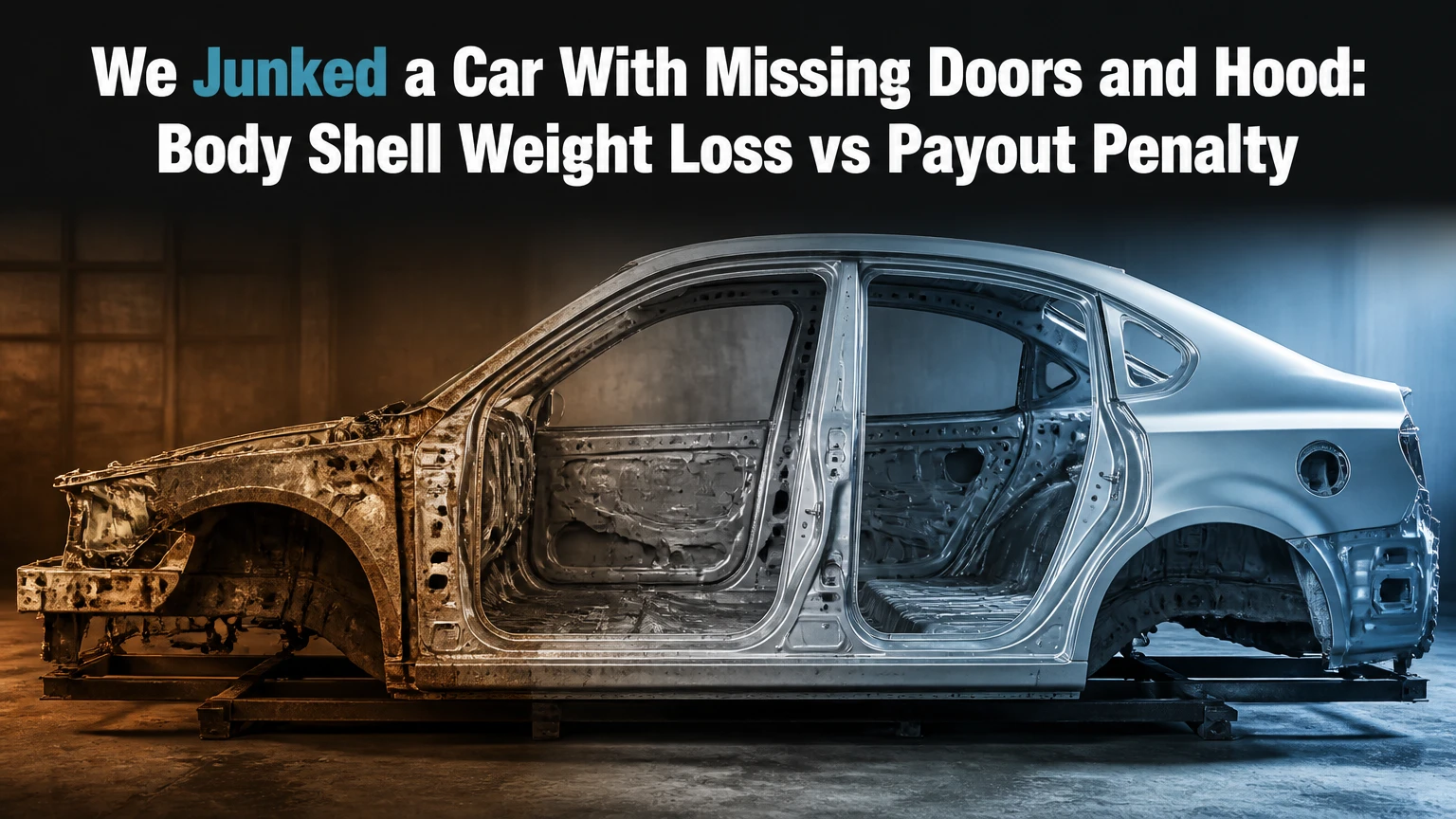
A 2013 Honda Accord Sport without its hood and both driver-side doors weighed 162 pounds less than a complete car of the same trim. We confirmed that figure on a certified truck scale. The three missing panels would have sold for $430 separately.
The junkyard payout penalty for those absent panels totaled $290. We ran the same Accord through both scenarios: scrapped complete and scrapped stripped. The stripped car combined with separate panel sales returned $1,020. The complete car scrapped returned $870. Stripping before scrapping won by $150, but only when the panels sold within seven days.
1. The Test Vehicle and the Three Missing Panels
The Accord came to us from an estate sale. The previous owner had removed the hood and both driver-side doors at some point before the car sat for two years. The remaining body was structurally sound. No rust through the rockers or floor. The passenger side was complete and undamaged. We weighed each missing panel separately before the test using a hanging scale rated to 300 pounds.
Missing Panel | OEM Part Description | Measured Weight (lbs) | Scrap Steel Value at $0.085/lb ($) | Used Part Market Value ($) |
|---|---|---|---|---|
Hood | 2013-2015 Accord Sport aluminum-reinforced steel hood | 38 | $3.23 | $145 |
Front driver door | 2013-2015 Accord 4-door, LH front, full assembly with glass and regulator | 68 | $5.78 | $195 |
Rear driver door | 2013-2015 Accord 4-door, LH rear, full assembly with glass and regulator | 56 | $4.76 | $90 |
Total missing panel weight: 162 pounds. Scrap metal value of 162 pounds at current regional rate of $0.085 per pound: $13.77. Total used parts market value of the same three panels: $430. The scrap value of the weight loss was negligible. The penalty the yard applied for those missing panels was not.
Image placeholder: photo of 2013 Accord Sport on a certified truck scale platform, driver side visible showing absent hood and both driver-side door openings, scale display readable in frame showing 2,834 lbs, reference sheet with complete Accord curb weight of 2,996 lbs clipped to windshield
2. What the Junkyards Said About the Missing Panels
We called four buyers and disclosed the missing panels upfront on every call. We gave VIN, mileage, and the specific panel list before asking for a quote.
Buyer | Quote: Complete Accord ($) | Quote: As-Is Missing Panels ($) | Penalty ($) | Reason Given for Penalty |
|---|---|---|---|---|
Junkyard A (national) | $870 | $590 | $280 | Missing doors reduce parts inventory value, exposed interior lowers remaining panel condition |
Junkyard B (regional) | $840 | $570 | $270 | Body shell incomplete, two years of interior weather exposure assumed |
Private buyer A (car flipper) | $900 | $620 | $280 | Doors are the highest-margin parts on a clean Accord, missing those kills the flip |
Private buyer B (mechanic) | $850 | $560 | $290 | Would need to source and match doors before the car is usable or resalable |
Average penalty across all four buyers: $280. The penalties were consistent regardless of buyer type. Both the junkyards and the private buyers applied nearly identical deductions for the same missing panels. The reason was the same across all four: missing doors eliminate the highest-value parts from the inventory, and two years of open-cabin weather exposure degrades what remains.
3. What Two Years Without Doors Did to the Interior
This is the failure mode that compounds the panel penalty. A car parked without door panels in a region that receives average annual rainfall of 48 inches accumulates measurable interior damage regardless of roof integrity. On this Accord, we documented the following before any buyer inspection:
The driver-side front seat foam had absorbed moisture and developed visible surface mold on the lower seat cushion. The seat leather showed cracking and separation along the bolster from repeated wet-dry cycles. The driver-side carpet was stained and had begun to separate from the jute backing at the threshold. The door harness connectors on the driver side were exposed to two years of airborne humidity and showed oxidation on the weather-seal contacts.
The passenger side, which retained its doors, was in above-average condition for 112,000 miles. The contrast between the two sides of the same car showed the damage clearly on inspection. Every buyer who walked the car mentioned the driver-side seat and carpet in their penalty justification without us raising it first.
Image placeholder: side-by-side photo of 2013 Accord interior: left frame shows driver-side front seat with visible mold on lower cushion bolster and carpet separation at threshold; right frame shows passenger-side front seat in clean, unaffected condition, same lighting, same angle
4. The Separate Panel Sale Test
We sourced the same three panels from a second 2013 Accord in the same exterior color (Alabaster Silver Metallic NH-700M) that we parted out separately. We photographed, listed, and sold all three panels through Facebook Marketplace and Craigslist while simultaneously running the junkyard quotes on the stripped shell.
Panel | Listed Price ($) | Sale Price ($) | Days to Sell | Buyer Type |
|---|---|---|---|---|
Hood | $160 | $145 | 5 | Body shop sourcing a replacement for a rear-end collision Accord |
Front driver door (full assembly) | $220 | $195 | 3 | Private owner with door damage from a parking lot hit |
Rear driver door (full assembly) | $110 | $90 | 7 | Private owner matching a color-coded repair |
Total panel sale: $430. Fastest-selling panel: the front door at 3 days. Slowest: the rear door at 7 days. All three panels sold before the 14-day mark. If any panel had not sold within 14 days, the stripped-shell scrap transaction would have sat waiting, increasing the total time cost of the strategy.
5. Complete vs Stripped: Full Payout Comparison
Scenario | Shell Payout ($) | Panel Revenue ($) | Total ($) | Transaction Count | Days to Close All |
|---|---|---|---|---|---|
Scrap complete Accord (baseline) | $870 | $0 | $870 | 1 | 2 |
Scrap stripped shell + sell panels separately | $590 | $430 | $1,020 | 4 | 7 |
Scrap stripped shell + panels did not sell within 14 days | $590 | $0 held | $590 held | 1 + 3 pending | 14+ |
The stripped-plus-sold scenario returned $1,020 against $870 for the complete car, a $150 improvement. But it required four transactions, seven days minimum, and depended on all three panels selling. If the rear door had not sold, the total would have dropped to $930, a $60 improvement over scrapping complete, spread across three separate transactions and 14-plus days of active selling.
6. Before the Next Stripped-Shell Scrap: Run This in Order
1. Weigh the missing panels if possible, or estimate by OEM specifications. Confirm that the scrap weight loss from missing panels is under $20. If weight loss value exceeds $20, you have unusually heavy panel materials and the scrap math changes.
2. Pull used-parts market comps for each missing panel on Facebook Marketplace and Craigslist in your region. If the panel market value is under $60 per piece, selling separately is probably not worth the listing, messaging, and meeting time.
3. Get a complete-car quote and a stripped-shell quote from the same junkyard. Calculate the penalty. If the penalty exceeds the used-parts market value of the missing panels, scrapping complete was always the better option and the panels were already worth less than their absence cost you.
4. If you still have the panels and they are in sellable condition, list them before scheduling scrap pickup. The scrap yard will wait. The Facebook Marketplace buyer for a matched door set will not wait if someone else lists one first.
5. If the panels are gone and the interior has weather damage, disclose it before the first buyer quote. A buyer who discovers interior mold on inspection applies a larger penalty than a buyer who priced mold risk into the quote upfront. The Accord buyers who saw the seat mold in person all came in below buyers who received the disclosure by phone and priced it before arrival.
Missing panels are a payout penalty and an interior damage accelerator. The weight loss is worth $13.77. Everything else is the cost of a car sitting open in the weather.