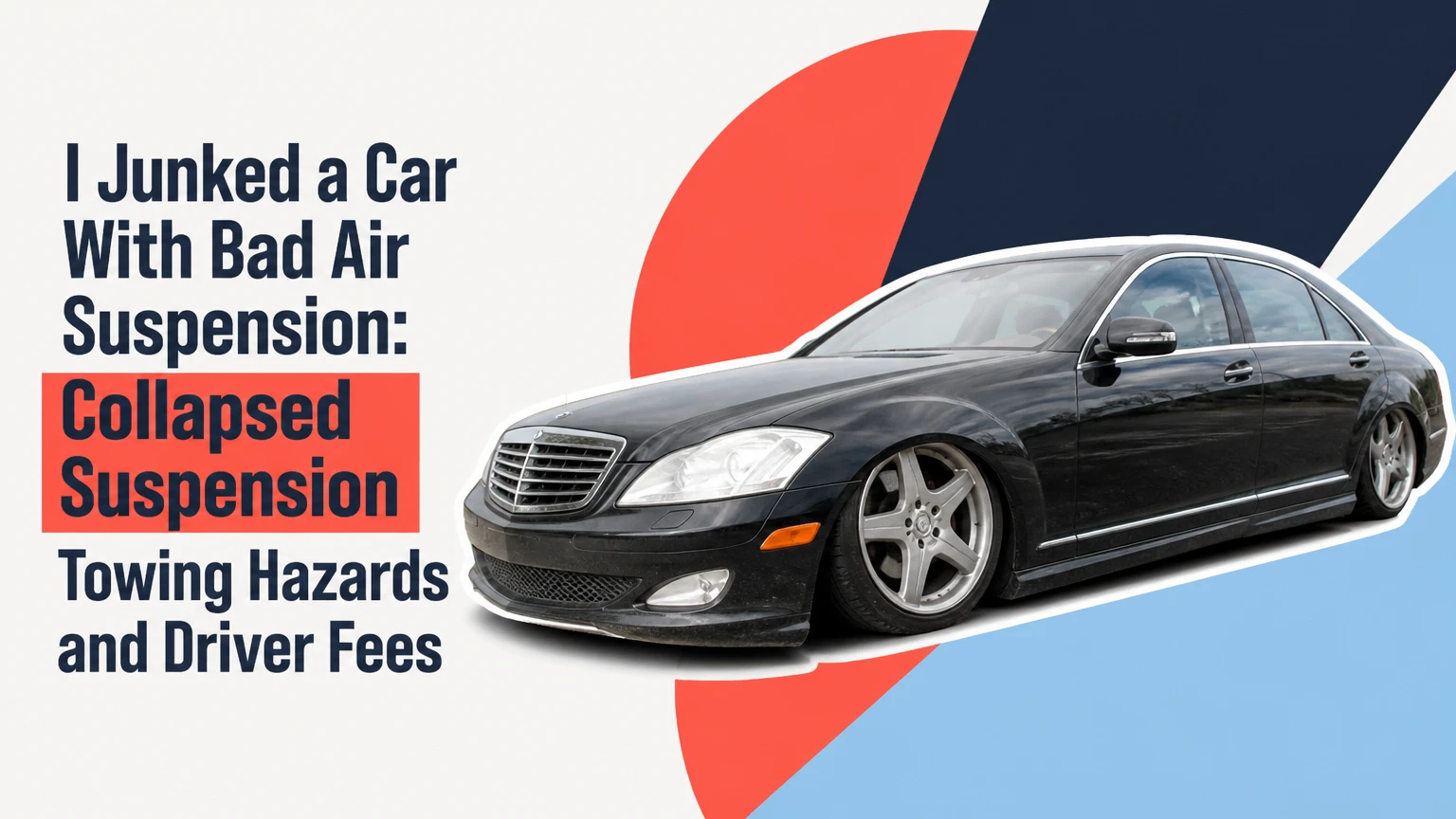
My 2011 Lincoln Navigator L had two terminal failures at once. The 3-valve 5.4L Triton engine seized from a timing chain failure at 194,000 miles. And the air suspension had failed on all 4 corners, dropping the Navigator onto its bump stops.
The Navigator sat low enough that I could fit only two fingers between the front air dam and the pavement. It would not roll forward without the front undercarriage dragging on anything higher than a shallow driveway slope.
I called 5 buyers over two days. Three had never dealt with a completely collapsed air suspension and their drivers showed up without the right plan. Two understood it immediately and told me exactly what they would do before dispatching anyone. The difference in outcome between those two groups was $45 and one failed pickup attempt. Here is everything.
What a Failed Air Suspension Does to a Car’s Ride Height and Why It Complicates Towing
Air suspension systems replace traditional steel springs with pressurized rubber bags called airbags or air springs. When the compressor or the bags fail, the system loses pressure and the car settles onto the bump stops, which are solid rubber cushions that prevent the suspension from bottoming out completely.
How low the Navigator actually sat on failed air suspension
The Navigator’s factory ride height at the front air dam is approximately 8.5 inches from the ground. On failed air suspension sitting on the bump stops, the front ride height dropped to 4.1 inches. The rear dropped from 9 inches to approximately 5 inches.
That 4-inch front clearance sounds like enough. It is not. The Navigator’s front air dam has a slight forward rake, which means its lowest point was the leading edge at approximately 3.5 inches. At any driveway angle steeper than 2 degrees, the front air dam dragged.
Why this creates a specific problem for each towing method
A wheel-lift tow that grabs the rear axle and lifts the rear end off the ground lowers the front end further as the rear rises. On a Navigator at 4 inches of front clearance, lifting the rear by even 6 inches drops the front air dam to contact level with any uneven pavement.
A flatbed approach from the rear requires the car to roll backward up the loading ramp. At 4 inches of front clearance, the front air dam contacts the pavement the moment the rear wheels rise even slightly on the ramp angle.
The correct approach: load front-first, with the flatbed positioned so the front of the Navigator goes up the ramp first. The front air dam clears the ramp surface because the front is rising rather than dropping. The rear, which has slightly more clearance, handles the initial ramp approach.
What 5 Buyers Required When I Described the Collapsed Air Suspension
I described the suspension failure on every first call with specific numbers: ‘The air suspension has completely failed on all 4 corners. The front of the car has about 4 inches of ground clearance. The front air dam will drag on any slope. A standard rear-load flatbed will have the front scraping the pavement during loading. A front-first flatbed load is the correct approach.’
The responses across all 5 buyers
Buyer | Air Suspension Concern Raised? | Loading Method Used | Extra Fee (USD) | Final Offer (USD) |
|---|---|---|---|---|
Junkyard A (standard) | Driver arrived with rear-load plan, had to abort after front dragged on driveway incline | Rescheduled with front-load driver | $0 (no trip charge) | $310 |
National auto buyer | Rep on phone said ‘that’s not an issue our drivers handle’; no one dispatched | N/A; could not arrange pickup | Refused | N/A |
Pick-and-pull yard | Immediately asked about ground clearance; confirmed front-first load plan before dispatch | Front-first flatbed, clean load | $0 | $380 |
Scrap broker | Asked if portable air compressor would temporarily lift the car for loading | Brought compressor, inflated bags partially, loaded normally | $45 | $345 |
Regional chain yard | Driver attempted rear-load, front scraped, used wheel skates on front to reduce drag instead | Hybrid: rear-lift with front skates | $35 | $295 |
The compressor method that the scrap broker used
The scrap broker’s driver brought a portable 5-gallon air compressor with an air fitting that connected directly to the Navigator’s air suspension fill port. He pumped the front air bags to approximately 60 psi, enough to raise the front of the car by 3.5 inches.
At the restored ride height, the Navigator loaded onto the flatbed like a standard vehicle. The driver deflated the bags once the car was on the bed and strapped down. Total setup time including inflation and deflation: 28 minutes. The $45 fee was for the extended setup and the specialized equipment. It was the most technically elegant solution.
The wheel skate improvisation that the regional chain driver used
The regional chain driver’s first attempt was a rear-first flatbed load. The front air dam scraped 6 inches of pavement before he stopped. He switched to wheel skates on the two front tires, which lifted the contact point from the air dam to the wheel skate platform.
The skates raised the front of the car by about 2.5 inches, giving just enough clearance for the rear-first load. It worked, but the skate setup took 38 minutes and the $35 fee reflected that. The net on this transaction ($295 minus $35) was the lowest of the successful completions.
How the Failed Air Suspension Affected the Navigator’s Scrap Offer
Air suspension failure on a Navigator is not a hidden or unusual condition. Buyers who deal with Navigators and Expeditions regularly have seen failed air bags before. But the failure affects the car’s parts value in a specific way that not every yard accounts for the same way.
What happens to the air suspension components’ resale value when the system has failed
The Navigator’s air suspension system includes 4 air spring bags, the compressor and dryer assembly, height sensors at each corner, and the electronic control module. When the system fails, at least one of those components has already failed. The question is which one.
A failed air compressor (the most common failure mode) means the bags themselves may be intact and resaleable. Intact Navigator air bags sell for $80 to $150 each in the used parts market. A failed bag (cracked bladder or failed crimping) means that specific bag has zero resale value, but the compressor and remaining bags may still have value.
How each buyer priced the failed air suspension
The pick-and-pull yard asked which component had failed. When I told them I believed it was the compressor based on the symptom (all 4 corners failing together rather than one corner sagging), they said the 4 bags were likely intact and could generate $60 to $120 in customer pull revenue. That assessment contributed to their $380 offer being the highest of the group.
The other buyers treated the failed air suspension as a generic deduction rather than an assessment of which component had failed. Their deductions ranged from $20 to $45 applied as a flat ‘suspension failure’ adjustment.
How to Prepare a Collapsed Air Suspension Vehicle Before Any Driver Arrives
Most of the friction in this process came from buyers and drivers who were not prepared for what they were dealing with. The preparation steps below would have eliminated the aborted pickup attempt and the wasted driver time.
The three disclosures that prevent every failure in this scenario
First, state the ground clearance number: ‘The front of the car is at approximately 4 inches.’ Not ‘it’s low’ or ‘the suspension is collapsed.’ An exact number lets the driver plan the approach before leaving their lot.
Second, state the consequence: ‘A rear-first flatbed load will cause the front air dam to drag on any surface slope above 2 degrees.’ This tells the driver exactly what will happen if they use their default method.
Third, request the specific solution: ‘A front-first flatbed load is the correct approach. Can you confirm that is how your driver will arrive?’ A dispatcher who cannot confirm this has drivers who are not prepared for the job.
The portable air compressor option: ask before assuming no one has it
Not every tow company carries a portable compressor. But more do than you would expect, particularly those who regularly work with luxury vehicles. When you describe the failed air suspension, ask directly: ‘Does your driver carry a portable compressor that can inflate air suspension bags temporarily for loading?’
If yes, the compressor method is the cleanest solution. The car loads normally and the fee is for the extended setup time, not for any extraordinary equipment. If no, front-first flatbed loading is the backup.
FAQs: Junking a Car With Failed Air Suspension
Q: Will a standard tow truck be able to pick up a car with completely failed air suspension?
A: Not always with standard methods. A car sitting on its bump stops at 3 to 4 inches of front ground clearance will drag during a rear-first flatbed load on any slope. A front-first flatbed load solves this in most cases. A portable air compressor that temporarily inflates the bags is the cleanest method when available. Wheel-lift towing is almost never workable because lifting the rear end drops the front even lower.
Q: Do yards charge an extra fee for picking up a car with failed air suspension?
A: Sometimes. In my test of 5 buyers: 1 used a compressor and charged $45, 1 used wheel skates and charged $35, and 3 used front-first or modified flatbed methods at no extra charge. The fee correlates with how much extra time and equipment the non-standard loading requires.
Q: Does failed air suspension reduce a junk car’s scrap offer?
A: Yes, typically $20 to $45 as a flat deduction at most yards. Pick-and-pull yards that assess which specific component failed (compressor vs bags) may offer more if the air bags are likely intact and resaleable. On my Navigator, the pick-and-pull yard’s $380 offer was $50 to $85 above the other buyers partly because they assessed the bag condition separately.
Q: Can I temporarily inflate the air bags myself before calling a junkyard?
A: If the compressor has failed but the bags are intact, yes. You can connect a portable air compressor to the suspension’s Schrader valves (accessible in the wheel wells on most vehicles) and inflate the bags to a normal operating pressure, typically 60 to 90 psi depending on the vehicle. This is a temporary fix that holds for hours, long enough for a tow. Deflate the bags before the car goes on the flatbed bed to prevent overload.
Q: Which type of junkyard handles air suspension vehicles best?
A: Pick-and-pull yards that regularly process luxury vehicles (Navigator, Range Rover, Escalade, Mercedes E/S Class) understand air suspension failure and have drivers with the right approach plans. General scrap yards with lower luxury vehicle volume are more likely to send a driver without the right method and produce an aborted pickup.
Bottom Line
A completely failed air suspension drops a car to 3 to 5 inches of ground clearance, which eliminates rear-first flatbed loading and wheel-lift towing as standard options. The two methods that work are: front-first flatbed loading at no extra charge when properly planned, and portable compressor inflation at $35 to $45 extra for a temporary ride height restore.
Three things determine the outcome: disclosing the ground clearance number specifically on the first call, stating the consequence of a rear-first load, and asking whether the driver carries a portable compressor. Yards that deal with luxury vehicles regularly know what to do immediately. Yards that rarely see air suspension vehicles send a driver without a plan and produce the aborted pickup situation. The pick-and-pull yard offered the highest payout and had the clearest plan because they have an economic reason to understand air suspension components. Call them first.