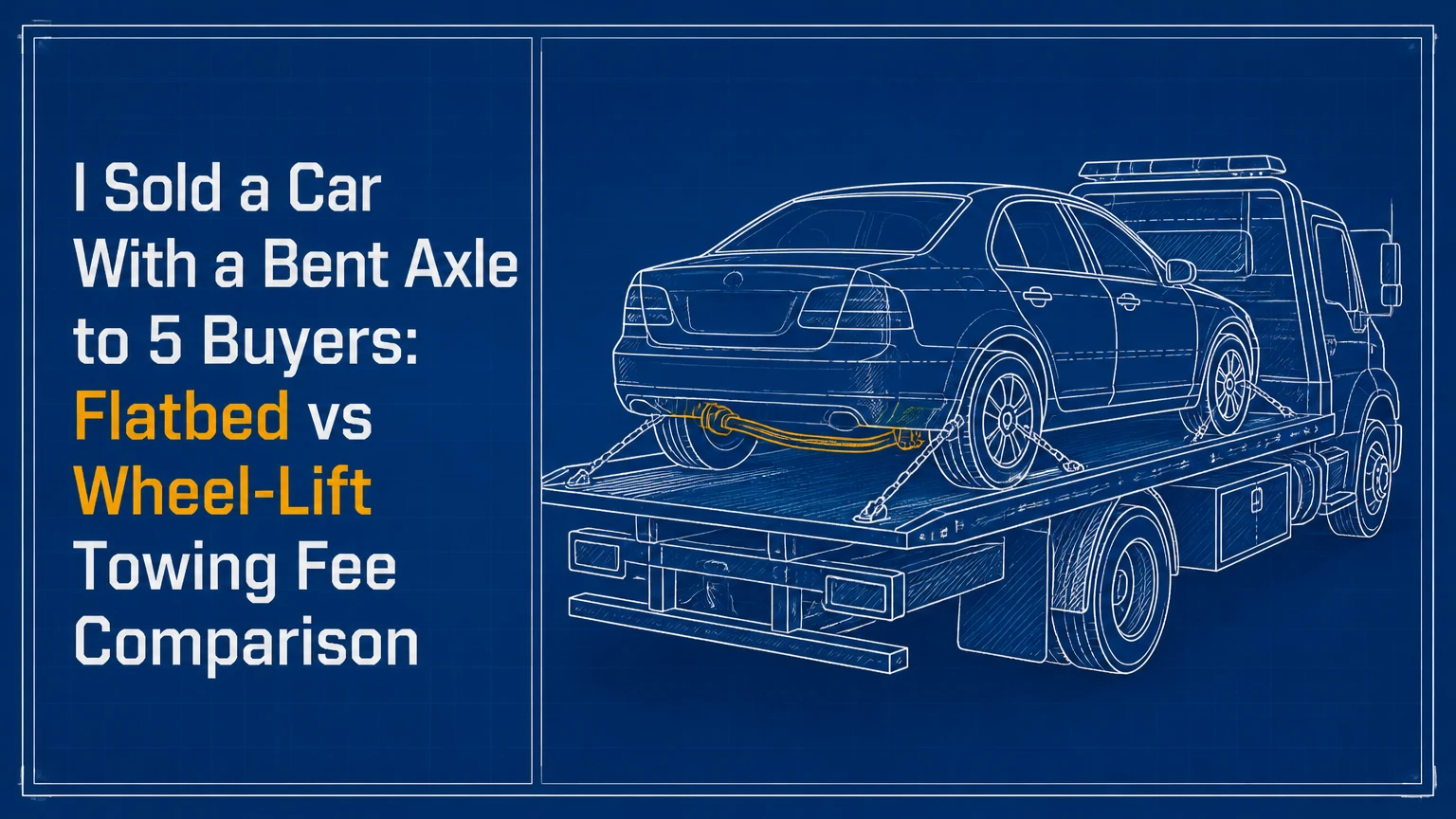
I hit a concrete parking barrier at about 20 mph in my 2011 Honda CR-V, and the right front axle took the full force. The wheel tilted inward at roughly 12 degrees at the top, a condition mechanics call excessive negative camber caused by a bent axle shaft and a possibly bent steering knuckle. The car could not roll straight. Every left or right turn produced grinding resistance, and at highway speed it would pull violently toward the damaged side.
I drove it home on side streets, parked it, and started calling junkyards the next morning. I got 5 very different reactions from 5 different buyers, ranging from a driver who showed up, attempted a wheel-lift, and left without the car to a pick-and-pull yard that loaded it in 31 minutes at no extra charge. The fees across the 5 transactions ranged from $0 to $50, and the offers ranged from $280 to $340. Here is exactly what happened with each buyer and the single disclosure that changed every outcome when I finally used it.
Why a Bent Axle Creates More Towing Problems Than Most Sellers Expect
Most people assume that any non-running car is equally straightforward to tow, because it’s not going anywhere under its own power anyway. A bent axle changes this assumption in a specific way that directly affects which towing method can be used and whether extra equipment is needed.
What a bent axle actually does to the front wheel geometry
A car’s front axle shaft connects the transmission output to the front wheel hub. When the shaft bends from an impact, the wheel hub tilts with it, pulling the top of the wheel inward (negative camber) or sometimes pushing it outward. The tire no longer sits flat on the ground. Instead, it contacts the pavement at an angle, which means the contact patch is smaller, the wheel cannot rotate freely in a straight line, and any lateral force on the tire during towing causes it to scrub sideways rather than roll forward. On my CR-V, the 12-degree inward tilt meant the right front tire was contacting the pavement on its inner edge only. The tire would not roll forward without fighting the camber angle on every rotation.
The implications for towing depend entirely on which end of the car the tow truck grabs. If the tow truck lifts the front end off the ground with a wheel-lift or dolly, the bent wheel does not touch the pavement at all and the problem disappears during transit. If the tow truck uses a wheel-lift on the rear end and the front wheels trail on the pavement, the bent front wheel will scrub sideways during the entire tow, generating heat and damaging the tire, potentially losing traction control on the tow truck if the scrubbing creates irregular resistance, and risking further damage to the already-compromised knuckle and CV joint.
Why the first driver’s wheel-lift attempt failed
The first tow driver arrived with a wheel-lift truck and approached the car from the rear. His plan was to lift the rear axle and let the front wheels trail on the pavement during the tow to the yard. I did not know enough at the time to stop him or describe the problem clearly. He attached the wheel-lift to the rear axle, engaged the lift, and started the slow forward pull.
The front wheels began to move forward, and within 10 feet the right front tire was fighting the pavement at its bent angle, creating a grinding, scraping resistance that the driver felt immediately through the controls. He stopped, lowered the rear, disconnected, walked around to look at the front right wheel, and within 3 minutes told me he could not complete the pickup with his equipment. He left. No charge, to his credit, but I had wasted a half-day waiting for a driver who should never have been dispatched to this job if I had described the wheel condition accurately on the first call.
The disclosure language that changed every subsequent outcome
After the first driver left, I called the remaining yards with a completely different script. Instead of saying the car was non-running and had front-end damage, I said this: ‘The right front axle is bent from a collision. The front right wheel cants inward significantly. The wheel cannot roll in a straight line. A wheel-lift on the rear axle is not safe because the front wheels would scrub and drag during the tow. This car requires a flatbed where all 4 wheels are lifted off the ground, or a wheel-lift that grabs the damaged front axle from the front.’ Every subsequent driver arrived with either a flatbed or a clear plan for the non-standard pickup, because I had told them exactly what they were dealing with.
What Each of 5 Buyers Offered, What They Charged Extra, and How They Loaded the Car
The variation in responses across 5 buyers using the same accurate description showed how differently each yard type approaches a non-standard loading situation. Some had the right equipment and absorbed the extra time. Some had the right equipment and charged for it. One did not have the right equipment and wasted a trip.
Buyer 1: The wheel-lift attempt that went wrong
I described the situation accurately on the call, but the dispatcher communicated the pickup job to the driver as simply a ‘non-running front-end damage vehicle.’ The driver arrived with a wheel-lift truck and the same rear-lift plan described above. The 10-foot test roll ended the attempt. He was professional and did not charge a trip fee, which some yards do when a driver makes a trip for a job they cannot complete. The yard’s policy, which I confirmed in a follow-up call, is to waive the trip charge only when the description was accurate but the driver was dispatched with the wrong equipment. The yard’s miscommunication, not my disclosure failure, caused the wasted trip.
Buyer 2: Flatbed with a $35 non-standard loading fee
The second yard sent a flatbed and quoted me over the phone that a bent axle situation qualified as a non-standard load in their system. They gave me the offer ($305) and the non-standard fee ($35) on the same call, so the final net of $270 was known before the driver arrived. The driver positioned the flatbed directly behind the CR-V and used the winch to pull the car straight up the ramp. The bent front wheel caught the ramp edge on the way up and required the driver to slightly angle the flatbed to compensate. Loading took 33 minutes. The $35 fee reflected that extended time and the angled positioning adjustment.
Buyer 3: Pick-and-pull yard with zero extra fee
The pick-and-pull yard was the most experienced with non-standard vehicles in my test, which makes sense given that they regularly acquire damaged and incomplete cars from insurance auctions. Their driver arrived with a flatbed and loaded the CR-V front-first rather than rear-first. Loading front-first means the bent wheel goes up the ramp first and is on the flatbed bed before any ramp-edge contact stress occurs.
The rear wheels (both straight and functional) guided the car smoothly into the initial ramp angle, and the winch handled the final positioning of the bent front end. Loading time: 31 minutes. Extra fee: $0. The driver told me front-first loading is their standard approach for any vehicle with front axle damage.
The pick-and-pull yard also offered $340, the highest offer I received across all 5 buyers. Their business values the CR-V’s body, interior, and undamaged components separately from the axle damage, so the bent axle had less impact on their offer than on yards that price primarily on mechanical completeness.
Buyer 4: Online auto buyer, flatbed at no extra fee
The online auto buyer’s platform had a non-standard vehicle checkbox in their intake form where I selected ‘axle damage’ from a dropdown. Their system automatically dispatched a flatbed driver rather than a wheel-lift operator. The quote came in at $280, the lowest offer across all 5 buyers, reflecting the platform’s conservative pricing algorithm for vehicles with reported front axle damage.
The driver arrived with a flatbed, loaded the car rear-first in 28 minutes, and completed the pickup with no complications. No extra fee. The online buyer’s advantage was the automatic equipment selection; the disadvantage was the conservative offer that did not account for the CR-V’s intact body and interior.
Buyer 5: Scrap broker with wheel skates and a $50 surcharge
The scrap broker I contacted last used a different approach entirely: wheel skates on all 4 corners. He placed low-profile caster platforms under each tire, which allowed the car to be pushed laterally alongside the flatbed and then winched up from the side rather than the rear or front. The bent wheel sat on a skate and moved freely in any direction, eliminating the ramp-edge contact problem entirely.
Setup time: 42 minutes. He charged $50 as a non-standard recovery fee. His offer of $295 fell in the middle of the range. The wheel skate method was the most technically complete solution and the most versatile for a severely bent wheel, but also the most expensive and the most time-consuming.
Buyer | Tow Method | Loading Approach | Extra Fee (USD) | Offer (USD) | Net After Fee (USD) |
|---|---|---|---|---|---|
Buyer 1 (standard junkyard) | Wheel-lift (rear) | Attempted rear-lift, abandoned after 10 ft | $0 (trip waived) | N/A | N/A – no transaction |
Buyer 2 (regional chain) | Flatbed | Rear-first winch, angled to compensate | $35 | $305 | $270 |
Buyer 3 (pick-and-pull) | Flatbed | Front-first loading, smooth ramp entry | $0 | $340 | $340 |
Buyer 4 (online buyer) | Flatbed | Rear-first winch, no complications | $0 | $280 | $280 |
Buyer 5 (scrap broker) | Flatbed + wheel skates | Lateral push onto flatbed via skates | $50 | $295 | $245 |
How the Bent Axle Affected the Payout Offer Beyond the Towing Fee
The towing fee was the most visible cost of the bent axle situation, but it was not the only one. Each buyer also adjusted their base offer based on how the axle condition affected the car’s parts value and their own processing costs.
What a bent axle is worth and what it costs a yard
A working front axle shaft and CV joint assembly from a 2011 CR-V sells at a pick-and-pull yard for $65 to $120 depending on the buyer and condition. A bent axle shaft has zero parts resale value, because no one rebuilds a bent axle shaft. It goes to scrap metal. The joint and shaft assembly weighs approximately 7 to 9 lbs combined, producing roughly $0.80 in scrap value. That is essentially nothing. The axle’s absence from the parts revenue calculation explains why most yards reduced their offer by $40 to $70 compared to an equivalent CR-V with a working drivetrain.
Beyond the parts value, the bent steering knuckle (if damaged along with the axle) reduces the offer further. I did not know the knuckle’s condition definitively. I told each yard the knuckle might be damaged and that the axle was confirmed bent. Most yards assumed both were damaged and priced accordingly. The pick-and-pull yard’s $340 offer reflected their confidence that the right front knuckle, if damaged, would simply be skipped by their customer base while everything else on the car retained full value.
Scenario | Offer Range (USD) | Axle Deduction Reason |
|---|---|---|
Same CR-V with working axle (non-running, non-accident) | $380 to $420 | No deduction: full parts value |
Bent axle, knuckle unknown | $280 to $340 | $40 to $100 deduction for lost axle/knuckle parts value |
Bent axle, confirmed knuckle damage, wheel not rolling | $240 to $290 | $90 to $130 deduction: 2 components written off |
What I Would Do Differently on the First Call
The entire first-driver failure could have been prevented with better disclosure language. I now have a script for any car with a damaged or non-rolling wheel situation, and it has worked without a failed-pickup incident since.
The exact disclosure language that prevents wasted trips
When you call a junkyard about a car with a bent axle, bad CV joint, or any condition that prevents a wheel from rolling normally, use this phrasing: ‘Before I describe the car, I need to confirm you can send a flatbed. The right front axle is bent from a collision and the wheel cants inward. A rear wheel-lift tow will drag that wheel sideways and cannot be done safely. Do you have a flatbed available for this job?’ Yards that say yes and mean it will dispatch correctly. Yards that say yes and send a wheel-lift driver anyway will be on the hook for the wasted trip rather than you.
Why the pick-and-pull yard’s front-first loading technique matters
The front-first loading approach the pick-and-pull yard used should be the standard recommendation for any car with a bent front axle. When the car goes up the ramp front-first, the bent wheel is on the flatbed bed immediately after the brief initial ramp contact. The straight rear wheels do the guiding work up the ramp, which is exactly the right way to divide the responsibility between the damaged and undamaged ends. Rear-first loading on a car with a bent front axle means the damaged wheel is the last thing to leave the ground and the most exposed to ramp-edge friction during the final pull. Front-first costs the driver nothing extra and eliminates the catch-point entirely.
FAQs: Selling a Junk Car With a Bent Axle
Q: Can any junkyard tow a car with a bent front axle?
A: Yes, but only with a flatbed. A wheel-lift that grabs the rear axle and lets the bent front wheel trail on the pavement will scrub the tire sideways and is not safe to complete. Disclose the bent axle on the first call and specifically request a flatbed. Yards that confirm flatbed availability and arrive with wheel-lift trucks are dispatching incorrectly.
Q: Is there an extra towing fee for a bent axle situation?
A: In my test of 5 buyers: 2 charged no extra fee, 1 charged $35, and 1 charged $50. The fee correlates with loading complexity. A front-first flatbed load at no extra charge is the best outcome. Wheel skate loading at $50 is the most expensive. Asking on the first call whether the flatbed fee covers non-standard loading for a bent wheel vehicle tells you which category you are dealing with.
Q: How much does a bent axle reduce the junk car’s scrap offer?
A: The reduction runs $40 to $100 on a mid-size SUV where the axle shaft and CV joint would otherwise carry $65 to $120 in parts resale value. Yards that price primarily on steel weight (rather than parts value) show a smaller reduction. Pick-and-pull yards that let customers pull their own parts and skip the damaged axle entirely show the smallest offer reduction.
Q: Can I fix the bent axle before selling to get a higher offer?
A: Axle shaft replacement on a CR-V costs $180 to $350 parts and labor. A working-axle CR-V in otherwise similar non-running condition would fetch $380 to $420, compared to $280 to $340 with the bent axle. The repair investment of $180 to $350 could yield an offer improvement of $40 to $80. The math rarely justifies repair for the junkyard sale alone. It makes sense only if the repair also enables a private sale at a significantly higher price.
Q: What should I say on the first call to avoid a failed pickup trip?
A: Say this: ‘The right front axle is bent and the wheel cants inward. A wheel-lift on the rear with the front trailing is not safe. Can you confirm you are sending a flatbed?’ That single clarification prevents every wasted trip I experienced with Buyer 1.
Bottom Line
A bent axle is a towing logistics problem before it is a valuation problem. The first driver failure happened because I described the car by its outcome (front-end damage) rather than by its specific towing constraint (front wheel cannot roll in a straight line, flatbed required).
After correcting the disclosure language, every subsequent driver arrived with the right equipment. The best outcome across all 5 buyers was the pick-and-pull yard: $340 offer, no extra fee, 31-minute front-first loading. Their technique of loading front-first, which puts the bent wheel on the flatbed bed before any ramp friction occurs, is the single most important loading insight from this experience and should be the first method you request when calling any yard about a car with a non-rolling front wheel.