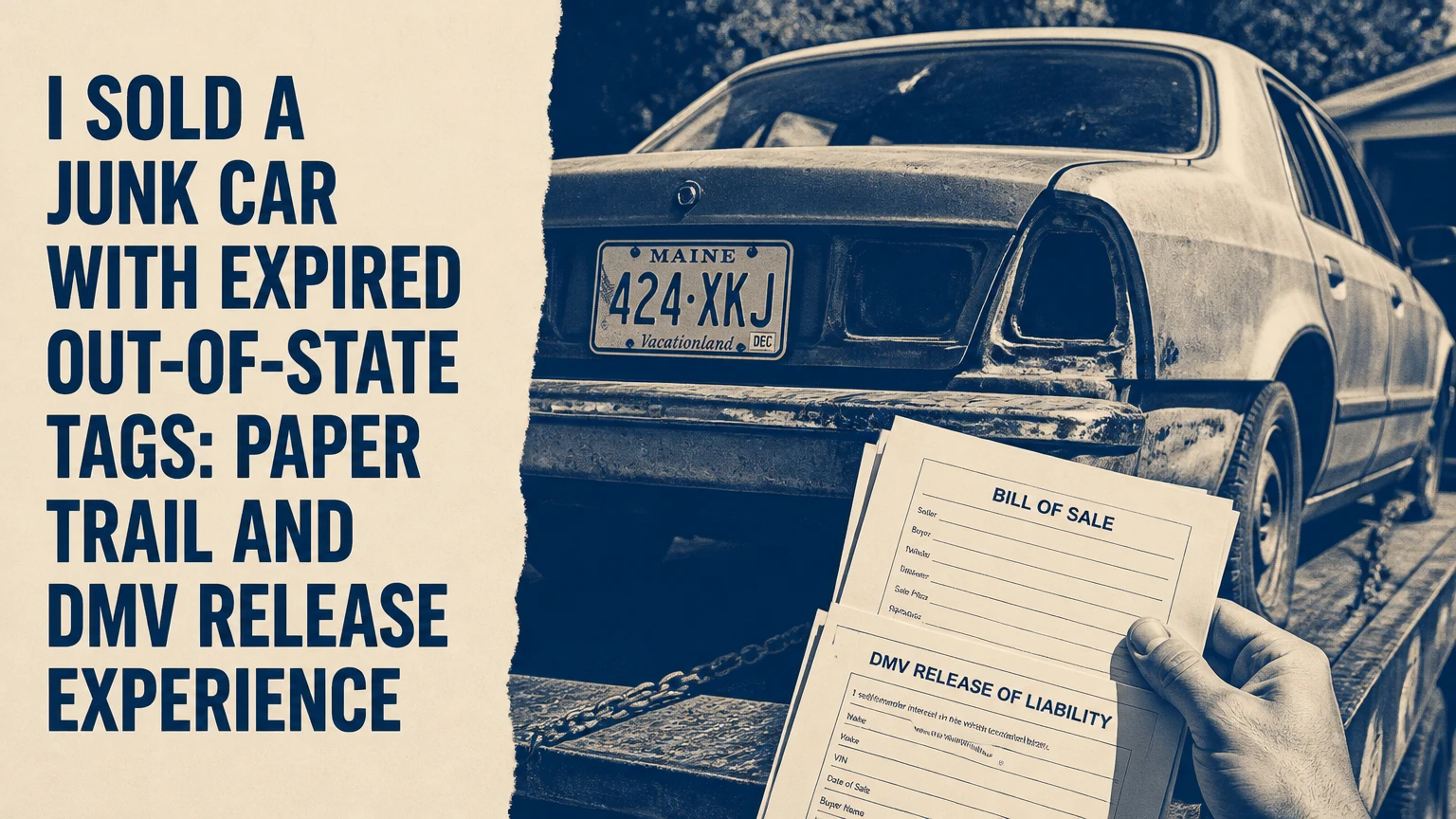
My 2009 Dodge Charger carried Tennessee plates 3 years expired when I tried to sell it for scrap in Texas. Two yards refused the transaction outright without a Texas title. One yard accepted a notarized bill of sale plus a Texas DMV Release of Liability. The payout was $245. Here is the complete paper trail from the first call to the signed check, including every form I filed, every department I contacted, and the one step I almost skipped that would have cost me future liability.
1. The Car, the Expired Tags, and the Problem I Walked Into
How an out-of-state registration creates a scrap transaction problem
When you sell a vehicle for scrap in a state different from its registration, the junkyard must process a title transfer in their operating state. If the title is from another state and the registration is expired, many yards face a more complex submission to the DMV. Some yards build that complexity into a lower offer. Others refuse entirely. The risk you carry as the seller is separate and more serious: if the car moves without a properly filed release of liability, any toll violations, parking tickets, or accident liability tied to the VIN after the sale can still reach you.
My specific situation with the Charger
The Charger held a Tennessee title in my name and Tennessee plates that expired in 2020. I relocated to Texas in 2021 and never re-registered the vehicle there because it stopped running shortly after the move. Texas requires valid state registration only for vehicles driven on public roads. Since I never drove it in Texas, I never re-registered. When the transmission failed and I decided to scrap it, that gap became a paperwork wall. I had a valid out-of-state title but expired tags in a state I no longer lived in, trying to sell in a state I had never registered the car in.
What ‘expired out-of-state tags’ signals to a junkyard
Junkyards flag expired out-of-state tags because they signal potential complications in the title chain. The yard must verify that no active lien appears on the title, that the seller’s name matches the title, and that no state is currently pursuing the vehicle for unpaid registration fees or violations. Two of the 4 yards I called described this as a ‘title risk’ they preferred not to carry. One was blunt: ‘We process 40 cars a week and can’t afford a title problem from a state we don’t operate in.’
2. What 4 Buyers Required Before They Would Process the Sale
The two yards that refused without a Texas title
Yards A and B told me they required a Texas title or a Texas-issued salvage certificate before processing the transaction. Yard A’s title clerk explained that their DMV submission process required a title issued in the state of operation or adjacent states they had prior relationships with. Tennessee was neither. Yard B said the 3-year expiration on the tags flagged their system for additional scrutiny and that their processor would hold the transaction until title concerns resolved, which could take 30 days.
Yard | Required Documents | Quote Offered | Outcome |
|---|---|---|---|
Yard A | Texas title required | None until clear | Refused transaction |
Yard B | Texas title required | Preliminary $395, held | Transaction stalled indefinitely |
Yard C | Out-of-state title + notarized BoS + TX Form VTR-346 | $245 | Completed, paid same day |
Yard D | Out-of-state title + VIN inspection + BoS | $210 | Completed in 3 days |
The yard that accepted out-of-state documentation
Yard C had processed out-of-state vehicles before and had a dedicated title clerk who reviewed the Tennessee title over the phone before scheduling pickup. She asked me to bring three things: the original Tennessee title signed over to the yard, a notarized bill of sale listing the yard’s business name and address as buyer, and a completed Texas Form VTR-346 (Release of Liability). She confirmed that the combination of these three documents gave the yard legal cover to process the title transfer in Texas without needing me to re-register the vehicle first.
What the accepting yard verified at the vehicle
The driver who arrived ran the VIN through his lot’s mobile terminal before loading. He checked that the VIN stamped on the dashboard, the driver-side door jamb sticker, and the Tennessee title all matched identically. He photographed all three documents before handing me the check. The tow took 22 minutes. The check was in my hand 35 minutes after the driver arrived.
3. The DMV Release of Liability: What It Does and How I Filed It
Why filing a release of liability protects you after the sale
A Release of Liability notifies the state DMV that you no longer own or control the vehicle. In Texas, Form VTR-346 is the document that accomplishes this. Once filed, it removes your name from the active ownership record for that VIN going forward. If the buyer drives the car before completing title transfer, any violations, tickets, or incidents that attach to the VIN during that window go to the buyer’s record, not yours. Without the filing, your name remains on the DMV record until the buyer completes their own title transfer, which at a junkyard can take 30 to 60 days.
How I filed Form VTR-346 for an out-of-state vehicle in Texas
Texas allows Form VTR-346 filing for any vehicle sold within the state regardless of the state of original registration. The form requires: your full legal name and Texas address, the buyer’s name and address (I used the junkyard’s business name and physical address), the VIN, and the date of sale. I completed the form on the TxDMV website and submitted it online the same afternoon I confirmed the sale with Yard C. Confirmation arrived by email within 2 hours. The form is free and takes 8 minutes to complete.
What happens to sellers who skip the release of liability filing
One seller at the yard told me about his experience. He sold a non-running car 8 months earlier, skipped the Release of Liability filing, and received 3 toll violations over the following 6 weeks. The yard’s driver had moved the car 28 miles on open roads before completing the title transfer internally. Because the seller’s name remained on the DMV record, the toll authority billed him. He spent 11 weeks and $85 in filing fees and certified mail costs getting the violations dismissed. The yard accepted no responsibility. Filing VTR-346 takes 8 minutes. Clearing toll violations takes 11 weeks.
The Tennessee registration cancellation step I almost missed
Tennessee requires a formal registration cancellation when a vehicle registered in the state will no longer operate there. I submitted this through the Tennessee DMV online portal. The process confirmed cancellation of the plates and sent me a written confirmation that the registration was officially closed. Without this step, Tennessee’s records would still show active registration tied to a VIN that was now scrapped in Texas. Future buyers of similar VINs and your own driving record can carry complications from a registration that shows as active but unrenewed. The cancellation cost nothing and took 6 minutes online.
4. The Complete Paper Trail, Timeline, and Total Cost
Every document filed and its purpose
Document | Purpose | Filed With | Cost | Time to Complete |
|---|---|---|---|---|
Tennessee Title (original) | Proves ownership, signed over to buyer | Yard C (original copy kept by yard) | $0 | Already had it |
Texas Form VTR-346 (Release of Liability) | Removes seller from DMV record after sale | TxDMV online portal | $0 | 8 min |
Tennessee Registration Cancellation | Closes active TN registration on scrapped vehicle | Tennessee DMV online portal | $0 | 6 min |
Notarized Bill of Sale | Documents the transaction for both parties and state | Notarized at UPS Store | $10 | 15 min |
VIN Verification (by yard driver) | Confirms VIN matches across title, dash, and door jamb | Performed on-site by yard | $0 (yard absorbs) | 5 min at site |
Day-by-day timeline from first call to cash in hand
Day | Action | Result |
|---|---|---|
Day 1 | Called 4 yards, described car and tag situation exactly | Yards A and B refused. Yards C and D quoted pending paperwork. |
Day 2 | Filed Texas Form VTR-346 online. Filed Tennessee registration cancellation online. | Both confirmed by email within 2 hours. |
Day 3 | Notarized bill of sale at local UPS Store. Confirmed pickup time with Yard C. | $10 notary fee. Pickup scheduled for next morning. |
Day 4 | Yard C driver arrived, verified VIN and documents, loaded car. | Check issued on-site: $245. Car cleared. |
Total time from first call to cash: 4 days. Total out-of-pocket cost: $10 (notary fee). Final payout: $245. Net after paperwork: $235.
FAQs: Selling a Junk Car With Expired Out-of-State Tags
Q: Can I sell a junk car with expired out-of-state tags without getting a new local title first?
A: Yes, in most states. You need the original out-of-state title signed over to the buyer, a notarized bill of sale, and a Release of Liability filed with the state where the sale occurs. Some yards refuse this combination; call at least 4 yards and tell them your exact situation before assuming it cannot be done.
Q: What is a Release of Liability and why do I need one for a junk sale?
A: A Release of Liability is a state DMV form you file to remove your name from the vehicle’s active ownership record after a sale. Without it, your name stays on record until the buyer completes their own title transfer. For junk sales, that can take 30 to 60 days. During that window, any violations tied to the VIN can come back to you.
Q: Will junkyards take a car with out-of-state paperwork?
A: Some will, some won’t. Yards with dedicated title clerks handle out-of-state titles routinely. Smaller operations that submit titles manually often refuse. Call and describe your paperwork situation before mentioning the car. If the yard refuses based on documentation alone, move to the next yard on your list.
Q: What if I lost the out-of-state title?
A: Contact the state that issued the original title and request a duplicate. Tennessee charges $11 for a duplicate title and processes it in 5 to 10 business days by mail. Most states offer online duplicate title requests. Some yards will accept a bonded title or a bill of sale plus a VIN verification in lieu of a title for vehicles 10 or more years old, depending on state law.
Q: Can I get in trouble for expired tags after I sell the car to a junkyard?
A: If you file the Release of Liability before the car leaves your possession, the expired tags become the buyer’s documentation problem, not yours. If you skip the filing, any future violations attached to the VIN can reach you. File the form the same day as the sale or the day before.
Q: Does an out-of-state title affect my payout amount?
A: At yards that accept out-of-state titles, the impact is minimal, typically $0 to $30 less than a locally registered vehicle. The car’s scrap value stays the same. The small difference reflects the yard’s additional processing time and the risk they carry until the title clears in their state.
Bottom Line
Expired out-of-state tags add paperwork but do not stop a junk sale in most states. Your three required documents are the original out-of-state title, a notarized bill of sale, and a Release of Liability filed with the state where the sale happens. File the Release of Liability the same day as the sale, not after. Cancel the original state registration in writing to close that record permanently.
Call at least 4 yards and describe your paperwork situation on the first call. Yards that have processed out-of-state vehicles before will tell you immediately. Yards that hesitate or ask you to come in person before quoting are signaling they have no internal process for this and will either refuse or delay. Budget 4 days and $10 to $20 in notary fees. Your payout should not drop more than $30 compared to a locally registered vehicle of the same make and model.