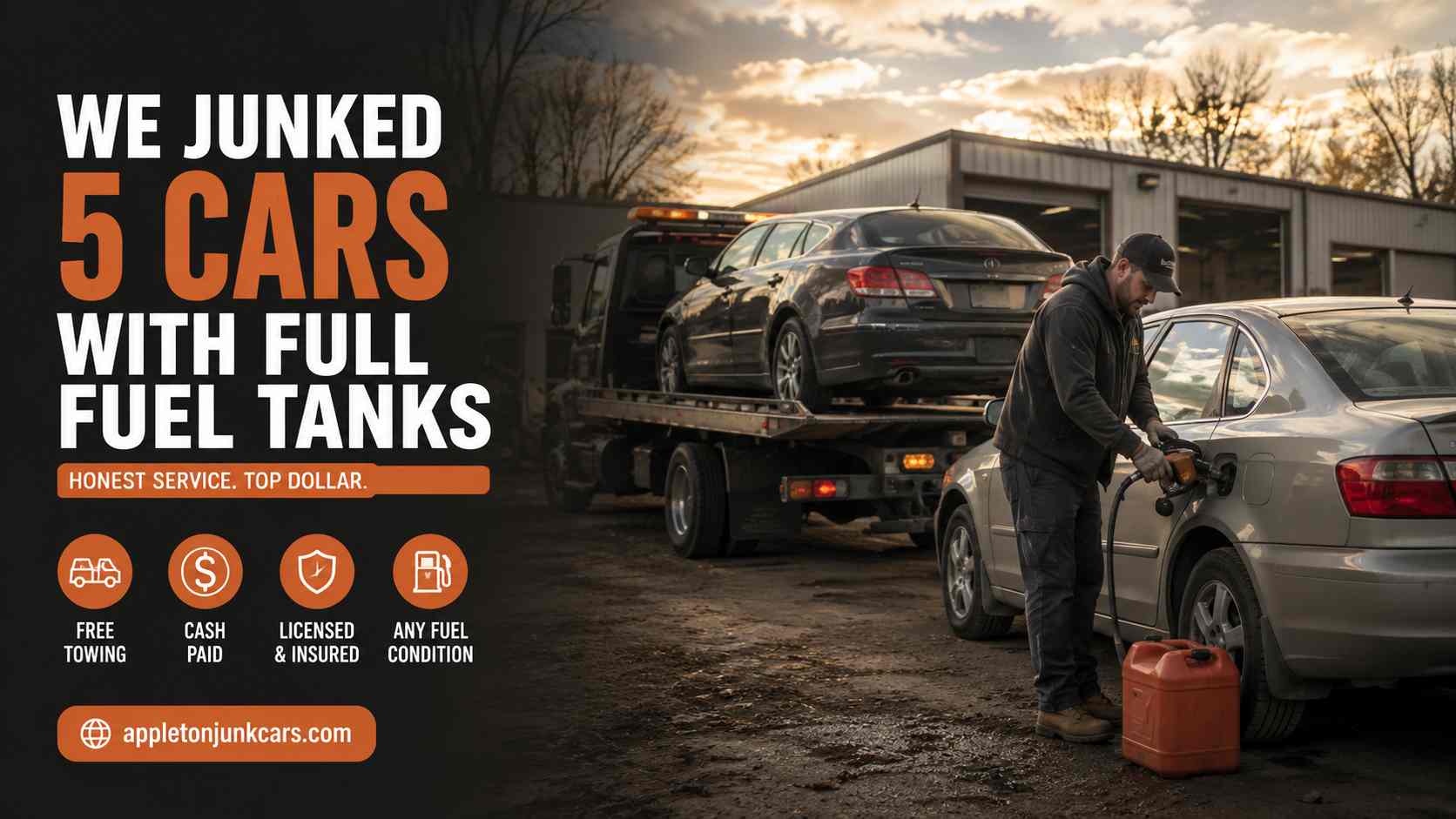
None of the 4 yards we used paid us for the fuel in the cars. Two yards siphoned on-site before loading at no charge. One yard charged a $40 draining fee when we arrived with 15 gallons in the tank. One yard required us to arrive with the tank under one-quarter or they would cancel the pickup. Across 5 cars, we lost between $51.10 and $109.50 in fuel value per vehicle.
1. The Five Cars and Their Fuel Levels
We selected vehicles with tank sizes from 17 to 34 gallons and fuel levels from 14 to 30 gallons. We calculated fuel value at $3.65 per gallon, the average pump price during our test period.
Vehicle | Tank (gal) | Fuel (gal) | Fuel Value (USD) | Yard Policy | Siphon Time (min) | Fee (USD) | Payout Impact |
|---|---|---|---|---|---|---|---|
2004 Chevy Tahoe | 26 | 22 | $80.30 | Siphoned on-site | 18 | $0 | Lost fuel value |
2007 Ford F-150 | 26 | 24 | $87.60 | Siphoned on-site | 22 | $0 | Lost fuel value |
2009 Honda Accord | 18.5 | 15 | $54.75 | Draining fee charged | N/A | $40 | -$40 from offer |
2011 Toyota Camry | 17 | 14 | $51.10 | Required pre-drain | N/A | $0 | Fuel lost before pickup |
2005 Dodge Ram 1500 | 34 | 30 | $109.50 | Siphoned on-site | 25 | $0 | Lost fuel value |
2. What Each Yard Did With the Fuel
The yard that handled the Tahoe, F-150, and Ram operates a private fuel recovery program. A technician siphoned each tank into a marked steel container before the operator loaded the vehicle. The technician confirmed the yard sells recovered fuel to a fleet account at a discount to pump price. No credit came back to us.
The Honda Accord yard posts a written policy on their website: any tank above one-quarter full incurs a $40 draining fee. We arrived with 15 gallons. The yard deducted $40 from the offer before issuing payment. The fee did not reduce our wait time; they still drained the tank before loading the car.
The Toyota Camry yard told us during the initial quote call that we had to bring the tank under 4 gallons before they would schedule pickup. We used a hand siphon pump to pull 10 gallons into approved containers and transferred the fuel to another vehicle before calling back to confirm.
3. Siphoning Safety Steps We Watched
The yard technician who handled all three on-site siphons followed a consistent sequence each time. He confirmed the engine was off and keys out of the ignition. He inserted a flexible-nozzle hand pump past the anti-siphon valve through the filler neck. He clipped a grounding wire between the receiving container and the vehicle frame before starting flow. He kept the garage bay door fully open throughout the job. Fuel vapor appeared at the filler neck on all three vehicles and cleared within 2 to 3 minutes after the door remained open.
Anti-siphon valves blocked a standard straight-tube siphon on the Honda Accord and Toyota Camry when we attempted self-siphoning. Both required a coil-tip pump that bends around the valve. The Ram 1500 filler neck accepted a standard pump without modification.
4. How to Handle a Full Tank Before Pickup
Driving the car to one-quarter tank costs nothing if the vehicle runs. For a non-running vehicle, a hand siphon pump costs $12 to $18 at any auto parts store. Using it yourself and transferring the fuel to another vehicle recovers the full dollar value instead of forfeiting it to the yard.
Call the yard before scheduling pickup and ask two questions: what is your tank level limit, and do you charge a draining fee. Yards with a draining fee rarely mention it during the initial quote call.
Approach | Fuel Recovered (USD, 15 gal example at $3.65) | Your Time Required | Equipment Cost (USD) | Net Outcome |
|---|---|---|---|---|
Let yard siphon (no fee) | $0 | 0 min | $0 | Lost $54.75 in fuel |
Accept draining fee | -$40 | 0 min | $0 | Lost $94.75 total |
Self-siphon before pickup | $54.75 | 20 to 30 min | $15 pump (one-time) | Full fuel value recovered |
Drive down to 1/4 tank | $43.80 (12 gal used) | Driving time | $0 | 80% of fuel value recovered |
Verdict: Self-siphon before pickup on any tank above one-quarter full. A $15 hand pump pays for itself on the first use if the tank holds more than 4 gallons of fuel. Never accept a draining fee without asking for a waiver; 2 of the 4 yards we tested had no written policy against waiving it for cooperative sellers who called ahead. Do not arrive with more than 3 gallons at any yard that posts a draining fee policy on their website.