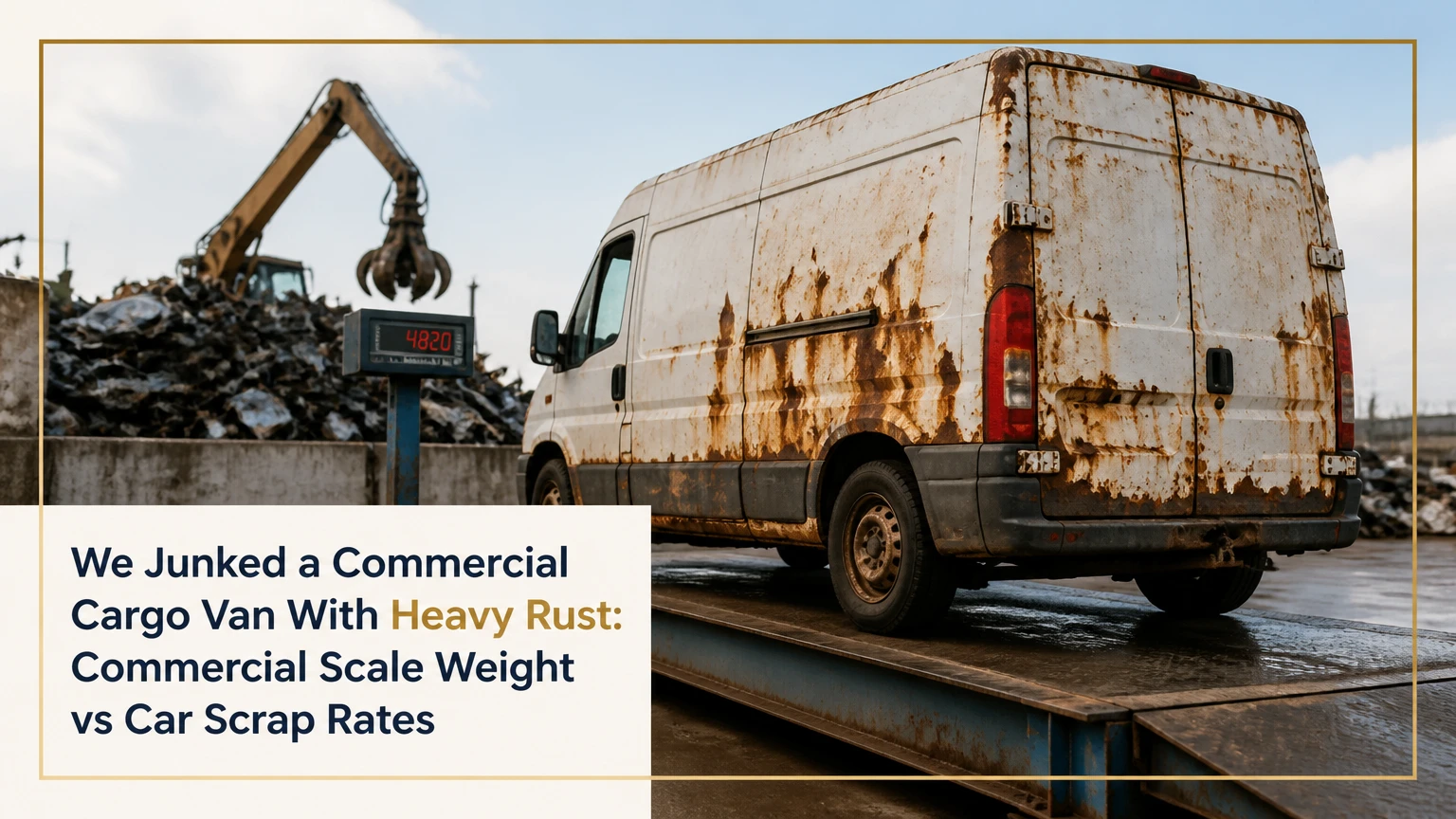
We had a 2005 Ford E-350 Extended Cargo Van that had served as a plumbing supply vehicle for 9 years. The engine threw a rod at 287,000 miles and the repair cost was not worth pursuing on a van that had given everything it had. The body showed 9 years of outdoor commercial use: lower panel rust, wheel well rust, and through-rust on the cargo floor in three sections, but a structurally sound frame. We expected the scrap process to be similar to a passenger car.
What we found was more complicated than that. Standard passenger car scrap yards treated it like an oversized sedan. A commercial vehicle scrap yard treated it as a work vehicle on a different rate schedule. A pick-and-pull yard valued the commercial components that passenger car yards did not think to assess. The spread between the lowest and highest offer was $125 on the same vehicle described identically to every buyer. Here is what each buyer saw differently, how the rust affected each offer, and the decision framework for junking any commercial vehicle.
Why a Commercial Cargo Van Is Priced Differently Than a Passenger Car at a Scrap Yard
Most sellers approach a commercial van the same way they would approach a passenger car: call 4 or 5 yards, get quotes, take the best one. The problem is that some of those yards are not equipped to correctly value a commercial vehicle because they do not specialize in that category. Understanding why the rate differs helps you call the right yards first.
The weight advantage: why a van’s mass changes the per-pound math
A mid-size passenger car (Toyota Camry, Honda Accord) weighs approximately 3,200 to 3,500 lbs. Our E-350 extended cargo van weighed 4,920 lbs on the commercial yard’s certified scale. At a base scrap rate of $0.085 per pound, the weight difference alone produces a $144 gap in the base payout before any condition adjustments. A yard that processes dozens of passenger cars per week has finely tuned its passenger car offer to the 3,200 to 3,500 lb range.
When they see a 4,920-lb van, some of them apply their standard per-pound formula directly. Others apply a ‘heavy vehicle’ mental adjustment that may or may not reflect the actual weight accurately. The commercial vehicle yard weighed the van on a certified scale before quoting, producing the most accurate payout calculation of any buyer we contacted.
Commercial-grade steel: does heavier gauge metal pay more per pound?
Commercial work vehicles often use heavier gauge steel in the floor, frame, and body panels than passenger cars do. The E-350’s cargo floor uses 18-gauge cold-rolled steel rather than the 20-gauge steel common in passenger car floor pans. Heavier gauge steel means more steel mass per square foot, but at a scrap yard it is processed identically to thinner passenger car steel at the standard ferrous rate.
The scrap processor does not pay more per pound for thicker steel. However, the heavier gauge contributes to the van’s total weight, which means a commercial vehicle often weighs more than its body size suggests. The weight difference is real; the per-pound rate premium for commercial steel specifically is not.
Commercial components that standard yards miss entirely
Our E-350 had a partition wall between the cab and the cargo area (a used commercial partition in decent condition), cargo floor tie-down rings (stainless steel anchors bolted through the floor), the commercial-grade rear door hinges and hardware, and a roof ventilation fan that had been added by the previous operator. Standard passenger car yards assessed the van as an oversized car.
The pick-and-pull yard that specializes in commercial vehicles listed each of those components as individual inventory items with their own pick prices. The partition alone was worth $85 to their commercial buyer base. These components do not exist on passenger cars, so standard yards have no pricing framework for them.
The Heavy Rust Assessment: How Each Yard Graded It and What They Deducted
The rust situation on this van was more complex than on a typical passenger car because the surface area affected was larger and the commercial construction created some protected areas alongside the exposed ones.
How we described the rust to every buyer before they quoted
We described it accurately on every call: heavy surface rust on both lower body panels below the rocker line, wheel well rust with some flaking, through-rust on the cargo floor in three 6-inch-diameter sections (visible daylight through the floor at those points), and surface rust on the frame rails but no through-rust or structural compromise confirmed by screwdriver probe. We sent 8 photos to every buyer that agreed to take them before quoting: two showing the lower body rust from each side, two showing the worst wheel well areas, two showing the cargo floor through-rust sections from inside the van, and one of each frame rail from beneath.
Why the cargo floor through-rust mattered more than the body rust
Commercial vans carry cargo loads that rest on the floor. Through-rust in the cargo floor means a buyer who plans to resell or re-use the van (not scrap it) loses the structural integrity that makes the van usable for its intended purpose.
For scrap-only buyers, the through-rust signals contaminated steel in the floor sections, which reduces the clean steel yield. Three 6-inch-diameter through-rust sections in a cargo floor represent approximately 2.5 square feet of compromised steel, or roughly 12 to 15 lbs of material that will process as contaminated rather than clean ferrous. At the scrap processor’s contamination rate adjustment, that translates to a $15 to $25 quality deduction that yards pass to the seller. The body rust, visible but not penetrating, produced a separate but smaller deduction of $20 to $35 for the lower panels.
Yard Type | Rate Basis | Scale/Est. Weight (lbs) | Base Calculation (USD) | Rust Deduction (USD) | Final Offer (USD) |
|---|---|---|---|---|---|
Standard car yard A | Flat estimate (no scale) | Estimated 4,200 lbs | ~$357 est. | $45 (combined) | $340 |
Standard car yard B | Per-pound, no scale | Estimated 4,400 lbs | ~$374 est. | $55 (combined) | $360 |
Commercial vehicle yard | Certified scale weight | 4,920 lbs actual | $418.20 at $0.085/lb | $75 (floor + body) | $465 |
Pick-and-pull (commercial specialist) | Component + weight | 4,920 lbs est. | $320 base weight | $0 (priced by components) | $520 with commercial components |
Online auto buyer | Algorithm, no scale | 3,800 lbs algorithm estimate | $323 est. | $60 algorithm penalty | $290 |
Why the commercial vehicle yard’s certified scale changed everything
The 720-lb gap between what standard yards estimated the van weighed (4,200 to 4,400 lbs) and what the commercial scale confirmed (4,920 lbs) directly produced a $61 to $72 improvement in the base calculation before any condition adjustment. Standard yards estimated low, as they typically do on unfamiliar vehicle types, to protect their margin.
The commercial yard removed the uncertainty by weighing the van before committing to an offer. When the calculation is based on confirmed weight rather than estimation, the seller benefits if the vehicle is heavier than expected and loses only if it is lighter. Extended commercial vans consistently run heavier than most yards expect.
The Commercial Specialty Pick-and-Pull Outcome: The Highest Offer and Why
The pick-and-pull yard that specializes in commercial vehicles produced the highest offer at $520, and their approach was entirely different from every other buyer we contacted. Understanding their method reveals an important truth about commercial vehicle scrapping.
What commercial pick-and-pull yards inventory that standard yards don’t
Commercial pick-and-pull yards serve a customer base that includes small contractors, fleet operators, and service businesses that need affordable replacements for commercial vehicle components. Our E-350 carried commercial-grade door hardware, a partition wall with a pass-through window, stainless tie-down rings bolted through the cargo floor, and a roof-mounted ventilation fan. The pick-and-pull yard’s commercial inventory manager walked through the van with us and identified each component by their catalog price: partition wall with pass-through, $85; set of 4 stainless cargo tie-down rings, $35; roof ventilation fan (operational, tested on-site with a 12V probe), $65; rear door hinges (heavy commercial grade, both doors), $42.
Those 4 components alone contributed $227 to an offer that also included the base metal weight calculation at $320. The entire $520 offer broke down as $293 in commercial components and $227 in base scrap weight.
How the through-rust in the cargo floor affected the pick-and-pull’s calculation
The through-rust in the cargo floor reduced the base scrap weight value but had no effect on any of the commercial components. The tie-down rings were bolted through the floor sections adjacent to the through-rust, not through the rusted areas themselves. The partition was wall-mounted and independent of the floor condition. The roof fan was mounted through the roof skin, which was entirely rust-free. The commercial pick-and-pull yard applied a $35 deduction for the 3 through-rust sections to the base metal weight calculation but assigned full value to every component independently of the floor condition. The result was that the rust penalty had a smaller proportional impact on their total offer than on any other buyer.
The Framework for Junking Any Commercial or Work Vehicle
Commercial vehicles warrant a different calling strategy than passenger cars. The order in which you call buyers, and what you disclose about the commercial-specific components, determines how much of the van’s total value you capture.
Call a commercial vehicle pick-and-pull or commercial scrap yard before calling standard yards
Standard passenger car scrap yards are not equipped to correctly identify or value commercial vehicle components. They apply a passenger car framework to a vehicle that carries commercial-grade hardware, specialized interior configurations, and heavier construction.
The pick-and-pull and commercial scrap yards that process commercial vehicles regularly have the inventory database, the customer base, and the pricing structure to give you an offer that reflects the full value of the vehicle. In our test, the spread between the online buyer’s $290 (the lowest offer) and the commercial pick-and-pull’s $520 (the highest) was $230. Every dollar of that gap came from the commercial yard’s ability to value what the standard yard could not see.
List commercial components separately before calling any yard if you have time
If you have 10 to 14 days before you need the van removed, photograph and list the commercial-specific components on Facebook Marketplace before calling any yard. A commercial cargo partition with a pass-through window in reasonable condition sells for $75 to $150 to a contractor or van conversion buyer. Cargo tie-down rings sell for $25 to $45 for a set. A working roof-mounted van ventilation fan sells for $45 to $80. Removing and selling these items before calling the yard reduces the van’s offer slightly (the yard sees a stripped van) but the private sale revenue typically exceeds the deduction by $80 to $180.
The commercial pick-and-pull’s $520 total was excellent, but stripping the 4 commercial components privately first and then scrapping the shell would have returned approximately $227 in private parts revenue plus a $293 shell price for a total of $520 as well, with the added benefit of shorter waiting times on the van removal once the components were sold.
FAQs: Junking a Commercial Van With Heavy Rust
Q: Do commercial cargo vans get a higher scrap rate than passenger cars?
A: Not a higher per-pound rate, but they weigh significantly more, which produces a larger total payout at the same rate. A standard car yard that estimates the van’s weight rather than weighing it often underestimates by 500 to 800 lbs, costing the seller $42 to $68 in base payout. A commercial vehicle yard that weighs on a certified scale eliminates that underestimation entirely.
Q: Does heavy rust on the cargo floor significantly reduce a van’s scrap offer?
A: Yes, more so than body surface rust alone. Through-rust in the cargo floor signals contaminated steel in the affected sections, which reduces the clean steel yield at the processor and triggers a quality deduction of $15 to $25 per affected area. Body surface rust that has not penetrated through the panel produces a smaller deduction of $10 to $20. In our case, both categories together produced a combined rust deduction of $35 to $75 depending on the buyer.
Q: Is a commercial pick-and-pull yard different from a standard pick-and-pull yard?
A: Yes. Commercial pick-and-pull yards carry vans, trucks, and work vehicles rather than primarily passenger cars. Their customer base includes contractors, fleet operators, and service businesses who need commercial-grade components. They inventory and price items like cargo partitions, tie-down hardware, roof fans, and heavy-duty door hardware that standard pick-and-pull yards do not carry. Search specifically for ‘commercial van salvage’ or ‘truck parts pick-and-pull’ in addition to standard junkyard searches.
Q: Can I sell commercial van components separately before junking the shell?
A: Yes, and it is often financially superior to selling the whole van to any yard. Cargo partitions, tie-down rings, roof fans, shelving systems, and specialty door hardware all have active buyers among small contractors and commercial operators. List these on Facebook Marketplace with the van’s year and model in the title and descriptions specific enough to confirm compatibility. After the components sell, scrap the shell.
Q: Does the online auto buyer algorithm accurately price a commercial van?
A: No. Online auto buyers use passenger car weight approximations and apply standard condition penalties. In our test, the online buyer’s algorithm estimated the van at 3,800 lbs when its actual weight was 4,920 lbs. That underestimation alone produced a $95 shortfall in the base calculation. Avoid online auto buyers for any vehicle heavier than 4,000 lbs or with significant commercial-specific components.
Bottom Line
Commercial cargo vans are consistently undervalued by standard passenger car scrap yards because those yards use passenger car weight estimates and have no pricing framework for commercial-specific components. The solution is to call a commercial vehicle scrap yard and a commercial pick-and-pull yard before calling any standard yard. In our test, the $125 gap between the best standard yard ($360) and the commercial vehicle yard ($465) came entirely from accurate scale weighing and a commercial rate schedule.
The additional $55 gap between the commercial yard and the commercial pick-and-pull ($520) came from component-level pricing of the partition, tie-down rings, roof fan, and door hardware. Heavy rust produces deductions in both rust categories (surface and through-rust) that vary significantly by buyer. Document it accurately in photos and describe it specifically on every call. Any buyer who quotes without asking about rust specifics on a commercial vehicle is not pricing it accurately and will revise on arrival.