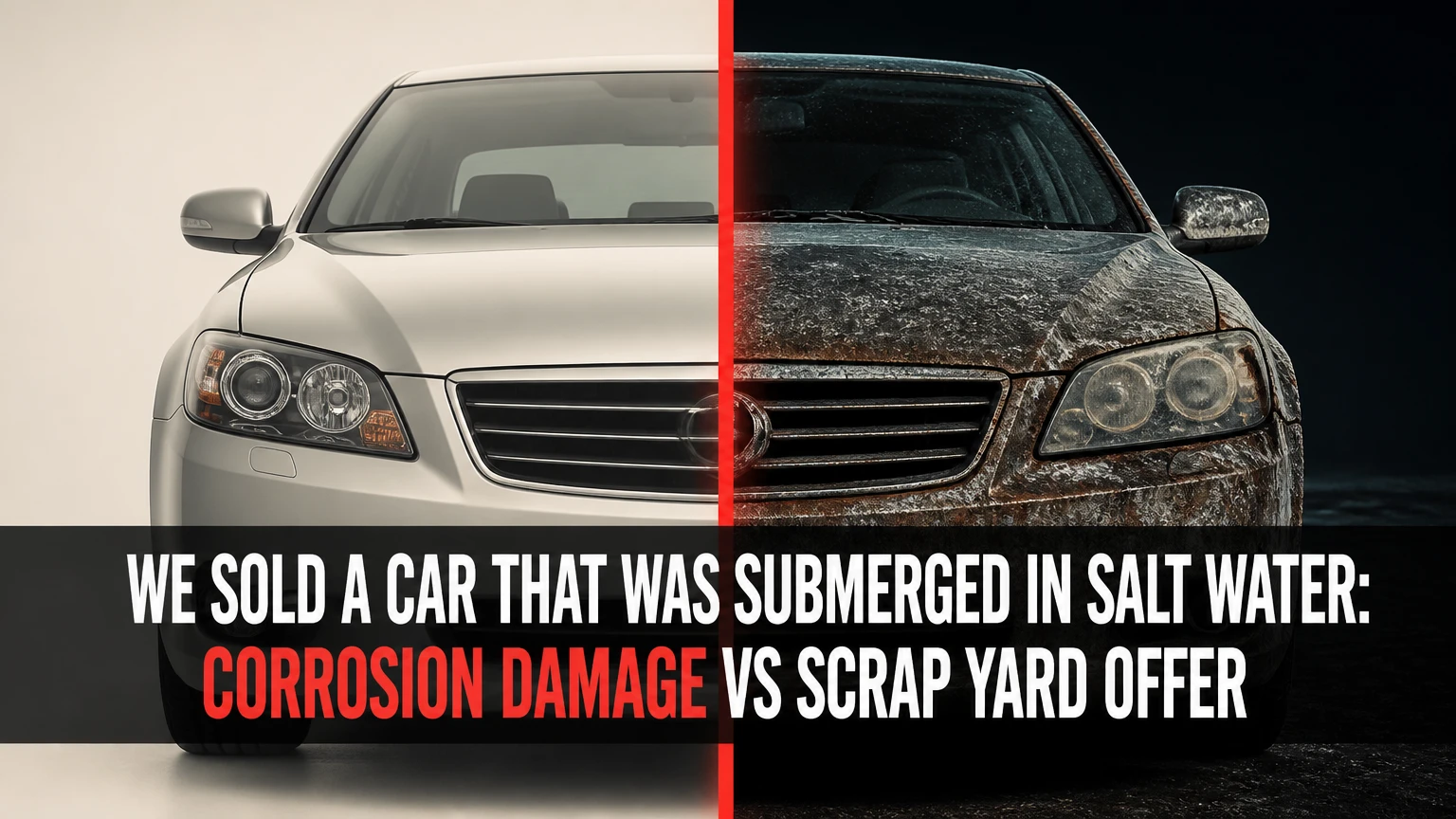
A coastal storm surge submerged our 2018 Toyota RAV4 in roughly 5 feet of salt water for 4 days before the water receded. We recovered the car, towed it to our property, and spent 3 weeks researching what to do before concluding that the repair cost made no financial sense. By the time we called the first junkyard, the salt water had already been working on the car for 21 days.
The difference between what a comparable fresh water flood car would have fetched, approximately $330 based on our own prior experience with a flooded Civic two years earlier, and what the RAV4 produced, $185 at its best, was $145. That gap was not about the flood event itself. It was about the chemistry of salt water corrosion, which operates on an entirely different timeline and severity level than fresh water damage.
Three yards refused the car outright. Two cited steel contamination concerns. Here is what we found when we inspected the car before calling, why salt water damage is categorically worse than fresh water damage, and what the offers actually reflected.
What Salt Water Does to a Car That Fresh Water Does Not
When someone says ‘flood car,’ most buyers and sellers picture a vehicle that got wet from rain or river water and developed mold in the carpet and electrical corrosion at the connector pins. Salt water flood damage is in a different category entirely, and the difference is not degree but chemistry.
The electrochemical reaction that makes salt water corrosion so much faster
Fresh water is a poor conductor of electricity. When fresh water contacts steel, it allows very slow oxidation (rusting) because the electrical conductivity of the water is limited. Salt water, specifically water containing dissolved sodium chloride, is a strong electrolyte that dramatically increases electrical conductivity between dissimilar metals.
This creates a galvanic corrosion process: wherever two different metals or alloys contact each other through a salt water bridge, an electrochemical cell forms and the more reactive metal begins to dissolve at an accelerated rate. In a car, this means every steel-to-aluminum joint, every steel fastener through an aluminum casting, every ground strap connection, and every electronic connector pin begins to corrode rapidly from the moment the salt water contacts it.
The practical result is visible within days, not weeks or months. Fresh water that dries from a car’s interior may leave water stains and eventually produce mold, but the steel underneath rarely shows significant rust within the first 30 days if it dries quickly. Salt water that dries from the same surface leaves a salt deposit on every metal contact point. As atmospheric humidity cycles through the salt deposit, the corrosion cycle restarts every time humidity rises above the salt’s deliquescent point, even if no additional water contacts the car.
This is why vehicles submerged in coastal storm surge continue to corrode rapidly even after the water is gone and the vehicle appears dry.
What we found when we opened every access point on the RAV4 three weeks after submersion
We did a systematic inspection before calling any buyer. What we found in three weeks of salt corrosion on a 2018 vehicle was startling. Every electrical connector we opened in the engine bay showed green patina corrosion on the pin contacts, not just at the extreme ends but penetrating 3 to 5mm into the housing. The main engine harness connector at the PCM showed contact corrosion severe enough that we could not confirm any pin was still making good electrical contact.
The brake calipers on both rear wheels were completely seized: we could not compress the pistons manually with a c-clamp, which normally takes moderate hand pressure. The front calipers were seized on the slide pins but not yet at the pistons. The seat tracks on the driver and passenger seats had surface rust that prevented smooth movement within 2 weeks of the submersion. The spare tire well in the cargo area had standing rust water still visible when we opened it 3 weeks after the submersion event. The roof rail attachment points showed rust weeping through the headliner material.
Why the interior looked deceptively normal but the structure did not
The carpet, seats, and dashboard looked reasonable after 3 weeks of drying with the windows cracked and a shop fan running inside the car. The visual deception of dried salt water cars is one of the most important things to understand: they can look better than they are because the fabric dries and loses the immediate visual evidence of flooding faster than the structural metal loses its integrity. A buyer who walks up to a salt water flood car 3 weeks after the event and looks only at the interior may not see the full story. The buyers who looked at the RAV4’s undercarriage, opened electrical connectors, and physically tested the brake calipers saw the real condition immediately.
Damage Category | Fresh Water Impact (3 weeks later) | Salt Water Impact (3 weeks later) | Reversibility |
|---|---|---|---|
Electrical connectors | Possible green patina at extreme pin tips only | Severe green patina penetrating 3-5mm into housing on every connector checked | Essentially irreversible without full rewiring |
Brake calipers | May slide slowly, pistons usually compress | All rear calipers seized solid; front slide pins seized | Replacement required, not repair |
Seat tracks | May be stiff but functional | Surface rust preventing smooth movement within 2 weeks | Seized tracks require replacement or grinding |
Body steel (lower panels) | Surface rust beginning at bare metal chips | Accelerated rust at every exposed metal point including paint chips | Treatment possible but rust returns faster |
Frame rails | No visible change within 3 weeks if prior finish intact | Visible rust weeping at frame seam joins and drain holes | Structural concern on extended exposure |
Carpet and fabric | Wet, mold beginning below 2-3 weeks | Visually similar but salt deposits in fiber; reactivates with humidity | Surface cleaning only; salt reactivation ongoing |
What 6 Buyers Offered on the Salt Water RAV4 vs a Comparable Fresh Water Car
We called 6 buyers over 3 days, disclosing the salt water submersion specifically on every first call. The distinction between salt water and fresh water mattered to more buyers than we expected. Most flood-damaged car disclosure conversations cover whether the car was flood damaged. Salt water submersion is a more specific condition that some buyers price very differently.
Why salt water matters to the buyers beyond the obvious damage
Two of the 6 buyers mentioned a concern we had not anticipated: steel contamination at the shredder. Salt water leaves dissolved chloride compounds embedded in the steel’s surface and in the rust deposits that form. When a salt-corroded vehicle goes through a car shredder and the processed steel is melted in an electric arc furnace, the chloride content contributes to chlorine gas production that attacks the furnace’s refractory lining and creates quality issues in the resulting steel billet.
Steel processors prefer low-chloride scrap loads, and vehicles with known salt water exposure are sometimes flagged as higher-chloride content by processors who are aware of the vehicle’s history. Two yards confirmed that their shredder operator applies a quality downgrade to vehicles they know experienced salt water submersion, and they passed that downgrade back to us as an additional deduction on top of the standard flood vehicle adjustment.
The three buyers who refused and what they each said
Buyer 1, a standard junkyard, heard ‘submerged in salt water for 4 days’ and immediately said they do not take salt water vehicles. When I pressed for the reason, the rep said their lot insurance has a clause about vehicles with known chemical contamination, and salt water qualifies. Buyer 2, a pick-and-pull yard, said their customer base will not pull brake parts, electrical connectors, or suspension hardware from a salt water car because the components have already failed beyond useful service life.
They would have taken a fresh water car at discounted value but had no customer pull-demand for a salt water car’s components. Buyer 3, a national online buyer, went through their full intake process, submitted a quote, but flagged the vehicle during processing and retracted the quote after their verification step identified the salt water submersion from the insurance records they pulled on the VIN.
Buyer | Type | Offer (USD) | Comparable Fresh Water Flood Offer (USD) | Gap (USD) | Primary Stated Reason |
|---|---|---|---|---|---|
Buyer 1 | Standard junkyard | Refused | $295 est. | N/A | Insurance clause: chemical contamination |
Buyer 2 | Pick-and-pull yard | Refused | $320 est. | N/A | No customer demand for salt water parts |
Buyer 3 | National online buyer | Retracted | $260 est. | N/A | VIN history flagged salt water submersion |
Buyer 4 | Regional scrap chain | $185 | $330 est. | $145 gap | Steel contamination deduction + parts write-off |
Buyer 5 | Commercial scrap broker | $210 | $310 est. | $100 gap | Partial parts value retained (body panels) |
Buyer 6 | Independent salvage dealer | $170 | $280 est. | $110 gap | Stated highest risk of re-corrosion after drying |
Why Buyer 5 (the scrap broker) returned $25 more than the best yard
The scrap broker who offered $210 explained his calculation differently from every other buyer. He assessed the RAV4’s body panels (hood, doors, fenders, hatch) as having partial resale value because those panels, manufactured from drawn steel with primer and paint, showed only surface rust at chip and scratch locations, not the deeper corrosion present on unpainted surfaces and hardware.
His customer base includes body shops sourcing used panels for collision repairs, and a body panel with some surface rust in the chips can be cleaned and used if the underlying steel is not pitted through. He estimated 3 of the 4 door panels and the hood were still viable parts. His offer of $210 reflected $125 in body panel component value and $85 in base scrap weight, minus his $75 internal contamination adjustment. No other buyer assessed the body panels independently of the car’s total condition.
The Steel Contamination Concern That Two Yards Raised in Detail
The steel contamination argument was the most technically specific objection we encountered, and it is worth understanding in detail because it explains a pricing dynamic that sellers of salt water cars will encounter repeatedly.
How chloride contamination affects a steel processor’s operation
Electric arc furnace steelmaking melts scrap steel using high-power electrical arcs. The furnace is lined with refractory materials, typically magnesia-based, that must withstand the extreme heat of the melt. When chloride compounds in the scrap decompose at melt temperature, they produce hydrogen chloride and chlorine gas, which react with moisture in the furnace atmosphere to form hydrochloric acid.
This acid attacks the refractory lining at an accelerated rate, reducing furnace lining life and increasing maintenance costs. Processors who receive heavily salt-contaminated loads must compensate with more frequent lining inspection and occasional spot repair. Over time, a supplier who consistently delivers high-chloride loads will see a reduced per-ton rate from processors who have tracked the quality impact.
For the seller of a single salt water car, this concern operates at a distance. The yard passes the processor’s quality adjustment back to you as part of their intake price. Two of our yards applied a specific $25 to $35 ‘salt water vehicle’ adjustment on top of their standard flood vehicle deduction. The combined impact of the standard flood deduction plus the salt water supplement accounted for roughly half of the $145 gap between the salt water offer and a fresh water equivalent.
What to do with a salt water car in the first 48 hours to limit the damage
We did not do this because we were managing the aftermath of the storm more broadly, but the actions taken in the first 48 hours after a salt water submersion determine how much of the car’s value survives. The immediate priority is fresh water flushing: rinsing the engine bay, the brake hardware, the wheel wells, and the undercarriage with clean fresh water dilutes the salt concentration before it begins depositing chloride compounds in the metal’s surface.
The secondary priority is drying: opening every door, removing the carpet, and creating airflow through the interior before mold establishes itself and before the salt deposits reactivate during humidity cycles. We could not do this during an active storm response, but any salt water vehicle owner who recovers the car within 24 to 48 hours of the submersion and can perform these steps will see meaningfully better offers at sale time because the surface corrosion will be less advanced.
FAQs: Selling a Car Submerged in Salt Water
Q: Is salt water flood damage worse than fresh water flood damage for a junk car’s value?
A: Yes, significantly. Salt water accelerates corrosion through electrochemical reaction, destroys electrical connectors within days, seizes brake hardware within weeks, and introduces chloride contamination into the steel that affects the car’s value to scrap processors. Fresh water flood damage primarily produces mold and electrical corrosion that develops over weeks and months. A salt water car we sold for $185 would have fetched approximately $330 as a comparable fresh water flood car.
Q: Will a junkyard refuse a car that was submerged in salt water?
A: Some will. Of 6 buyers we contacted, 3 refused. Standard yards with insurance clauses about chemical contamination, pick-and-pull yards with no customer demand for salt water components, and online buyers who check VIN history flags were the most likely to decline. Scrap brokers and commercial salvage dealers who assess body panels separately from mechanical components were the most likely to offer and the most likely to offer something above the scrap-only floor.
Q: Does salt water submersion show up on a vehicle’s title history?
A: The flood event itself may generate an insurance total loss claim, which would eventually produce a salvage or flood title brand in the state DMV records. In many cases, VIN history services (Carfax, AutoCheck) independently log reported flood damage or total loss events. One of our buyers retracted a quote after pulling the VIN history confirmed the storm surge event.
Q: What should I do immediately after recovering a salt water-submerged car?
A: In the first 48 hours: flush the engine bay, wheel wells, undercarriage, and brake hardware with fresh water to dilute the salt concentration before it deposits chloride compounds. Remove the carpet and open all doors to begin drying the interior. These actions do not reverse the damage but reduce its rate of progression and can preserve body panel condition well enough to improve offers from buyers who value them separately.
Q: Why did some buyers mention steel contamination from salt water?
A: Electric arc furnaces that melt scrap steel are sensitive to chloride compounds because at melt temperature, chloride compounds produce corrosive gases that attack the furnace lining. Processors who receive salt-contaminated loads see accelerated lining wear and apply a quality adjustment to their per-ton payment to yards. Yards pass this adjustment to sellers as a ‘salt water vehicle’ deduction on top of the standard flood vehicle pricing.
Bottom Line
Salt water submersion is not a more severe version of fresh water flooding. It is a different category of damage with its own chemistry, timeline, and market response. The electrochemical corrosion from salt water damages electrical connectors in days, seizes brake hardware in weeks, and embeds chloride compounds in the steel that continue degrading the car with every humidity cycle even after the car appears dry.
The $145 gap between our salt water RAV4’s best offer ($185) and a fresh water equivalent (approximately $330) came from five sources: parts write-off for seized and corroded mechanical components, no customer demand for salt water parts at pick-and-pull yards, steel contamination surcharges from processors passed through to the intake price, insurance clause refusals at some yards, and VIN history flags triggering online buyer retractions. If you recover a salt water vehicle, flush it with fresh water within 48 hours.
If you are selling one weeks later, call scrap brokers and commercial salvage dealers who assess body panels independently before calling standard junkyards.