The scrap metal price paid to vehicle owners for whole cars is not the same as the commodity scrap steel price, and understanding the gap between these two numbers is essential to evaluating whether a junk buyer offer is fair or low. Vehicle owners typically receive the equivalent of $40 to $130 per ton for their vehicles from junk buyers, while the commodity price at the recycler is $130 to $250 per ton, with the difference covering the junk buyer’s towing cost, processing, overhead, and profit margin.
The Two-Level Pricing Structure You Need to Understand
Level 1: The Commodity Price (What Recyclers Pay Processors)
Scrap steel prices are set by the commodity market and change weekly. They are quoted in dollars per gross ton (2,240 pounds) or short ton (2,000 pounds). The price you see on sites like iScrap App, ScrapMonster, or in industry publications is the price a licensed metal processor receives when selling processed shredder scrap or HMS (heavy melting steel) to a steel mill. As of mid-2024 to early 2025, shredder scrap prices in the United States ranged from approximately $130 to $220 per short ton at processors, varying by region and weekly market conditions.
Level 2: What Vehicle Owners Receive
You are not selling directly to a steel mill. You are selling to a junk buyer who transports your vehicle, drains it of fluids, removes any hazardous materials, and processes it before selling it to the recycler. The junk buyer’s costs per vehicle include towing ($75 to $200), fluid removal and disposal ($30 to $80), administrative overhead, and a profit margin. These costs come out of the spread between what the recycler pays them and what they pay you.
For a vehicle sold purely for scrap weight with no significant parts value, the owner typically receives $40 to $130 per short ton equivalent. At $80 per ton and a 3,500-pound vehicle weight (1.75 tons), that produces a $140 base offer before any parts value is added.
Why Junk Buyer Offers Exceed Pure Scrap Weight Calculations
Here is the critical point that explains why junk buyer offers for most vehicles are $400 to $2,500 rather than $150 to $300 from raw scrap calculations: junk buyers do not simply crush and weigh vehicles. They recover individual parts that have higher value than the equivalent weight of scrap steel.
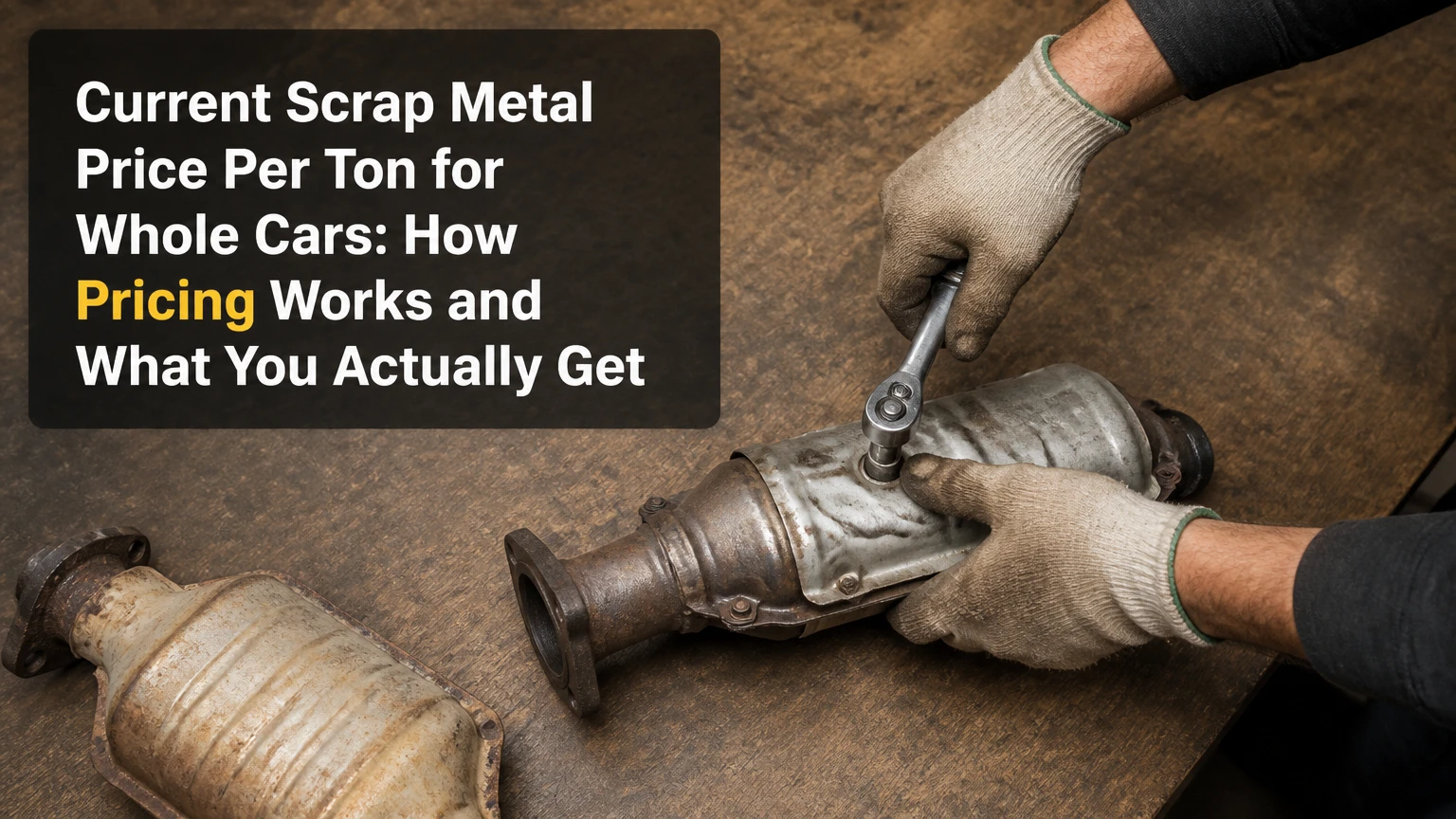
A catalytic converter that weighs 8 pounds has a precious metal value of $100 to $600. Eight pounds of shredder scrap steel is worth approximately $0.32. The difference between those two numbers is why a junk buyer pays you $600 to $1,200 for a car that has only $150 in raw scrap weight value: they are buying $600 to $1,200 worth of recoverable components, not just $150 of steel.
As a practical consequence, the commodity scrap price per ton is a starting point for understanding the floor of a junk offer, not the total offer itself.
How the Scrap Price Floor Works
Vehicle Weight | Tons (Short) | Floor Offer at $80/ton | Floor Offer at $110/ton | Typical Full Junk Offer (Parts + Scrap) |
|---|---|---|---|---|
2,500 lbs (small car) | 1.25 tons | $100 | $138 | $400 to $900 |
3,200 lbs (midsize car) | 1.60 tons | $128 | $176 | $500 to $1,200 |
4,000 lbs (large car or crossover) | 2.00 tons | $160 | $220 | $600 to $1,500 |
5,000 lbs (half-ton truck or full SUV) | 2.50 tons | $200 | $275 | $800 to $1,800 |
6,500 lbs (HD truck) | 3.25 tons | $260 | $358 | $1,000 to $2,500 |
The floor offer (scrap weight component only) is what a buyer pays if the vehicle has essentially no recoverable parts value: fully stripped, burned, or so deteriorated that nothing can be resold. The typical full offer reflects the parts plus scrap value for a reasonably complete vehicle.
How to Find the Current Scrap Price in Your Area
Scrap prices vary by region, yard, and week. The most reliable way to get a current local price is:
iScrap App (iscrapapp.com): Reports current prices from yards across the United States. Search for your zip code and look for the “whole car” or “auto shredder” price, which is what yards pay per ton for complete vehicles. This gives you the commodity context for evaluating junk buyer offers.
Call three local scrap yards directly and ask their current price per ton for whole cars. This is the ground truth for your specific market on the day you are selling.
ScrapMonster.com and Scrap Price Bulletin report national and regional commodity prices and can help you identify whether your region is at a premium or discount to the national average.
Regional Price Variation
Scrap metal prices are not uniform across the United States. Proximity to steel mills and ports (Midwest, Northeast, and Gulf Coast) generally correlates with higher scrap prices because transportation costs to the end consumer are lower. Markets far from steel mills and ports may pay $20 to $50 per ton less than coastal or industrial-belt markets. This regional variation is part of why the same car can bring meaningfully different offers in different cities.
When the Scrap Price Floor Matters Most
For most vehicles in reasonable condition, parts value dominates the offer and scrap price fluctuations matter less. The scrap price floor matters most for: heavily damaged or burned vehicles where no parts are recoverable, stripped vehicles where the major components have been removed, very old vehicles where parts have no market demand, or very small and light vehicles where the weight contribution is minimal. In these cases, the scrap commodity price directly determines the floor of what any buyer can sustainably offer.
Frequently Asked Questions
Should I wait for scrap prices to go up before selling my junk car?
For most sellers, no. The scrap price component is a relatively small part of a complete vehicle’s junk offer. A $30 per ton increase in scrap prices translates to $45 to $90 more for an average car. If the car is deteriorating while you wait (catalytic converter theft risk, title issues, storage costs), the waiting cost likely exceeds the potential price gain. Sell when you are ready rather than timing the commodity market.
Why does one junk buyer offer $800 and another offer $1,200 for the same car?
Both buyers are paying the same commodity scrap price. The difference comes from their assessment of parts value from your specific vehicle. A buyer with current demand for your vehicle’s transmission, engine, or body panels offers more. A buyer without that specific demand offers closer to the scrap floor. This is exactly why getting multiple quotes matters: you are finding the buyer for whom your car has the highest value.
Is the scrap price the same for cars, trucks, and vans?
The per-ton scrap price is the same regardless of vehicle type: steel is steel. The difference in total offers between vehicle types comes entirely from the weight difference and parts value difference. A heavy-duty truck that weighs 6,500 pounds has more scrap tons than a 3,000-pound compact car, and its components command higher individual parts prices in the used market.
The Bottom Line
The commodity scrap metal price per ton is the foundation under every junk car offer but is not the offer itself. Most complete vehicles are worth two to five times their raw scrap weight value because of recoverable parts. The owner’s share of the commodity price is $40 to $130 per ton after the buyer’s costs are covered. Use iScrap App or direct yard calls to find your current local price, use the weight and scrap floor table to understand the baseline, and recognize that a buyer offering well above the floor is appropriately capturing the parts value in your specific vehicle.