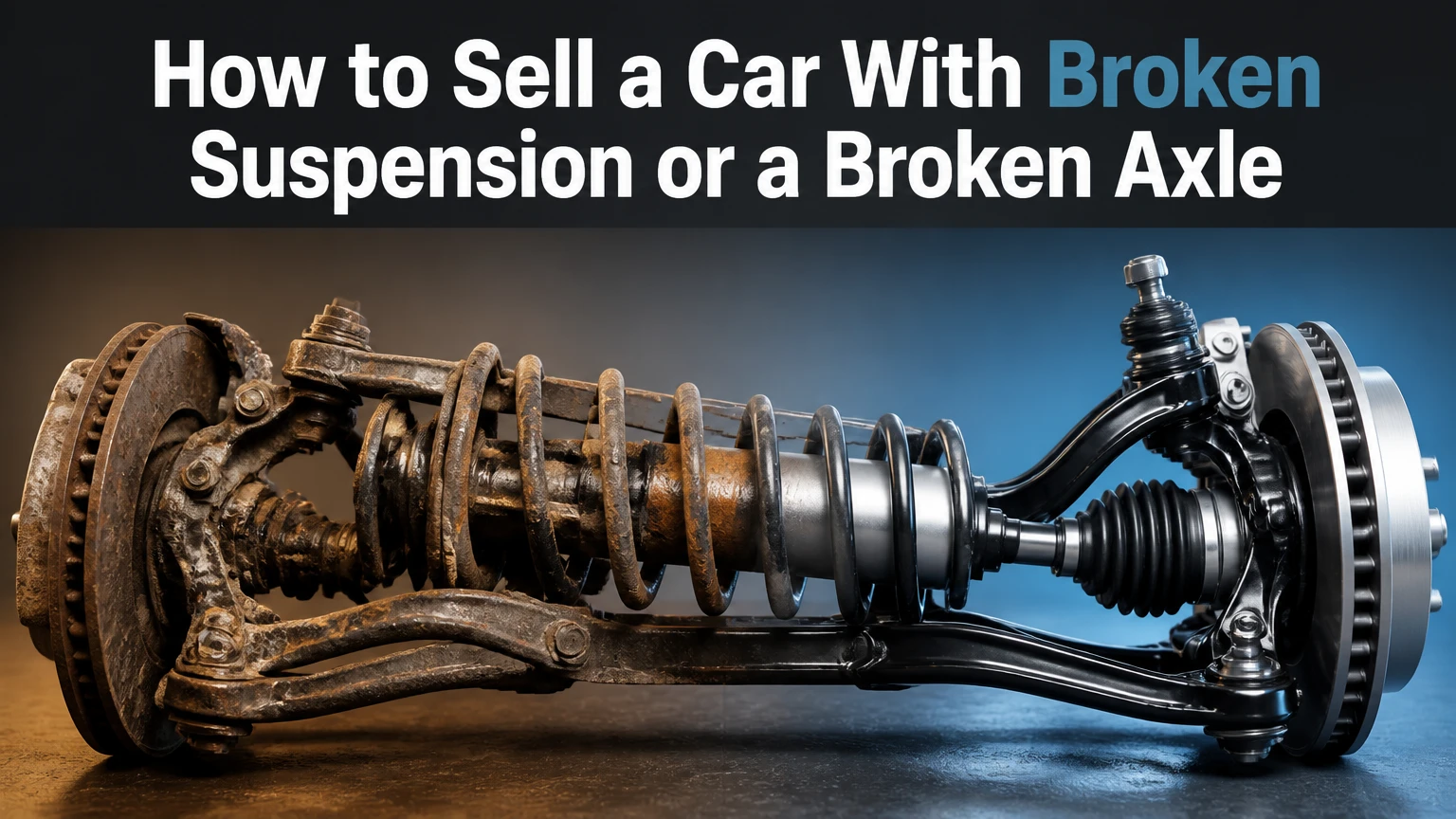
You can sell a car with a broken suspension component or broken axle to any junk buyer or salvage yard, and the repair cost versus sale price math often favors fixing certain failures first because some axle and suspension repairs are inexpensive enough that a repaired, driveable car sells for several times more than a non-driveable junk price.
Whether to repair before selling depends entirely on which component broke and what the vehicle is worth running.
What Broke Matters More Than That It Broke
Broken suspension and axle failures cover a wide range of severity and repair cost. A snapped CV axle shaft costs $150 to $400 to replace and takes two to three hours. A broken ball joint costs $200 to $500. A collapsed strut costs $250 to $600. A broken control arm costs $200 to $700. None of these are the $3,000 engine repairs that make selling as-is an obvious choice.
Understanding exactly which component failed is the first step because it determines repair cost, sale options, and the repair-versus-sell math that follows.
Types of Failures and What They Mean
Broken CV Axle or Half Shaft
A CV (constant velocity) axle is the shaft that transmits power from the transmission or differential to the wheel. When it breaks, the wheel receives no power and the vehicle cannot move under its own power on the affected axle. On a front-wheel-drive vehicle, one broken front axle means the car cannot drive. On an all-wheel-drive vehicle, it may limp in a degraded mode.
This is one of the cheapest major repairs on any vehicle. Aftermarket replacement axles for most common vehicles cost $60 to $150 in parts. Labor runs $100 to $250. Total repair: $160 to $400 at an independent shop. If your car is worth $3,000 or more running, a $300 repair to convert it from a junk sale to a private sale is almost always the right call.
Broken Ball Joint
A ball joint connects the control arm to the steering knuckle and allows the wheel to pivot for steering and absorb suspension travel. A failed ball joint causes the wheel to collapse outward or inward, making the vehicle undriveable and dangerous. In a complete ball joint failure, the wheel can separate from the vehicle.
Ball joint replacement costs $200 to $500 per corner including parts and labor. On most vehicles, both ball joints on the same axle are replaced simultaneously. A broken ball joint with an otherwise sound vehicle warrants the same repair-versus-sell analysis as a CV axle: if the car is worth more than $2,000 running, the repair likely pays for itself.
Broken or Collapsed Strut
A strut is a combined shock absorber and structural suspension component. When the strut body fractures or the mount separates, the suspension collapses. The wheel tucks under the car or sits at an extreme angle. Strut replacement costs $250 to $600 per corner for most vehicles, with complete strut assemblies available as direct bolt-on units for common platforms.
Broken Control Arm
A control arm fracture (the arm itself, not just the bushing) is less common than the above failures and typically results from a significant impact. Replacement costs $200 to $700 depending on the vehicle and whether the arm is a common part with aftermarket availability.
Bent or Broken Steering Knuckle
A broken steering knuckle, typically from a severe impact, requires replacement of the knuckle itself. This is a more labor-intensive repair ($400 to $1,200) because the entire corner of the suspension must be disassembled. Used knuckles from salvage yards are often available for $50 to $150 for common vehicles, reducing the total repair cost significantly.
Repair vs. Sell As-Is: The Decision Table
Failure Type | Repair Cost Range | Break-Even Vehicle Value | Recommendation |
|---|---|---|---|
Broken CV axle (FWD or AWD) | $160 to $400 | $1,500 running value | Repair first if car is worth over $2,000 |
Broken ball joint | $250 to $550 | $2,000 running value | Repair first if car is worth over $2,500 |
Collapsed strut | $300 to $700 | $2,500 running value | Repair first if car is worth over $3,000 |
Broken control arm | $250 to $800 | $2,500 running value | Repair first if car is worth over $3,000 |
Broken steering knuckle | $400 to $1,200 | $3,500 running value | Case by case: get a repair quote first |
Multiple components broken (accident) | $1,500 to $4,000+ | Rarely justified | Sell as-is in most cases |
The break-even vehicle value column represents approximately the minimum running value at which the repair investment is recovered in sale price improvement. These are conservative estimates: a repaired car that moves from junk buyer pricing to private buyer pricing typically sees a $1,500 to $3,000 improvement, making even a $600 repair worthwhile on a $4,000 vehicle.
Who Buys Cars With Broken Suspension or Axle
Junk Car Buyers
Junk buyers purchase non-driveable suspension and axle failure vehicles routinely. The offer reflects the non-running condition but all other components (engine, transmission, body, interior, catalytic converter) retain their full parts value. A non-driveable car from a suspension failure gets a significantly better junk offer than a car with a blown engine because the mechanical drivetrain is typically intact and recoverable.
Salvage Yards
Salvage yards are particularly interested in suspension and axle failure vehicles because the parts they recover (engine, transmission, wheels, electronics) are all undamaged. The axle or suspension part that failed is a common, inexpensive replacement item for the yard anyway. Offers from salvage yards are similar to junk buyers for these vehicles.
Private Buyers and DIY Mechanics
A knowledgeable private buyer will purchase a suspension-failure car at a significant discount and repair it themselves for a fraction of shop labor rates. Listing the vehicle accurately on Craigslist or Facebook Marketplace with the specific failure identified attracts mechanics, car flippers, and experienced DIYers who see the opportunity. This buyer pays 40 to 70 percent of running vehicle value rather than 25 to 40 percent from a junk buyer.
What to Do Before Calling Any Buyer
Get an exact diagnosis of what broke. If you know the car collapsed after hitting a pothole, get under it (safely, on level ground) or have a mechanic put it on a lift and identify the specific failed component. Knowing whether you have a broken CV axle ($300 repair) or a broken steering knuckle plus bent control arm ($1,200 repair) completely changes your decision.
Confirm that all other mechanical components are undamaged. A suspension failure from a pothole impact typically causes no damage to the engine or transmission. Confirming this fact to buyers improves the offer because buyers know they are recovering a complete, undamaged drivetrain.
Photograph the failed component clearly. Buyers making remote offers on suspension failures want to see the damage. A clear photo of the broken ball joint or collapsed strut gives the buyer confidence in your description and supports an accurate quote.
The Accident Damage Question
Some broken suspension and axle failures result from collision damage rather than normal wear failure. A car that was in an accident and has a bent subframe, broken control arms, and damaged body panels in addition to the axle failure is in a different category from a car with a single suspension component failure. Collision-damaged vehicles with multiple affected systems have lower offer values because parts recovery is complicated by the damage pattern and some components may be unsalvageable.
Be transparent about whether the failure was from an accident or a component failure. Misrepresenting collision damage as a simple mechanical failure is a serious problem at pickup when the buyer arrives and discovers structural damage not reflected in the offer.
Frequently Asked Questions
Can a car with a broken axle be towed safely?
A car with a broken CV axle can be flat-towed (all four wheels on the ground) only if the broken axle is from a rear wheel on a rear-wheel-drive vehicle and the transfer case can be put in neutral. Most junk buyers use flatbed trucks that lift the vehicle completely, which is the safest method for any suspension or axle failure. Confirm with the tow driver that a flatbed is coming rather than a hook and chain or dolly tow.
Does a broken CV axle damage the transmission?
A broken outer CV axle shaft typically does not damage the transmission because the inner joint usually remains in the differential or transmission. However, if the inner CV joint separates completely and the stub shaft withdraws from the differential housing, transmission fluid can leak from the opening. Have the buyer confirm at pickup that the inner joint is still in place to avoid a transmission fluid loss situation during transport.
Is a broken ball joint covered by insurance?
A ball joint failure from normal wear is not covered by most auto insurance policies, which cover collision and comprehensive events rather than mechanical failure. If the ball joint broke as a result of a collision, the collision damage claim may cover the repair as part of the overall damage. Check with your insurer if an accident was involved.
How much less will a junk buyer offer for a non-driveable suspension failure vs. a running car?
Typically 25 to 45 percent less than the same car running and driveable. The reduction reflects the non-driveable condition, the towing cost the buyer absorbs, and a margin for uncertainty about undisclosed damage. A running car with a minor suspension rattle might bring $3,000 from a junk buyer; the same car with a broken CV axle might bring $1,800 to $2,200. The repair cost of $300 to $400 to fix the axle recovers more than the discount in most cases.
The Bottom Line
A broken suspension component or axle is often the most repairable non-running condition in the junk car market. Before accepting a junk buyer offer, spend $80 to $150 getting a precise diagnosis of what broke. If the repair cost is under $600 and the vehicle is worth $3,000 or more running, fixing it first and selling to a private buyer is almost always the better financial outcome.
For vehicles where multiple components are broken, repair costs exceed $1,000, or the car has other significant issues in addition to the suspension failure, junk buyer pricing is the right path. Get three quotes, be specific about which component failed and confirm the engine and transmission are undamaged, and take the best offer.