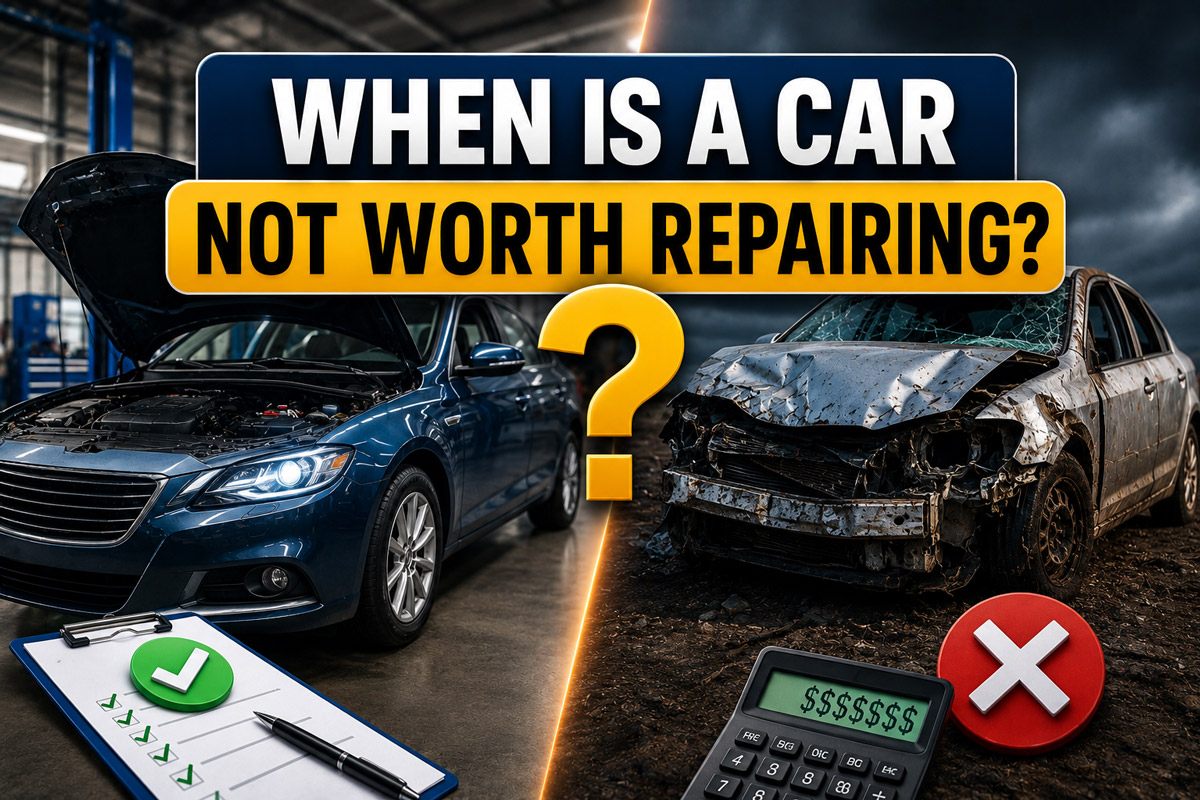
Standing in front of a mechanic with a quote that costs more than your monthly mortgage payment is an overwhelming experience. You are left asking the ultimate question: when is a car not worth repairing?
Every vehicle eventually reaches a tipping point where pouring more money into keeping it running turns into a financial sinkhole. Sunk cost fallacy often convinces drivers to sink another $2,000 into a $1,500 car simply because they just replaced the tires six months ago. However, emotion should never dictate automotive financial decisions.
Knowing whether to fix your vehicle, buy a replacement, or junk your car comes down to evaluating cold financial math, structural safety thresholds, and daily reliability requirements.
The Financial Rules: Weighing Repair Cost vs Car Value
To determine if your vehicle has reached the end of its financial life, you must remove emotional attachment and apply objective benchmarks. Mechanics and insurance adjusters use specific financial ratios when evaluating repair cost vs car value.
1. The 50% to 70% Rule
Industry standard practices dictate that if a single repair estimate equals or exceeds 50% to 70% of the vehicle’s Actual Cash Value (ACV), the car is practically a total financial loss.
To calculate your car’s ACV, look up its current market value on trusted pricing guides like Kelley Blue Book (KBB) or Edmunds in its current pre-damaged state. If your vehicle is worth $3,000 on the open market and your mechanic hands you a $2,200 estimate for a head gasket repair, you are spending 73% of the vehicle’s total worth on a single fix. Even after the fix, the car remains a $3,000 vehicle.
2. The 12-Month Payment Rule
If you do not face a single catastrophic bill but instead suffer a continuous sequence of $400 to $800 repairs, evaluate your annual cumulative repair spend.
Multiply the typical monthly payment of a reliable replacement vehicle (for instance, $350 to $450 per month) by 12 months. That gives you an annual benchmark of $4,200 to $5,400. If keeping your old car on the road required $5,000 in mechanics’ bills over the past year, you are essentially paying modern car loan prices for an unreliable vehicle without enjoying any of the benefits of a newer, covered model.
3. The High-Cost Component Threshold
Certain major component failures almost always tip older cars past the point of return:
- Engine Replacement or Rebuild: $3,500 to $7,500
- Transmission Replacement: $2,500 to $5,000
- Head Gasket Repair: $1,800 to $3,200
- Complete ABS/Brake System Overhaul: $1,200 to $2,500
When these major failures occur on vehicles valued under $5,000, the repair cost almost never yields a positive return on investment.
Structural and Safety Deal-Breakers
While financial math gives clear guidance, safety represents an absolute non-negotiable line. Some mechanical and structural failures compromise the integrity of the vehicle to a point where no amount of money can truly make it safe again.
-
1
Deep Frame Rot & Subframe CorrosionStructural metal flaking off; crash safety zeroed.
-
2
Airbag System DeploymentSensors, modules, & bags cost $2,000 – $4,000+.
-
3
Cascading Electrical or Flood DamageEndless diagnostic labor and intermittent failures.
Deep Structural Rust and Frame Rot
Surface rust on quarter panels or doors is cosmetic, but deep structural rot on the vehicle frame, subframe, or strut towers is fatal. Once rust eats through load-bearing steel components, the vehicle loses its structural rigidity. In a collision, a rusted frame cannot absorb impact forces properly, putting passengers at severe risk. Weld repairs on heavily rusted frames are often illegal or uninsurable.
Airbag Deployment
If your vehicle was involved in a moderate collision where the airbags deployed, the cost to restore the restraint system alone can reach several thousand dollars. Replacing the airbag modules, crash sensors, clock springs, dashboard housing, and tensioner seatbelts easily overwhelms the value of older models.
Cascading Electrical and Flood Damage
Modern automobiles rely on dozens of interconnected electronic control units (ECUs) and miles of wiring harnesses. If a car suffers water damage from flooding or develops severe harness degradation, phantom electrical problems will haunt the vehicle indefinitely. Mechanics spend hours at high labor rates simply diagnosing intermittent electrical faults, turning the vehicle into an open-ended money pit.
Is It Worth Fixing a 15 Year Old Car?
One of the most frequent questions drivers ask is: is it worth fixing a 15 year old car?
At 15 years old, most mainstream passenger cars have accumulated between 150,000 and 220,000 miles. Their market value typically hovers between $1,500 and $3,500 depending on condition.
Evaluating a 15-year-old vehicle requires looking at its overall mechanical health rather than just the single broken component:
| Evaluation Factor | Worth Fixing | Not Worth Fixing (Junk / Replace) |
|---|---|---|
| Current Market Value | $3,500 or higher | Under $2,000 |
| Engine / Transmission | Runs smoothly, no strange noises | Slipping gears, knocking, low compression |
| Rust / Body Condition | Clean frame, light surface rust | Rot on subframe, rocker panels, or floorboards |
| Repair Nature | Wear-and-tear (brakes, tires, alternator) | Internal engine failure, transmission overhaul |
| Recent Repair History | First major repair in over 12 months | Third major breakdown this year |
If a 15-year-old vehicle is completely paid off, rust-free, and requires a simple $600 repair like an alternator or water pump replacement, fixing it makes logical sense. That $600 represents less than two months of new car payments. However, if that same 15-year-old car needs a $3,000 transmission replacement and exhibits severe rust, the money is far better applied toward a down payment on a reliable replacement.
A Practical “Car Repair or Replace Calculator” Framework
When making your final determination, run your numbers through this practical mental calculator.
To execute this car repair or replace calculator logic effectively:
- Find Current ACV: Check local listings or KBB for your car in its pre-breakdown state.
- Calculate Total Immediate Fixes: Add up every item flagged by your mechanic during the inspection, including deferred maintenance items like worn tires or thin brake pads.
- Estimate 12-Month Projection: Add an estimated $500 to $1,000 for unexpected wear-and-tear items likely to fail given the vehicle’s age and mileage.
- Compare Totals:
- If your Total Repair Projection exceeds 60% of ACV, or exceeds 12 months of prospective new car loan payments, replace or junk the car.
- If your Total Repair Projection is under 40% of ACV and the frame is solid, repair the car.
When Repairing Still Makes Financial Sense
It is easy to panic when hit with a large repair bill, but keeping your current vehicle is often the smartest financial move under the right circumstances:
- The Car Is Fully Paid Off: Eliminating a monthly auto loan payment saves you thousands per year. Spending $1,000 once a year on maintenance is significantly cheaper than paying $450 every single month plus higher comprehensive insurance rates.
- It Is an Isolated Maintenance Item: Parts like brake rotors, struts, water pumps, batteries, and timing belts wear out on every vehicle. Replacing a worn wear-and-tear component does not mean your car is unreliable; it simply means it is due for scheduled service.
- The Underlying Drivetrain Is Solid: If your engine burns no oil, the transmission shifts crisp and clean, and the vehicle has under 150,000 miles, investing in minor or mid-level repairs preserves a capable mode of transportation.
What to Do When It Is Time to Repair or Junk an Old Car
Once you determine your car is no longer worth fixing, you must decide how to exit the vehicle cleanly. You have three primary pathways when choosing whether to repair or junk an old car:
EXIT STRATEGY MATRIX
| Option | Best Used When… | Primary Benefit |
|---|---|---|
| Private Sale | Car runs, minor fixes | Highest possible payout |
| Dealership Trade | Buying new from dealer | Fast, effortless process |
| Junk Car Removal Service | Major mechanical/frame failure, non-running | Immediate cash, free towing & zero hassle |
- Private Sale (As-Is): If the car still runs and has minor cosmetic or mechanical flaws, selling it privately as a handyman special yields the highest financial return. Be fully transparent about known defects.
- Dealership Trade-In: Dealerships will accept non-running or damaged vehicles, but they heavily discount trade-in values to cover their wholesale auction risks.
- Junk Car Buyer or Scrap Yard: When a car suffers catastrophic engine failure, severe structural rust, or total loss status, professional auto recyclers and junk car buyers provide the best option. They purchase vehicles based on scrap metal weight and salvageable parts, offering instant cash pickup and free towing without requiring you to pay for repairs.
Frequently Asked Questions
Is a $2,000 repair worth it on a car worth $3,000?
Generally no. Spending $2,000 on a $3,000 car represents 66% of its total value. Unless that $2,000 repair guarantees the vehicle will run flawlessly for another two to three years without additional issues, that money is better spent as a down payment on a more reliable vehicle.
What is the average lifespan of a modern car?
The average age of cars on American roads is approximately 12.5 years, with most modern vehicles capable of reaching 200,000 miles or more with disciplined maintenance. Beyond 15 years or 200,000 miles, rubber seals, electrical wiring, and suspension components deteriorate rapidly regardless of brand.
How do I know if my engine is totally blown?
Key indicators of a severe engine failure include heavy knocking sounds from the lower block (rod knock), thick white smoke pouring from the exhaust (head gasket or block failure), metal shavings in the oil pan, or complete hydraulic lockup.
Still Unsure What to Do With Your Vehicle?
Making the final call on an old car can be tricky. If you are stuck staring at a repair quote and cannot decide your next step, evaluate your vehicle’s specific details:
- Year, Make, and Model:
- Quoted Repair Cost:
- Current Mileage and Main Symptoms:
By weighing your vehicle’s exact market value against its required repairs and structural condition, you can confidently choose the path that protects your safety and your wallet.