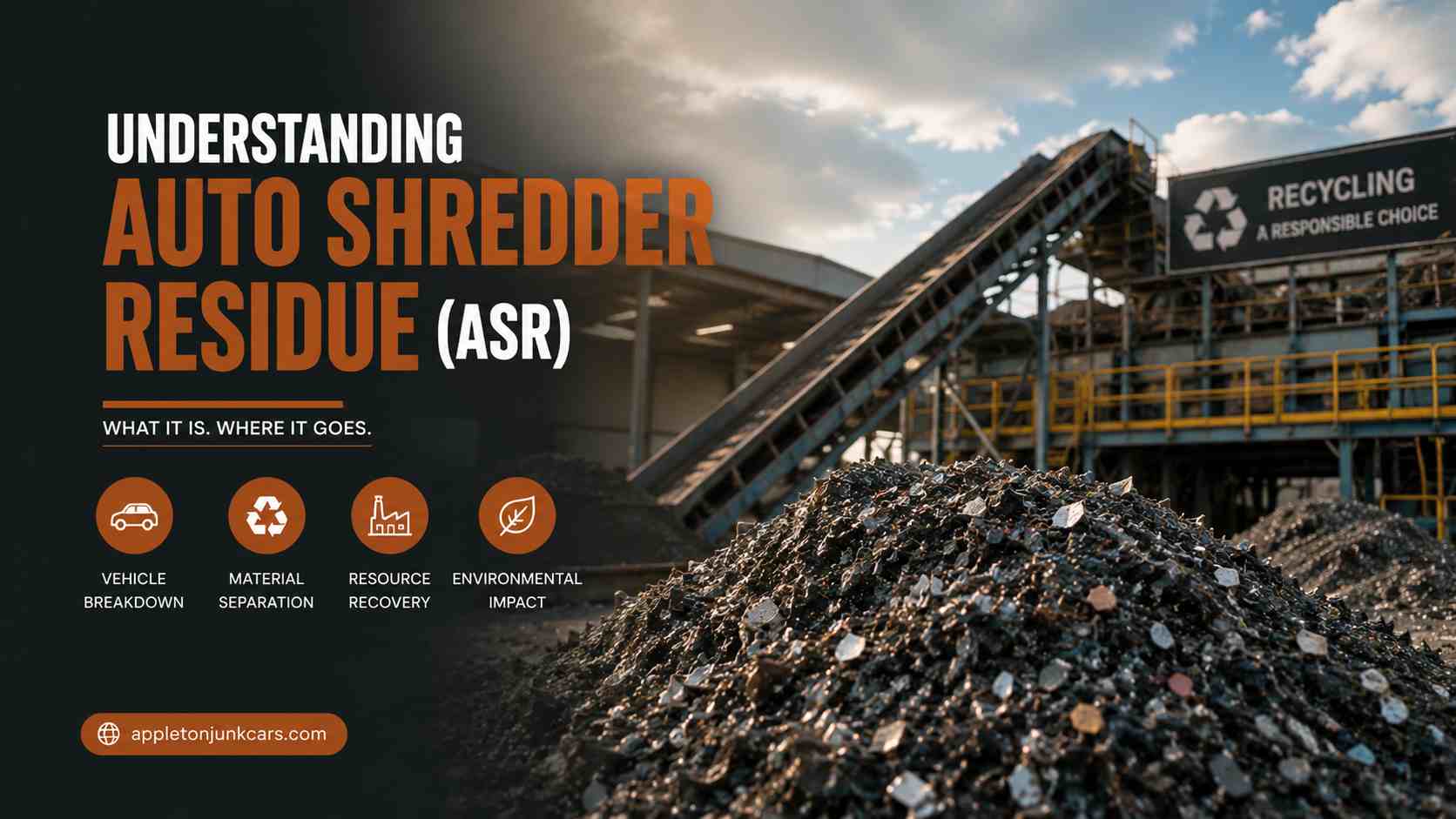
After a depolluted vehicle has been shredded and its ferrous and non-ferrous metals separated, approximately 20 to 25 percent of the original vehicle weight remains as a heterogeneous mixed material called auto shredder residue (ASR). Also referred to as automotive shredder fluff, shredder light fraction, or fluff, ASR is the primary unresolved environmental challenge in end-of-life vehicle processing.
It is the reason that even modern, fully certified auto recycling cannot claim to recover 100 percent of a vehicle’s material, and it is the focus of significant research investment and regulatory pressure in Europe and, increasingly, in the United States.
Auto shredder residue is generated in enormous volumes. The United States processes approximately 12 to 14 million end-of-life vehicles annually. With each vehicle generating 300 to 450 pounds of ASR after metal recovery, the annual US ASR stream is estimated at 4 to 5 million tons per year. At present, the majority of this material is landfilled, making it one of the largest single streams of material going to landfill in the industrial sector. Understanding what ASR is, why it is difficult to recycle, and what the industry is doing about it is essential context for anyone who wants to understand the real environmental footprint of vehicle disposal.
This guide explains the composition of ASR at the material level, why its hazardous constituents complicate disposal, every current and emerging management pathway, the regulatory gap between Europe and the United States, and what the future of ASR management looks like.
What Auto Shredder Residue Actually Is
Auto shredder residue is defined as the non-metallic fraction that remains after an automobile hull is processed through an industrial auto shredder and the ferrous and non-ferrous metals are separated by magnetic and eddy current systems. The name “fluff” reflects the material’s low density: ASR is predominantly composed of light materials including foams, fabrics, and plastics that exit the shredder as a voluminous, irregular mass.
ASR is not a single material. It is a complex mixture of dozens of different polymers, foams, fibers, glass fragments, residual metals, and contaminants that vary significantly based on the age of vehicles being processed, the completeness of pre-shredding depollution, and the efficiency of the metal separation equipment used. A shredder operation processing primarily older vehicles generates ASR with a different composition than one processing newer vehicles, because vehicle material content has changed substantially over decades as manufacturers increased plastic and foam content and reduced steel content.
The Composition of ASR: Material by Material
Material Category | Approximate Percentage of ASR | Source in Vehicle | Recyclability |
|---|---|---|---|
Polyurethane foam (seats, headliner, padding) | 20 to 30 percent | Seat cushions, headliner, door inserts | Difficult; thermoset polymer; primarily energy recovery or rebonding |
Thermoplastic polymers (PP, PE, ABS, PVC) | 15 to 25 percent | Bumpers, trim, dashboards, wiring insulation | Theoretically recyclable but heavily contaminated; separation required |
Rubber (tires partially processed, seals, hoses) | 8 to 15 percent | Tire remnants, door seals, hoses, belts | Limited; crumb rubber from this fraction is lower quality |
Glass (shattered windshield, window glass) | 10 to 15 percent | Windshields, side and rear windows | Very limited; mixed with contaminants; not suitable for glass recycling |
Textile and fiber (carpet, seat fabric, headliner backing) | 8 to 12 percent | Carpeting, seat upholstery, insulation batting | Very limited; mixed fiber types prevent standard textile recycling |
Residual metals (below separation threshold) | 3 to 8 percent | Wire fragments, small brackets, fasteners | Recoverable with more sophisticated separation; partially recovered |
Soil, debris, and moisture | 5 to 10 percent | Road contamination, prior vehicle use accumulation | Not recyclable; contributes to landfill bulk |
Hazardous constituents (distributed throughout) | Trace | Lead wheel weights, PCBs in older wiring, brominated flame retardants | Must be managed; affect landfill classification in some jurisdictions |
The hazardous constituent fraction deserves specific attention because it affects how ASR is classified and managed under environmental regulations. Lead from wheel weights and battery remnants, cadmium from older pigments, polychlorinated biphenyls (PCBs) from pre-1980 wiring insulation and capacitors, and brominated flame retardants from plastics and textiles are all present in ASR to varying degrees depending on the age of vehicles processed. These constituents are distributed throughout the ASR mass rather than concentrated in identifiable components, making selective removal impractical with current technology.
Why ASR Is Classified as Hazardous Waste in Some Jurisdictions
The hazardous waste classification of ASR varies significantly by jurisdiction and depends on which regulatory test the material is subjected to. Under the EPA’s RCRA hazardous waste framework in the United States, ASR is not universally classified as hazardous waste, though it contains substances that would be hazardous if managed separately. ASR typically fails the Toxicity Characteristic Leaching Procedure (TCLP) for lead and occasionally for other metals, which would classify it as hazardous under RCRA. However, a mixture rule and other regulatory provisions sometimes affect how ASR is classified in practice.
In Germany, ASR is classified as a hazardous waste under EU waste regulations and must be managed accordingly, with higher costs and more restrictive disposal requirements. France, the Netherlands, and several other EU member states have similar classifications. The EU’s End-of-Life Vehicles Directive sets a minimum material reuse and recovery target of 95 percent by weight for end-of-life vehicles by 2015, with at least 85 percent through material reuse and recycling. This target cannot be met without addressing ASR, which is why European auto recyclers have invested significantly more in ASR processing technology than their US counterparts.
In the United States, the absence of a federal equivalent to the EU ELV Directive means there is less regulatory pressure to develop ASR recycling alternatives to landfill. ASR disposal costs at US landfills, typically $30 to $70 per ton, are lower than in Europe, which reduces the economic incentive for the advanced processing that would reduce landfill dependency. Several states have implemented stricter rules, but no comprehensive federal framework exists.
Current Management: Where ASR Goes Today
Management Method | Percentage of US ASR (Approximate) | Cost per Ton | Environmental Outcome |
|---|---|---|---|
Landfill disposal | 70 to 80 percent | $30 to $70 | Volume reduction only; leachate risk from hazardous constituents; long-term monitoring required |
Thermal treatment (incineration or cement kiln co-processing) | 5 to 15 percent | $60 to $150 | Energy recovery; significant volume reduction (70 to 90 percent); residual ash requires disposal |
Physical separation and upgrading (density separation, optical sorting) | 5 to 10 percent | $80 to $200 | Recovers plastic, glass, and metal fractions for recycling; residuals still require disposal |
Gasification and pyrolysis | Under 5 percent | $100 to $250 | Converts organic fraction to syngas or oil; steel and inorganic ash recovered; commercial scale limited |
The dominance of landfill disposal reflects both the economic reality of US landfill pricing and the technical complexity of processing a material as heterogeneous as ASR. Unlike clean industrial waste streams that consist of a single material type, ASR requires multi-step separation to recover any individual material at useful purity, and even after advanced separation, residuals requiring landfill remain.
Advanced Thermal Treatment: Gasification and Pyrolysis of ASR
Gasification and pyrolysis are thermal processes that decompose the organic fraction of ASR at high temperatures in the absence of oxygen or with limited oxygen. Both processes convert the carbon-containing plastics, rubber, foam, and fiber in ASR into useful energy products while concentrating the inorganic fraction (glass, metals, mineral ash) into a much smaller residue volume.
Gasification
Gasification converts ASR organic content into synthesis gas (syngas), a mixture of carbon monoxide, hydrogen, and methane that can be used as fuel in power generation or as feedstock for chemical synthesis. The inorganic residue from gasification is a vitrified slag that is significantly more stable than raw ASR and may be suitable for use as a construction aggregate in some applications. Commercial ASR gasification facilities operate in Japan and several European countries. The technology has not achieved wide commercial deployment in the United States, primarily because of the relatively low cost of landfill alternatives.
Pyrolysis
Pyrolysis of ASR produces oil, gas, and a carbon-rich solid residue similar to the outputs from tire pyrolysis. The plastic and rubber fractions in ASR respond well to pyrolysis, but the glass, fiber, and mineral content dilutes the organic fraction and increases the residue that must be managed after pyrolysis. Pre-processing ASR through density or optical separation to concentrate the plastic fraction before pyrolysis significantly improves the economics and product quality of the pyrolysis step.
Physical and Chemical Separation Approaches
Several companies in Europe and North America have developed physical separation systems designed to recover recyclable material fractions from ASR before or instead of thermal treatment. These systems use combinations of trommel screening, density separation (float-sink in liquids of specific gravity), air classification, optical sorting, and eddy current separation to separate ASR into distinct fractions.
MBA Polymers, a California-based company operating facilities in the UK, Austria, and China, has developed a physical separation process that recovers engineering-grade plastic from ASR at qualities sufficient for use in new automotive and consumer product applications. Their technology has demonstrated recovery of 10 to 15 percent of ASR weight as recyclable plastic, with the remainder handled through alternative pathways. The process is commercially operational and represents one of the most advanced ASR upgrading systems currently in production.
Chemical recycling, which uses solvents or chemical reactions to break down plastics into their monomer components for repolymerization, is theoretically applicable to the plastic fraction of ASR but has not been deployed at commercial scale for this specific feedstock. The mixed nature of the plastic fraction in ASR (multiple polymer types contaminated with glass, metal, and organic material) is a significant barrier to chemical recycling processes designed for cleaner plastic streams.
European Regulation vs US Policy: The Gap That Drives the Difference
The contrast between European and US approaches to ASR management is stark and instructive. The EU End-of-Life Vehicles Directive, first enacted in 2000 and updated progressively, establishes binding recovery and recycling targets for member states. The 2015 target of 95 percent total recovery, with 85 percent through material recycling, cannot be achieved while routing 70 to 80 percent of ASR to landfill. This regulatory pressure has driven investment in ASR processing technology across Europe.
Under the directive, vehicle manufacturers bear financial responsibility for the take-back and recycling of their vehicles at end of life. This extended producer responsibility (EPR) framework means automakers have a direct financial incentive to design vehicles with recyclable materials and to fund the infrastructure for proper end-of-life management. German, French, and Dutch automakers have collectively invested in ASR processing research and commercial infrastructure as a direct result of this obligation.
The United States has no federal equivalent to the ELV Directive. Responsibility for end-of-life vehicle management falls primarily on the salvage and scrap industry rather than on vehicle manufacturers. The absence of EPR requirements for vehicles means automakers have no direct financial obligation for ASR management, and the economic incentive to develop alternatives to landfill disposal is limited to the landfill disposal cost itself.
What the Future of ASR Management Looks Like
Several trends are converging to increase pressure on ASR management in the United States and globally. Growing EV adoption means future vehicle fleets will contain substantially different material compositions: larger battery systems with specific recycling requirements, less steel, different polymer mixes, and different electronics content. EV shredding residue will have characteristics distinct from current ASR, with higher lithium-ion battery material content requiring specific handling.
Automakers are increasingly designing vehicles with recyclability as a design criterion, partly voluntarily and partly in anticipation of regulatory requirements. Reducing the number of polymer types used in interior components, avoiding thermoset materials where thermoplastics can substitute, and simplifying material connections that make disassembly difficult all reduce the complexity of the end-of-life material stream. These design changes will gradually improve the recyclability of future ASR fractions, though they will take decades to flow through the vehicle fleet.
Advanced recycling technology investment is increasing. Chemical recycling of mixed plastics, pyrolysis of polymer-rich industrial waste streams, and gasification of heterogeneous organic waste are all attracting significant capital investment as recycling mandates tighten globally. ASR is one of the feedstocks that these technologies are designed to address, and commercial deployment at scale would substantially reduce the fraction of ASR going to landfill.
Frequently Asked Questions
What is auto shredder residue (ASR)?
Auto shredder residue (ASR), also called automotive shredder fluff, is the non-metallic material that remains after a vehicle is shredded and its ferrous and non-ferrous metals are separated. It makes up approximately 20 to 25 percent of the original vehicle weight and consists primarily of foam, plastic, rubber, glass, fabric, and residual metals. ASR is the primary unresolved waste stream in auto recycling and is currently landfilled in the majority of US operations.
Why can’t auto shredder residue be recycled?
ASR is extremely difficult to recycle because it is a heterogeneous mixture of dozens of different materials including multiple polymer types, thermoset foam, glass, rubber, and fabric, all contaminated with each other and with trace hazardous materials. Standard recycling processes require a relatively clean, single-material feedstock. ASR requires multi-step physical or chemical separation to recover any individual material at useful purity, and even after advanced separation, residuals requiring landfill remain.
How much auto shredder residue is generated in the US each year?
The United States generates approximately 4 to 5 million tons of auto shredder residue annually, based on approximately 12 to 14 million end-of-life vehicles processed per year, each generating 300 to 450 pounds of ASR after metal recovery. This makes ASR one of the largest single streams of industrial material sent to landfill in the United States each year.
Is auto shredder residue classified as hazardous waste?
In the United States, ASR is not universally classified as hazardous waste under federal RCRA regulations, though it contains substances including lead, cadmium, and brominated flame retardants that would be hazardous if managed separately. In Germany and several other EU countries, ASR is classified as hazardous waste and subject to more restrictive disposal requirements. The classification depends on jurisdiction and which regulatory tests are applied.
What is being done to reduce auto shredder residue going to landfill?
Several approaches are being developed and deployed. Physical separation using density separators and optical sorters recovers plastic, metal, and glass fractions for recycling. Thermal processes including gasification and pyrolysis convert the organic fraction to energy and reduce landfill volume by 70 to 90 percent. Chemical recycling of the plastic fraction is in development. European regulations requiring vehicle manufacturers to fund end-of-life recovery have accelerated investment in ASR processing technology there, while the absence of equivalent US policy has slowed commercial deployment domestically.
What hazardous materials are found in auto shredder residue?
ASR contains trace concentrations of lead from wheel weights and battery remnants, cadmium from older plastic pigments, polychlorinated biphenyls (PCBs) from pre-1980 wiring insulation and capacitors, brominated flame retardants from interior plastics and textiles, and zinc from galvanized steel coatings. These materials are distributed throughout the ASR mass rather than concentrated in specific components, making selective removal impractical with current technology.
How does the EU End-of-Life Vehicles Directive address ASR?
The EU End-of-Life Vehicles Directive requires that at least 95 percent of a vehicle’s weight be recovered, with a minimum of 85 percent through material reuse and recycling. This target cannot be achieved while landfilling most ASR. The directive also applies extended producer responsibility to vehicle manufacturers, requiring them to fund end-of-life vehicle take-back and recycling. This financial obligation has driven automaker investment in ASR processing research and in designing vehicles with better end-of-life recyclability.
What is automotive shredder fluff?
Automotive shredder fluff is another name for auto shredder residue (ASR). The term “fluff” refers to the low-density, voluminous appearance of the material, which is composed primarily of foam, fabric, and plastic and exits the shredding process as a light, irregular mass. The terms ASR, shredder fluff, shredder light fraction, and automotive shredder residue are used interchangeably in the recycling industry.
The Bottom Line
Auto shredder residue is the gap between the auto recycling industry’s impressive metals recovery rates and the 100 percent material recovery that a truly circular vehicle economy would require. The 20 to 25 percent of vehicle weight that emerges as ASR after shredding and metal separation represents a mix of materials that no single recycling technology can efficiently handle, and the trace hazardous constituents distributed throughout it complicate disposal options.
The technology to do better exists in prototype and limited commercial form. Physical separation systems, gasification, and advanced pyrolysis can all reduce the fraction of ASR going to landfill, and MBA Polymers and similar companies have demonstrated commercial recovery of recyclable plastic from ASR streams. The limiting factor in the United States is economic incentive: without the regulatory pressure that the EU ELV Directive creates, landfill disposal at $30 to $70 per ton competes favorably against processing technologies that cost two to five times more.
The trajectory is toward improvement. Stricter state regulations, advancing recycling technology, EV transition bringing different material compositions, and the possibility of federal EPR legislation are all factors that will gradually shift the ASR management picture. The goal of recovering 95 percent of vehicle material, which Europe has set as a regulatory target, remains achievable with current and near-commercial technology, even if reaching it will require policy, investment, and design changes that are still in progress.