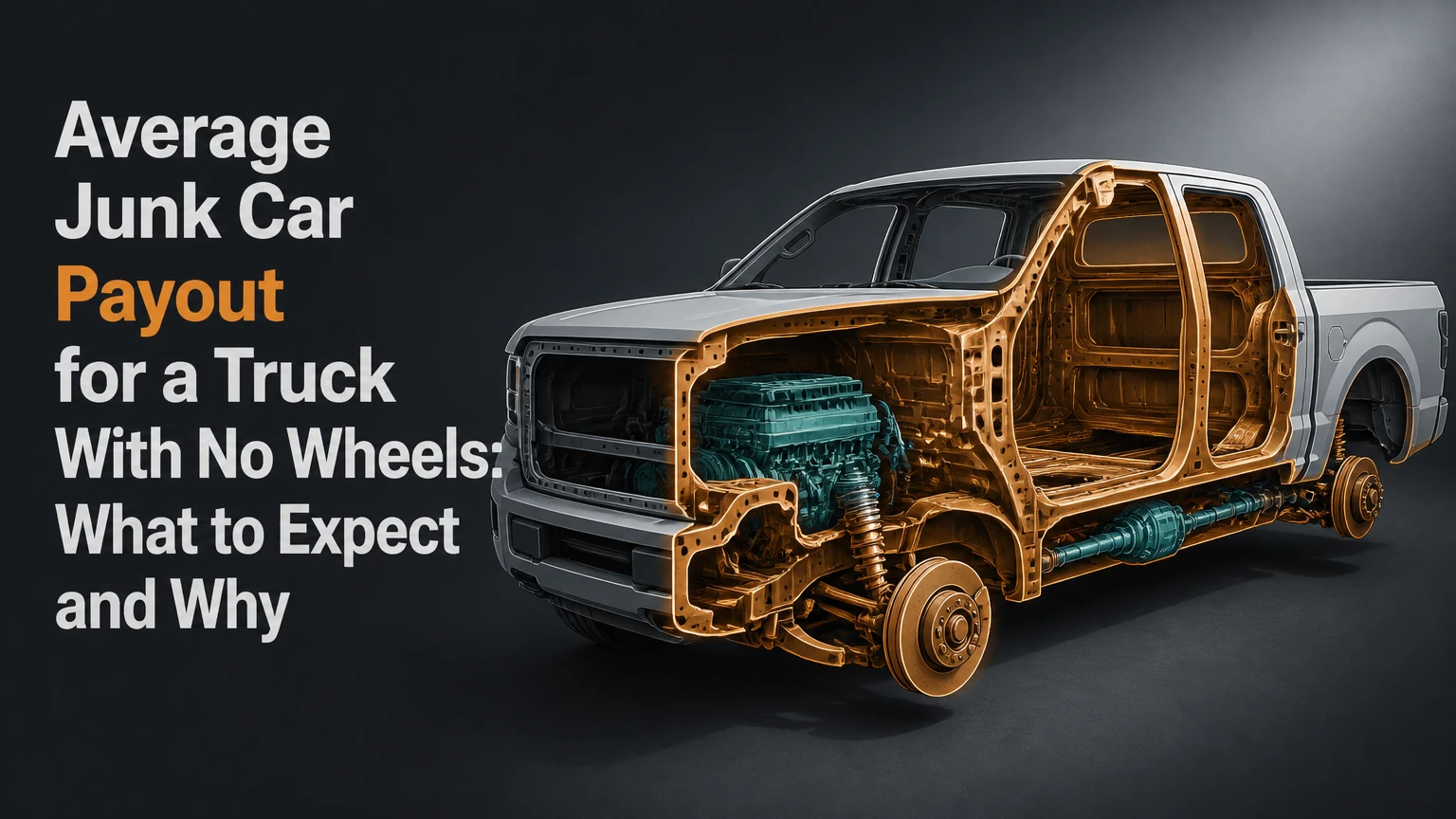
A truck with no wheels typically brings $500 to $1,600 from a junk buyer depending on the truck’s make, model, year, weight, and mechanical condition, which is $200 to $800 less than the same truck would bring with its wheels intact, because a complete set of truck wheels and tires represents genuine recoverable value that the buyer is no longer getting.
The heavier weight of trucks still works in your favor relative to cars, and all non-wheel components retain their full parts value.
What Missing Wheels Actually Cost You in the Offer
Truck wheels and tires are not cosmetic items to a junk buyer: they are recoverable inventory that sells. The deduction for missing wheels is not punitive but reflects the buyer’s actual loss of that asset. The exact deduction depends on what type of wheels were on the truck.
Wheel Type | Typical Used Resale Value Per Set | Offer Deduction When Missing |
|---|---|---|
Stock steel wheels (work truck spec) | $80 to $200 per set | $100 to $250 from offer |
Factory alloy wheels (standard) | $200 to $500 per set | $200 to $400 from offer |
Factory alloy wheels (large: 20-inch or above) | $400 to $900 per set | $350 to $600 from offer |
Aftermarket alloy or off-road wheels | $300 to $800 per set | $250 to $500 from offer |
Tires alone (if wheels present but tires missing) | $100 to $300 per set (used) | $100 to $200 from offer |
A no-wheels truck sitting on rotors or blocks also presents a logistics challenge: the buyer cannot roll the vehicle onto a flatbed in the normal way. Most buyers use a flatbed with a winch to drag the truck up or use dollies. This is their standard process for non-rolling vehicles and does not typically produce an additional deduction beyond the missing wheel value.
Offer Ranges for Trucks With No Wheels
Truck Type | Approx. Weight | Running (No Wheels) | Non-Running (No Wheels) |
|---|---|---|---|
Compact truck (Tacoma, Ranger, Colorado) | 3,500 to 4,500 lbs | $500 to $1,000 | $350 to $700 |
Half-ton pickup (F-150, Silverado 1500, RAM 1500) | 4,500 to 5,500 lbs | $700 to $1,400 | $500 to $1,000 |
Three-quarter ton (F-250, Silverado 2500, RAM 2500) | 5,500 to 6,800 lbs | $900 to $1,800 | $650 to $1,300 |
One-ton heavy duty (F-350, Silverado 3500, RAM 3500) | 6,500 to 8,000 lbs | $1,100 to $2,200 | $800 to $1,600 |
Full-size diesel pickup (any class, diesel engine) | 5,500 to 8,000 lbs | $1,200 to $2,500 | $900 to $1,800 |
Diesel engines carry a premium in the junk market because diesel components (injectors, turbochargers, fuel systems) command higher used prices than equivalent gasoline components. A no-wheels diesel truck consistently brings $200 to $500 more than a gasoline equivalent of the same weight.
Why Truck Weight Still Works in Your Favor
Even without wheels, trucks command higher junk offers than most cars because their curb weight is substantially greater. A half-ton F-150 weighs 4,500 to 5,500 pounds. A midsize sedan weighs 3,000 to 3,600 pounds. That additional weight means more scrap metal and often more heavy-component parts (larger catalytic converters, heavier axle assemblies, bigger alternators and AC compressors) that contribute to the recoverable value.
The catalytic converter on a full-size truck is worth $200 to $500 to a junk buyer, compared to $100 to $250 on a compact car. The rear axle assembly on a heavy-duty truck is worth $500 to $1,500 in the used market, far above any car axle. These factors give trucks a meaningful floor value even when stripped of their wheels.
What Else Affects the No-Wheels Offer
Whether the truck runs matters significantly. A no-wheels truck that starts and the engine sounds healthy gets a substantially higher offer than one that does not run and whose mechanical condition is unknown. Tell buyers whether the engine runs, whether the transmission engages, and what condition the interior and cab are in.
The presence or absence of the catalytic converter is the next biggest line item. Confirm it is still on the truck before calling buyers and mention it explicitly. If it has been cut off, disclose that upfront and expect a $200 to $500 reduction from any offer.
4WD or AWD adds value even on a no-wheels truck because the front axle, transfer case, and 4WD system components retain full parts value regardless of whether the wheels themselves are present.
How to Get the Best Offer for a No-Wheels Truck
Get quotes from at least three buyers. Truck offers vary significantly between buyers based on their downstream market for heavy truck parts. A buyer who specializes in truck dismantling or has immediate demand for your truck’s components will bid more aggressively than a general buyer.
Describe the truck completely: year, make, model, engine, transmission type, 4WD or 2WD, running or not, cab configuration (regular, extended, crew), and bed length. More specific information leads to more accurate quotes and fewer renegotiations at pickup.
Frequently Asked Questions
Will a junk buyer still pick up a truck with no wheels?
Yes. All junk buyers have flatbed trucks equipped to handle non-rolling vehicles. This is their standard equipment, not an exception. They use a winch or dollies to load the truck and the pickup proceeds normally. Free towing is standard regardless of whether wheels are present.
Should I try to sell the wheels separately before calling a junk buyer?
If you already have the wheels and they are in sellable condition (alloy wheels with decent tires), selling them privately can net $200 to $600 more than the deduction the junk buyer applies. List them on Craigslist or Facebook Marketplace before calling the junk buyer. If they sell quickly, you come out ahead. If they do not sell within a week, call the junk buyer with the wheels still available and let the buyer take them as part of the vehicle offer.
Does the truck need to be on a flat surface for pickup?
It helps but is not always required. A junk buyer’s flatbed can access vehicles in most positions. Call the buyer and describe the exact situation: whether the truck is on jack stands, blocks, the ground on its rotors, or in some other configuration. They will tell you whether their equipment can handle the pickup safely.
The Bottom Line
A truck with no wheels loses $200 to $800 from its potential offer compared to a truck with wheels, but the heavy weight and strong parts demand from the non-wheel components give it a meaningful floor value. Running trucks with no wheels on common platforms like the F-150, Silverado, or RAM 1500 consistently bring $700 to $1,400 from buyers who recover parts value. Get three quotes, describe the truck completely, and confirm the catalytic converter and engine condition upfront.