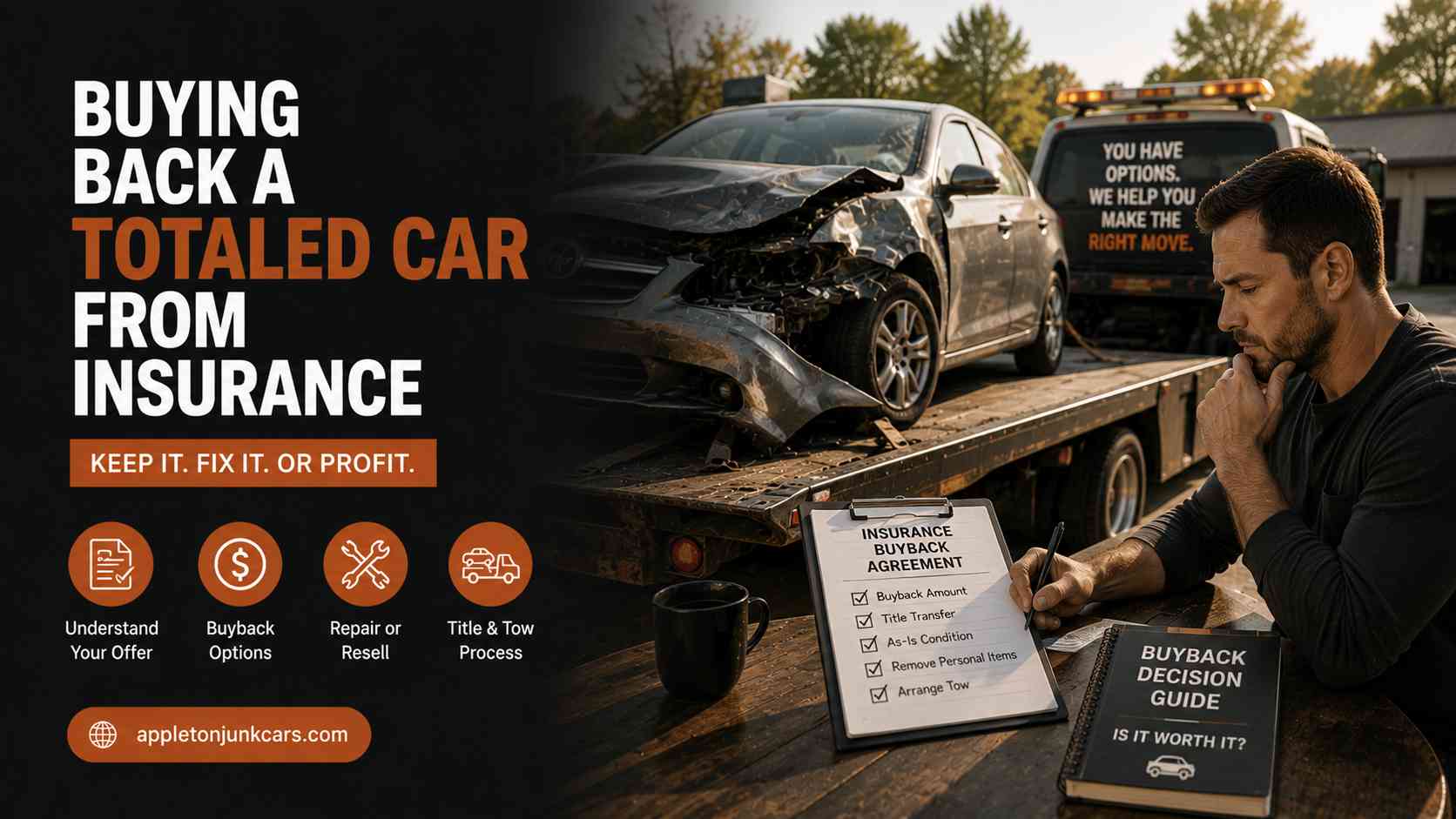
Your insurance adjuster has declared the car a total loss. The settlement offer is in your inbox, and somewhere in the documentation is a line about a “salvage retention option.” Most policyholders scroll past it without understanding what it actually means. For some vehicles in the right circumstances, exercising that option is one of the better financial decisions available after an accident. For others, it leads to a title problem that follows the car for the rest of its life and an insurance situation that is more complicated than expected.
Buying back a totaled car means accepting a reduced insurance payout in exchange for keeping the vehicle. The insurer deducts the salvage value from your settlement, the title transitions to salvage status, and you own a damaged car with restricted legal standing until the rebuild process is complete. You also own something you know, something you may be able to repair for less than the insurer’s estimate, and something that might be genuinely difficult to replace at the settlement amount.
This guide covers exactly how the buyback calculation works, where the room to negotiate is, what the salvage title means for registration and insurance, and the specific conditions where keeping the car makes clear financial sense.
What Actually Happens to Your Vehicle After a Total Loss Declaration
When an insurer declares a total loss, they are making a financial determination rather than a mechanical one. The threshold varies by state: most use a specific percentage of the vehicle’s actual cash value (ACV), typically 75 to 100 percent. Others use a total loss formula that compares estimated repair cost plus salvage value against ACV. Once that threshold is crossed, the standard process runs as follows.
The insurer pays you the ACV and you sign the title over to them. They submit the vehicle to a salvage auction platform (Copart and IAA are the two dominant national platforms) where it is purchased by a licensed dismantler, rebuilder, or parts buyer. The vehicle is retitled as salvage and enters the secondary market.
The buyback option interrupts that process at step two. Instead of you signing the title to the insurer for a full ACV payment, you accept a reduced payout equal to the ACV minus the vehicle’s estimated salvage value. The insurer processes the title as a salvage title in your name rather than theirs. You keep the car, you keep the reduced settlement check, and you take responsibility for everything that follows.
How the Buyback Deduction Is Calculated and Where to Push Back
The deduction from your settlement equals the salvage value: specifically, what the insurer estimates they would receive selling your vehicle at auction. Insurers use third-party valuation tools including CCC One, Audatex, and Mitchell to calculate expected auction proceeds based on make, model, year, mileage, damage type, and current salvage market pricing in your region.
This is the negotiation point most policyholders miss. Salvage value estimates are projections, not guaranteed prices, and they can be inflated. If the insurer overestimates what your specific vehicle would bring at auction, the deduction from your payout is higher than it should be.
Item | Amount |
|---|---|
Vehicle ACV (pre-loss fair market value) | $14,000 |
Insurance estimate for repair | $11,200 |
Salvage value estimate used by insurer | $3,800 |
Your standard payout (title transferred to insurer) | $14,000 |
Your payout with buyback (you keep the car) | $10,200 |
Effective cost to buy back the vehicle | $3,800 (the deduction) |
Repair cost breakeven point | Under $3,800 to profit from buyback |
How to push back on the salvage estimate: search Copart.com and IAA-auctions.com for recently completed sales of the same year, make, model, and damage type in your region. Filter to sold results only. If comparable vehicles consistently sold below the insurer’s estimate, that data is your negotiating tool. Submit it in writing and request a revised salvage valuation. Adjusters can update these figures when presented with market evidence.
The Salvage Title: What It Does to Registration, Insurance, and Future Resale
A salvage title is not just a notation. It is a legal status that restricts what you can do with the vehicle in ways that most policyholders do not fully understand before agreeing to the buyback.
Registration and Road Use
In most states, a vehicle with a salvage title cannot be registered for road use. To drive it legally again, you must repair the vehicle and pass a salvage vehicle inspection at a state-approved facility. After passing, the title is reissued as “rebuilt” or “rebuilt salvage.” The inspection process, what it requires, who conducts it, and how long it takes varies significantly by state.
Insurance Coverage
Standard comprehensive and collision coverage is unavailable on a salvage-titled vehicle from most mainstream carriers. Some carriers offer liability-only policies on salvage-titled vehicles. Once the rebuilt title inspection is passed and the title is upgraded, full coverage typically becomes available again. However, a small number of carriers will not write any policy on a rebuilt title at any coverage level. Verify your carrier’s rebuilt title policy before agreeing to the buyback, not after.
Resale Value Reduction
A rebuilt title permanently reduces the vehicle’s market value by 20 to 40 percent compared to a clean title vehicle of the same year, make, model, and condition. Most franchise dealers will not accept rebuilt titles as trade-ins. Private buyers will discount their offers accordingly. If resale is part of your plan for this vehicle, that discount applies regardless of how thoroughly the car is repaired and regardless of how little the damage affected structural integrity.
State Rebuilt Title Inspection Requirements: How Much Complexity to Expect
The rebuilt title process is not uniform across states. Some states have a simple single-inspection process that takes a week or two. Others involve multiple agencies, component-level documentation requirements, and waiting periods that stretch to two months. Before committing to a buyback, research the specific process in your state.
State | Inspection Authority | Estimated Cost | Typical Timeline |
|---|---|---|---|
California | California Highway Patrol station | $100 to $200 | 4 to 10 weeks |
Texas | State-licensed vehicle inspector | $40 to $75 | 1 to 3 weeks |
Florida | Licensed dealership or state inspector | $50 to $100 | 1 to 2 weeks |
New York | DMV inspection station | $50 to $100 | 2 to 6 weeks |
Pennsylvania | State-certified inspector | $50 to $75 | 1 to 2 weeks |
Washington | Washington State Patrol | $75 to $150 | 2 to 5 weeks |
Illinois | Local police department or state inspector | $50 to $100 | 1 to 3 weeks |
California is consistently the most demanding state for rebuilt title processing. The CHP inspection covers not just safety systems but requires documentation of all replaced parts with receipts. Texas and Florida are generally more straightforward. Requirements do change over time, so confirm current rules at your state’s DMV website rather than relying on information that may be outdated.
When a Buyback Actually Makes Financial Sense
Your Real Repair Cost Is Significantly Below the Insurance Estimate
Insurance estimates use new OEM parts priced at full MSRP and flat-rate labor at regional shop rates. If you have a trusted mechanic, access to quality used parts, or the ability to do some of the work yourself, the actual cost to restore the vehicle can be 40 to 60 percent lower than the insurer’s estimate. When the realistic repair cost falls well below the salvage deduction being applied to your settlement, the buyback is profitable on a pure dollar basis.
The Vehicle Has Value That ACV Does Not Capture
ACV is a formula-based average. It prices your vehicle at the mean market value for that year, make, and model in your region, adjusted for mileage and condition. Vehicles with documented exceptional maintenance histories, rare factory packages, aftermarket upgrades that genuinely add value, or condition that puts them above the average for their year often receive ACV payouts that undervalue what you are actually giving up. Keeping the car lets you preserve an asset the market formula under-priced.
You Plan to Keep the Vehicle Long-Term Regardless
If you intend to drive the vehicle until it is no longer worth repairing and resale value is not a consideration, the rebuilt title resale penalty is irrelevant to your situation. The question reduces to a simple comparison: can I repair this vehicle for less than I would spend buying a comparable replacement? When the answer is yes, the buyback preserves capital. The rebuilt title question only matters if you eventually plan to sell.
The Costs Most Policyholders Don’t Factor In Before Agreeing
The buyback decision is often made quickly, under pressure, with the storage clock ticking. These costs are the ones most commonly overlooked in that moment.
Storage Fees and the Timing Trap
After a total loss declaration, your vehicle sits at a tow yard or designated storage facility. Storage fees accumulate daily, typically at $30 to $75 per day. The insurer may cover fees for a limited window, often 3 to 7 days, before the clock transfers to you. If you take more than one to two weeks to decide on the buyback, storage charges alone can add $200 to $700 to your effective cost. Ask the adjuster on day one: how many days of storage are covered, who pays after that, and what is the daily rate.
Active Lien Complications
If you still owe money on the vehicle, the lender has first priority on the insurance proceeds. The insurer typically pays the lender directly and issues you any remaining equity. You cannot buy back a totaled vehicle with an active lien without the lender’s explicit cooperation, and most lenders will decline because they cannot hold a salvage-titled vehicle as valid loan collateral. This situation often makes the buyback impossible unless the outstanding loan balance is paid off from other funds.
Post-Buyback Towing and Transport
Once you accept the buyback, the vehicle is your responsibility to move. Towing from the storage yard to your property and then from your property to the repair shop are your costs. On a seriously damaged vehicle, this requires a flatbed tow both ways. Budget $150 to $400 for towing depending on distance.
Inspection and Retitling Fees
The rebuilt title process involves inspection fees, DMV title fees, and in some states, separate appraisal or documentation requirements. Budget $100 to $500 for the full process depending on your state. California sits at the high end. States with simpler processes cost less but involve more of your time.
What Drivers Who Bought Back Totaled Vehicles Consistently Discover
People who have been through this process share a consistent set of lessons. The most common: the actual repair cost to bring the vehicle to rebuilt title inspection standard was meaningfully higher than the initial estimate. Insurance estimates are comprehensive in their scope. Personal estimates tend to be optimistic. The structural components that look straightforward in photos often reveal additional damage when the shop opens up the work. Most experienced buyers of salvage vehicles recommend budgeting a 20 to 30 percent contingency on top of any initial repair quote before committing to the buyback.
The second most consistent surprise is the insurance coverage gap. Drivers who assumed their carrier would seamlessly cover the rebuilt vehicle at similar rates often found that their carrier would not insure a rebuilt title for comprehensive and collision, or quoted significantly higher premiums. A quick call to your agent before signing anything confirms whether the rebuild path leads to the coverage you expect.
The most consistently positive outcomes came from policyholders who were paying minimal or no external labor costs on the repair: shop owners, working mechanics, and people with genuine mechanical skills who could source used parts accurately and complete the work themselves. When the repair is completed at market labor rates by an outside shop, the math rarely favors keeping the vehicle. When most of the work is done by the owner, the buyback consistently makes financial sense.
Frequently Asked Questions
Can I buy back my car after the insurance company totals it?
Yes. Most insurers offer a salvage retention option on total loss claims. You notify the adjuster that you want to keep the vehicle, and instead of receiving the full ACV settlement, you receive a reduced payout equal to ACV minus the vehicle’s estimated salvage value. The title is issued as salvage in your name. The process, timeline, and paperwork vary by insurer and state, but the option is available in virtually every state.
How much does it cost to buy back a totaled car from insurance?
The buyback does not cost money upfront. The insurer deducts the vehicle’s estimated salvage value from your settlement check. If the ACV is $12,000 and the salvage value is $3,500, you receive $8,500 and keep the vehicle. The effective cost of the buyback is the $3,500 deduction. You then pay separately for any repairs, towing, inspection fees, and retitling costs required to get the vehicle back on the road.
Can I drive a car with a salvage title?
In most states, no. A salvage-titled vehicle cannot be registered for road use until it is repaired and passes a rebuilt title inspection conducted by a state-authorized inspector. Operating an unregistered vehicle on public roads carries significant legal risk. Once the inspection is passed and the title is upgraded to rebuilt status, the vehicle can be registered and driven normally in most states.
Will insurance cover a car with a rebuilt title?
Most mainstream carriers will write full coverage on a rebuilt title vehicle once the salvage inspection is passed and the rebuilt title is issued. However, the claim settlement process for rebuilt title vehicles differs: the insurer may apply a market value adjustment that reflects the rebuilt title discount at the time of any future claim. A small number of carriers decline rebuilt titles entirely. Confirm your carrier’s policy before completing the buyback.
Does buying back a totaled car affect my insurance rates?
The total loss claim itself affects your rates regardless of whether you buy the car back. The buyback decision does not add a separate rate impact. However, choosing to keep the salvage vehicle and then insuring the rebuilt version may involve a different rate than a clean title vehicle of the same type, depending on your carrier’s rebuilt title underwriting guidelines.
What is the difference between a salvage title and a rebuilt title?
A salvage title is issued when an insurer declares a vehicle a total loss and the title is transferred to reflect that damage status. The vehicle cannot be legally registered for road use. A rebuilt title is issued after a salvage-titled vehicle is repaired to a passable standard and inspected by a state-authorized inspector. The rebuilt title allows the vehicle to be registered and driven again, but it permanently reflects the vehicle’s salvage history in its records.
Can I get a loan on a rebuilt title vehicle?
Financing a rebuilt title vehicle is more difficult than financing a clean title vehicle. Most mainstream lenders, including banks and credit unions, will not write auto loans on rebuilt titles because the collateral value is harder to assess. Some specialty lenders and credit unions work with rebuilt titles at higher interest rates. Personal loans and cash purchases are more common for rebuilt title acquisitions.
How do I know if the buyback is worth it for my specific car?
Run the math on three numbers: the actual repair cost to rebuilt title standard (get this from a trusted shop, not just an estimate), the vehicle’s post-repair market value as a rebuilt title (typically 25 to 35 percent below clean title comparable value), and the salvage deduction being applied to your settlement. If your repair cost is well below the deduction amount and the rebuilt title resale value is meaningfully above the settlement offer, the buyback makes financial sense. If repair costs are uncertain or the rebuilt title resale value barely exceeds the settlement amount, taking the full payout and purchasing a replacement is usually the more predictable outcome.
The Bottom Line
Buying back a totaled car from your insurance company is a legitimate financial option that works well in specific circumstances and works poorly in most others. The deciding factors are straightforward: what does the actual repair cost, who is doing the work, and does the vehicle’s value after repair justify what you are giving up in the settlement.
The buyback works best when you have genuine access to below-market repair costs, the vehicle has value that the ACV formula did not fully capture, and you plan to keep it long enough that the rebuilt title resale discount is not a factor. It works poorly when the repair requires full shop labor rates, when the settlement offer is already close to the vehicle’s realistic rebuilt value, or when an active lien complicates the title transfer.
Before committing, confirm three things in writing: the salvage deduction amount and how it was calculated, your carrier’s coverage policy for rebuilt title vehicles after the inspection is passed, and the storage fee clock so you know how long you have to decide without additional cost. Those three data points make the decision clear in almost every situation.