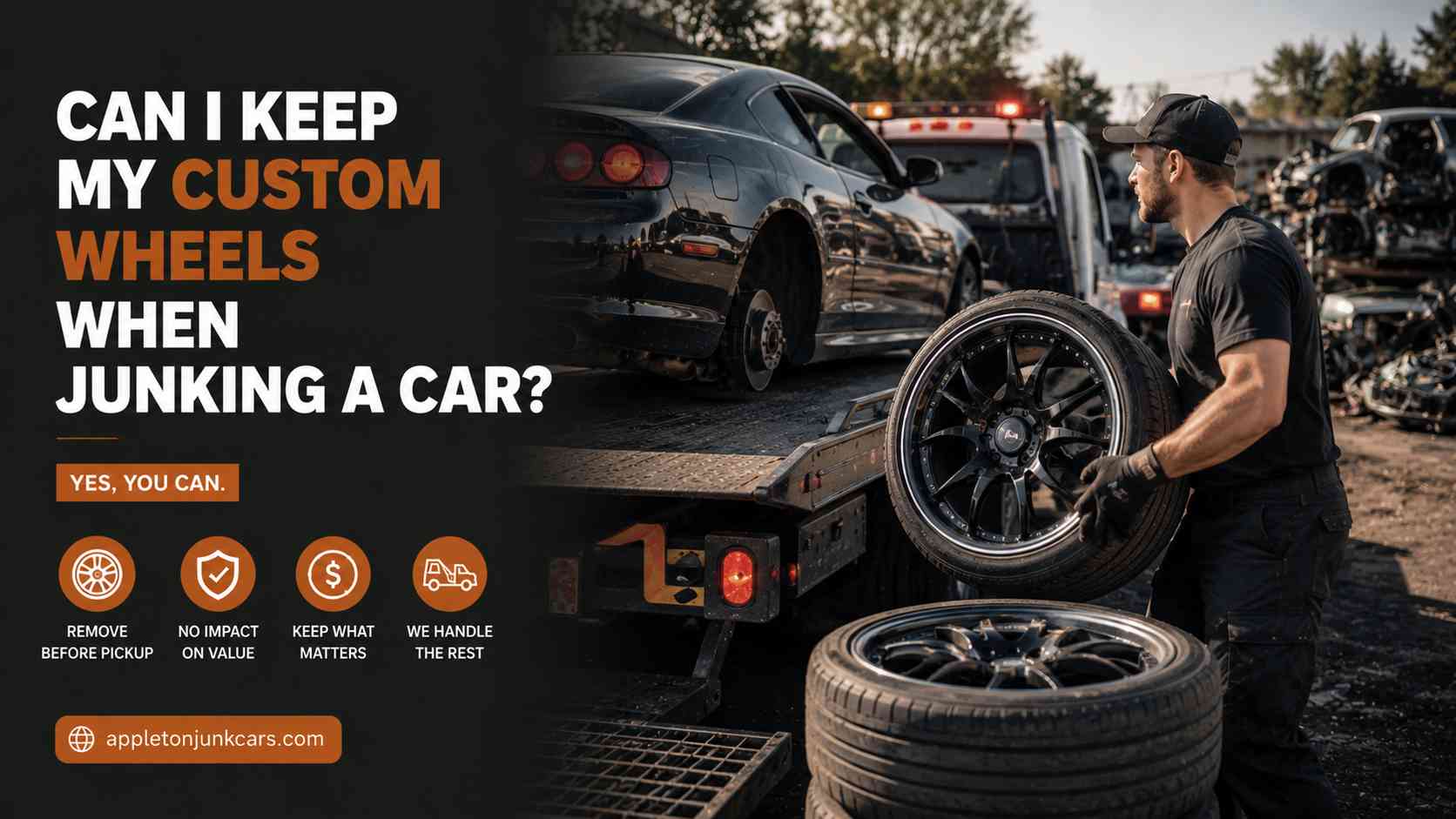
Picture this: you spent $800 on a set of 18-inch alloys a couple of years ago. They are clean, they fit perfectly, and honestly they are the best-looking thing about a car that has otherwise given up on life. Now the engine is gone or the frame is bent or repair quotes have hit numbers that made you laugh humorlessly in a mechanic’s parking lot. The car is done. But those wheels did nothing wrong.
Yes, you can absolutely keep your custom wheels when junking a car. They are yours. You bought them. The junkyard is buying the vehicle, not the life decisions you made with your own money in the aftermarket aisle. This article covers exactly how to handle the swap, what happens to your offer when you remove them, the one situation where the rules are different, and how to make the most money from those wheels before the car disappears forever.
Why Custom Wheels Are Yours to Take
When you bought your car, the stock wheels came with it as original equipment. When you paid for aftermarket wheels out of your own pocket, you added them as your personal property mounted on someone else’s frame. Legally and practically, the car and the wheels you added are two separate things.
A junk car buyer is making an offer on the vehicle itself: its metal weight, its usable components, its parts value. Unless they have specifically appraised and quoted your custom wheels as part of the offer, they are not included in the transaction. You have every right to remove them before the pickup.
Think of it the same way you would think about a stereo system you installed, a dash camera you mounted, or a trailer hitch you bolted on. You added it, it is yours, and you take it with you. The car goes to the yard. The wheels go with you.
What Happens to Your Junk Car Offer If You Remove the Wheels
This is the part people worry about, and the answer is more favorable than most people expect.
Junk car buyers price based on several factors: total vehicle weight, condition of major components, current scrap metal rates, parts demand for your specific make and model, and whether the catalytic converter is present. Custom aftermarket wheels almost never factor meaningfully into that calculation.
Here is why. A junkyard or junk buyer is not in the business of retailing custom wheels. They buy cars in volume and process them for scrap and used OEM parts. A set of aftermarket Enkei or BBS rims sitting on a junk car does not make the car worth significantly more to them because those wheels appeal to a specific niche buyer, not to their standard parts operation.
When you remove your custom wheels and replace them with the stock wheels or steel rims, the junk buyer may notice a slight reduction in total weight, but the dollar impact is small. Removing $800 worth of custom wheels from a car typically reduces the junk offer by somewhere between zero and thirty dollars in most scenarios.
The math makes this obvious. Eight hundred dollars in custom wheel value you keep, versus a potential twenty dollar reduction in the junk car offer. There is no scenario where leaving premium aftermarket wheels on a car headed to the crusher is the financially rational choice.
The One Exception: Totaled Cars and Insurance Claims
If your car was declared a total loss by an insurance company rather than being junked by your own choice, the rules change. Pay close attention here because this is where people accidentally give up significant money.
When your insurer appraises a totaled car, they calculate the vehicle’s actual cash value based on its pre-accident condition. Custom wheels, if they are on the car at the time of the appraisal, may be included in that valuation and can increase the settlement offer. If you remove them before the appraisal, the insurer sees a car with stock wheels and adjusts the value accordingly.
If you want to keep the custom wheels on a totaled car covered by insurance, the cleanest approach is to swap them for your original stock wheels before the appraisal. The insurer values the car with stock wheels, you keep your custom set, and everyone knows what they are working with. Alternatively, some people choose to leave the custom wheels on, receive a higher settlement that reflects their value, and then let the insurer take the car with the wheels included. That choice depends on how much the settlement premium is versus what you could sell the wheels for independently.
What you want to avoid is leaving the custom wheels on during appraisal, receiving a settlement that includes their value, and then removing them before handing the car over. That creates a discrepancy that insurers take seriously. Communicate with your adjuster first if you want to keep them.
How to Do the Swap Properly
The process of removing custom wheels and putting stock wheels back on before junking is straightforward if you approach it with a little planning.
Step 1: Locate Your Stock Wheels
Many people who put on aftermarket wheels store the original stock set in a garage, basement, or storage unit. If you kept them, dig them out. If you sold them or disposed of them when you installed the custom set, you have a couple of options: find a matching set at a salvage yard for a small fee, buy a set of basic steel wheels that fit your bolt pattern, or contact the junk car buyer and let them know the car has no wheels and will need a flatbed or wheel skates for pickup.
Most reputable junk car buyers will accommodate a vehicle without wheels. Just tell them upfront when you schedule the pickup. They will send a flatbed instead of a wheel lift, and the offer adjustment, if any, is typically minimal.
Step 2: Remove the Custom Wheels
Basic wheel removal requires a car jack, jack stands, and a lug wrench or impact driver. Work on one corner at a time. Loosen the lug nuts before jacking the corner up, then remove them fully once the wheel is off the ground. Set the custom wheel safely to the side.
If the lug nuts are stuck, penetrating oil and a breaker bar handle most situations. Let the penetrating oil work for ten to fifteen minutes before applying force. Avoid hammering on the lug nuts directly. If you strip a lug nut, replace the stud at a shop before selling the wheels, as buyers will notice.
Step 3: Mount the Stock Wheels or Alternatives
If you have the original stock wheels, mount them the same way. Torque the lug nuts to the manufacturer’s specification if you have a torque wrench. Hand-tight plus a quarter turn is a reasonable approximation if not. You are not driving anywhere on these, but they need to stay on for the tow.
If you are not putting replacement wheels on at all, notify the tow company and let them know the car needs a flatbed. Most junk car buyers manage this regularly and it is not a problem. Just do not surprise them with it on pickup day.
Step 4: Tell the Buyer What to Expect
When you schedule the pickup, mention that the car has stock wheels on it now rather than the aftermarket set it may have had previously. If the buyer quoted the car over the phone and mentioned the alloys as a factor, clarify this. Transparency prevents any confusion or negotiation at pickup.
What Your Custom Wheels Are Actually Worth
Before deciding what to do with your wheels, it helps to have a realistic sense of their market value. Custom wheels are worth what someone will actually pay for them, which depends on several factors.
Brand. Recognized aftermarket brands like BBS, Enkei, Work, Vossen, and similar carry real resale value because buyers trust quality and fitment. Generic or lesser-known brands sell for less regardless of appearance.
Size and fitment popularity. Wheels in sizes and bolt patterns that fit many vehicles are easier to sell than highly specific fitments. A set of 18×8 wheels in a 5×114.3 bolt pattern fits dozens of common vehicles. A set in an unusual size or rare pattern fits far fewer.
Condition. Curb rash, deep scratches, bent lips, or cracked welds significantly reduce value. Clean wheels in good condition command near-retail pricing on the used market. Damaged wheels sell for a fraction of that, if they sell at all.
Whether tires are included. A set of wheels with decent tires is worth considerably more than bare rims. If your tires still have usable tread, selling them mounted together is almost always better than selling the rims alone.
Wheel Type and Condition | Typical Private Sale Range | What You Would Get at Scrap |
|---|---|---|
Premium brand alloys, great condition, with tires | $500 to $1,500+ | $20 to $60 (aluminum weight) |
Mid-range aftermarket, good condition, with tires | $250 to $700 | $15 to $50 |
Budget aftermarket, minor curb rash, no tires | $75 to $200 | $10 to $30 |
Damaged or bent, any brand | $30 to $100 (as-is) | $5 to $20 |
OEM alloys (stock, not custom) | $100 to $400 depending on model | $15 to $40 |
The gap between private sale value and scrap value for custom wheels is consistently large. This table alone explains why removing them before junking is almost always the right financial move.
Where to Sell Your Custom Wheels
Once the wheels are off the car, you have several good options for finding buyers.
Facebook Marketplace. The largest active used parts market in most regions. List with clear photos from multiple angles, include the brand, size, bolt pattern, and tire size if applicable, and set a fair price. Local buyers who can pick up avoid shipping complications with heavy wheels. Expect inquiries within 24 to 48 hours on a well-priced listing.
Craigslist. Still active in many markets for automotive parts. No listing fees and cash transactions make it simple. The buyer pool is smaller than Facebook, but serious local buyers still use it regularly for wheels and tires.
eBay Motors. Ideal if your wheels have broad national appeal or if the local market has not produced buyers after a week or two. eBay reaches a national audience, which is valuable for specific brands or fitments that appeal to enthusiasts outside your area. Factor shipping costs into your pricing as wheels are heavy and expensive to ship.
Car-specific forums and communities. If your wheels came off a vehicle with an active enthusiast community, the forum marketplace is often the best place to sell. Enthusiasts know the fitment, trust listed specs, and are willing to pay fair prices. Search for the make and model’s primary online community and check whether they have a classifieds section.
Local tire shops. Some independent shops buy used wheel and tire sets to resell. They will not pay top dollar, but it is a quick transaction without the back-and-forth of private sales. Call a few shops in your area and ask whether they buy used wheels.
What If You Cannot Find Your Stock Wheels?
Losing track of the original wheels is common, especially if the car has changed hands, been stored for a long time, or if you sold the stock set when you installed the aftermarket ones. Here are your practical options.
Buy a matching steel wheel set from a salvage yard. Salvage yards often have basic steel wheels for $10 to $30 each. They do not need to look good. They just need to fit the bolt pattern and be structurally sound enough to hold the car steady for towing. Call a local yard, give them your bolt pattern and center bore measurement, and they can usually match you up quickly.
Tell the junk buyer no wheels are on the car. This is the simplest option if you do not want to deal with sourcing replacements. Most junk buyers handle wheelless cars regularly. A flatbed truck loads the car from the body rather than the wheels. Let the buyer know in advance so they send the right equipment. The adjustment to your offer, if any, will be small.
Leave the custom wheels on if the numbers work. This is rare, but occasionally custom wheels are in poor enough condition, or the fitment is unusual enough, that the private market for them is thin and the time investment to sell them is not worth the return. In that case, leaving them on the car and taking a marginally higher junk offer is a reasonable choice. Run the numbers before you decide.
What Happens to the Wheels After Junking If You Left Them On
Out of curiosity, here is what typically happens to wheels that go to a salvage yard with the car.
Usable wheels in good condition are pulled from the vehicle and sold through the salvage yard’s parts inventory. Someone shopping for an inexpensive replacement wheel for the same vehicle model might buy them at a fraction of new cost. Wheels that are damaged or unusual go into the scrap pile and are sold by weight as aluminum. Premium custom wheels get the same treatment if no buyer comes along for them, because most salvage yards are not equipped to market niche aftermarket products the way a private seller can.
This is the fundamental inefficiency that works in your favor. You can market your wheels to the right buyer and receive fair value. A junkyard has to make money across thousands of vehicles without customizing their sales approach for every set of rims that comes through. The private market will almost always pay you more.
What People in This Situation Consistently Wish They Had Known
People who have junked cars with custom wheels share a pattern that comes up almost every time the story is told in automotive communities.
The most common version: they did not realize they could remove the wheels, assumed they came with the car and had to stay with it, and watched a $600 set of alloys disappear on the back of a tow truck. The money was not even factored into the junk offer. The wheels were simply collateral.
A close second: people who knew they could take the wheels but ran out of time. They scheduled the pickup before they had a chance to swap the tires, the driver showed up on time, and out of convenience they let the wheels go. The convenience cost several hundred dollars.
The lesson both groups share: handle the wheel swap before you call for quotes, not after. Remove the custom set, put on whatever replacements you have, and get quotes on the car as it will actually sit at pickup. That way there are no surprises, no last-minute logistics, and no watching good wheels disappear for free.
Frequently Asked Questions
Can I keep my aftermarket rims when I junk my car?
Yes. Custom or aftermarket wheels are your personal property. You installed them and you have every right to remove them before junking the car. The junk buyer is purchasing the vehicle, not the aftermarket accessories you added to it.
Will the junk car offer go down if I remove my custom wheels?
By a small amount, possibly. Removing wheels reduces the car’s total weight slightly and removes aluminum that would otherwise be recycled. However, junk car buyers do not typically price custom aftermarket wheels at their true market value, so the reduction in offer is rarely more than ten to thirty dollars. This is almost always far less than what you could sell the wheels for privately.
What do I put on the car if I do not have stock wheels anymore?
You can find matching steel wheels at a local salvage yard for very little money, or simply let the junk buyer know the car has no wheels and will need a flatbed. Most junk buyers handle this regularly and it is not a problem as long as you mention it before pickup day.
What if my car was totaled by insurance? Can I still keep the wheels?
This depends on timing. If you want to keep the wheels and still receive a fair insurance settlement, swap them for stock wheels before the appraisal. If the custom wheels were on during the appraisal and included in the settlement value, removing them afterward and handing over the car without them creates a discrepancy. Talk to your adjuster first.
Where is the best place to sell custom wheels after removing them?
Facebook Marketplace is the most active local market for used wheels in most areas. eBay Motors reaches a national audience, which is valuable for specific brands or unusual fitments. Car-specific forums are excellent for enthusiast brands. Local tire shops will buy quickly at a lower price. List on two or three platforms simultaneously for the fastest sale.
Should I sell the tires separately from the wheels?
Usually no. Wheels with matching mounted tires sell faster and for more money than bare rims. Buyers prefer a set they can put straight on the car. Only separate them if the tires are worn out or in poor condition that would hurt the overall appeal of the listing.
What if my custom wheels are damaged or bent?
Damaged wheels still have a buyer market, particularly for specific fitments where the buyer only needs two matching wheels or plans to repair a bent rim. List them honestly at a reduced price reflecting the damage. If they do not sell after two weeks, the scrap value as aluminum is always there as a fallback.
The Bottom Line
Custom wheels do not belong to the junkyard. They belong to you, and the junkyard’s offer almost never reflects what they are actually worth on the open market. Taking them off the car before junking takes an hour at most and regularly saves hundreds of dollars that would otherwise ride away on a tow truck for free.
Swap the wheels before you call for quotes. Let the buyer know what the car will look like at pickup. Sell the custom set on Facebook Marketplace or eBay Motors to the right buyer who will actually pay what they are worth.
The car is done. Those wheels are not.