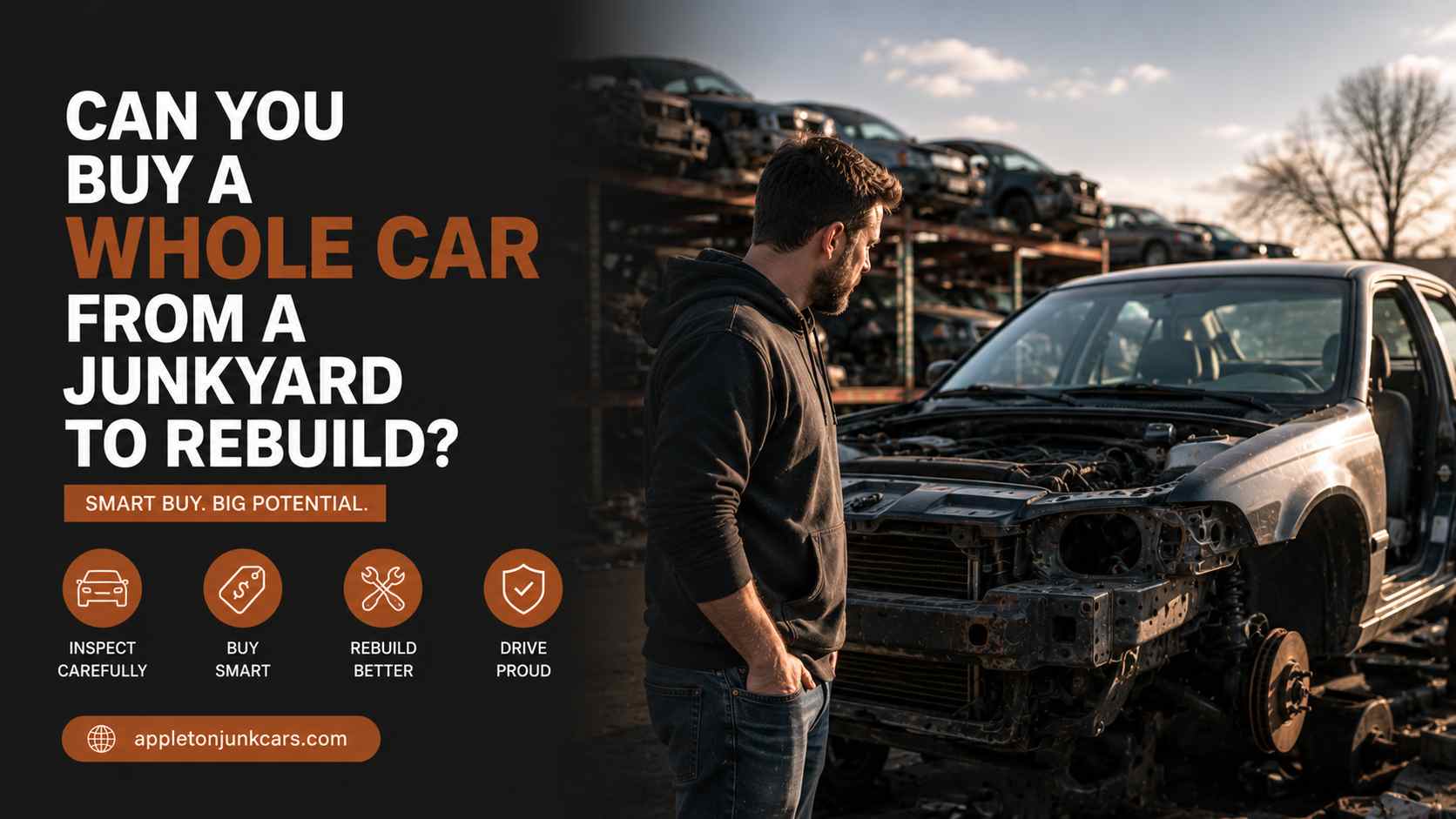
Yes, you can buy a whole car from a junkyard. However, whether that car can ever be legally driven on public roads depends entirely on one thing: the type of title it comes with. If the yard sells it as a parts car, it will not have a title and cannot be registered. To make a junkyard car street legal, you need a vehicle with a salvage title and must navigate a state-level rebuilt title inspection process before it can be plated and driven.
This article covers every factor worth understanding before you write a check: title types, the rebuilding and inspection process, where to find whole cars for sale, insurance complications, and the honest math on whether a junkyard rebuild actually saves you money.
Understanding Title Types: The Most Important Thing to Know Before You Buy
The title status of a vehicle determines everything about what you can do with it after purchase. This is the first question to ask any yard or auction, and the answer shapes every decision that follows.
| Title Type | What It Means | Can It Be Street Legal? |
| Rebuildable Salvage | Totaled by an insurer but structurally eligible for rebuilding and inspection | Yes, after a rebuilt title inspection |
| Parts Only / Junk | Sold with a bill of sale only. Title has been permanently cancelled. | No. Ever. In any state. |
| Non-Repairable | State has permanently removed it from the drivable vehicle pool | No. |
| Flood / Hail Brand | Totaled for weather damage; may be rebuildable depending on state | State-dependent |
Rebuildable Salvage Title
A rebuildable salvage title means an insurance company declared the vehicle a total loss, typically when the repair cost exceeded 70 to 80 percent of the car’s actual cash value, but the vehicle’s structure is intact enough to be repaired and returned to roadworthy condition. This is the title type you need if your goal is a drivable, registered vehicle.
Salvage titles can be transferred from seller to buyer. They can be registered in your name. And after the rebuild process is complete and the vehicle passes inspection, the state issues a rebuilt title that allows you to register the car, insure it, and drive it legally.
Parts-Only and Junk Titles
A parts-only car cannot be rebuilt into a street-legal vehicle. When a vehicle’s title is cancelled and marked as junk or parts only, the state has permanently removed it from the pool of registerable vehicles. No amount of mechanical work, no inspection, and no legal pathway converts a junk-titled vehicle into a licensed road car. If a car junkyard near me lists a vehicle as a parts car, treat it exactly as that: a source of components, not a potential driver.
The distinction between salvage and parts-only is the single most important piece of information to confirm before purchasing any whole car from a yard. Always ask for documentation of the title status before committing to a purchase.
Where to Find Whole Cars for Sale: Junkyards, Auctions, and Tow Yards
Knowing how to buy a car from a scrap yard or salvage auction is a different skill set from knowing how to buy at retail. The inventory exists across several channels, and the best prices are often in places most buyers have not thought to look.
Local Salvage Yards
The most straightforward starting point for anyone searching for “junk yards that sell whole cars near me” is the local salvage yard. Many yards keep whole vehicles, particularly recent arrivals or higher-value models, separate from the pull-a-part rows for individual component buyers. Calling ahead and asking specifically whether they sell complete vehicles with salvage titles is the fastest way to identify which local operations are worth visiting.
Local yards are most useful for buyers who want to inspect a vehicle in person before purchasing, negotiate price directly, and avoid the competitive bidding environment of online auctions. The inventory is smaller than online platforms but the transaction is simpler and faster.
Car-Part.com is the most comprehensive national aggregator of salvage yard inventory. Searching for a specific year, make, and model returns results from yards across the country. Many yards update their inventory daily, and the search can filter by title status.
Salvage Vehicle Auction Platforms
For buyers comfortable purchasing without in-person inspection, the national salvage vehicle auction platforms provide access to enormous inventory at transparent pricing.
Copart is the largest salvage vehicle auction platform in North America. It processes vehicles from insurance companies, rental fleets, fleet operators, and banks that have repossessed vehicles. Copart vehicles include both salvage-titled and clean-titled total loss vehicles, and the online bidding system runs continuously. Photographs and condition reports are provided for each vehicle, though they are not substitutes for physical inspection when possible.
Insurance Auto Auctions (IAA) operates a similar platform and also processes a large volume of total loss vehicles from major insurers. Both platforms charge buyer fees above the winning bid, typically a few hundred dollars depending on the vehicle’s sale price, which must be factored into the true acquisition cost.
For buyers searching for cheap junkyard cars for sale, these auction platforms consistently produce the lowest acquisition prices because they sell to whoever bids the most rather than setting retail prices. The tradeoff is less opportunity to inspect the vehicle before bidding.
Tow Yards and Impound Lots
Tow yard cars for sale represent a distinct category that many buyers overlook. When a vehicle is towed and stored at an impound yard and the owner does not claim it within the legally required period, the yard gains the right to sell it to recover storage fees. These vehicles sometimes come with clean titles, because they were not necessarily in accidents or declared total losses. They were simply abandoned or left unclaimed.
The inspection opportunity at a tow yard depends on the specific operation. Some allow pre-purchase inspections. Others sell as-is sight-unseen from a list. Searching for tow yard cars for sale in your area through local government websites, county sheriff auctions, and storage yard websites surfaces this inventory. It is inconsistent but occasionally produces excellent buys on mechanically sound vehicles.
The Rebuilding and Inspection Process: What It Actually Takes
Buying a rebuildable salvage vehicle is the beginning of a process, not the end of one. The path from salvage title to rebuilt title involves specific repairs, documented evidence of those repairs, and a state inspection that is more thorough than a standard emissions or safety check.
The Repair Requirements
You must repair the vehicle to meet all relevant safety standards for your state before it can pass a rebuilt title inspection. What this means in practice depends on the nature of the original damage.
- Structural damage requires certified repair to factory dimensional specifications. Frame straightening must restore the vehicle to its original geometry, which is verified during inspection.
- Airbag deployment requires replacement of the inflated airbag modules, the clock spring, and all sensors associated with the deployment event. Inspectors specifically check airbag system status.
- Safety systems including brakes, lights, steering, tires, and mirrors must all meet state minimums. Inspectors are looking for a roadworthy vehicle, not just a cosmetically repaired one.
- Parts documentation is required in most states. You must save receipts for replacement parts, particularly major components, to prove they were legitimately purchased rather than obtained from stolen vehicles. VIN numbers on major parts may be checked against theft databases during inspection.
The Rebuilt Title Inspection
Once repairs are complete, you submit an application for a rebuilt title inspection to your state’s DMV or, in some states, state police. The inspection process varies significantly by state: some states send inspectors to the vehicle, others require you to bring it to a specific location.
Inspectors verify that the VIN on the vehicle matches the salvage title documentation, that all safety systems are functional, that the repairs are completed to an acceptable standard, and that no stolen components have been used in the rebuild. The documentation you bring, including parts receipts, photographs taken during the repair process, and the original salvage title, supports the inspection.
Not every state has a clear or accessible rebuilt title process. A few states make the process genuinely difficult as a matter of policy to discourage rebuilt vehicles on the road. Research your specific state’s requirements before purchasing any salvage vehicle with the intent to rebuild it for street use.
The Math: When a Junkyard Rebuild Actually Makes Sense
A rebuilt car is only a bargain if your repair costs plus the purchase price stay well below the car’s actual market value. This sounds obvious but is the calculation many people skip when they get excited about a low acquisition price.
| Cost Element | What to Include |
| Purchase price | Winning bid or yard price |
| Buyer fees / transport | Auction buyer premiums, towing to your location |
| Parts and materials | All replacement parts, welding materials, shop consumables |
| Labor (shop or your own time) | Shop rates are $80 to $150/hr. Factor your own time honestly. |
| DMV and inspection fees | Rebuilt title application, inspection, registration |
| Total project cost | Sum of all above. Compare against clean-title market value. |
Run this calculation before buying. If a car has a $15,000 clean-title market value and you can acquire and repair it for $8,000 to $9,000 total, the math works in your favor. If the repair costs escalate to $12,000 and you add the purchase price on top, you have spent near-market money on a car that will sell for significantly below market because of its rebuilt title history.
Insurance Complications After the Rebuild
Insurance is the area that produces the most surprises for first-time salvage rebuilders, and knowing the landscape before you start prevents unpleasant discoveries after the work is done.
Getting Coverage
Liability insurance for a rebuilt-title vehicle is generally not difficult to obtain. Most major insurers will write a liability policy for a rebuilt title car without issue. This covers damage you cause to other vehicles and people. It does not cover damage to your own vehicle.
Comprehensive and collision coverage is significantly harder. Many standard insurers decline to offer comprehensive and collision on rebuilt-title vehicles because the salvage history creates uncertainty about the vehicle’s structural integrity and therefore unpredictable claims exposure. Specialty insurers and a handful of standard companies do offer it, but often at higher premiums and with limitations on the payout.
The Payout Reality
Insurance companies typically pay out only about 80 percent of the car’s listed value if a rebuilt-title vehicle is in another accident. The reasoning is that the pre-existing salvage history reduces the vehicle’s actual market value compared to a clean-title equivalent. This 20 percent gap is a real financial exposure that rebuilt title owners carry regardless of how perfect the rebuild is.
For buyers who plan to drive the car long-term, this gap may be acceptable in exchange for the significant savings on acquisition. For buyers who expect to sell the vehicle after a year or two, the insurance limitation compounds the resale value problem discussed next.
Resale Value: Why This Is a Project for Keeps, Not for Flipping
This is the part of the conversation that most enthusiasts who buy their first salvage vehicle wish they had understood clearly before starting.
Even after a perfect rebuild, cars with rebuilt titles have significantly lower resale value than clean-title equivalents. The market discount varies by vehicle, market conditions, and how well the rebuild is documented, but a 20 to 40 percent reduction from clean-title pricing is typical. A car worth $18,000 with a clean title might sell for $12,000 to $14,000 with a rebuilt title regardless of the rebuild quality.
Dealerships almost universally reject rebuilt-title trade-ins. Even when dealers do accept them, they offer amounts that reflect wholesale auction pricing, not retail, because rebuilt-title vehicles are difficult for dealers to resell on their own lots. Most dealer trade-in software assigns a deep discount or a flat rejection to any rebuilt or salvage title when processing an appraisal.
Private sales are the only realistic channel for a rebuilt vehicle at a reasonable price, and even there, buyers run VIN checks that immediately surface the salvage history. A buyer who learns the car has a rebuilt title mid-negotiation almost always adjusts their offer downward significantly or walks away.
The practical conclusion: buy a salvage car to rebuild and keep. The math works best when you drive the car for years and capture the value difference in the form of a lower monthly cost of ownership rather than a sale price at the end. Buying a salvage car to flip for profit almost never produces the returns that buyers project at the beginning of the project.
How to Inspect a Whole Car Before Buying From a Yard or Auction
Whether you are buying from a car junkyard near me or bidding on Copart from across the country, the inspection approach determines how accurately you can project the total cost of the rebuild before committing.
In-Person Inspection at a Local Yard
Local salvage yards and pull-a-part operations that sell whole vehicles usually allow some level of inspection before purchase. Bring a mechanic if at all possible. Have them assess the extent of visible structural damage, look for signs of fire or flood that go beyond the reported damage cause, and check whether the powertrain shows any signs of damage beyond what the cosmetic assessment suggests.
At a pull-a-part type yard that allows access to the vehicle row, you may be able to open the hood, check under the car, and assess accessibility of the components you will need to replace. Even thirty minutes of physical inspection is worth more than any number of photographs in assessing the actual scope of the rebuild.
Remote Inspection via Auction Platforms
When buying through Copart or IAA, the inspection options are more limited. Both platforms provide photographs and condition reports, but these are compiled by lot personnel rather than independent inspectors and may miss internal or hidden damage. Both platforms also offer third-party inspection services, where an independent inspector visits the lot and provides a more detailed assessment for a fee.
For a vehicle where you are projecting a significant repair investment, paying $100 to $200 for a third-party inspection before placing a serious bid is often the most cost-effective insurance available. Discovering that a vehicle has undisclosed structural damage after winning the bid is far more expensive than the inspection fee.
Run the VIN on any vehicle before bidding. A free VIN check through the National Motor Vehicle Title Information System or a paid service like Carfax surfaces accident history, title brands, odometer discrepancies, and state-level title information. Knowing the full history of a salvage vehicle before purchasing it prevents bidding on a car whose damage is worse than the current listing suggests.
Frequently Asked Questions
Can you buy a car from a junkyard?
Yes. Many salvage yards sell complete vehicles rather than just individual components. The title status determines whether the car can ever be street legal. Ask specifically whether the car comes with a salvage title (rebuildable) or a bill of sale only (parts only). Only salvage-titled vehicles can go through the rebuilt title process.
What is the difference between a salvage yard and a pull-a-part yard for buying a whole car?
Traditional salvage yards often maintain whole vehicles for resale alongside their parts inventory. Pull-a-part operations are self-service yards where customers remove their own parts, and whole car sales are less common there. Some pull-a-part chains do sell whole vehicles separately from the self-service rows, but it varies by location. Calling ahead to ask about whole vehicle availability saves the trip.
How to buy a car from a scrap yard?
Identify local salvage yards through a web search for car junkyard near me or through Car-Part.com’s yard locator. Call and ask whether they sell whole vehicles with salvage titles. Visit to inspect before purchasing. Confirm the title type and VIN before paying. Get a signed title transfer and ask about their bill of sale process. Run the VIN on any vehicle before finalizing the purchase.
What are Copart and IAA and how are they different from a local scrap yard?
Copart and IAA are national salvage vehicle auction platforms that sell total loss vehicles from insurance companies, fleet operators, and financial institutions. They offer far broader inventory than any local yard and operate on a competitive bidding system rather than fixed prices. The tradeoff is less opportunity for in-person inspection and the requirement to register as a buyer before bidding, which in some states requires a dealer’s license.
Are cheap junkyard cars for sale worth buying for a rebuild?
They can be, if the math works. The key variables are the total cost of acquisition and repair versus the clean-title market value of the completed vehicle. When the total project cost comes in at 50 to 60 percent of clean-title market value, the rebuild produces genuine financial benefit. When repair costs escalate beyond that, the advantage disappears. The rebuilt title discount on resale value (20 to 40 percent below clean-title) means you need to capture real savings to come out ahead.
What states make the rebuilt title process easiest?
State-level rebuilt title processes vary significantly. Texas, Florida, California, and most midwestern states have relatively clear and accessible rebuilt title inspection processes. A few states, including Kentucky, make the process deliberately difficult or restrict it in ways that effectively prevent private party rebuilt title work. Research your specific state’s requirements, forms, and inspection availability before purchasing any salvage vehicle with the intent to register it.
The Bottom Line
You can buy a whole car from a junkyard to rebuild. Whether that makes sense for your situation depends on the title status, your realistic assessment of repair costs, your state’s rebuilt title process, and what you plan to do with the car when the work is done.
A rebuildable salvage vehicle that you can acquire and repair for well below its clean-title market value, drive for several years, and then sell privately with full documentation of the rebuild, is a genuinely good financial decision for the right buyer. A salvage car bought on optimism with an incomplete estimate of repair costs, insured with a payout gap, and then put on the market against clean-title competition, is a money-losing project that costs more in total than buying clean would have.
Do the math before you bid. Confirm the title before you commit. Inspect as thoroughly as the purchase channel allows. If all three of those checks produce favorable results, a junkyard rebuild is one of the most cost-effective ways to acquire a quality vehicle.