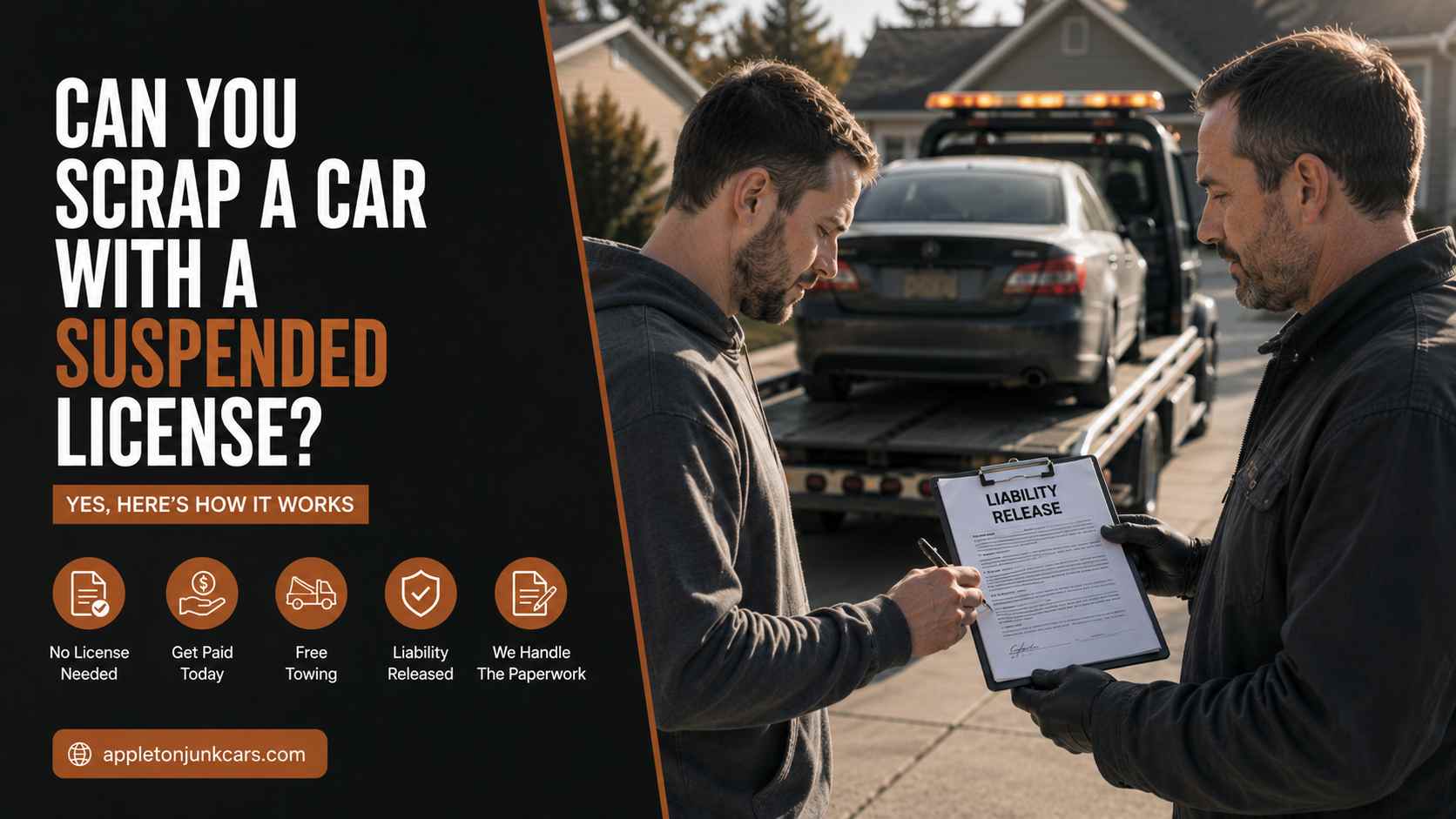
Your driving privileges are gone for now, but your car is still sitting in the driveway. Maybe it is wrecked, maybe it is just not worth fixing, and you want cash for it. The good news is that scrapping the car is completely legal with a suspended license. A suspension affects your right to drive, not your right to own and sell property.
What it does affect is which ID you bring to the scrapyard, how the car gets there, and which administrative steps you need to cover before and after pickup. Skip any of those, and the transaction either falls apart at the gate or leaves you exposed to new legal problems.
This guide covers every step of the process in plain language. By the end, you will know exactly which IDs work at scrapyards, what to do if a court hold is on the vehicle, how to get the car there without driving it, which DMV paperwork to file after the sale, and when a Limited Power of Attorney is the tool you need. Nothing is left out.
Your License Is Suspended, Not Your Ownership Rights
A driver’s license is a state-issued privilege to operate a motor vehicle on public roads. When it is suspended, that privilege is temporarily taken away. Your property rights are a completely separate matter. You still legally own the car and have every right to sell it, scrap it, or transfer it.
Think of it this way: if the state pulled your fishing license, you would not lose the right to sell your boat. Same principle applies here. No state law in the country prohibits a person with a suspended license from scrapping a vehicle they own outright. What changes is the mechanics of how you do it.
You cannot drive the car to the yard. Your suspended license will not pass as valid ID. And depending on the reason for the suspension, the vehicle itself may have a court hold attached to it. Each of those issues has a specific fix, and this guide walks through all of them.
The One Thing You Absolutely Cannot Do
Drive to the scrapyard. That is it. If your license is suspended and you get behind the wheel, you are risking a driving-while-suspended charge, which is a misdemeanor in most states on a first offense and escalates to a felony with repeat violations. Some states go further.
In California, law enforcement can impound your vehicle for 30 days if you are caught driving with a suspended license. In Ohio, getting caught driving on a suspended license tied to a prior DUI can mean another 30-day hold on top of existing penalties. The fine for driving while suspended typically runs $300 to $1,000, not counting court fees, and a new charge can extend your suspension period further.
The practical solution is simple: do not drive it. Several major junk car buying services, including Peddle, Wheelzy, and Junk Car Medics, offer free towing as part of the cash offer. The tow truck comes to you. In many cases you do not spend a dollar to get the car off your property.
Scraping a Car With a Suspended License
Step 1: Sort Out Your ID Before You Call Anyone
Federal and state anti-theft laws require every licensed scrapyard to record the identity of the person selling a vehicle. This is not a yard policy. It is a legal requirement tied to vehicle theft prevention, and yards that skip it face serious licensing consequences. The question is: what do you bring when your driver’s license is either confiscated, physically held by a court, or marked as suspended?
Why the scrapyard cannot accept a suspended license
In many states, law enforcement physically takes the license at the time of the suspension. Even if you still have the card in your wallet, its legal validity as government-issued ID is gone in most jurisdictions the moment the suspension takes effect. Scrapyards know this and are trained to flag it. Presenting a suspended license as valid ID creates legal liability for the yard, and they will turn you away.
IDs that actually work at the scrapyard
Non-driver state ID card
This is your most practical option. Every state in the country issues non-driver photo ID cards through the DMV or its equivalent. This card carries the same legal weight as a driver’s license for identity purposes. It is not a driving document and it cannot be suspended. If you do not already have one, getting it is your first task. The section below covers how.
US Passport or Passport Card
A valid US passport or passport card is accepted at scrapyards nationwide without question. It is a federal document, it cannot be suspended by a state, and it is the most universally accepted form of photo ID in the country. If you have one, you are already set.
US Military ID
Active duty military personnel, certain veterans with a current ID, and qualifying military family members can use a US Military ID. Most scrapyards are familiar with this document and accept it without issue.
Permanent Resident Card (Green Card)
A current, valid Permanent Resident Card issued by USCIS is accepted as government-issued photo ID at most scrapyards. Make sure it is not expired before you bring it.
Getting a non-driver ID with a suspended license
You can apply for a state-issued non-driver ID even while your driver’s license is suspended. The two are separate documents issued for separate purposes. A suspension of your driving privilege does not block you from obtaining a non-driving photo ID.
The general process across most states:
- Go to your local DMV or equivalent office. You cannot drive yourself there, so arrange a ride or use public transit.
- Bring proof of identity (birth certificate, Social Security card or printout) and proof of state residency (utility bill, bank statement, lease agreement).
- Complete the non-driver ID application. Form names vary: Form DL-54B in Pennsylvania, Form BA-208 in New Jersey, Form DL 44 in California, Form MV-44 in New York.
- Pay the fee. Costs range from $9 in New York and Ohio to $35 in California.
- Some states, such as Connecticut, require you to physically surrender your suspended license when applying for the non-driver ID. Others do not. Check your state’s policy before the visit.
Processing time is typically one to three weeks by mail. Some states issue the card over the counter the same day. Call the DMV or check their website before making the trip so you know exactly what to bring.
Step 2: Confirm the Car Is Legally Yours to Sell
Before you contact a single buyer, check the vehicle’s legal status. Scrapyards run VIN checks through the National Motor Vehicle Title Information System (NMVTIS) when you show up. Anything flagged in that system will stop the transaction. You want to know what they will find before they find it.
What the yard needs from you
The ideal package is a clean title in your name, free of active liens, plus your valid alternative photo ID and the vehicle’s current or recently expired registration. The title is the most critical piece. You sign the back of it, in the “Seller” section, to transfer ownership at the time of the transaction.
If there is an active lien on the title because you still owe money to a bank or finance company, you cannot scrap the car without the lienholder’s authorization. The lender holds a security interest in the vehicle. Call them, explain you want to scrap it, and ask for a lien release letter or written permission to proceed. Most lenders will cooperate when the loan balance is already paid; fewer will when it is not.
No title? Know your options by state
Scrapping without a title is possible in several states if the vehicle is old enough and you can prove ownership through registration and other documents. In Illinois, a Scrap for Salvage note from the yard works for any vehicle age. In Florida, cars 10 years or older qualify for a Derelict Vehicle Certificate at licensed salvage yards. In North Carolina, vehicles 12 model years or older can be transferred using Form NCGS20-62.1. In Virginia, 20-year-old vehicles can move without a title using registration and ID.
If you have no title and no registration, your first call is the DMV. A replacement title costs $15 to $50 depending on the state and typically arrives by mail in two to six weeks. For a vehicle with meaningful scrap value, that wait is worth it.
Run the VIN yourself before you call anyone
Go to vehiclehistory.gov, which is the official NMVTIS consumer portal run by the US Department of Justice. A VIN history check costs a few dollars and tells you whether the vehicle is flagged as stolen, whether there is a recorded active lien, or whether the title has been branded as salvage, junk, or parts-only. Knowing this in advance saves you from arranging a tow and showing up at the gate only to be turned away.
Step 3: Check for Court Holds Before You Go Any Further
This section matters most to anyone whose suspension is connected to a DUI, OVI, reckless driving charge, or unpaid civil judgment. A suspended license frequently comes with active legal proceedings, and those proceedings can restrict what you are allowed to do with the vehicle, separate from the title and ownership question.
DUI-related impoundment
If your license was suspended because of a DUI or OVI arrest and your vehicle was towed at the scene, it may be sitting in an impound lot right now with a hold on it. In Ohio, a first DUI arrest typically results in a 30-day impoundment. A second OVI conviction within six years can add another 90 days. In California, driving on a suspended license from a prior DUI conviction triggers mandatory impoundment, and the hold can last 30 days on the first incident.
Impound fees pile up fast. Towing alone often runs $200 or more. Daily storage fees typically fall between $30 and $70 per day. A car that has been impounded for 30 days can accumulate $1,100 to $2,300 in fees before you can touch it. If those fees exceed the car’s value, the impound company may eventually seek a lien on the vehicle, which creates yet another layer of complexity before you can transfer ownership to a scrapyard.
If the car is currently impounded, call the lot, get a complete written breakdown of all fees owed, and consult a local attorney before making any decisions. You generally have the right to a hearing to contest an impoundment hold, and that avenue is worth exploring before you pay fees on a car you plan to scrap anyway.
Court orders that restrict what you can do with the vehicle
Some judges issue pretrial orders that prohibit the defendant from selling or disposing of a vehicle tied to the case. This is common when a plea deal includes a mandatory vehicle immobilization period (Ohio courts frequently impose 10-day immobilization as a condition). In Florida, a DUI conviction can result in vehicle forfeiture if the driver had a prior DUI suspension at the time of the new arrest.
Scrapping a vehicle that is under a court disposal restriction can be treated as a probation violation or contempt of court, either of which can trigger new penalties on top of the existing case. Read your court paperwork carefully. If any condition references the vehicle, talk to your attorney before you call a scrapyard.
Civil judgment liens on the title
In some states, when you fail to satisfy a civil money judgment tied to an auto accident, the judgment creditor can record a lien against your property, including your vehicle. This lien appears in NMVTIS and will stop a title transfer cold. The yard cannot complete the purchase until the lien is cleared. An attorney or a title search company can tell you in short order whether a civil lien is recorded against your vehicle.
How to check quickly
If you have an attorney, call them first. If you do not, do three things:
- Contact the county clerk’s office where your case is pending and ask whether any court orders restrict disposal of the vehicle.
- Run a VIN check through vehiclehistory.gov (NMVTIS) to see whether a lien or flag is recorded in the national system.
- Call your state DMV and request a title status check by VIN. Most states offer this service by phone or online.
Step 4: Get the Car There Without Driving It
Once the paperwork is clean and there are no holds, the car still needs to get to the buyer. This part is simpler than most people expect.
Hire a tow company
Any licensed towing company can move your vehicle to the scrapyard. A local tow typically costs $75 to $150. The driver does not need to know why you are using a tow instead of driving. Call the scrapyard first to confirm their hours, gate access for tow trucks, and exactly which documents to bring along with the vehicle.
Use a junk car service that picks up at your location
Several national buyers build free towing into their cash offer. Peddle, Wheelzy, Junk Car Medics, and Pull-A-Part all offer in-home pickup in most areas of the country. You get a quote online or by phone, choose a pickup time, and a driver brings a truck to your address. They pay you cash or a certified check on the spot and handle transport themselves.
This is the most convenient option when your license is suspended. The entire transaction can happen in your driveway. You do not have to go anywhere. Just have your alternative ID, title, and registration ready at the time of pickup.
Step 5: Handle the Plates and DMV Paperwork After the Sale
Handing the car over is not the final step. Two more things need to happen to protect you from future liability.
Remove the plates before the tow truck leaves
In most states, license plates belong to the owner, not the vehicle. Remove them before the car is taken. If you leave them on and the vehicle is cited during transport or at the yard, any violations or tolls get tied to your plate number. Return the plates to your DMV or transfer them to another vehicle, depending on your state’s rules.
File the Notice of Transfer the same day
Every state has a process for notifying the DMV that a vehicle has been transferred or destroyed. In California, this is the Notice of Transfer and Release of Liability, which can be completed online at dmv.ca.gov in under five minutes. In Texas, it is a Vehicle Transfer Notification filed through the Texas DMV website. In New York, the licensed yard is legally required to file a report, but you should also surrender your registration separately.
Filing this notice removes the vehicle from your name in the state’s records. Until you do it, the car is still tied to you. If something happens to it after the sale and before the state is notified, you may receive correspondence about it.
When a Limited Power of Attorney is the right move
If your suspended license was physically confiscated and it is the only ID your state’s DMV would normally accept for plate returns or in-person registration surrenders, you can use a Limited Power of Attorney to authorize someone else to handle those steps for you. A Limited POA is a narrow legal document that grants a specific person authority to conduct specific transactions on your behalf. It does not give them general control over your affairs.
Texas: Form VTR-271
The Texas Department of Motor Vehicles issues Form VTR-271 (Limited Power of Attorney for Eligible Motor Vehicle Transactions). This authorizes an agent to sign title documents, complete odometer disclosures, and handle registration tasks for a specific vehicle on your behalf. You sign the form, have it notarized, and give it to your agent. Download it from txdmv.gov.
Nevada: Form VP-136
Nevada’s DMV uses Form VP-136 to grant an agent authority to sign title and registration documents for a named vehicle. It must be notarized before use and is available through the Nevada DMV website.
New York
New York does not issue a single standard POA form for vehicle transactions. The state accepts a general notarized POA that specifically references the vehicle by VIN and describes the authorized transactions. Full guidance is available on the NY DMV website at dmv.ny.gov.
All other states
Most states have their own equivalent form. Search “[Your State] DMV limited power of attorney vehicle transactions” to find it. In virtually every state, the document must be notarized. A notary public is available at most banks, UPS or FedEx locations, and many law offices, typically for $5 to $20.
State-by-State Reference: Non-Driver IDs and Scrapping Notes
The table below covers 15 commonly asked-about states. Laws change, so always confirm current requirements with your state DMV directly before proceeding.
State | Non-Driver ID Fee | Application Form | OK While Suspended? | Key Scrapping Note |
|---|---|---|---|---|
Alabama | $23 | Contact AL DMV | Yes | Most vehicles require a clear title. SCRAP Portal submission required after the transaction. |
California | $35 | Form DL 44 | Yes | Form REG 227 used in place of title for older vehicles. POA via Form REG 260. |
Connecticut | $28 | Form P-147 | Yes, must surrender license | Title required for most vehicles. Non-driver ID arrives by mail in up to 20 business days. |
Florida | $25 | Contact FL DMV | Yes | Derelict Vehicle Certificate accepted for vehicles 10 years or older at licensed salvage yards. |
Georgia | $32 | Contact GA DMV | Yes | Form MV1SP covers vehicles 12 model years or older. Non-driver ID accepted as valid seller ID. |
Illinois | $20 | Contact IL DMV | Yes | Scrap for Salvage note issued by yard. No title required regardless of vehicle age. |
Michigan | $10 | Contact MI DMV | Yes | Title required for all vehicle sales with no age exemption. Replacement title costs $15. |
New Jersey | $24 | Form BA-208 | Yes (downgrade available) | Suspended license holders can downgrade to non-driver ID. Confirm vehicle title status with NJ MVC. |
New York | $9 | Form MV-44 | Yes | Yard is required to report to NY DMV. General notarized POA accepted for title transfers. |
North Carolina | $13 | Contact NC DMV | Yes | Form NCGS20-62.1 for vehicles 12 model years or older. Non-driver ID accepted at all licensed yards. |
Ohio | $9 | Contact OH BMV | Yes | DUI arrests may result in 30-day to 90-day vehicle impound. Confirm no court hold before proceeding. |
Pennsylvania | $30 | Form DL-54B | Yes | Title required for most transactions. POA accepted for DMV dealings when license is confiscated. |
Texas | $16 | Form DL-14C | Yes | POA via Form VTR-271. Licensed salvage dealers can buy without title in certain cases. |
Virginia | ~$10 | Contact VA DMV | Yes | Vehicles 20 years or older can transfer without a title using registration and ID. |
Wisconsin | $28 | Contact WI DMV | Yes | Junk Bill of Sale accepted at licensed yards for vehicles of any age. No title exemption applies. |
Your state is not listed? Call your state DMV and ask: “Can I apply for a non-driver photo ID while my driver’s license is suspended?” The answer is yes in every state that issues non-driver IDs, which is all 50.
What the Process Actually Looks Like From Start to Finish
Timeline
Getting a non-driver state ID (if you do not already have one) takes one to three weeks by mail, or same-day at states that offer over-the-counter issuance. The NMVTIS VIN check takes five minutes online. Finding a buyer and scheduling pickup with a national junk car service typically takes one to three days. DMV paperwork filed online is confirmed immediately. If a Limited POA and in-person DMV visit are needed, add two to four weeks for any records to clear through the state system.
What you will get for the car
Most junk cars sell for $200 to $700. Heavier vehicles like full-size trucks and SUVs can bring $500 to $2,000 or more. Running vehicles with intact engines and working catalytic converters command higher offers. Cars without a clear title typically sell for $100 to $200 less than titled equivalents, because the buyer’s options for the vehicle are limited to scrap and parts.
If there are no court holds and the paperwork is in order, the cash-for-junk-car process can be completed in a single afternoon once your ID is ready and the buyer is scheduled.
Out-of-pocket costs in a typical case
- Non-driver state ID: $9 to $35 (only if you do not already have one)
- Notary fee for Limited POA: $5 to $20 (only if one is needed)
- VIN history check through vehiclehistory.gov: $2 to $5
- Towing: $0 with a free-tow junk car service, or $75 to $150 if you hire your own tow company
Everything else is money coming in. For a vehicle with clean title and no court complications, total out-of-pocket costs before you receive payment are typically under $60.
Where Things Go Wrong | Scrap Cars With Suspended Licenses
Driving the car there yourself
This is the most common mistake. Even a three-block drive to a nearby yard with a suspended license risks a new misdemeanor charge, another vehicle impoundment, a fine of $300 to $1,000, and a potentially extended suspension period. No amount of convenience is worth that. Arrange a tow.
Showing up without a valid alternative ID
Scrapyards have no legal option to skip identity verification. If you show up with only a suspended driver’s license, a printout of your DMV record, or nothing at all, the transaction ends at the front desk. Get your non-driver ID, passport, or military ID in hand before you contact any buyer.
Scrapping the car when it has a court hold
Disposing of a vehicle that is under a court immobilization order, forfeiture proceeding, or pretrial disposal restriction is a criminal act. It adds new charges to an existing case and can convert a misdemeanor situation into something significantly worse. Confirm the vehicle’s legal status with your attorney or the court before you arrange anything.
Leaving the plates on the car
Plates left on a junked vehicle can generate parking violations, toll charges, or other citations that come back to you. Always remove them before the tow truck pulls away.
Not filing the Notice of Transfer after the sale
Until the DMV knows the car is gone, it is still registered to you. Fees, citations, and liability notifications may keep arriving. File the Notice of Transfer or Release of Liability the same day the car leaves your property.
Skipping the VIN check
If there is a recorded lien or a flag in NMVTIS that you were not aware of, the yard will find it when they run the check at their end. The transaction gets refused and you have wasted the time of everyone involved. A $2 to $5 check at vehiclehistory.gov before you call prevents that entirely.
Not getting impound fee details in writing
If the car is in an impound lot, verbal quotes on fees are not reliable. Get a complete written breakdown of all charges (towing, storage, administrative fees) before you make any decisions. Impound lots are not required to give you a discount because the car is going to scrap, and the final bill is often higher than the verbal estimate.
Questions People Ask When Their License Is Suspended
Does a suspended license affect my right to sell or scrap my car?
No. A driver’s license suspension restricts your right to operate a vehicle on public roads. It does not restrict your property rights. You remain the legal owner of the car and can sell, transfer, or scrap it, provided there are no court orders or liens that separately restrict the vehicle.
What ID do I bring to the scrapyard?
A non-driver state ID card, a valid US Passport or Passport Card, a US Military ID, or a current Permanent Resident Card (Green Card). Any of these satisfies the identity verification requirements at licensed scrapyards. A suspended driver’s license does not.
Can I get a non-driver ID card while my license is suspended?
Yes. In all 50 states, a suspended driving privilege does not prevent you from applying for a non-driver state ID card. The two documents are issued for different purposes. Visit your local DMV with proof of identity and residency, complete the application form for your state, and pay the fee (typically $9 to $35). Some states ask you to surrender the physical suspended license when you apply.
Can someone else handle the scrap transaction on my behalf?
Yes. If you sign a Limited Power of Attorney that specifically names the vehicle and the authorized transactions, your agent can sign the title, deal with the buyer, and complete DMV paperwork in your name. The POA must be notarized in virtually every state. Your agent can also be the towing company or a junk car service representative if you authorize it in the document.
What if the car is in an impound lot?
You need to confirm two things before acting: whether the impound hold has expired (or can be waived), and whether the court has issued any orders preventing you from selling or disposing of the vehicle. Contact the impound lot for a written fee breakdown. Contact an attorney or the court clerk to confirm there are no legal holds. If fees exceed the car’s scrap value, your attorney may be able to negotiate a release or argue for a reduction at an administrative hearing.
Will the scrapyard report the sale to anyone?
Yes. Licensed scrapyards are legally required to report vehicle purchase transactions to the state DMV and in many cases to NMVTIS. This reporting exists specifically to prevent stolen vehicles from being destroyed and evidence from being disposed of. For a legitimate transaction with clean ownership documentation, this reporting is routine and causes no problems for the seller.
Do I need the title to scrap the car?
In most states, yes, for vehicles under a certain age. No-title exemptions exist in several states for older vehicles (typically 10 to 20 years old) using state-specific forms or alternative documentation. If you do not have the title, contact your state DMV about a replacement ($15 to $50, two to six weeks). If the vehicle qualifies for a no-title exemption in your state, the scrapyard can walk you through the paperwork at pickup.
What if there is still an unpaid loan on the car?
An active lien prevents the title transfer. The lienholder has a legal security interest in the vehicle that must be resolved before you can scrap it. Contact the lender directly, explain the situation, and ask for a lien release or payoff arrangement. Some lenders will accept the scrap proceeds as a partial payoff. Until the lien is released in writing, the transaction cannot legally proceed.
Does scrapping the car help with the license suspension?
Not directly. Scrapping the car has no effect on the suspension timeline or the underlying charge. What it does do is remove a vehicle from your possession that you cannot legally drive, which eliminates the temptation and the risk of accumulating additional driving-while-suspended charges.
How long does the whole process take?
With a valid alternative ID already in hand and no legal complications on the vehicle, you can go from first quote to cash received in 24 to 72 hours using a national junk car buying service. If you need to get a non-driver ID first, add one to three weeks. If a court hold needs to be cleared, the timeline depends on the court schedule and the complexity of the case.
What happens to my insurance after the sale?
Cancel it the same day the car is gone. Call your insurer, tell them the vehicle has been sold for scrap, and request cancellation of the policy for that specific vehicle. Most companies prorate the remaining premium and issue a refund for unused days. Keeping insurance on a vehicle you no longer own is a waste of money.
Can I sell individual parts instead of scrapping the whole car?
Yes, if the car has valuable components like a working engine, functional transmission, or intact catalytic converter. Individual parts can often be sold to auto parts shops or private buyers without a title. However, you still cannot drive the car to a buyer, and selling the bare shell as a whole vehicle still requires ownership documentation. For most people in this situation, selling the whole car to a junk buyer is faster and simpler than parting it out.
Your Action Plan
Work through these steps in order. Each one builds on the last.
- Check for court holds first. Read your case paperwork. If any condition references the vehicle, call your attorney before you do anything else. Also run the VIN at vehiclehistory.gov to check for recorded liens or flags.
- Get a valid photo ID. If your license was confiscated or is not accepted as valid ID, visit your state DMV and apply for a non-driver state ID card. Bring a birth certificate, Social Security card, and proof of address. Fee is $9 to $35 depending on state.
- Locate the title and confirm its status. Make sure it is in your name and free of active liens. If it is missing, apply for a replacement at your state DMV ($15 to $50, two to six weeks).
- Run the VIN. Go to vehiclehistory.gov before contacting any buyers. Know what the yard will find before they find it.
- Get at least three quotes. Contact one or two local salvage yards and at least one national service (Peddle, Wheelzy, Junk Car Medics, or Pull-A-Part). Ask whether they offer free towing and whether they accept non-driver photo IDs.
- Arrange transport, not a drive. Use the buyer’s free towing or hire a licensed tow company. Do not drive the vehicle under any circumstances.
- Remove the license plates before pickup. Take them off before the tow truck leaves. Return or transfer them per your state’s rules.
- Sign all paperwork at pickup. Typically the back of the title and a bill of sale. Have your valid alternative ID with you at the time of pickup.
- File the Notice of Transfer that same day. Online in most states (dmv.ca.gov in California, TxDMV website in Texas, etc.). This removes the vehicle from your name in the state’s records.
- Cancel your insurance immediately. Call your insurer the day of the sale. Request cancellation for that specific vehicle and ask about the prorated refund for unused premium days.
A suspended license complicates the process in specific, well-defined ways, all of which have clear solutions. With the right ID, clean paperwork, and a junk car service that handles its own transport, most people get through this in a few days and walk away with cash. The car is gone, the liability is closed, and one more thing associated with a difficult period is off your plate.