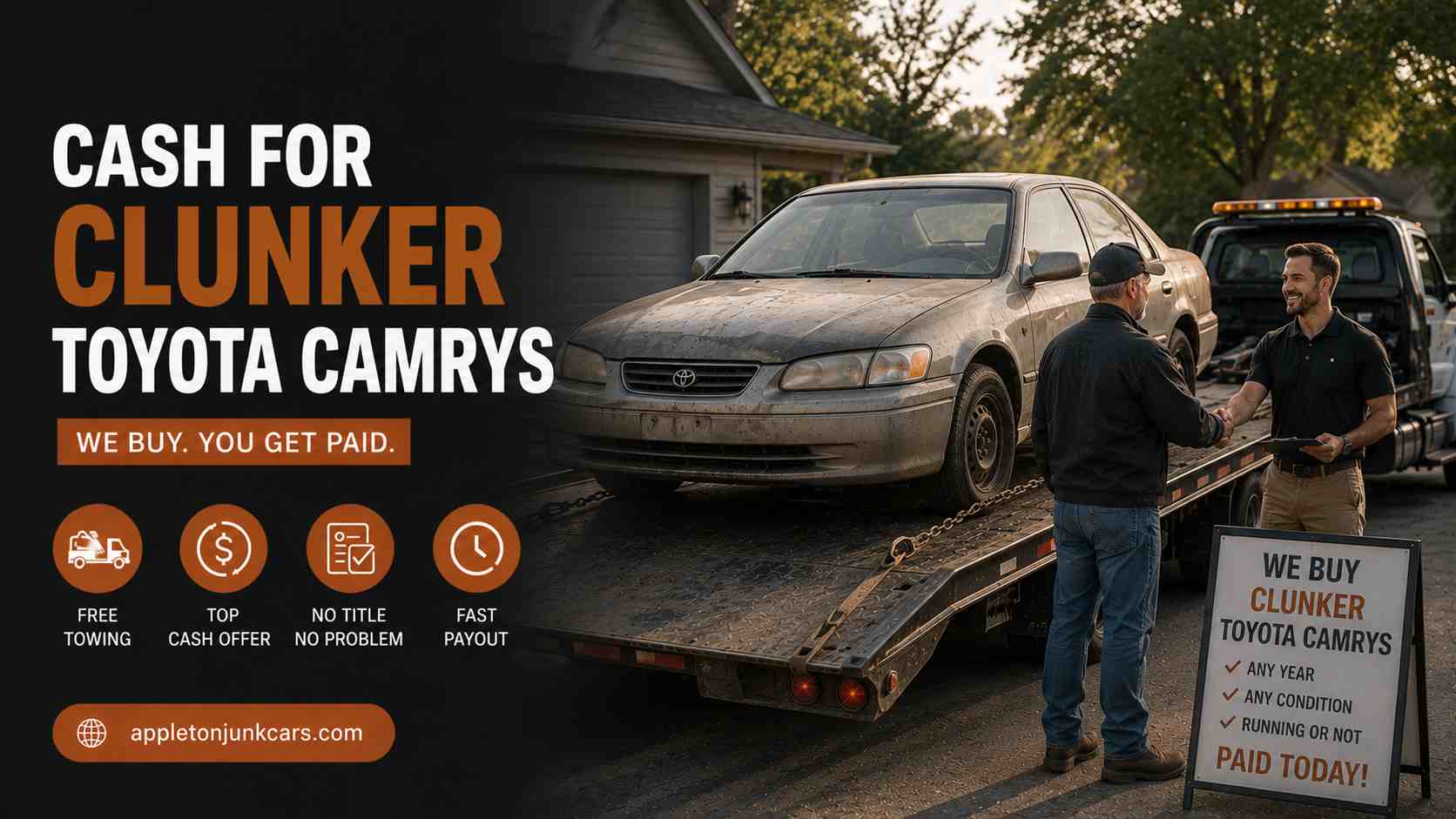
A clunker Toyota Camry sells for $200 to $4,500 depending on the model year, engine configuration, current condition, and which type of buyer you reach. That range is wider than most owners expect, and the difference between the low end and the high end is almost entirely determined by one factor: whether you call a generic junk buyer first or a buyer who understands the Toyota parts market.
The Toyota Camry has been one of the top three best-selling passenger cars in the United States for more than two decades. That sales volume creates deep and consistent aftermarket demand for used Camry parts at salvage yards, independent mechanics, and private buyers across the country. A non-running Camry is not simply a piece of scrap metal with a Toyota badge on it. It is a parts inventory that salvage buyers price differently than a junk car buyer who only sees the weight.
This guide covers what your specific Camry generation is worth before your first call, which engine configurations command the highest offers, which components are worth pulling and selling separately, and how to run the quote process to make sure you are getting the real market value rather than the first number offered.
What a Non-Running or High-Mileage Camry Is Worth by Generation
Toyota Camry values in junk or non-running condition vary significantly by generation because parts demand is tied to how many of each generation are still on the road and how actively mechanics are repairing them. Newer generations with more vehicles in circulation command higher salvage values. Older generations with limited parts demand often earn only scrap weight value.
Camry Generation | Model Years | Non-Running / Junk Condition | High Mileage, Driveable |
|---|---|---|---|
8th Generation | 2018 to 2024 | $600 to $2,500 | $4,000 to $12,000 |
7th Generation | 2012 to 2017 | $500 to $2,000 | $3,000 to $9,000 |
6th Generation (incl. Hybrid) | 2007 to 2011 | $400 to $1,800 | $2,500 to $7,500 |
5th Generation | 2002 to 2006 | $250 to $1,200 | $1,500 to $5,000 |
4th Generation | 1997 to 2001 | $150 to $700 | $800 to $3,000 |
3rd Generation and Older | 1996 and earlier | $100 to $400 | $400 to $1,800 |
Any generation Camry Hybrid | 2007 to present | $800 to $3,500 | $3,500 to $10,000 |
Camry Hybrid models carry a meaningful premium across all condition levels because the hybrid battery pack, inverter, and high-voltage components have significant standalone value to hybrid repair shops and private buyers. A Camry Hybrid with a failed hybrid system is still worth $800 to $2,500 to a buyer who wants the remaining powertrain components or plans to rebuild the hybrid battery pack.
Why the Toyota Parts Market Changes the Math on Every Offer
The Toyota Camry holds a specific position in the salvage yard ecosystem that most sellers do not know about. Every major salvage yard in the United States actively seeks Camry inventory because demand from repair shops never stops. Mechanics who work on Camrys every week need used engines, transmissions, doors, control arms, alternators, and hundreds of other components sourced from salvage rather than new parts to keep repair costs competitive for their customers.
This demand creates a pricing dynamic where a salvage yard values your Camry on the sum of its recoverable parts, not on its metal weight. A junk car buyer who works from a generic pricing formula calculates the truck fee and scrap rate. A salvage yard buyer who specializes in Toyotas calculates the catalog value of the engine, transmission, doors, and drivetrain components they expect to pull and sell over the next six to twelve months.
The practical difference: for a 2010 Camry SE with 195,000 miles and a blown engine, a generic junk buyer might offer $350 based on weight and standard scrap rates. A Toyota salvage yard might offer $650 to $900 for the same car because they know the 2GR-FE engine block has salvage value, the transmission is in demand, the doors and interior are intact, and the catalytic converter is still on the car.
The Camry Engine Configurations That Command the Highest Salvage Offers
The engine under the hood is the single most important factor in determining a salvage yard’s offer for a non-running Camry. Each engine family has a different level of secondary market demand, and knowing which one is in your car lets you target the right buyer and understand why offers vary.
Engine | Found In | Salvage Demand | Notes for Sellers |
|---|---|---|---|
2GR-FE (3.5L V6) | 2007 to 2011 Camry V6 | Very High | V6 Camrys are the most sought-after in salvage. Engine alone worth $600 to $2,000 |
A25A-FKS (2.5L I4) | 2018 to present Camry | High | Newest platform; strong demand for late-model parts |
2AR-FE (2.5L I4) | 2012 to 2017 Camry | High | Most common modern Camry engine; consistent demand at all salvage yards |
2AZ-FE (2.4L I4) | 2002 to 2011 Camry | Moderate | Known oil consumption issue reduces engine value; other parts still strong |
Hybrid Synergy Drive + 2AZ-FXE | 2007 to 2011 Camry Hybrid | High | Hybrid system parts carry large premiums; battery pack $800 to $2,500 |
5S-FE / 1MZ-FE (older I4 and V6) | 1997 to 2001 Camry | Low to Moderate | Aging platform; parts market narrowing but still active for popular repairs |
The 2GR-FE 3.5-liter V6 found in 2007 to 2011 Camry V6 models is the highest-value engine in the Camry lineup for salvage purposes. This engine family is shared across multiple Toyota and Lexus platforms, which means demand is broader than just Camry owners. A rebuildable 2GR-FE block consistently sells for $600 to $2,000 at salvage yards and $800 to $2,500 to private engine buyers. Owning a V6 Camry, even a non-running one, positions you in a different part of the market than a 4-cylinder seller.
Which Buyers Pay the Most for a Non-Running or Damaged Camry
Toyota-Specific Salvage Yards
Salvage yards that specialize in or carry significant Toyota inventory are the highest-paying commercial buyers for any non-running Camry. They have established buyer relationships for every component, they know exactly which parts are in demand for each generation, and they can offer more for an intact car because they can move the inventory efficiently. Calling yards that specifically advertise Toyota or Japanese vehicle inventory rather than general salvage operations typically produces offers 20 to 40 percent higher for the same car.
National Junk Car Buying Platforms
Online junk car platforms that provide instant quotes use market data to price vehicles and generally produce offers above the scrap floor for popular makes and models like the Camry. The offer will typically be between scrap value and what a Toyota specialist salvage yard pays, but the transaction is fast (24 to 48 hours), includes free towing, and requires minimal negotiation. For sellers who want the process over quickly rather than maximum recovery, these platforms are the most frictionless path.
Private Buyers for Specific Repairs
Camry owners who need a specific part their mechanic quoted at retail price are consistent buyers on Craigslist and Facebook Marketplace. Someone whose 2014 Camry needs a replacement transmission will pay $400 to $900 for a used one pulled from your car, because the new unit costs $1,500 to $2,500. If you have the title and the car is otherwise intact, private buyers for individual parts can collectively produce more than any whole-car sale, though managing multiple buyers takes more time and effort.
Scrap Metal Yards
A scrap metal yard is the floor buyer for any Camry. A typical Camry weighs 3,200 to 3,400 pounds. At current scrap steel rates, the pure metal value is $240 to $510. This number is your baseline. Any buyer above this is paying for parts value. Any buyer below this number is not a serious offer and should be declined immediately.
The Camry Components That Boost Any Offer or Justify Selling Separately
Before calling any buyer, take five minutes to note the condition of these specific components. Their presence or absence will directly affect every quote you receive, and knowing their standalone value lets you make an informed decision about whether to sell the car whole or pull one or two items first.
Camry Component | Typical Used / Salvage Value | When It Is Worth Selling Separately |
|---|---|---|
Catalytic converter (OEM, in place) | $100 to $400 depending on year | Always included in whole-car offer; removing it first reduces the offer by more than its separate sale value |
2GR-FE V6 engine (rebuildable) | $600 to $2,000 | Worth separating if you have a direct buyer; adds significant complexity |
Hybrid battery pack (2007 to 2011 Hybrid) | $800 to $2,500 to a hybrid shop | High value; specialist buyer needed; Toyota hybrid shops pay the most |
Transmission (6-speed or CVT, functional) | $400 to $1,200 | Private sale through Craigslist or eBay; quick market |
OEM alloy wheels, good condition (set of 4) | $150 to $500 | Worth separating only if aftermarket replacement or curb damage is absent |
Headlights (LED or HID, late-model) | $150 to $500 per side | 2018+ Camry LED headlights have strong demand; OEM units only |
Airbag modules (undeployed, complete set) | $150 to $500 per module | Salvage yards value this; do not disturb airbag system before sale |
Seats and interior (leather, good condition) | $200 to $800 for complete set | Viable if leather is clean and undamaged; niche but real market |
For most sellers, the most practical approach is to confirm the catalytic converter is intact (its removal reduces your offer by more than it earns separately), note whether you have a V6 or a Hybrid (both command premium quotes), and sell the car whole. The hybrid battery exception is worth considering: if you have a 2007 to 2011 Camry Hybrid with a failed hybrid system, calling a Toyota hybrid specialist before calling a generic salvage yard frequently produces a $400 to $800 better offer for the entire car.
How to Get Competing Offers and Use Your Baseline Effectively
The process for getting the best offer on a non-running Camry is identical to the process for any popular vehicle with an active parts market. It requires three steps done in the right order.
Step one: establish your scrap floor. Call the nearest scrap metal yard, give them the Camry’s approximate weight (3,200 to 3,400 pounds for standard models), and get a firm quote. This is the number no buyer should ever come in below. Write it down and reference it in every subsequent conversation.
Step two: call two or three Toyota-specific or Japanese vehicle salvage yards in your region. Provide the exact year, generation, trim level (LE, SE, XSE, XLE), engine (4-cylinder or V6, standard or Hybrid), odometer reading, the specific mechanical failure if known, title status, and condition of the exterior and interior. Specific descriptions produce specific quotes. Vague descriptions produce conservative low-ball bids designed to protect the buyer from unknowns.
Step three: get a quote from one national junk car platform. These quotes are fast, serve as a second benchmark, and sometimes exceed what local salvage yards offer, particularly for newer generations where demand is high across all markets. Use all three quotes in your final negotiation. “I have a competing offer of $750 from another yard” gives any buyer a concrete number to beat, and most Toyota salvage yards will meet or exceed a nearby competitor’s offer for a desirable intact Camry.
What Sellers of Old Toyota Camrys Consistently Report
Sellers who have moved non-running or high-mileage Camrys share a consistent pattern. The most common: accepting the first online junk buyer quote without ever calling a Toyota salvage yard or mentioning the engine configuration. For standard 4-cylinder Camrys, the difference is often $150 to $300. For V6 Camrys, the gap between the generic junk offer and the Toyota salvage offer is frequently $400 to $800 because the 2GR-FE engine demand is not reflected in generic pricing formulas.
The second consistent finding is the hybrid premium. Camry Hybrid owners who disclosed the hybrid badge and called a Toyota hybrid specialist consistently received offers $500 to $1,200 higher than owners who called generic junk buyers. Generic buyers often have no framework for pricing a hybrid battery pack or inverter. Toyota hybrid shops do, and they pay accordingly.
Those who got the best outcomes spent 30 to 45 minutes on the phone before accepting any offer, called at least one Toyota-specific salvage buyer, and used every number they received as leverage in the next conversation. The Camry’s reputation for durability works in the seller’s favor even when the car is not running: salvage buyers know that a Camry with a mechanical failure often has hundreds of usable miles left in its other components, and they price with that confidence.
Frequently Asked Questions
How much is a junk Toyota Camry worth?
A junk Toyota Camry is worth $200 to $2,500 at a salvage yard depending on the generation, engine, and condition of the key components. Scrap metal value for a standard Camry runs $240 to $510 based on its approximate 3,200 to 3,400-pound weight at current steel rates. V6-equipped Camrys and Hybrid models consistently earn 30 to 60 percent more than equivalent 4-cylinder non-hybrid models because of the higher-value engine and drivetrain components.
What year Toyota Camry is worth the most in scrap?
The 2007 to 2011 Toyota Camry V6 (with the 2GR-FE engine) and the 2018 and newer Camry with the A25A-FKS engine currently command the strongest salvage values among non-running Camrys. The V6 premium comes from strong cross-platform demand for that engine family. The newest generation commands strong prices because parts demand for recent models is high and the supply of wrecked or non-running units is lower than for older generations.
Who buys non-running Toyota Camrys?
Non-running Toyota Camrys are purchased by Toyota-specific salvage yards that pull and resell parts to mechanics and DIY repairers, national junk car buying platforms that process vehicles for salvage and scrap, private buyers through Facebook Marketplace and Craigslist who need specific components at below-retail prices, and scrap metal yards that buy for metal weight only. Toyota-specific salvage yards consistently pay the most for any intact non-running Camry.
How much is a Toyota Camry Hybrid worth as a junk car?
A junk Toyota Camry Hybrid is worth $800 to $3,500 depending on the year and the condition of the hybrid system components. The hybrid battery pack alone is worth $800 to $2,500 to a Toyota hybrid repair shop if the pack is rebuildable. The inverter, voltage control module, and high-voltage wiring are additional value components. Toyota hybrid specialists pay significantly more for Camry Hybrids than generic junk car buyers because they can sell the hybrid components into the specialized repair market.
Does the catalytic converter affect how much I get for my Camry?
Yes, significantly. The catalytic converter on a Toyota Camry is worth $100 to $400 at current precious metal prices, and its presence or absence is the first thing most buyers check when pricing a vehicle. Salvage yards and junk buyers factor the converter into their offer as a standard component. Removing it before the sale reduces your offer by at least the converter’s value and often by more, because buyers who see a missing converter also lower their estimate of the rest of the car’s condition. Leave the converter in place.
How do I get the most money for my old Camry?
Getting the most money for an old Camry requires three steps. First, call a scrap yard to establish your metal weight baseline. Second, call two or three Toyota-specific salvage yards with the exact year, engine, trim, and condition details. Third, get a quote from one national junk car platform. Use all three quotes as competing leverage in your final conversations. Disclosing that you have a V6 or Hybrid engine and that the catalytic converter is intact are the two details that most reliably produce higher offers from buyers who understand the Toyota parts market.
Can I sell a Toyota Camry without a title?
Selling without a title limits your buyer pool. Most Toyota salvage yards and legitimate junk car buyers require a clean title for legal ownership transfer. Scrap metal yards may accept a vehicle on current registration with ID verification in some states for low-value vehicles. If the title is lost, applying for a replacement at your state DMV is the fastest path to a full offer. The process costs $15 to $25 and takes one to three weeks in most states. The additional offer value from having a title in hand typically recovers that cost many times over.
What is the difference between a junk car buyer and a salvage yard for a Camry?
A junk car buyer prices your Camry using a formula based primarily on weight and scrap rates, sometimes adjusted for popular makes. A Toyota salvage yard prices your Camry based on the sum of usable parts they expect to pull and resell over the next several months. For a popular vehicle like the Camry with a strong aftermarket, the salvage yard’s formula almost always produces a higher offer. The practical difference is often $200 to $800 for a standard Camry and $500 to $1,500 or more for a V6 or Hybrid model.
The Bottom Line
A clunker Toyota Camry is one of the better junk vehicles you can have if you know how to sell it. The Camry’s ubiquity on American roads creates deep and reliable parts demand that salvage yards translate into real offers above scrap weight value for almost every year and trim level.
The two variables that matter most are the engine (V6 and Hybrid models earn meaningfully more) and which buyer you call first. A Toyota-specific salvage yard and a generic junk buyer are pricing completely different things when they look at the same car. The Toyota yard is pricing a parts inventory. The generic buyer is pricing weight. Make sure you get both quotes before accepting either.
Establish your scrap floor, call a Toyota-specific salvage buyer, get a national platform quote, and use every number as leverage. For most non-running Camrys in the 2007 and newer generations, that process takes less than an hour and consistently produces an additional $300 to $800 compared to accepting the first offer from the first buyer who picks up the phone.