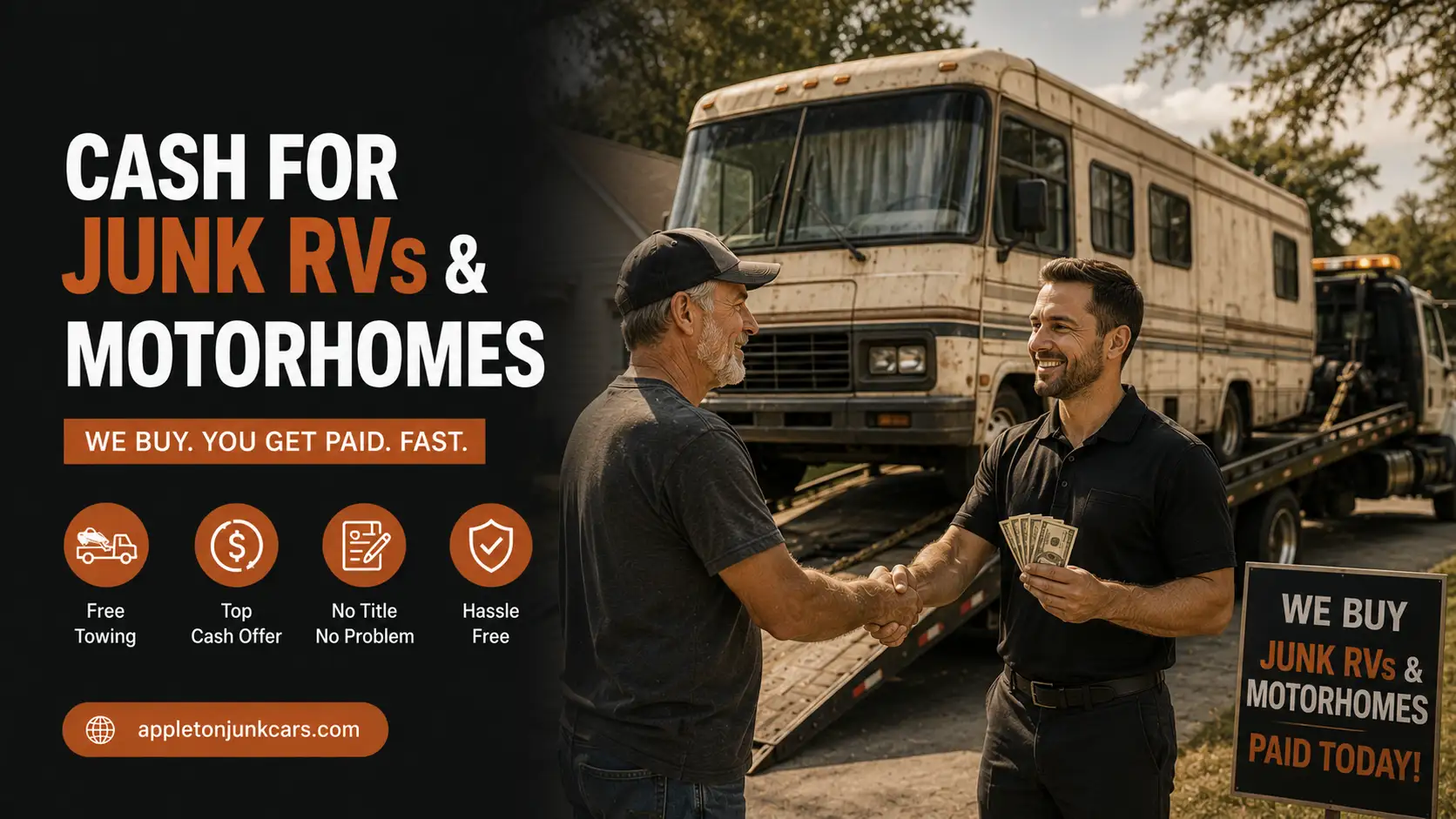
Junk RVs and motorhomes sell for $500 to $10,000 or more depending on size, class, engine type, and which buyer you reach. Class A diesel motorhomes on full commercial chassis hold the highest values even in poor mechanical condition. Small pop-up campers and folding trailers at the end of their useful life sit near the floor of that range. The difference between what you get from the first buyer who responds and what the market will actually support for your specific unit is often measured in thousands of dollars, not hundreds.
The market for non-running, aged, or water-damaged RVs is more active than most sellers expect. Buyers include RV salvage facilities, conversion builders, scrap yards, full-time RV communities, and renovation flippers who specialize in distressed units. Each buyer type values your rig differently, and knowing which one is the right fit for your specific unit determines which call you make first.
This guide covers realistic price ranges by RV class and condition, how each type of buyer calculates value, the single biggest value killer in this market, and how to navigate the logistics of moving a unit that cannot drive or be towed.
What a Junk RV or Motorhome Is Actually Worth in Today’s Market
The price ranges below reflect current cash offers from real buyers, not retail or trade-in values. Actual offers will vary based on your specific unit’s condition, geographic market, and which buyer type you reach.
RV Type | Poor Condition (Non-Running or Major Damage) | Fair Condition (Running, High Mileage or Cosmetically Rough) |
|---|---|---|
Class A Motorhome, gas chassis | $1,500 to $4,500 | $5,000 to $18,000 |
Class A Motorhome, diesel pusher | $3,000 to $10,000 | $12,000 to $40,000+ |
Class B Campervan (Sprinter or Transit) | $2,000 to $6,000 | $8,000 to $25,000 |
Class C Motorhome (cutaway chassis) | $1,500 to $5,500 | $6,000 to $20,000 |
Travel Trailer (conventional, 20 to 35 ft) | $300 to $2,500 | $2,500 to $10,000 |
5th Wheel Trailer (large) | $500 to $3,500 | $4,000 to $15,000 |
Pop-up / Folding Camper | $100 to $800 | $1,000 to $5,000 |
Toy Hauler | $800 to $4,000 | $5,000 to $18,000 |
Diesel pushers command the largest premium across all condition categories because the chassis, drivetrain, and suspension components retain significant value independent of the coach condition. A non-running Class A diesel on a Spartan, Roadmaster, or Freightliner chassis is worth two to three times more than a gas-chassis Class A in equivalent cosmetic condition simply because of what the running gear is worth to a rebuilder.
The Buyers Who Pay Real Money for Non-Running or Damaged RVs
RV Salvage Facilities
Dedicated RV salvage yards buy distressed motorhomes and trailers for their recoverable interior and mechanical components. Slide-out systems, awnings, generators, inverters, solar panels, air conditioning units, refrigerators, propane systems, water heaters, leveling jacks, and furniture are all pulled and sold individually. A 30-foot Class C motorhome with a blown engine but an intact interior and all its appliances functioning has significant salvage value even when it will never drive again. These buyers are the most consistent market for units too damaged to repair economically but still rich in functional components.
Conversion Builders and the Skoolie-Adjacent Market
Class B campervans built on Sprinter, Transit, or Promaster chassis attract serious buyer interest from the conversion community even in poor mechanical condition. These buyers want the chassis, not the coach. A Sprinter-based Class B with a dead engine is worth $3,000 to $7,000 to a conversion builder who plans to drop in a remanufactured engine and build a custom interior. The same unit at a scrap yard earns $600 in metal weight. Reaching conversion buyers through van life forums and Facebook groups rather than standard classified platforms produces dramatically different results.
Renovation Flippers and Distressed Unit Specialists
A segment of buyers specializes in purchasing cosmetically rough but mechanically functional RVs at significant discounts and reselling them after basic repairs and cosmetic work. For a unit that runs but has dated interiors, minor water damage in non-structural areas, or cosmetic issues that photograph poorly, these buyers often pay more than an RV dealer or a salvage yard. Their offer reflects a resale premium minus renovation cost and their margin.
Scrap Metal Yards
Large motorhomes contain significant structural steel and aluminum. A 38-foot Class A with a failed engine and severe interior water damage may yield $1,200 to $2,000 in pure metal weight at a commercial scrap facility. This is always the floor for any motorhome offer, not the ceiling. For units with functional salvageable components, every other buyer type on this list pays more. Scrap is the right option only when everything else has failed.
Private Buyers Through RV Communities
The full-time RV community, off-grid living enthusiasts, and buyers planning to convert a motorhome into a stationary home or workshop represent a segment that will pay more than any commercial buyer for the right unit. They are not pricing your rig against what parts are worth or what metal weighs. They are pricing it against what a renovation-ready motorhome of that size would cost to buy in retail condition. Reaching these buyers requires listing on RV-specific forums, Facebook groups for full-time RV living, and platforms like RVTrader with explicit disclosure of the unit’s condition.
Class A, B, and C: How RV Type Determines Who the Right Buyer Is
The RV class determines more than the price range. It determines which buyer type will actually make a move on the unit and how you should approach the sale.
Class A motorhomes on full commercial chassis (Freightliner, Spartan, Workhorse) appeal to salvage buyers for their drivetrain components and to private buyers for their living space. Diesel units attract the most competition between buyer types. Gas units on older P-chassis frames have narrower buyer pools but still generate meaningful interest from the conversion and tiny home community.
Class B campervans are the most liquid segment in the distressed RV market. The underlying chassis (Sprinter or Transit) has robust buyer demand completely independent of the camper conversion. Even a campervan with a destroyed interior and a failed transmission retains value as a donor chassis. This is the one RV type where the salvage or conversion buyer will often pay more than many sellers expect.
Class C motorhomes on cutaway van chassis (Ford E-Series or Chevy Express) have a mid-range buyer pool. Salvage facilities buy them regularly. Private buyers interested in conversion projects purchase them. Parts and appliance buyers are active in this segment. The cutaway chassis itself has limited conversion appeal compared to a Sprinter or Transit, which keeps the floor lower than Class B but the ceiling is supported by the coach components.
Travel trailers and 5th wheels attract the widest range of private buyers but the most limited commercial buyer interest. Salvage yards that specialize in towable RVs exist but are less common than motorhome salvage operations. The private buyer market, including campground hosts, hunting camp operators, and permanent site owners, is the primary exit for most damaged towable units.
The Single Biggest Value Killer in the Junk RV Market
Water intrusion and the resulting delamination are the single most damaging condition issues in the distressed RV market, and they destroy value faster than any mechanical failure. A motorhome with a dead engine is fixable. A motorhome with delaminated sidewalls, a soft roof from sustained water penetration, or structural rot in the floor or subframe is a fundamentally different category of problem.
Delamination occurs when water enters the layered composite construction of an RV wall or roof, causing the fiberglass, foam insulation, and interior paneling to separate. It is visible as bubbling or wavy exterior surfaces. Salvage buyers discount heavily for delamination because removing and reselling interior components from a structurally compromised unit is difficult and the components themselves may be water-damaged.
Floor rot from chronic water intrusion affects the structural subframe. A floor that flexes underfoot or shows soft spots indicates compromised wood framing. Replacing an RV subfloor is one of the most labor-intensive renovations possible in a motorhome and pushes many buyers out of the project.
Missing or non-functional appliances are the second major value reducer for salvage buyers. The refrigerator, generator, HVAC, water heater, awning, and slide-out systems represent a large portion of what a salvage facility expects to recover and resell. An RV with all these systems stripped or non-functional earns significantly less than one with all systems intact, even if the cosmetic condition is similar.
How the Sale Works When the Unit Cannot Move
Non-running motorhomes require specialized transport. Standard flatbed tow trucks can handle most Class B and smaller Class C units. Full-size Class A motorhomes typically require a heavy-duty commercial tow vehicle or a transport trailer rated for the coach weight, which ranges from 18,000 to 40,000 pounds for diesel pushers. Confirm that your buyer or their transport company has the appropriate equipment before agreeing to a price.
Travel trailers and 5th wheels that cannot be towed due to structural damage or axle failure are the hardest units to move. Some buyers have specialized tilt-bed or lowboy trailers capable of loading a stationary trailer. Others will only purchase units they can tow conventionally. If your trailer cannot be towed, clarify transport logistics before the deal is agreed on, because pickup complications frequently cause deals to fall through at the last minute.
Units that have been parked long enough to settle, have flat tires, or are partially surrounded by vegetation may need basic site preparation before a transport vehicle can access them. Inflating tires to allow movement, clearing a path for the tow vehicle, and confirming overhead clearance are seller responsibilities in most transactions. Buyers who are asked to manage extensive access complications will typically reduce their offer to reflect the added difficulty.
Title and Paperwork: What the RV Sale Requires
Title requirements for RVs differ depending on type. Motorhomes are titled as motor vehicles in all states and follow the standard vehicle title transfer process. The seller signs the back of the title, the buyer takes it to their DMV, and the transfer is registered. This is the same process as selling a car.
Travel trailers and 5th wheels are titled as trailers in most states, which is similar to vehicle titling but may involve a different DMV department or a simpler form depending on the state. In some states, trailers above a certain weight require separate licensing from the tow vehicle. In others, a trailer of any size is titled with a single document.
RVs without titles present the same complication as vehicles without titles: most legitimate buyers require one for legal transfer of ownership. If a title is lost, start the replacement process at your state DMV before listing. For motorhomes with active liens from a financing company, the lender must release the title before any sale can close. This process typically takes two to four weeks from payoff to title delivery.
What Sellers of Junk RVs and Motorhomes Consistently Wish They Had Known
Sellers who have been through this process share a consistent set of discoveries. The most common: calling a standard junk car buyer first and accepting their offer without understanding that RV salvage specialists and conversion buyers exist and pay significantly more. Junk car buyers assess RVs the way they assess cars: weight and scrap rate. That formula undervalues every RV that has functional interior systems, appliances, or a convertible chassis.
The second consistent finding is that online communities move these units faster than any classified platform. Facebook groups specifically for Class B conversions, skoolie builds, and full-time RV living have tens of thousands of active members who are actively searching for exactly what most sellers are trying to offload. A detailed post with honest photos in the right group frequently generates multiple serious offers within 48 hours at prices well above what any commercial buyer quoted.
Those who came away most satisfied invested time in photographing everything honestly and describing the unit’s condition accurately. Buyers for distressed RVs are experienced. They have seen hundreds of listings. They are not fooled by optimistic descriptions, and they are not scared away by honest ones. A seller who leads with what is wrong and follows with what is still good consistently generates more serious buyer interest than one who buries the problems.
Frequently Asked Questions
Who buys junk RVs and motorhomes near me?
RV salvage facilities are the most consistent commercial buyers for non-running or severely damaged units. Conversion builders and the skoolie community buy specific types, particularly van-based Class B units. Private buyers through RV forums and Facebook groups are often the highest-paying option for units that still have functional living systems. Scrap metal yards will take any motorhome for metal value but typically pay the least. Search specifically for RV salvage yards rather than general auto salvage yards, as they have the specialized equipment and buyer relationships that produce better offers.
How much is a non-running motorhome worth?
A non-running motorhome is worth between $500 and $10,000 depending on class, chassis type, condition of the coach systems, and which buyer you reach. Class A diesel pushers are worth the most even non-running because the chassis components have significant independent value. Gas-chassis Class C and Class A units in the $1,500 to $4,000 range are the most common non-running sales. Class B campervans on Sprinter or Transit chassis hold value well because of strong conversion market demand. Getting quotes from multiple buyer types is essential because the spread between a scrap yard quote and a conversion buyer quote for the same unit can be $3,000 or more.
Do RV junk buyers offer free towing or pickup?
Most RV salvage facilities and conversion buyers will arrange pickup for units they want, often at no cost to the seller. However, motorhomes over a certain size, particularly Class A units and diesel pushers, may require specialized transport equipment that limits which buyers can handle pickup. Travel trailers that cannot be conventionally towed are the most difficult units to move and may require negotiation over transport costs. Confirm the pickup logistics before agreeing to a final price.
What happens if my junk RV does not have a title?
Most buyers require a title for legal transfer of ownership. Without one, your buyer pool narrows significantly to private buyers willing to work through a bonded title process and scrap yards in states that allow titleless scrap transactions for specific vehicle categories. Before listing a titleless unit, check your state DMV’s replacement title process. For a motorhome, a replacement title typically takes two to four weeks and costs $25 to $75 depending on the state. That investment dramatically expands your buyer pool.
Should I scrap my RV or try to sell it as a complete unit?
In almost every case, selling it as a complete unit to the right buyer pays more than scrapping it. Scrap yards pay for metal weight. The appliances, furniture, plumbing systems, electrical systems, solar panels, generators, and slide-outs in even a heavily damaged RV have individual resale values that collectively exceed the scrap metal offer by a significant margin. Only when the unit is structurally compromised beyond any usable component extraction does pure scrap become the realistic ceiling.
Who buys flood damaged or fire damaged RVs?
RV salvage facilities buy flood and fire-damaged units regularly, though at discounted offers that reflect the condition. Flood-damaged motorhomes with intact drivetrains and recoverable mechanical systems attract interest from buyers who will part them out. Fire-damaged units with survivable structural components occasionally interest conversion builders who plan to gut and rebuild. Private buyers for project units also exist in these condition categories. The key is accurate disclosure with detailed photos: buyers for distressed units make accurate assessments when they have complete information.
How do I sell a motorhome that will not start?
A motorhome that will not start is still a motorhome, and the buyer pool is only slightly narrower than for a running unit. Document the specific mechanical issue if you know it. RV salvage buyers, conversion builders, and experienced private buyers for projects will all consider a non-starting unit. Your listing should specify what does work: the appliances, slide-outs, generator, coach systems, and the condition of the body and roof. Buyers price non-starting units on everything except the engine, so the more complete your condition description, the better the offers.
What is a junk Class A motorhome worth as scrap?
A full-size Class A motorhome weighs 18,000 to 40,000 pounds depending on length and construction. At current scrap steel rates, the pure metal value of a large Class A is approximately $1,200 to $2,500. Diesel pusher units with aluminum construction may yield slightly more per pound in some markets. This is the absolute floor: any buyer other than a pure scrap yard should offer more if the coach has functional systems or a rebuildable drivetrain. Use the scrap estimate as your negotiating floor, not as the number you accept.
The Bottom Line
The cash value of a junk RV or motorhome depends almost entirely on which buyer you reach first. Scrap yards set the floor. RV salvage facilities, conversion builders, and private buyers in RV communities set the ceiling, which can be two to five times higher for the same unit depending on its class and remaining functional components.
Water damage is the one condition factor that shifts every buyer’s math. A non-running motorhome with a solid structure, a dry interior, and functioning appliances is a fundamentally more valuable asset than a running motorhome with a delaminated roof and rotted floor. Know which category your unit falls into before you start making calls, because it determines the realistic ceiling and which buyer type is worth pursuing.
The most consistently effective approach: photograph everything honestly, describe what works and what does not with specificity, and reach conversion buyer communities and RV forums before calling a scrap yard. The difference in what those buyers will pay versus metal scrap value is real, and the process of reaching them is simpler than most sellers expect.